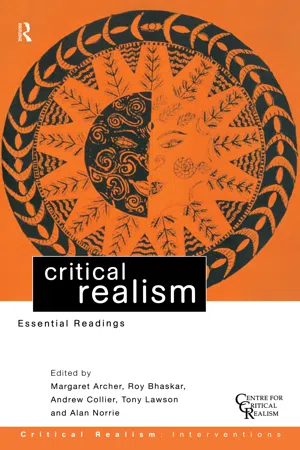
Critical realism is a movement in philosophy and the human sciences most closely associated with the work of Roy Bhaskar. Since the publication of Bhaskars A Realist Theory of Science, critical realism has had a profound influence on a wide range of subjects. This reader makes accessible, in one volume, key readings to stimulate debate about and within critical realism.
It explores the following themes:
* transcendental realist
* the theory of explanatory critique
* dialectics
* Bhaskar's critical naturalist philosophy of science.
eBook - ePub
Critical Realism
Essential Readings
- 784 pages
- English
- ePUB (mobile friendly)
- Available on iOS & Android
eBook - ePub
Critical Realism
Essential Readings
About this book
Information
Part I Transcendental Realism and Science
1 Introduction Basic texts and developments
DOI: 10.4324/9781315008592-1
Roy Bhaskar's A Realist Theory of Science emerged into the intellectual scene at a time of vigorous critical activity in western philosophy of science. Central to the latter was a sustained challenge to the then dominant positivist conception of science. Two fundamental elements of the positivist world view undergoing particular scrutiny and criticism were the assumptions that science is monistic in its development and deductive in its structure. Even so support for the positivist conception was far from giving way entirely. And a significant reason for its continuing survival was the inability of its opponents to sustain in a sufficiently coherent manner, precisely those features – scientific change and the non-deductive aspects of theory – that had been found to be fundamental to the anti-positivist critique. A major achievement of Bhaskar's A Realist Theory of Science is that it explained and contributed significantly to resolving this situation. Specifically, Bhaskar demonstrated how the preservation of the rational insights of both the anti-monistic and anti-deductivist tendencies in the philosophy of science necessitated the construction of a new ontology – and of a corresponding account of (natural) science. It necessitated, in fact, a reorientation of philosophy towards a non-anthropomorphic conception of the place of humanity in nature. This was a shift in philosophy, referred to by some as a Copernican Revolution, that culminated in a new realist philosophy of science.
It is conceivable that most scientists would subscribe to being scientific realists in the sense that they accept that the theoretical terms they employ possess real referents independently of their theorising. It is important to recognise, however, that Bhaskar's support for a realist conception of science does not depend upon any empirical assessment that scientists (implicitly or explicitly) so subscribe. Rather Bhaskar sustains a metaphysical realism by way of elaborating an account of what the world ‘must’ be like for those scientific practices accepted ex posteriori as successful, to have been possible. In this manner a realist perspective is obtained which neither presupposes nor justifies a realistic interpretation of any substantive scientific theory, and which preserves the possibility of criticising specific practices of scientists.
In establishing such a metaphysical realism Bhaskar confirms the feasibility of a (revelatory) philosophy of science, as well as, within philosophy, of an ontology. Philosophy is distinguished from science not according to its subject field, nor even in virtue of the questions asked, and certainly not because of any supposed investigation of some autonomous order of being. Rather philosophy is distinguished by its method and more generally by the sorts of arguments it deploys, which are transcendental in the sense of Kant.
Specifically, the general form of a philosophical investigation accepted by Bhaskar, the transcendental argument, turns upon elaborating necessary conditions of certain human (in the case of A Realist Theory of Science, scientific) activities. Now Kant employed the transcendental procedure (in elaborating his transcendental idealism) in an individualist and idealist mode. However, Bhaskar demonstrates that there is little need to be so restrictive. In particular the social activities described in the premises which initiate the argument may be both historically transient and also dependent upon the powers of human beings as material objects or causal agents rather than merely thinkers or perceivers. Similarly, philosophical conceptions of scientific activities may also be historically transient, just as the results of philosophical analysis may constitute transcendental realist, not idealist, and epistemically relativist, rather than absolutist, conclusions. Philosophical argument so interpreted can be seen to be dependent upon the form of scientific practices but irreducible to the content of scientific beliefs. In applying the transcendental procedure in this less-restrictive manner Bhaskar develops and sustains his account of transcendental realism.
But how is it possible for premises of transcendental arguments to be selected without implying an invalid commitment to the epistemic significance of the activities described? Why, in particular, should opponents of any transcendental realist conception be convinced by Bhaskar's choice of premises for his argument? Avoidance of arbitrariness can be achieved only by focusing upon accounts of activities that are acceptable to both (or all) sides to a dispute. If possible, indeed, it is best to find premises that opponents have regarded as fundamental. Where this is achieved the aim is to demonstrate not only that the transcendental realist account can accommodate the activities in question, but also that opponent positions sponsoring the activities cannot so accommodate them consistently, i.e., without generating metaphysical absurdity or some such.
Such a demonstration is precisely what Bhaskar achieves in his classic analysis of experimental activity, an analysis which forms the centrepiece of Chapter 1 of A Realist Theory of Science reprinted below. By so considering experimentation, sponsored by both empiricists and Kantians (as well as conceptual transformations sponsored by super idealists) Bhaskar demonstrates how, in the end, it is only a realist analysis that can sustain the intelligibility of such practices. Moreover the resulting realist theory, Bhaskar's transcendental realism, provides an alternative to positivism which allows us both to recognise the cumulative character of scientific knowledge without collapsing this into a monism, and also to acknowledge a surplus component in scientific theory without sliding into subjectivism.
In the course of his analysis, Bhaskar grounds the insight that causal laws are ontologically distinct from the pattern of events. Specifically Bhaskar shows how the intelligibility of experiments presupposes that reality is constituted not only by experiences and the course of actual events, but also by structures, powers, mechanisms and tendencies – by aspects of reality that underpin, generate or facilitate the actual phenomena that we may (or may not) experience, but are typically out of phase with them. Bhaskar also establishes that reality in general is both multi-dimensional and stratified and also open and differentiated (in the sense that closed systemic situations in which event regularities occur are highly restricted).
From this transcendental realist ontology of structures and differences an account of rational scientific development is quickly determined. This Bhaskar sets out in Chapter 3 of A Realist Theory of Science, the relevant parts of which are also reproduced below. Briefly put, explanatory science, according to the perspective supported, seeks to account for some phenomenon of interest – typically an experimentally produced event pattern – in terms of a (set) of mechanism(s) most directly responsible. Producing this explanation will involve drawing upon existing cognitive material, and operating under the control of something like a logic of analogy and metaphor, to construct a theory of a mechanism that, if it were to work in the postulated way, could account for the phenomenon in question. The reality of the mechanism so retroduced is subsequently subjected to empirical scrutiny, and the empirical adequacy of the hypothesis maintained compared to that of competing explanations. Following this any explanation that is (tentatively) accepted must itself be explained, and so forth, a move which, in itself, presupposes a certain stratification of reality. On the transcendental realist view of science, then, its essence lies in the movement at any one level from knowledge of manifest phenomena to knowledge, produced by means of antecedent knowledge, of the structures that generate them.
So among the distinctive features of Bhaskar's original account of transcendental realism are:
- A revindication of ontology, of the theory of being, as distinct from (ultimately containing) epistemology, the theory of knowledge, and a critique of the ‘epistemic fallacy’ which denies this;
- A distinction between the domain of the real, the actual and the empirical and a critique of the reduction of the real to the actual in ‘actualism’ and then to the empirical in ‘empirical realism’, together with a conception of the transfactual, non-empirical universality of laws as the causal powers, or more specifically tendencies, of generative mechanisms which may be possessed, unexercised, exercised, unactualised and actualised independently of human perception or detection;
- A conception of the stratification, differentiation and openness of both nature and sciences, and of the distinction between pure and applied sciences and explanations;
- Isolation of a general dynamic of scientific discovery and development involving the identification of different levels of natural necessity, which in turn is understood as radically non-anthropomorphic. And thence:
- The associated resolution of a whole series of philosophical problems to which orthodox accounts of science had given rise, most notoriously the problem of induction (cf. Realist Theory of Science, 3.5/3.6, reprinted below).
It is easy enough to see how philosophy of science has the potential to provide a directional input into the practices of science. For although Bhaskar's analysis suggests that when scientists are practising science they are implicitly acting upon something like transcendental realism, it does not follow that transcendental realism, or any other philosophy, is always or consistently acted upon, or dominant, or even acknowledged. It is for this reason that in his subsequent Possibility of Naturalism, Bhaskar is able to conclude that ‘one is … qua philosopher of science, at perfect liberty to criticise the practice of any science’ (p. 16). Nothing in the foregoing should be taken to imply that philosophy can do the actual work of science for it. If the elaboration of a transcendental realist perspective provides grounds for supposing that science can successfully uncover structures and mechanisms that govern some identified phenomenon of interest, philosophy cannot do the work of uncovering. This is the task of science. Philosophy, however, is able to make a difference to science in the manner noted: by, amongst other things, affecting the questions put to reality, and the manner in which this is done.
If A Realist Theory of Science demonstrates that an adequate account of scientific development requires the concepts of a stratified and differentiated reality, it is clearly a further requirement that knowledge cannot be equated with direct experience. Nor is it intelligible that knowledge is created out of nothing. Rather knowledge can only be a produced means of production, as revised understandings are achieved via the transformation of existing insights, hypotheses, guesses and anomalies, etc. Bhaskar's own contribution, of course, is itself a transformation of prior claims and understandings, and the work of Rom Harré figures prominently amongst those whose contributions significantly influenced A Realist Theory of Science. One such influential contribution by Harré – Chapter 1 of Causal Powers, written jointly with E.H. Madden – is reprinted below, albeit a contribution that only appeared in this published form at the same time as A Realist Theory of Science was also appearing in print.
In line with much philosophy of science of the period, the starting point for Harré and Madden is a conviction that positivism, specifically the Humean conception of causality and its linear descendent, the ‘regularity theory’, is not sustainable. Indeed, for Harré and Madden it is essential to explain why the Humean point of view continued over many centuries to attract so many adherents. In providing their explanation Harré and Madden identify two widely held, but questionable, assumptions, which lead inexorably to the Humean position. The first assumption presupposes, amongst other things, an exclusive dichotomy between the formal and the psychological. Specifically, it is a belief maintained by empiricist philosophers, that the philosophical analysis of non-empirical concepts must be wholly in terms of formal logic, and that any residual features not so susceptible to philosophical analysis, must be capable of analysis in terms of its psychological origins. Against this Harré and Madden argue that adequate accounts of the most important metaphysical concepts with which philosophy deals, like cause, theory, explanation, natural necessity, can be neither purely formal nor psychological but require attention to what they term ‘the content of knowledge’, content which usually goes beyond reports of immediate experience. These authors argue that such concepts can be successfully differentiated, the rationality of science defended, and the possibility of an independent reality sustained only by way of considering certain general features of the ‘content’ of relevant propositions by which they can ultimately be distinguished as possessing a conceptual necessity, irreducible to either logical necessity or psychological illusion.
The second Humean assumption questioned by Harré and Madden is that the ontology of science is restricted to the world of events. This conception, of course, is encouraged by Hume's opening comments in both the Treatise and the Enquiry, in which he quickly moves from a theory that experience comes in atomistic impressions, to a conception of the experienced world whereby this too is atomistic, comprising atomistic events. The supposed independence of successive events, and of coexisting properties, is a related and also fundamental aspect of this Humean view. Against this standpoint Harré and Madden draw upon the psychology of perception to demonstrate the untenability of Hume's doctrine of atomist impressions. And against the conception that the experienced world can be adequately conceived as a sequence of atomistic and independent events, the authors defend an ontology of ultimate and derived things whose interactions produce the flux of events. Specifically, through developing concepts of powers, natures and generative mechanisms, Harré and Madden, like Bhaskar, are able to demonstrate that a variety of rational constraints upon logical possibility can be determined so as to limit expectations as to the patterns of events likely to be identified and what ensembles of properties the things and materials of the world are likely to manifest. From these constraints Harré and Madden develop a theory of natural necessity. The upshot is a conception of the natural world as a interacting system of powerful particulars, giving rise to a patterning of events and a manifestation of properties, bearing upon the multitudinous phenomena of the world we experience.
In the chapter of Causal Powers reproduced below, Harré and Madden indicate how natural necessity in the world is reflected in discourse about the world. In particular, they argue that causal hypotheses invariably involve conceptual necessity, and that this necessity is not merely stipulative or conventional in character but expresses something about the nature of physical systems. Fundamen...
Table of contents
- Cover Page
- Half Title Page
- Title Page
- Copyright Page
- Contents
- General introduction
- Part I Transcendental Realism and Science
- Part II Critical Naturalism and Social Science
- Part III The Theory of Explanator Critiques
- Part IV Dialectic and Dialectical Critical Realism
- Index
Trusted by 375,005 students
Access to over 1.5 million titles for a fair monthly price.
Study more efficiently using our study tools.
Frequently asked questions
Yes, you can cancel anytime from the Subscription tab in your account settings on the Perlego website. Your subscription will stay active until the end of your current billing period. Learn how to cancel your subscription
No, books cannot be downloaded as external files, such as PDFs, for use outside of Perlego. However, you can download books within the Perlego app for offline reading on mobile or tablet. Learn how to download books offline
We are an online textbook subscription service, where you can get access to an entire online library for less than the price of a single book per month. With over 1.5 million books across 990+ topics, we’ve got you covered! Learn about our mission
Look out for the read-aloud symbol on your next book to see if you can listen to it. The read-aloud tool reads text aloud for you, highlighting the text as it is being read. You can pause it, speed it up and slow it down. Learn more about Read Aloud
Yes! You can use the Perlego app on both iOS and Android devices to read anytime, anywhere — even offline. Perfect for commutes or when you’re on the go.
Please note we cannot support devices running on iOS 13 and Android 7 or earlier. Learn more about using the app
Please note we cannot support devices running on iOS 13 and Android 7 or earlier. Learn more about using the app
Yes, you can access Critical Realism by Margaret Archer, Roy Bhaskar, Andrew Collier, Tony Lawson, Alan Norrie, Margaret Archer,Roy Bhaskar,Andrew Collier,Tony Lawson,Alan Norrie in PDF and/or ePUB format, as well as other popular books in Philosophy & Epistemology in Philosophy. We have over 1.5 million books available in our catalogue for you to explore.