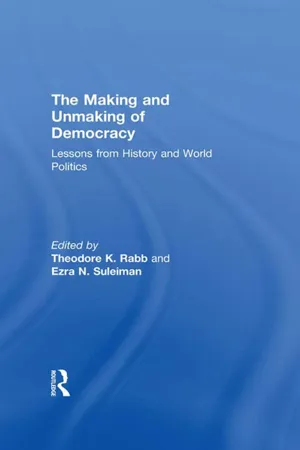
eBook - ePub
The Making and Unmaking of Democracy
Lessons from History and World Politics
- 392 pages
- English
- ePUB (mobile friendly)
- Available on iOS & Android
eBook - ePub
The Making and Unmaking of Democracy
Lessons from History and World Politics
About this book
For every citizen of the world, there is no more urgent issue than the spread of democracy. Democracy is what the WTO-protestors are calling for; it's the main concern of human rights advocates; and it's only long-term way to end terrorism. But how does democracy spread? What can be done to encourage and support. This remarkable new collection brings together some of the best minds in variety of fields to discuss the conditions that promote and sustain, or undermine and extinguish democratic institutions and ideas. Spanning political thought from ancient Athens to contemporary sub-Saharan Africa, the contributors develop an outline of how democracy develops. Several key factors emerge: Democratic transitions are always heavily shaped by the ideas and practices of past regimes (like tribal traditions in Africa), international political and economic pressure to liberalize (as in Asia) and current economic conditions. The quality of democracy is almost always improved by the elimination of religion as the center of the state, by the move from democracy as protection of the individual from the state to democracy as enhancer of rights, and by the progression from a focus on the individual to a focus on the community. Expansive in its coverage and fundamental in its significance, The Making and Unmaking of Democracy is a volume to learn from, argue against, and expand upon.
Information
ASIA, AFRICA, AND
THE MIDDLE EAST
Chapter Nine
Recasting the Primacy of
Politics in Israeli Democracy
INTRODUCTION
The conditions that Israeli democracy faced in its first half century of consolidation did not augur well for success:
• A lack of consensus regarding the state's basis of legitimacy
• A country in which the prime minister was assassinated
• A policy of granting citizenship upon arrival to co-religionists of the majority group and their immediate relatives
• A population that increased tenfold in fifty years by absorbing immigrants from some 100 countries, of whom few had experience with democracy
• A state with no agreed-upon or recognized international boundaries
• A territory with few natural resources
• An army that had successfully fought a half-dozen wars with its hostile neighbors
• A once-mighty party system in a parliamentary setting, since followed by an electoral system (then repealed) featuring the direct election of the prime minister in addition to parliamentary elections
Israel is a tumultuous, thriving, rough-and-tumble adolescent democracy, featuring vocal expression of a plurality of positions in the eyes of some; or a contentious, corrupt, battered, and a poorly constructed, deteriorating vehicle, allowing for the dominance of specific groups and interests in the minds of others. Like many other things in Israel, there is no consensus about the state of the country's democracy, and there is more than a kernel of truth in most descriptions. There seems to be, at one and the same time, a shift from universal principles toward particularistic, more traditional, tribal, and primordial emphases, and a head-on clash between a communal understanding of society with a more individualist ethos. Changes in Israel have added challenges of identity, control, and representation to the full plate of its democracy. The domestic issues on the agenda vie for attention as the leadership tries to solve the enduring foreign policy and security dilemmas. Israeli democracy was successful in incorporating the dissimilar parts of its population into a governing whole by resolving some issues and by postponing the solution of others.
HAVING IT BOTH WAYS: A JEWISH AND DEMOCRATIC STATE
The critical tension in Israel is between a citizen's individual rights and the endowed rights of the group to which s/he belongs. The 1948 Declaration of Independence declared Israel a Jewish and democratic state. Alone among the movements spawned by the crisis of European Jewry in the second half of the nineteenth century, Zionism claimed to speak on behalf of a worldwide Jewish nation. The Orthodox demanded that Jewish religious law be the touchstone for legislation; others called for Israel to be a state “for all of its citizens,” including non-Jews. Squaring that circle has been the source of countless coalition crises and social tension, and a major reason that the state has no written constitution.
How individuals and groups are incorporated in society is an appropriate organizing concept for this discussion.1 A liberal interpretation highlights personal liberty and focuses on the individual as the bearer of universal, equal, and publicly affirmed rights. The role of politics is negative—to aid and protect individuals from interference by government and by one another in pursuing their rights. A republican rendition stresses community. By virtue of participating in the political community, members affirm their citizenship and actively participate in the pursuit of a common good.2
Ethnonationalism, or its political expression, ethnic democracy, posits citizenship not as an expression of individual rights or of contribution to the common good, but of membership in a homogenous descent group.3 In this view, community is not conceived of as existing outside the state, or over it, but rather as expressed and embodied by the state. Nations are radically different from one another in this view because members possess distinct cultural markers, such as language, religion, and history. Because nations are inscribed into the identity of their members, ethnic nationalism denies the possibility of cultural assimilation.4
Israel has been the site of much verbal battle regarding these issues. In the pre-state period, the Histadrut, the kibbutz, the political parties, and the military formed a coherent institutional regime with a common moral purpose—the success of the Zionist project.5 Being a chalutz [pioneer] , according to Shafir and Peled,6
was a composite of two virtuous qualities, corresponding to the two bases of legitimation invoked by the Zionist settlers; Jewish historical rights in Palestine and the redemptive activity of the pioneers, consisting of physical labor, agricultural settlement and military service. Being a chalutz meant, therefore, first and foremost being a Jew, and then engaging in those redemptive activities. Thus the foundation was laid for distinguishing between the civic virtue, and consequent rights and privileges, not only of Jews and Arabs but also of different groupings within the Jewish community, based on their presumed contributions to the project of Zionist redemption.
After independence, functions such as defense, education, and employment were gradually transferred from political parties to the state, and the role of the parties changed. As citizens became less dependent on the political party than before, and as the party leadership (especially in Mapai) became the national leadership, the perceived importance of party membership was reduced. Health services, one of the last bastions of party strength and patronage, were nationalized in 1995.7 What emerged in Israel was an understanding of citizenship that emphasized both the republican and ethnonationalist version of citizenship relegating liberal individualist expression to a permitted but lower level of acceptance.
With the fading of the dominant socialist-Zionist institutions and the waning of the republican ethos, liberal sentiments seemed to grow as more universalistic institutions, such as the Supreme Court, and governmental financial institutions, such as the Bank of Israel and the Ministry of Finance, became more influential. But the social services provided by government ministries did not solve all the problems or promote weaker segments of society. The universal rules seemed to favor the more fortunate, so it was not surprising that weaker groups (Arabs, Sephardim, and new immigrants) still looked to their parties for solutions. Menachem Begin understood that when he attracted Sephardi voters from Labor to Likud in 1977. The phenomenal success of Shas in 1999, the Sephardi haredi party that increased its representation from 10 to 17 seats, was based on its harnessing government funds for services that the competing parties once supplied, such as longer school hours, school busing, and housing. Arab parties, barred by practice from the government coalition, are still looking for the key to their success at benefiting their voters at the expense of the government.
Loosening of the republican ethos was promoted by the most privileged groups that were interested in liberalization for the sake of continued accumulation, and by the most encumbered, including many Sephardim and including Israeli Arabs, intent on getting a larger share of the national pie. Major changes in Israeli public life have coincided with the fall of the Soviet Empire, an international event with enormous impact for Israel: Enemy Arab states lost their major backer, a million trained and skilled immigrants from the former Soviet Union poured into the country, and globalization erupted. Processes fostering peace and privatization were the inexorable results. And the society's stronger groups were better positioned to take advantage of these developments.
DEMOGRAPHY
Israel's democracy, like that of other countries, is profoundly influenced by the composition of its population. Unlike other countries, however, changes in Israel's population are immediately relevant to politics, because Jews and their immediate family can gain citizenship on arrival. Inclusion is automatic for Jews, but very difficult for others. Group membership often determines one's future.
The size of Israel's population at the end of 2000 was 6.3 million. Almost 80 percent were Jews, 15 percent Moslem, 1.7 percent Arab Christians, less than one half of 1 percent non-Arab Christians, and 1.5 percent Druze. Another 3 percent were listed by the Statistical Abstract of Israel as “Religion unclassified.” This listing first appeared in 1996 because of the growing number of immigrants from the former Soviet Union who were Israelis but not Jews.8 Since the 1990s there have been almost one million immigrants from the former Soviet Union; the estimates of non-Jews among them range from 10 to 30 percent.
The anomaly of admitting non-Jews to the country as Israeli citizens stemmed from the 1950 Law of Return, a law that assured the right of every Jew to immigrate to Israel. When this law was drafted in the shadow of the Holocaust, the definition of who is a Jew seemed self-evident. Whomever the Nazis identified as a Jew and sent to the death camps was to be offered refuge in the newly established state. Over the years, the debate over who is a Jew has been heated. The only new legislation that resulted from this debate was the 1970 amendment defining a Jew as one born to a Jewish mother or who had converted to Judaism.
The 1952 Law of Citizenship grants citizenship to every Jew, his or her spouse, children, and grandchildren. In effect, this meant that a single Jewish grandparent was sufficient to ensure the right to citizenship on immigration to Israel. Granting Israeli citizenship had no bearing on the determination of the Orthodox rabbinate regarding the question of whether the person was or was not a Jew. Stories abound of immigrants tracing their rights to Israeli citizenship to a grandparent who had no connection to Judaism other than by an accident of birth. Imagine a young Bolshevik whose progeny, decades later, came to Israel. Or of a Jewish woman in Kurdistan who married a Moslem man and bore him nine sons. Eventually, she was allowed to enter Israel along with her family of 170 people—children, grandchildren, and their spouses. Were Americans to contemplate immigrating to Israel under existing rules, perhaps as many as 50 million people would be eligible under the Law of Return.
Zionism was very successful in reaching its goal of changing the place of residence of the world's Jews from the Diaspora to Zion.9 In 1882, there were 24,000 Jews in Eretz (the Land of) Israel, or 0.31 percent of the world's Jews. By the end of 2000, Israel's 4.9 million Jews constituted 37.7 percent of the 13 million world Jewish population. The estimate for the first decades of the new millennium is that a majority of the world's Jews will live in Israel, with some 40 percent living in the United States.
There was a major group fault line among the Jews. Zionism was an initiative of secular Ashkenazim (mostly Jews from European states); they created the system and ran it. Sephardim (mostly Jews from Middle Eastern and North African states) came decades after the bang of creation; they were immediately admitted to the club, although they were treated more like clients than partners. They still occupy a lower rung in the stratification ladder of Israeli social, economic, and political life, notable exceptions notwithstanding. The immigrants from the former Soviet Union who flooded into Israel in the 1990s were mostly Ashkenazi; many came as highly trained cousins of the founding fathers. While not spared the traumas of immigrant absorption, their probabilities of being absorbed successfully into the system were high.
The great historical asymmetry was that the Zionist movement— based on secular, nationalist, European ideas—was not particularly successful among secular European Jews. While most were ready to subscribe to its ideology, few were actually willing to live in Israel. In a sense, the Zionist movement generated a leadership but failed to attract its natural followers. Most of the 13 million Jews in the world are Ashkenazi, but only a minority of them live in Israel; by contrast, most of the Sephardim of the world do live in Israel. The split among Israeli Jews today is about even.
Israeli Arabs find themselves in an especially difficult bind, because they are citizens, yet perceive themselves as outsiders. They are largely law-abiding citizens, conflicted, and cross-pressured.10 They are full citizens in the sense that they vote, are elected to the Knesset, and organize politically. Psychologically, however, their pos...
Table of contents
- Cover
- Half Title
- Title Page
- Copyright Page
- Contributors
- Table of Contents
- Introduction
- Pre-Modern Europe
- Modern Europe
- Asia, Africa, and the Middle East
- Latin America
- United States
- Conclusion
- Index
Trusted by 375,005 students
Access to over 1.5 million titles for a fair monthly price.
Study more efficiently using our study tools.
Frequently asked questions
Yes, you can cancel anytime from the Subscription tab in your account settings on the Perlego website. Your subscription will stay active until the end of your current billing period. Learn how to cancel your subscription
No, books cannot be downloaded as external files, such as PDFs, for use outside of Perlego. However, you can download books within the Perlego app for offline reading on mobile or tablet. Learn how to download books offline
Perlego offers two plans: Essential and Complete
- Essential is ideal for learners and professionals who enjoy exploring a wide range of subjects. Access the Essential Library with 800,000+ trusted titles and best-sellers across business, personal growth, and the humanities. Includes unlimited reading time and Standard Read Aloud voice.
- Complete: Perfect for advanced learners and researchers needing full, unrestricted access. Unlock 1.5M+ books across hundreds of subjects, including academic and specialized titles. The Complete Plan also includes advanced features like Premium Read Aloud and Research Assistant.
We are an online textbook subscription service, where you can get access to an entire online library for less than the price of a single book per month. With over 1.5 million books across 990+ topics, we’ve got you covered! Learn about our mission
Look out for the read-aloud symbol on your next book to see if you can listen to it. The read-aloud tool reads text aloud for you, highlighting the text as it is being read. You can pause it, speed it up and slow it down. Learn more about Read Aloud
Yes! You can use the Perlego app on both iOS and Android devices to read anytime, anywhere — even offline. Perfect for commutes or when you’re on the go.
Please note we cannot support devices running on iOS 13 and Android 7 or earlier. Learn more about using the app
Please note we cannot support devices running on iOS 13 and Android 7 or earlier. Learn more about using the app
Yes, you can access The Making and Unmaking of Democracy by Theodore K. Rabb,Ezra N. Suleiman in PDF and/or ePUB format, as well as other popular books in Politics & International Relations & Comparative Politics. We have over 1.5 million books available in our catalogue for you to explore.