For generations, influential thinkers--often citing the tragic polarization that took place during Germany's Great Depression--have suspected that people's loyalty to democratic institutions erodes under pressure and that citizens gravitate toward antidemocratic extremes in times of political and economic crisis. But do people really defect from democracy when times get tough? Do ordinary people play a leading role in the collapse of popular government?
Based on extensive research, this book overturns the common wisdom. It shows that the German experience was exceptional, that people's affinity for particular political positions are surprisingly stable, and that what is often labeled polarization is the result not of vote switching but of such factors as expansion of the franchise, elite defections, and the mobilization of new voters. Democratic collapses are caused less by changes in popular preferences than by the actions of political elites who polarize themselves and mistake the actions of a few for the preferences of the many. These conclusions are drawn from the study of twenty cases, including every democracy that collapsed in the aftermath of the Russian Revolution in interwar Europe, every South American democracy that fell to the Right after the Cuban Revolution, and three democracies that avoided breakdown despite serious economic and political challenges.
Unique in its historical and regional scope, this book offers unsettling but important lessons about civil society and regime change--and about the paths to democratic consolidation today.
eBook - ePub
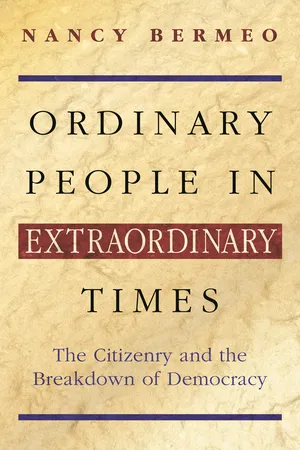
Ordinary People in Extraordinary Times
The Citizenry and the Breakdown of Democracy
- English
- ePUB (mobile friendly)
- Available on iOS & Android
eBook - ePub
About this book
Information
Publisher
Princeton University PressYear
2020Print ISBN
9780691089706
9780691089690
eBook ISBN
9780691214139
PART I
OUR LITERATURE AND INTERWAR EUROPE
WHAT ROLE DO ORDINARY PEOPLE play in the making of popular government? What role do they play in its collapse? The scholarly community has given a great deal of attention lately to the drama of democratization, but the spotlight has fallen most often on political elites. Though there can be little doubt that professional politicians, interest group leaders, and military officials play key roles in the creation and the maintenance of any democratic state, the role of ordinary people deserves close attention too. This is true first and most obviously because democracy is supposedly “rule by the people,” but it is also true because much of what elites attempt to do is conditioned by their judgments of how ordinary people will behave.
The ordinary people who stand in the foreground of this study are simply citizens. Some might call them “the masses” or “the public,” but both terms have connotations of singularity that do a disservice to the heterogeneity of the group. The term “people” draws our attention to the individuality of the group’s membership and the adjective “ordinary” underscores the fact that they have no extraordinary powers vis-à-vis the states in which they live. They are neither politicians nor military officers. They spend most of their lives in personal endeavors— earning money, supporting families, and pursuing whatever leisure activities their social status allows. They are the people who compose the vast majority of the citizenry in virtually every country in the world. Their sheer force of numbers makes them worthy of close attention— but what is most interesting about ordinary people is what they do in extraordinary times. What do they do when times get hard? How often do they abandon the normally exhausting pursuit of private security and comfort and take actions that contribute to forming a new political landscape with a new political regime? How often are they moved to defend democracy and how often do they embrace dictatorship instead?
These are timely but extremely difficult questions. They present us with two challenges. First, though ordinary people are ubiquitous in the world around us, they are often hard to find in social science studies of regime change. This is due in part to the weighty role of elites (and to our own elitism), but it is also the result of the fact that we usually rename people when we study them in a systematic way. They are there throughout our work but often disassembled. When ordinary people leave the private sphere and enter the texts of social scientists, they typically do so as “voters,” as “demonstrators,” and as “members” of public associations. They become part of what is often called “civil society.” Reassembling ordinary people from an array of partial identities and abstractions is our first challenge.1
Our second and more serious challenge is to evaluate two competing visions of how ordinary people behave in the drama of democracy’s construction and consolidation. In one vision, ordinary people seem heroic. Either as single actors challenging dictatorship through individual acts of resistance or as members of associations nurturing democracy in civil society, common citizens appear in some of our literature as democracy’s salvation. In a second set of works, ordinary people seem much less noble. As members of groups, they can demand too much of democracy and erode its capacity to perform and survive. As individuals, ordinary people can be democracy’s fickle friends. In times of crisis, they will abandon democratic parties and support polarized parties instead. Rather than being democracy’s salvation, ordinary people can be democracy’s undoing.
Evaluating these competing perspectives requires a sustained empirical analysis of what ordinary people are doing as democracies move from situations of crisis to situations of collapse. If we are to understand the extent to which ordinary people are (or are not) responsible for democracy’s undoing, we must analyze the connections between citizen action and regime breakdown. How were ordinary people acting when democracies fell on hard times? Since I obviously cannot analyze all political action, I have chosen to answer this question through the study of electoral behavior, strikes, demonstrations, and acts of violence. There are other forms of political participation, of course, but these are certainly among the most important, and they link up with my larger research questions in direct ways. Voting and taking collective action are essential elements of democratic citizenship. These activities are also essential to the fate and quality of democratic regimes because political and military leaders judge the risks of democracy by looking at how ordinary people use the freedoms that democracy affords. Political activity takes place in many spheres, but streets, factories, farms, and polling places are uniquely important because of the role they play in the calculations of political elites.
Examining the role of ordinary people in the breakdown of any single democracy requires a narrative of regime change that puts ordinary citizens in the role of protagonists. Formulating even tentative conclusions about democracies in general requires multiple historical narratives. This book is thus a comparative political history. It tells the untold stories of actors who have never received the attention they deserved. Its first empirical section deals with interwar Europe and history’s first set of failed democracies.2 Its second empirical section examines a set of failed democracies in South America in the 1960s and 1970s. The geographical and temporal sweep of the histories related here is broad, but the commonalties are deep and multiple.
It is in the tracing of these commonalties that the book accomplishes its central task, for the stories of seemingly diverse people separated in time and space yield general lessons of substantial theoretical and political importance. These lessons challenge much of our common wisdom about how ordinary people react to political crisis and about how and when moments of crisis develop into full-blown dramas of regime change.
The strengths of previous scholarship on democratic decline and collapse are many. Thus, though my arguments here have a critical bent, they use previous work as a foundation rather than a foil. Giovanni Sartori’s work on polarization provides the bedrock for much of my thinking. He does us great service by pointing out a simple truth: when political actors group themselves in opposite and distant ideological camps, they vacate the middle ground where cooperation is most likely and leave democracy vulnerable to collapse. The histories I analyze here confirm this insight. Yet they also have forced me to think harder about the connection between polarization, regime change, and the actions of ordinary people. For Sartori (and many others), ordinary people are the masons of polarization. They use their votes, one by one, to create distant and uncooperative political blocks. I show that this vision is accurate in only a small minority of cases and that mass defections to extremist parties are rare. Where support for extremist parties does rise, it is often the result of either an expansion of the franchise or the mobilization of nonvoters. Those who have attributed the breakdown of democracy to popular defections have mistaken changes in the composition of the electorate for changes of mind and heart.
In pointing this out, I do not deny the basic utility of the polarization model. I argue instead that the model suits some political actors better than others. Political elites and the leaders of groups in civil society often do polarize, and their polarization often does contribute mightily to the breakdown of democracy. Close analysis of the chronologies of regime change led me to understand that polarization is not a single process but a set of processes unfolding with different sets of actors, in different spheres, and with different degrees of intensity. Polarization can take place in private spheres or in public spheres, and the distinction is highly consequential for our understanding of the role of ordinary...
Table of contents
- Cover Page
- Title Page
- Copyright Page
- Dedication
- Contents
- List of Figures
- List of Tables
- Acknowledgments
- Part I: Our Literature and Interwar Europe
- Part II: South America and Our Literature Revised
- Index
Trusted by 375,005 students
Access to over 1.5 million titles for a fair monthly price.
Study more efficiently using our study tools.
Frequently asked questions
Yes, you can cancel anytime from the Subscription tab in your account settings on the Perlego website. Your subscription will stay active until the end of your current billing period. Learn how to cancel your subscription
No, books cannot be downloaded as external files, such as PDFs, for use outside of Perlego. However, you can download books within the Perlego app for offline reading on mobile or tablet. Learn how to download books offline
Perlego offers two plans: Essential and Complete
- Essential is ideal for learners and professionals who enjoy exploring a wide range of subjects. Access the Essential Library with 800,000+ trusted titles and best-sellers across business, personal growth, and the humanities. Includes unlimited reading time and Standard Read Aloud voice.
- Complete: Perfect for advanced learners and researchers needing full, unrestricted access. Unlock 1.5M+ books across hundreds of subjects, including academic and specialized titles. The Complete Plan also includes advanced features like Premium Read Aloud and Research Assistant.
We are an online textbook subscription service, where you can get access to an entire online library for less than the price of a single book per month. With over 1.5 million books across 990+ topics, we’ve got you covered! Learn about our mission
Look out for the read-aloud symbol on your next book to see if you can listen to it. The read-aloud tool reads text aloud for you, highlighting the text as it is being read. You can pause it, speed it up and slow it down. Learn more about Read Aloud
Yes! You can use the Perlego app on both iOS and Android devices to read anytime, anywhere — even offline. Perfect for commutes or when you’re on the go.
Please note we cannot support devices running on iOS 13 and Android 7 or earlier. Learn more about using the app
Please note we cannot support devices running on iOS 13 and Android 7 or earlier. Learn more about using the app
Yes, you can access Ordinary People in Extraordinary Times by Nancy G. Bermeo in PDF and/or ePUB format, as well as other popular books in Politik & Internationale Beziehungen & Internationale Beziehungen. We have over 1.5 million books available in our catalogue for you to explore.