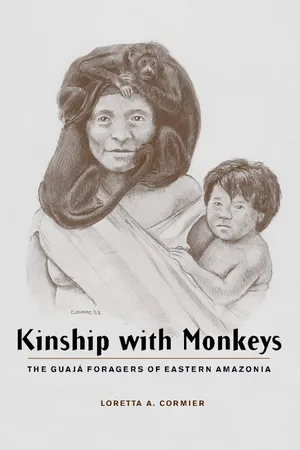
Intrigued by a slide showing a woman breast-feeding a monkey, anthropologist Loretta A. Cormier spent fifteen months living among the Guajá, a foraging people in a remote area of Brazil. The result is this ethnographic study of the extraordinary relationship between the Guajá Indians and monkeys. While monkeys are a key food source for the Guajá, certain pet monkeys have a quasi-human status. Some infant monkeys are adopted and nurtured as human children while others are consumed in accordance with the "symbolic cannibalism" of their belief system.
The apparent contradiction of this predator/protector relationship became the central theme of Cormier's research: How can monkeys be both eaten as food and nurtured as children? Her research reveals that monkeys play a vital role in Guajá society, ecology, economy, and religion. In Guajá animistic beliefs, all forms of plant and animal life—especially monkeys—have souls and are woven into a comprehensive kinship system. Therefore, all consumption can be considered a form of cannibalism.
Cormier sets the stage for this enlightening study by examining the history of the Guajá and the ecological relationships between human and nonhuman primates in Amazonia. She also addresses the importance of monkeys in Guajá ecological adaptation as well as their role in the Guajá kinship system. Cormier then looks at animism and life classification among the Guajá and the role of pets, which provide a context for understanding "symbolic cannibalism" and how the Guajá relate to various forms of life in their natural and supernatural world. The book concludes with a discussion of the implications of ethnoprimatology beyond Amazonia, including Western perceptions of primates.
- English
- ePUB (mobile friendly)
- Available on iOS & Android
eBook - ePub
About this book
Information
Subtopic
Cultural & Social AnthropologyIndex
Social SciencesTable of contents
- Cover
- Half title
- Series Page
- Title
- Copyright
- Contents
- Acknowledgments
- Notes on Orthography
- Introduction
- 1. A Brief History of the Guajá
- 2. A Brief History of New World Monkeys
- 3. Monkey Hunting
- 4. Guajá Kinship
- 5. Animism and the Forest Siblings
- 6. Pet Monkeys
- 7. Cosmology and Symbolic Cannibalism
- Conclusion: Ethnoprimatology in Amazonia and Beyond
- Appendix: Monkeys in the Guajá Habitat
- Notes
- References
- Index
Trusted by 375,005 students
Access to over 1.5 million titles for a fair monthly price.
Study more efficiently using our study tools.
Frequently asked questions
Yes, you can cancel anytime from the Subscription tab in your account settings on the Perlego website. Your subscription will stay active until the end of your current billing period. Learn how to cancel your subscription
No, books cannot be downloaded as external files, such as PDFs, for use outside of Perlego. However, you can download books within the Perlego app for offline reading on mobile or tablet. Learn how to download books offline
We are an online textbook subscription service, where you can get access to an entire online library for less than the price of a single book per month. With over 1.5 million books across 990+ topics, we’ve got you covered! Learn about our mission
Look out for the read-aloud symbol on your next book to see if you can listen to it. The read-aloud tool reads text aloud for you, highlighting the text as it is being read. You can pause it, speed it up and slow it down. Learn more about Read Aloud
Yes! You can use the Perlego app on both iOS and Android devices to read anytime, anywhere — even offline. Perfect for commutes or when you’re on the go.
Please note we cannot support devices running on iOS 13 and Android 7 or earlier. Learn more about using the app
Please note we cannot support devices running on iOS 13 and Android 7 or earlier. Learn more about using the app
Yes, you can access Kinship with Monkeys by Loretta A. Cormier in PDF and/or ePUB format, as well as other popular books in Social Sciences & Cultural & Social Anthropology. We have over 1.5 million books available in our catalogue for you to explore.