- 200 pages
- English
- ePUB (mobile friendly)
- Available on iOS & Android
eBook - ePub
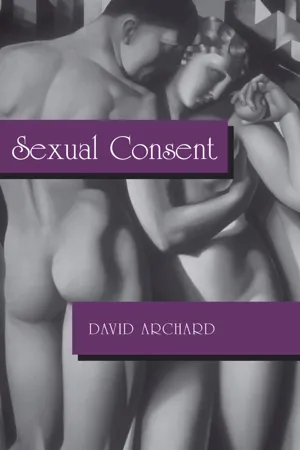
Sexual Consent
About this book
A popular belief is that whatever takes place in private between consenting adults should be allowed. This is the first book to offer a systematic philosophical examination of what might be meant by consent and what role it should play in the context of sexual activity. Investigating the adequacy of standard accounts of consent, the book criticizes
Information
◄ 1 ►
Questions of Consent
IN JUNE 1994 TWO READERS of the British newspaper the Independent on Sunday reacted angrily to the previous week’s column by one of that paper’s regular contributors, Geoffrey Wheatcroft. He had suggested that men were fast becoming the victims of a sexual game whose rules were changing. Understandably, they were no longer able to understand what these rules were. Wheatcroft had been discussing the vexed issue of ‘date rape’ with particular reference to the cases of the American boxer Mike Tyson and the English solicitor Angus Dibble. Wheatcroft’s view was that such men were only guilty of the crime of rape to the extent that they had found themselves stranded and vulnerable in the minefield that the game of sexual relationships between men and women had become. The letter writers protested that unconsented sex is nevertheless rape and that it remains the responsibility of men to be sure that consent is given. The newspaper’s subeditor gave the two protesting letters the heading ‘There is only one rule in the sex game, and that’s consent.1
This statement rather neatly and accurately summarises a common view, and one which is reflected in popular judgements about sexual matters. This is that consent makes a difference to whether some sexual activity is seen as immoral or not. Indeed it will be said to make all the difference between the permissibility and impermissibility of some practice or activity. On the one hand, a sexual practice which is not consented to is immoral. Rape, for instance, is wrong, and it will always be wrong, because the victim of rape does not consent to the sexual advances of her assailant. On the other hand, a sexual practice which is consented to is permissible. Whatever people do sexually as ‘consenting adults’ should be allowed, even if the rest of us find a particular practice disgusting or shocking. An example discussed in Chapter 7 is that of consensual adult sado-masochism.
It should be obvious that the common view is not a simple one. Equally it should be evident that it is not endorsed by everyone; nor need people endorse both of its halves. This book is not a defence of the ‘common view’ that consent is the ‘only rule in the sex game’. It is generally sympathetic to that view, and its approach is to proceed on the basis of such a general sympathy. There are other understandings of the morality of sex, and at various points in the book these other views are signalled. However, the purpose of the book is not to show that the common view of sex is the only correct one. Rather, it is to explore the implications of holding the common view, to spell out the common view, and to try to understand what it claims, why it has plausibility, and what its implications might be in particular instances. What, for instance, is consent, and what is it within the context of sexual activity? Does consent have a particular significance in the area of sexual activity, and if so, why should this be? Why should we think that consent plays the role that it does in the legitimation of some practice?
These and other questions will be addressed in due course. But by way of a context to this discussion, the general view, as it has been called, should first be given a more formal statement. Let me suggest that the general view consists of two principles. The Principle of Consensuality states that ‘a practice, P, is morally permissible if all those who are parties to P are competent to consent, give their valid consent, and the interests of no other parties are significantly harmed’. The Principle of Non-consensuality states that ‘a practice, P, is morally impermissible if at least one of those who are parties to P, and who are competent to consent, does not give their valid consent, even if the interests of no other parties are significantly harmed’. The first principle is a formal statement of the view that whatever consenting adults do is all right; the second formally expresses the view that something is not all right if somebody does not agree to it.
Some of the terms of these principles—such as ‘third parties’ and ‘competent to consent’—will have to be explained. For the moment attention need only be drawn to the phrase ‘valid consent’. Clearly the common view holds that not every instance of what appears to be consenting should be taken as sufficient to legitimate a practice. This is because what appears to be consent is, on occasion, not really. Most obviously agreement at the point of a gun is not. There is a need thus to make clear what does and does not count as valid consent. This may well be done by means of a Principle of Valid Consent which states that ‘the consent of a person, X, to some practice, P, is not valid if…’ or ‘is valid only if…’ where what follows is a statement of the conditions whose occurrence invalidate or validate the consent of that person. Since it is plausible to hold that the consent of a person competent to consent is valid unless some condition can be shown to hold (and it is more useful to operate with such a presumption), most attention will focus on the statement of invalidating conditions. This statement is likely to be a disjunction. Consent, for example, is invalid if obtained by coercion or given in unavoidable ignorance of some significant relevant fact or given by someone who is temporarily mentally disturbed. Whether a complete disjunctive statement of invalidating conditions can be agreed upon is obviously a crucial and difficult question to resolve.
With all of the foregoing in mind let us move to address a series of questions about consent. In answering these questions, I am trying to be clearer about what consent is—what is its moral significance, what is its scope, and how may it be given. In subsequent chapters I will examine the role of consent in sex and what it is about consent that may be thought to make any activity permissible. Still later chapters will examine some worries about the relationship between consent and permissibility, before exploring some practical applications of the understandings gained.
What Is Consent?
For present purposes there are four claims about consent that need to be identified and elucidated.2 First, the giving of consent is something which makes a difference to the situation, normatively characterised; it alters the normative relationships between individuals in that situation. Consent has been described as ‘morally transformative’, as displaying a certain ‘moral magic’ in the way that it can suddenly make an otherwise wrong action right.3 If I consent to the doing of something, I put myself under some sort of obligation in respect of that doing. It may be that I consent to do the thing in question—I agree to organise the meeting, and I should then take steps to realise that end. It may be that I consent to someone’s else doing of something, in which case I am obliged not to obstruct their doing of it or to assist their doing of it in a manner indicated by the giving of the consent. If I agree to a friend’s using my house while I am away, I should give them a key, not change the locks or move others in beforehand. Those to whom I give the consent thereby acquire rights or legitimate expectations in respect of what it is I have agreed to do or allow to be done.
Second, there are actions which are ‘morally transformative’ but which are not the giving of consent. That is to say, consent is sufficient but not necessary to generate obligations and permissions. If, for instance, Smith has stolen goods from Jones, then Jones can take certain steps to recover these goods, and Smith is under an obligation not to prevent her from doing so. There are also behaviours of which one might say that it is almost ‘as if’ consent had thereby been given. Smith may not have consented to Jones’s doing something. Nevertheless, what Smith did do was sufficient for Jones reasonably to believe that she could do it and that Smith was under an obligation not to stop her or to assist her. Cases like this will be discussed later under the category of ‘quasi-consent’.
Third, the giving of consent needs to be accomplished in and by a positive, intentional act. Consent is an act rather than a state of mind.4 Consent is something I do rather than think or feel. When I give my consent, I may do so in ways other than by a public expression of the form ‘I consent to ….’ Whether consent can be given tacitly is moot. Whether what is argued to be tacit consent can be distinguished from other kinds of behaviour which may incur an obligation is also open to question. However, it is assumed that consent, whether express or tacit, is given rather than simply assumed in the absence of any sign to the contrary. I do not, normally, give my consent by my failure to perform some action which indicates dissent. There are, to be sure, circumstances in which being silent constitutes consent. If the chair of some meeting announces that she will take silence to betoken agreement, and pauses to permit any declaration of disagreement, then staying silent is something I can be described as subsequently deciding to do, and doing. But plainly this is not a mere failure or absence of voice.5
The view of consent as something that is done rather than as a state of mind is normally expressed by the statement that consent should be understood in ‘performative’ and not ‘psychological’ terms. Nevertheless, it is surely reasonable to expect that the person who consents, in the performative sense, will have, as a psychological state, the right kind of attitude towards that to which she is consenting.
The fourth claim about consent concerns the relevant mental states. When I say ‘I consent to X’, must I think to myself ‘I consent to X’? There are three types of relevant mental state, cognitive, dispositional, and volitional, whose character determine, respectively, whether I know I am consenting, whether I agree with what I am consenting to, and whether I intend to consent.
It seems, first, that someone consents only if they are aware that they are consenting. One gives one’s consent deliberately and knowingly. If I say ‘I do’ in a foreign language, believing myself to be saying something quite different, then I am not properly described as giving my consent by mistake. Rather, I have simply failed, in virtue of my linguistic incompetence, to give my consent. However, I do not, second, have to want or to approve of what I consent to. I can consent to P while having no view about P’s desirability, or even while disliking the very thought of P. Someone could consent to sex that is unwanted. A wife may have uncoerced, willing, and knowing sex with a husband in the knowledge that she will not enjoy it and preferring that it not take place. There is reason to condemn such a sexual interaction but not in virtue of its being non-consensual.
Consent is to be distinguished from assent. Etymology alone indicates that they are closely related. But while consent is essentially agreement to something, assent is essentially agreement with something. Agreeing with something is like Joseph Raz’s ‘consenting in one’s heart’: ‘Consenting in one’s heart is not a performative consent but a psychological state akin to coming to terms with. The core use of “consent” is its use in the performative sense’.6 When I consent to the holding of a party in my house, I agree that it may be held there. When I assent to holding the party, I agree that holding it in my house is a good idea.
My consent to the holding of the party in my house is ‘morally transformative’. If I consent to have the party in my house, then I have no right that others not hold it there. Before I gave my consent, I did have such a right. If I assent to having the party in Smith’s house, I do not thereby strip Smith of his right that it not be held there. It is for Smith to give his consent to holding the party in his house. Saying ‘I agree’ when it is the giving of consent is a performative utterance as saying ‘I do’ is in the context of the marriage ceremony. Saying ‘I agree’ only as an expression of assent is not.
Assent, unlike consent, can be both an act and a state of mind. I can express my approval of some state of affairs or merely wish for it. I can, in a single act, express both my assent and consent. To the question ‘Is it OK to hold the party in your house?’ I reply, ‘Yes’ and thereby both consent and assent to its being held there. Dissent may be taken as the contrary of both consent and assent. In the absence of further explanation or context an expression of dissent from P is both an explicit withholding of consent to P and the signalling of one’s disapproval of P. Dissent, like assent, can be both an act and a state of mind. However, a person may give her sincere and willing consent to that from which she dissents, that is, does not approve of. Equally, consent need not be given to that from which no act of dissent is expressed. When Smith submits sexually to Jones in real fear of her life, she makes no protest, but she does not consent.
When I consent to X, I must, cognitively, be in the state of knowing that I consent to X. Consent need not require the dispositional mental state of agreeing with X. The third type of mental state, the volitional, governs what I really will to be the case. Do I have to mean what I say when I say ‘I consent’? If I say these words in jest or with the intention of misleading the other, even though I know what the words mean, then am I actually giving my consent? In short, is an insincere consenting a consenting nonetheless? J. L. Austin suggested that something goes wrong when somebody who says ‘I promise’ does not have the corresponding intention to promise. The ‘performance’ is not ‘void’, but it is ‘unhappy’, an ‘infelicity’; it is given in ‘bad faith’.7 John Searle stipulates that a speaker makes a promise in uttering certain words only if he intends to do that which he promises to do and intends that the utterance will place him under an obligation to do what he promises to do.8
It does seem true that if I know what I am doing when I say ‘I consent’, then I put myself under an obligation to honour the commitments that are normally made by a sincere utterance of these words. I intend that my words shall be understood by the other as the giving of my consent. Moreover, since we would normally expect the utterance to be accompanied by the appropriate intentions and there is nothing in my behaviour to indicate that this is not the case in this particular instance, I lead others to believe that I am sincere in my utterance. If in saying ‘I consent’ I do not actually intend to consent, it is nevertheless the case that I intend to be responsible for the consequences of its being as if I did intend to consent. The man who insincerely but deliberately and knowingly answers ‘I will’ at the appropriate moment in the marriage ceremony does thereby and to all intents and purposes enter into the marriage.
What Is Consented To?
This is the second question we need to try to answer. This is a question about the scope of any act of consent. If I agree to your borrowing my car, I accord you the right to drive it. I do not alienate my right of ownership; nor do I, normally, allow you use of the car for more than a limited period. I also do not consent to you using the car in certain ways, for instance, as the getaway vehicle in a bank robbery. Many of these limits have to be understood as governed by informal conventions of usage. I should not have to say that you should not break the law when driving my car. There may, however, be disagreements. I did not say you should not take the car abroad when you asked to borrow it for a week, but I would have expected you to ask if you might. Any state of affairs or outcome or action that we consent to is thus limited in ways that any reasonable person, understanding the informal conventions in question, could be expected to acknowledge. These conventions, it should be emphasised, govern the question not of whether a person has consented or not, but of what, in having consented to something, a person has precisely or in full detail consented to. There is a question of whether in doing one thing a person is consenting to something else, and whether the inference from the first to the second is governed by conventions. But that is something that will need to be examined when we turn to the question of how consent is given.
It should be clear that in consenting to something, I do not consent to its being accomplished in any manner whatsoever. If I agree to have sex with you, I do not thereby agree to the form of sexual activity that you may prefer. If I consent to sexual intimacy in general, I do not consent to each and every possible particular sexual act. If I consent now to an act of sexual intimacy, I do not thereby consent to sex on each and every subsequent occasion that might arise. On the other hand, notoriously, it has been believed that through the act of marriage and its first consummation a woman thereby consents to all future sexual activity between herself and her husband. This belief has given support to the law’s refusal, until recently, to recognise the crime of rape within marriage. This refusal does of course have other explanations—that a wife, on marriage, becomes the property of her husband or only a constituent element of a single legal agent, husband-and-wife, whose decisions are made by the husband alone. Nevertheless, the idea of consent to future sexual activity in general being given through the single act of agreeing to marry is an influential one.
How Is Consent Given?
In answering this question, we need to distinguish, first, between types of consent and, second, between consent proper and ersatz consent.
Tacit Consent
A first distinction can be made between express and tacit consent. Express consent is the making of a public, explicit sign of agreement to something. At its most basic express consent can be given by someone saying ‘I consent to…’, or by signing one’s name under a written statement of the form ‘I consent to…’, or by responding to an inquiry as to whether one does consent with words such as ‘I do’. ‘Tacit’ or, as it is sometimes also described, ‘implicit’ consent is consent which is implied by, or can be understood from, a person’s action. With tacit consent an action can be taken to mean somet...
Table of contents
- Cover
- Half Title
- Title Page
- Copyright Page
- Dedication
- Table of Contents
- Preface and Acknowledgements
- 1 Questions of Consent
- 2 Sexual Consent
- 3 Sexual Consensuality
- 4 Real Consent
- 5 Consensuality and Permissibility
- 6 Gendered Consent
- 7 The Limits of Consensuality I: Incest, Prostitution, and Sado-masochism
- 8 The Limits of Consensuality II: The Age of Sexual Consent
- 9 The Limits of Consensuality III: Rape
- 10 Conclusion
- Notes
- Bibliography
- About the Book and Author
- Index
Trusted by 375,005 students
Access to over 1.5 million titles for a fair monthly price.
Study more efficiently using our study tools.
Frequently asked questions
Yes, you can cancel anytime from the Subscription tab in your account settings on the Perlego website. Your subscription will stay active until the end of your current billing period. Learn how to cancel your subscription
No, books cannot be downloaded as external files, such as PDFs, for use outside of Perlego. However, you can download books within the Perlego app for offline reading on mobile or tablet. Learn how to download books offline
Perlego offers two plans: Essential and Complete
- Essential is ideal for learners and professionals who enjoy exploring a wide range of subjects. Access the Essential Library with 800,000+ trusted titles and best-sellers across business, personal growth, and the humanities. Includes unlimited reading time and Standard Read Aloud voice.
- Complete: Perfect for advanced learners and researchers needing full, unrestricted access. Unlock 1.5M+ books across hundreds of subjects, including academic and specialized titles. The Complete Plan also includes advanced features like Premium Read Aloud and Research Assistant.
We are an online textbook subscription service, where you can get access to an entire online library for less than the price of a single book per month. With over 1.5 million books across 990+ topics, we’ve got you covered! Learn about our mission
Look out for the read-aloud symbol on your next book to see if you can listen to it. The read-aloud tool reads text aloud for you, highlighting the text as it is being read. You can pause it, speed it up and slow it down. Learn more about Read Aloud
Yes! You can use the Perlego app on both iOS and Android devices to read anytime, anywhere — even offline. Perfect for commutes or when you’re on the go.
Please note we cannot support devices running on iOS 13 and Android 7 or earlier. Learn more about using the app
Please note we cannot support devices running on iOS 13 and Android 7 or earlier. Learn more about using the app
Yes, you can access Sexual Consent by David Archard in PDF and/or ePUB format, as well as other popular books in Philosophy & Criminal Law. We have over 1.5 million books available in our catalogue for you to explore.