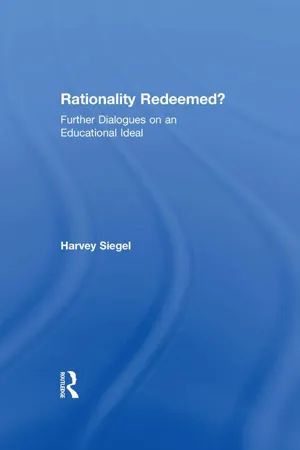
In Educating Reason, Harvey Siegel presented the case regarding rationality and critical thinking as fundamental education ideals. In Rationality Redeemed?, a collection of essays written since that time, he develops this view, responds to major criticisms raised against it, and engages those critics in dialogue. In developing his ideas and responding to critics, Siegel addresses main currents in contemporary thought, including feminism, postmodernism and multiculturalism.
- 245 pages
- English
- ePUB (mobile friendly)
- Available on iOS & Android
eBook - ePub
About this book
Information
DEVELOPMENT AND DEFENSE
part one |
EPISTEMOLOGY, CRITICAL THINKING, AND CRITICAL THINKING PEDAGOGY
Here's an object more of dread, Than aught the grave contains, A human form with reason fled, While wretched life remains. —Abraham Lincoln | chapter 1 |
BEING A CRITICAL THINKER requires basing one's beliefs and actions on reasons; it involves committing oneself to the dictates of rationality. The notions of “reason” and “rationality,” however, are philosophically problematic. Just what is a reason? How do we know that some consideration constitutes a reason for believing or doing something? How do we evaluate the strength or merit of reasons? What is it for a belief or action to be justified? What is the relationship between justification and truth? Why is rationality to be valued?
Questions such as these are central to epistemology. Because they are abstract and difficult, their relevance to education for critical thinking is not always appreciated. But so long as critical thinking is thought of as centrally involving reasons and rationality, these questions are basic to the critical thinking student's understanding of her subject matter. Without having some epistemological understanding of notions such as reason, rationality, knowledge, truth, evidence, warrant, justification, and so on, the critical thinking student has at best a superficial grasp of her subject. It is central to critical thinking education that students develop some understanding of the epistemology underlying critical thinking.
In this chapter my task is two-fold. First, I will examine the epistemology underlying critical thinking, and argue that taking critical thinking seriously requires the taking of particular, albeit contentious, positions with respect to certain standard epistemological issues. (For example, I will argue that a commitment to education for critical thinking requires a rejection of epistemo-logical relativism, and the embrace of an “absolutist” conception of truth.) Second, I will argue that the explicit consideration of such epistemological questions as the nature of reasons, truth and rational justification should be regarded as a basic component of critical thinking education. That is, I will argue that epistemology should be a fundamental part of any educational effort to foster critical thinking. In making these arguments, I hope to clarify both the epistemology underlying critical thinking and the relevance of that epistemology to critical thinking pedagogy. (Because of their interrelatedness, epistemology and pedagogy will be intertwined in what follows.)
CRITICAL THINKING AND THE EVALUATION OF REASONS
To be a critical thinker one must be able, at least, to evaluate the evidential or probative force of reasons.1 That is, the critical thinker must be able to tell whether a putative reason is a genuine one; whether it strongly or weakly supports some claim or action for which it is offered as a reason; and whether she ought, on the basis of the reason under consideration, to accept the claim or perform the action in question. The beliefs and actions of the critical thinker, at least ideally, are justified by reasons for them which she has properly evaluated; when the beliefs and actions, in other words, are based on good reasons. But when are reasons good ones? How do we distinguish good reasons from not-so-good ones? How do we know, for example, that
p: abortion is baby-killing
is a bad reason for
q: abortion is morally wrong;
while
r: a fetus is sentient and has a concept of self,
if justified, would be a good reason for q? In this example our evaluation of the force of reasons p and r for claim q is straightforward: p is a bad or weak reason for q because p begs the question against those who think that abortion is morally permissible since a fetus is not in relevant respects like a baby and so has no “right to life”; while r, if itself justified, would be a good reason for q because we think that beings who are sentient and have a concept of self do enjoy such a right, and that it is morally wrong to deny that right.2 So the belief that q, i.e. that abortion is morally wrong, is justified when (and only when) there are good reasons which support it.
It is obvious that more needs to be said concerning the goodness of reasons. r, we said, would be a good reason for q if justified;3 that is, we ought to believe that abortion is morally wrong (so far as this particular argument is concerned) only if we are justified in believing, i.e. have good reason to believe that it is the case, that fetuses are sentient and have concepts of self. But since there is good reason to think that r is false, r does not constitute a good reason for believing that q. r's unjustifiedness counts against its force as a reason for q, just as
s: Reagan had a deep understanding of foreign policy issues
is not a good reason for
t: We would have been better off if Reagan had
continued on in the presidency after 1988
because there is good reason to think that 5, like r, is false. If the belief that s were justified, s would be a consideration which favored an extended Reagan presidency; but if 5 is not justified it offers no support for t.4
Belief in some claim (q or t) is justified when there are good reasons which support that claim, and the belief is based on those reasons. We have just seen that one criterion by which we assess the force of reasons is their justifiability: r would be a good reason for q, except that r is itself unjustified, i.e. there is good reason to think that it is not true; similarly, s is not a good reason for t since there is good reason to believe that it is not true.5 But it is clear that this is only one criterion by which we evaluate reasons. Another which we have seen is that of question-begging-ness: just as a reason carries no weight if it is itself unjustified, it carries no weight if it begs the question.
But how do we know that these are legitimate criteria of reason assessment? What are the criteria of reason assessment? Where do these criteria come from, and how are they themselves justified? How do we tell, in general, whether some putative reason u is a good reason for some claim (or action) v?
Full answers to these fundamental questions are beyond both my ability and my available space. But some things can be said. First, it should be noted that there are a variety of types of criteria by which we assess reasons. Some are general, in that they apply to many diverse subject matters and circumstances. Our earlier example of begging the question illustrates this: a reason which begs the question—that is, one which assumes the very point for which it purports to be a good reason—is a bad reason, with no probative weight. This is true no matter what the context or subject matter happens to be. Begging the question functions as a general criterion of reason assessment, in that any putative reason which begs the question will fail to be a good reason, i.e. will fail to provide warrant or justification for the claim for which it purports to be a reason. Logic—both formal and informal—provides a large set of general criteria by which reasons are evaluated.
Other criteria are not so general, but are subject-specific. One needs to know some developmental psychology (and some philosophy), for example, in order to evaluate the claim that fetuses have a concept of self; one needs to know this in order to evaluate claims like “A fetus' performing behavior B is evidence that the fetus has a concept of self.” Similarly, to evaluate the claim that the sun's being in a certain position is a reason for setting the shutter speed at 5, one needs to know something about photography; to tell whether or not one's symptoms constitute good evidence that one has malaria, one needs to know some medicine. So some criteria by which reasons are properly assessed are subject-specific, while others are subject-neutral.6 (Often it is not easy to tell whether a putative reason is a good one, even when the relevant criteria are clear; evaluating reasons is often problematic. But to the extent that one is a critical thinker, one believes and acts on the basis of reasons which one evaluates, in accordance with relevant criteria, as best one can.)
How are criteria of reason assessment themselves justified? How do we know, for example, that a reason is a bad one because it begs the question, but not because it is more than five words long? There is no short, snappy answer to this question. In order to justify a claim about something's being a legitimate criterion of reason assessment, one has no choice but to appeal to epistemology—that is, to the general theory of knowledge, truth, reasons, justification and evidence.
Moreover, when we help students to become critical thinkers—by helping them to understand and apply appropriate criteria of reason assessment, and by encouraging them to seek reasons by which to justify candidate beliefs and actions—we in effect invite them to demand reasons for accepting as legitimate the criteria of reason assessment we are teaching them. In encouraging students to become critical thinkers, then, we encourage them to pursue epistemological questions concerning reason assessment and critical thinking for themselves. That is, we encourage them to be critical thinkers about critical thinking itself. We must do this if we are consistent; otherwise, we would be saying to students: “Be critical and demand reasons regarding all aspects of your life—regarding political views, scientific and literary beliefs, personal relationships, etc.—but just take our word for it that ‘begging the question’ is a fallacy, and that a reason which begs the question is not a good one.” This sort of message is incompatible with sound critical thinking instruction, for it in effect invites students not to be critical thinkers about the very thing we think it is so important for them to become. So critical thinking pedagogy requires that we allow and encourage students to think critically about critical thinking itself. This involves thinking critically about the justification of standards of reason assessment, which in turn involves considerations of epistemology—for example, it involves the consideration of views about the nature of reasons and justification, such that according to such views reasons which beg the question do not (or do) constitute good reasons—and it involves the consideration of reasons for and against those epistemological views themselves. Thus a self-consistent critical thinking pedagogy necessarily invites students to consider epistemological questions underlying critical thinking. (I shall return to this point below.)
THE EPISTEMOLOGY UNDERLYING CRITICAL THINKING
Our trail has led thus far to the conclusion that sound critical thinking peda-gogy requires attention to the epistemology underlying critical thinking. So what is that epistemology? What epistemology are we committed to when we favor the ideal of critical thinking; when we think it good to be a critical thinker and encourage our students to become critical thinkers? While I don't pretend to have anything like a full conception of an epistemology underlying critical thinking to offer, I do think that a commitment to critical thinking requires that we take particular stands on some contentious epistemological issues.
The Relationship Between Rational Justification and Truth
The first concerns the nature of rational justification, and the relation between such justification and truth. We saw earlier that for r to count as a reason for q, r must be justified. What about q itself? Must q be true if belief in q is to be rational? The answer, required by a commitment to critical thinking, is negative: it can be rational to believe that q even if q is false. The rationality of believing q is independent of q's truth.
Examples make this initially paradoxical stance plausible. In the heyday of Newtonian mechanics, for example, there was excellent reason for regarding that theory as true; it was certainly rational to believe it. We now regard Newton's theory as false (on the basis of evidence and theoretical considerations not available to scientists in the nineteenth century). So a Newtonian in, say, 1850, was perfectly rational in believing what was/is in fact false. The same could be said of belief in air which had negative weight, and of belief that the Earth was flat, in earlier centuries. In general, there can be good reasons/powerful evidence which supports belief in that which is false.
By the same token, it is quite possible for evidence to point against that which is true; that is, it can sometimes be rational to disbelieve that which is true, and believe that which is false. This can be illustrated by a famous anecdote concerning Bertrand Russell. In his widely broadcast BBC radio debates with Father Copleston on the existence of God, Copleston asked Russell what he would say to God if, despite all the evidence against His existence cited by Russell during the course of the debate, Russell arrived at the pearly gates upon his death and discovered that, evidence to the contrary notwithstanding, God did in fact exist. Russell replied that he would ask the Creator “why He had made the evidence for His nonexistence so compelling.” In this reply Russell makes clear that, despite the strength of the considerations favoring God's nonexistence, it is possible that He exists, despite the evidence, all the same. Other examples illustrate the same point. It may be true, for example, that Oliver North truly believes in the ideal of government by law, and that the United States Congress has a legitimate role to play (along with that of the Executive) in the establishment of foreign policy, despite the powerful evi-dence that North does not believe these things; similarly, it frequently is true of some people that they have not suffered heart attacks, despite the pain in the arm, tightness of chest, and shortness of breath that suggests that they have. It may be true, despite evidence to the contrary, that fetuses have a concept of self. In all these cases, a claim can be true (that God does exist, that North does believe, that the patient is not a heart attack victim, that fetuses have a concept of self, that aspirin does not lower the probability of stroke) despite powerful evidence to the contrary. And earlier we saw that a claim can be false, despite strong evidence in its favor. In short, the lesson here is that truth is independent of rational justification: we can be justified in believing that q even though q is false; and we can be justified in rejecting q as false even though it is true.
The idea that truth and rational justification are independent is contentious philosophically: it contradicts Dewey's view of truth as “warranted assertibility”; and it is rejected by contemporary philosophers like Hilary Putnam...
Table of contents
- Cover
- Half Title
- Title Page
- Copyright Page
- Dedication
- Table of Contents
- preface
- introduction That Old-Time Enlightenment Metanarrative Rationality As An Educational Ideal
- part one Development and Defense
- part two Dialogue
- epilogue Why Care (About Epistemology, Justification, Rationality, Etc.)? A Brief Metaphilosophical Excursus
- Notes
- Bibliography
- Index
Trusted by 375,005 students
Access to over 1.5 million titles for a fair monthly price.
Study more efficiently using our study tools.
Frequently asked questions
Yes, you can cancel anytime from the Subscription tab in your account settings on the Perlego website. Your subscription will stay active until the end of your current billing period. Learn how to cancel your subscription
No, books cannot be downloaded as external files, such as PDFs, for use outside of Perlego. However, you can download books within the Perlego app for offline reading on mobile or tablet. Learn how to download books offline
Perlego offers two plans: Essential and Complete
- Essential is ideal for learners and professionals who enjoy exploring a wide range of subjects. Access the Essential Library with 800,000+ trusted titles and best-sellers across business, personal growth, and the humanities. Includes unlimited reading time and Standard Read Aloud voice.
- Complete: Perfect for advanced learners and researchers needing full, unrestricted access. Unlock 1.5M+ books across hundreds of subjects, including academic and specialized titles. The Complete Plan also includes advanced features like Premium Read Aloud and Research Assistant.
We are an online textbook subscription service, where you can get access to an entire online library for less than the price of a single book per month. With over 1.5 million books across 990+ topics, we’ve got you covered! Learn about our mission
Look out for the read-aloud symbol on your next book to see if you can listen to it. The read-aloud tool reads text aloud for you, highlighting the text as it is being read. You can pause it, speed it up and slow it down. Learn more about Read Aloud
Yes! You can use the Perlego app on both iOS and Android devices to read anytime, anywhere — even offline. Perfect for commutes or when you’re on the go.
Please note we cannot support devices running on iOS 13 and Android 7 or earlier. Learn more about using the app
Please note we cannot support devices running on iOS 13 and Android 7 or earlier. Learn more about using the app
Yes, you can access Rationality Redeemed? by Harvey Siegel in PDF and/or ePUB format, as well as other popular books in Pedagogía & Educación general. We have over 1.5 million books available in our catalogue for you to explore.