Thickening Fat: Fat Bodies, Intersectionality, and Social Justice seeks to explore the multiple, variable, and embodied experiences of fat oppression and fat activisms. Moving beyond an analysis of fat oppression as singular, this book will aim to unpack the volatility of fat—the mutability of fat embodiments as they correlate with other embodied subjectivities, and the threshold where fat begins to be reviled, celebrated, or amended. In addition, Thickening Fat explores the full range of intersectional and liminal analyses that push beyond the simple addition of two or more subjectivities, looking instead at the complex alchemy of layered and unstable markers of difference and privilege.
Cognizant that the concept of intersectionality has been filled out in a plurality of ways, Thickening Fat poses critical questions around how to render analysis of fatness intersectional and to thicken up intersectionality, where intersectionality is attenuated to the shifting and composite and material dimensions to identity, rather than reduced to an "add difference and stir" approach. The chapters in this collection ask what happens when we operationalize intersectionality in fat scholarship and politics, and we position difference at the centre and start of inquiry.
1 The Big Colonial Bones of Indigenous North America’s “Obesity Epidemic”
Margaret Robinson
I have grown fat again. My body size waxes and wanes like phases of the moon. As a fledgling professor, I worry how my fat impacts my ability to obtain a tenure-track position in Mi’kmaki, the traditional territory of my people, the Mi’kmaq, on what is currently Canada’s eastern seaboard. Authority and truth, qualities valued by students, colleagues, and tenure or promotion committees, are not often ascribed to fat bodies (Fisanick, 2007). Instead, fatness is uncritically associated with “laziness, greed, and moral slackness” (p. 237), posing challenges for the academic credibility and success of people with larger bodies (Bacon, 2009; Cameron, 2016; Fisanick, 2006; Hunt & Rhodes, 2018). As a queer woman whose Indigeneity already evokes negative stereotypes, I worry my intersecting identities stretch the boundaries of academic collegiality too far, as my chest stretches the blazer that fit me last summer. So I control what I eat, skip meals, and walk to work and back, but feel complicit in shaping my body to meet colonial standards beyond my reach.
In this chapter I examine how Indigenous fatness—particularly that of women—is used to justify ongoing colonial domination and control by settlers and their governments. I explore this connection through a visual discourse analysis of fatness in the historical personification of America, content analysis of contemporary health research funding, and visual discourse analysis of a health promotion poster targeted at Indigenous people. My analyses demonstrate the colonial logic embodied in “the obesity epidemic” as applied by Canadian health research and health promotion campaigns. I focus on Canada, but practices that norm Indigenous bodies and maintain the occupation of Indigenous lands occur across Turtle Island and beyond.
French philosopher Michel Foucault used the term “biopower” to describe practices that shape and control populations (1990, p. 140). Biopower is manifested in biopedagogies, “the loose collection of moralized information, advice, and instruction about bodies, minds, and health that works to control people by using praise and shame alongside ‘expert knowledge’ to urge conformity to physical and mental norms” (Rice, Chandler, Liddiard, Rinaldi & Harrison, 2016, p. 4–5). Both the historical personifications of America and contemporary research funding practices train Settlers to perceive Indigenous bodies and land as requiring domination. Contemporary health promotion frames Indigenous bodies and populations as excessive and attempts to train them for absorption into the body politic. Such biopedagogy produces political and medical knowledge that is simultaneously moral and sexual, marking Indigenous bodies and populations as conquered, unhealthy and immoral, requiring ongoing intervention (Rice, Chandler, Liddiard, Rinaldi & Harrison, 2016).
America Is a Rich Fat Woman
To understand the colonization of Indigenous bodies we must start with the colonization of Indigenous land. Indigenous scholars Waziyatawin Angela Wilson (Dakota) and Michael Yellow Bird (Mandan, Hidatsa, and Arikara) define colonization as methods to “maintain the subjugation or exploitation of Indigenous Peoples, lands, and resources” (2005, p. 2). Biopower is one such method, especially as it produces knowledge and expertise about Indigenous fatness.
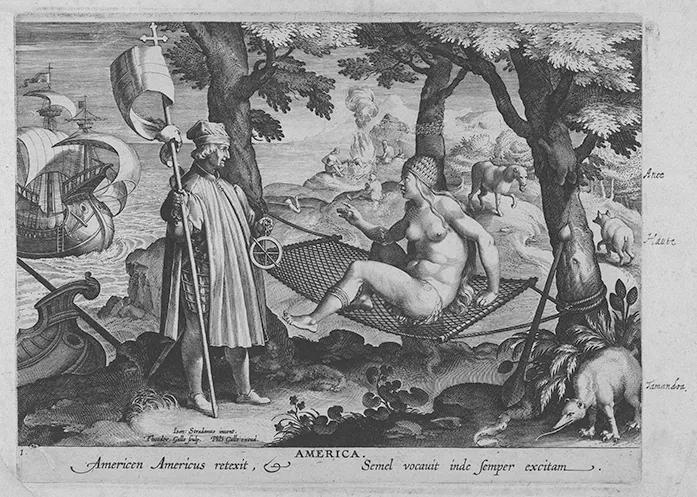
Efforts to control and discipline fat, feminine, Indigenous bodies have a long history. Settler literary theorist Louis Montrose (1991) notes that by the 1570s European artists had begun to personify America as a large-bodied woman with bare breasts and a feathered headdress. The Discovery of America (circa 1587–1589), a drawing by Jan van der Straet (best known via an engraving of it done by fellow Dutch artist Theodoor Galle ca. 1600), portrays the territory as a thick nude woman in a hammock encountering a fully dressed European man (Amerigo Vespucci) (see Figure 1.1). Vespucci is armed with a cross, navigational astrolabe, and sword, emphasizing the “mutually reinforcing emblems of belief, empirical knowledge, and violence” (Montrose, 1991, p. 4). The presence and danger of food is in the background, where Indigenous people roast a human leg over an open fire. Montrose notes that the position of the leg on the spit “inverts and miniaturizes” (2007, p. 4) Vespucci’s own leg. Professor of American Indian Studies M. Elise Marubbio refers to this personification of unconquered America as “the Native American Queen,” noting that her nakedness and repose “invite[s] the colonizer’s gaze, his exploration, and his exploitation” (2006, p. 10), even as the cannibalism motif suggests that Indigenous womanhood may consume European masculinity.
Figure 1.1 The Discovery of America. Galle, T. (ca. 1600). Discovery of America. After a drawing by Jan van der Straet.
Retrieved from https://www.metmuseum.org/art/collection/search/659655
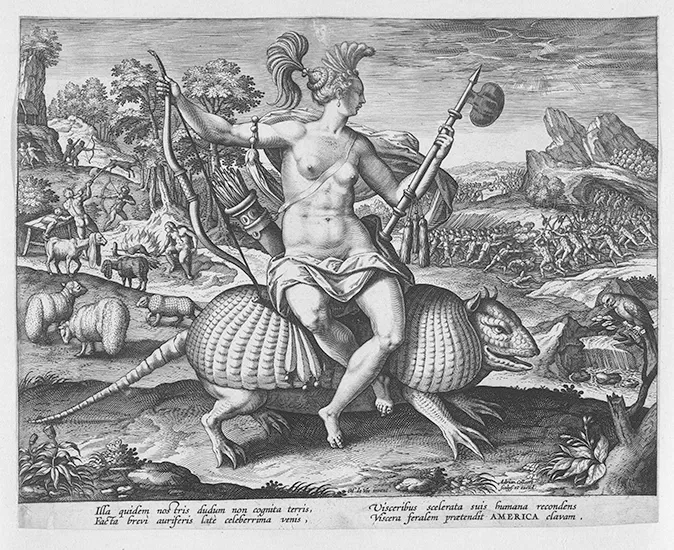
In an engraving called America, a Personification (c. 1590) by Flemish artist Adriaen Collaert, America is again a naked woman in a feathered headdress, armed with bow and arrows, riding a giant armadillo (see Figure 1.2). She turns her gaze to the right (the symbolic future, since English reads left to right), where naked people with axes battle armoured Europeans armed with guns. In the left background (the symbolic past), naked people hunt deer in a pastoral setting, a naked man butchers a human body with an axe, and a naked woman roasts a human leg on a spit. The message is that if left undominated, Indigenous people (especially women) resort to ungodly overconsumption, treating what Christians see as the very image of God—the human body—as mere meat. Once the image of the axe is connected with cannibalism, the European invaders on the right are fighting for their very lives (and for Christian values of the body) against an all-consuming enemy.
Figure 1.2 America, a personification. Collaert, A. (c. 1590). America, A Personification.
From The Public Domain Review. https://publicdomainreview.org/collections/america-a-personification-ca-1590/
Spanish and English visitors to the Americas personified the land as a large rich woman and conflated political and sexual conquest. Sir Walter Raleigh, in a passage from his 1597 book, Discovrie of the Large, Rich, and Beautiful Empire of Guiana, wrote:
Guiana is a country that hath yet her maydenhead, never sackt, turned, nor wrought… It hath never bene entred by any armie of strength, and never conquered or possesed by any Christian Prince.
(Raleigh, 2006)
The merging of sexual and colonial possession is a recurring pattern. Early settler colonist Thomas Morton described what is currently New England as:
Like a faire virgin longine to be sped
and meete her lover in a nuptial bed,
decked in rich ornaments t’advance her state.
(Morton, 2011, p. 10)
Similarly, in A Relation of the Second Voyage to Guiana, English explorer Lawrence Keymis, a contemporary associate of Raleigh, described the New World as “shires of fruitfull rich grounds, lying …waste for want of people,” that “prostitute themselves unto us, like a faire and beautiful woman, in the pride and floure of desired yeeres” (Kaymis, 1968, p. 487). The theme that emerges is of a sexualized and fertile fat female body demanding to be conquered.
The representation of America as eager for domination is one of the earliest tropes of Indigenous land as a feminine body. The portrayal of Indigenous territories as the “feminine Other” partakes of a colonial Christian binary in which men are associated with intellect and women with the body. Literary scholar Susanne Scholz (1998) notes that the association of men with intellect is made possible by the over-association of the body with women. In this gendered binary, the mind must dominate the body as men dominate women. The control of the body by a hyper-developed will justifies the leadership of men and masculinized subjects, such as England’s Virgin Queen Elizabeth I, over women, populations, and domains framed as feminine (Montrose, 1991). This ideology connects the colonial occupation of Indigenous land with the subjugation of Indigenous people and with Christian practices of body intended to display mastery of the mind or spirit over the flesh. Such practices concretize in movements from early Christian asceticism to the “muscular Christianity” of the nineteenth century (Webb, 2009), influencing European children’s literature and producing organizations such as the Scouting movement and the Young Men’s Christian Association (later, YMCA). Fatness becomes a metaphor for moral laxity.
America’s Puritan Makeover
Settler sociologist Abigail C. Saguy (2013) details how fatness came to be framed as both a moral crisis and a health crisis. Originally associated with success, nineteenth- and early twentieth-century America used categories of fatness and thinness to distinguish itself from Europe, reframing fatness from a sign of God’s favour to a marker of sloth, gluttony, and lack of the self-control (Saguy, 2013; Stearns, 2002). This process of reframing body fat into a foundational character flaw is inescapably raced, sexed, and classed:
[T]hinness (at least in women) has been associated with self-control and whiteness since early in U.S. history. In this national context, fatness has long been associated with lack of control, immorality, barbarity, and blackness.
(Saguy, 2013, p. 41)
Although briefly fashionable due to a wave of wealthy German immigration, once associated with poor Irish Catholic immigrants in the nineteenth century, fatness became indicative of laziness and moral laxity (Saguy 2013; Strings, 2012). More recently, stereotypes portray Black and Latina women as having voracious appetites for food and sex to justify punitive social control (Saguy 2013). In this way, campaigns against “obesity” can be used where more overtly racist, sexist, or classist campaigns might be challenged (Campos, Flegal, Carroll, Kuczmarski & Johnson, 1998; Saguy, 2013; Sobal & Stunkard, 1989).
Marubbio (2006) notes that as Settler norms around body size shifted, the large, fecund body of the militant “Native American Queen” became refigured as the “Squaw,” marked by excess fat, excess sexual appetite, and excess reproduction. By 1953, for example, Disney’s animated film Peter Pan has a fully developed “Squaw”—a fat, bullying woman with a child strapped to her back. The “Squaw” represents Indigenous women as taking too much space, physically, morally, and socially. She exemplifies what Geneviève Rail and Shannon Jette describe as the “bio-Other”: “the weak-willed, the lazy, the amoral, the unruly, those who do not live responsibly and engage in “risky” behavior or do not get involved in preventative behavior” (2015, p. 4). The “Squaw” image evokes shame and disgust, key emotions for internalizing the “normalizing and moralizing instructions for life” that constitute biopedagogy (Rice, 2015, p. 387).
Like the “Black Welfare Queen,” the “Squaw” reaffirms White body norms and sexual morality, justifying White domination over populations framed as lacking self-control (Roberts, 1999; Saguy, 2013; Witt, 1999). Implications of literal cannibalism shift to sexual, emotional, and economic “maneating.” Marubbio (2006) contrasts the sovereign and militant “Native American Queen” with the “Indian Princess” who sides romantically and politically with male Settlers against her own nation. The most familiar “Indian Princess” is Pocahontas, who rescues Captain John Smith from death and befriends colonists at Jamestown, in what is currently Virginia. The Princess is no longer large and rich—only beautiful. By the time we get to Walt Disney Pictures’ 1995 animated film Pochahontas, the flirtatious “Princess” is as slender as Barbie. Muscogee scholar Dwanna Lynn Robertson notes the racist binary of “sexy maiden” and “dirty squaw” promotes “the idea that Indigenous women are highly sexualized, act wild, like to be held captive, and become sexually active at earlier ages than other racial groups of women” (2013, p. 53). Such representations mark Indigenous women’s bodies as targets for sexual aggression, justifying the rape of bodies and lands as a civilizing practice.
“Obesity” Knowledge Production in Federal Research Funding
While controlling the symbolic body of America, colonial practices also strive to shape the literal bodies of Indigenous people through health discourse. Saguy traces the framing of fat as a crisis requiring government intervention, arguing that defining fatness as “obesity” “was crucial in convincing public opinion that fatness represented a medical problem” (2013, p. 42). Medical historian Robert Aronowitz, a Settler, argues that the medicalization of fatness distinguishes between upper and lower classes in America (Aronowitz, 2008). Saguy (2013) likewise notes how race, class, and gender intersect to prevent stigmatized women from uniting in solidarity while the image of elite Americans as thin both marks and justifies their authority over others. Here the “good citizen” is constructed as embodying “masculine” virtues of autonomy, responsibility, and self-control, manifested in physical, mental, economic, and moral strength (Rail & Jette, 2015; Rice, 2015). Within this framework, body sovereignty is reserved for those citizens who best reflect the political and economic sovereignty of the nation-state, while bio-Others require intervention.
Increasingly, public health research funders are framing “obesity” as “epidemic” among the Indigenous peoples of North America. As early as 1992, the National Institutes of Health in the United States initiated funding for school-based interventions to prevent obesity in American Indians and Alaska Natives. Since 2014 the Canadian Institutes for Health Research have funded the Pathways to Health Equity for Aboriginal Peoples initiative, which identifies “obesity” (conflated with diabetes) as one of four priority areas. My analysis of funded health research below sheds light on colonial biopower as it pertains to the promotion of an Indigenous “obesity epidemic” in Canada. Federally funded health research frames “obesity” in ways that erase the impacts of colonialism and neoliberal consumerism on Indigenous bodies, and shifts focus to interventions that discipline the bodies and practices of Indigenous women.
In May of 2018, I conducted a search of The Canadian Research Information System (http://webapps.cihr-irsc.gc.ca/cris/search) using the terms “Aboriginal,” “Indigenous,” “First Nation,” “Métis,” or “Inuit” and “weight,” “obesity,” “adipose,” “fat,” or “diabetes” (often conflated with fat), obtaining ...
Table of contents
Cover
Half Title
Title Page
Copyright Page
Table of Contents
Acknowledgments
Introduction
Part I: Our Heavy Inheritance
Part II: Exploding Our Expectations
Part III: Expanding Our Activisms
Part IV: Our Gainful Failures
Contributor Biographies
Index
Trusted by 375,005 students
Access to over 1.5 million titles for a fair monthly price.
Study more efficiently using our study tools.
Frequently asked questions
Yes, you can cancel anytime from the Subscription tab in your account settings on the Perlego website. Your subscription will stay active until the end of your current billing period. Learn how to cancel your subscription
No, books cannot be downloaded as external files, such as PDFs, for use outside of Perlego. However, you can download books within the Perlego app for offline reading on mobile or tablet. Learn how to download books offline
We are an online textbook subscription service, where you can get access to an entire online library for less than the price of a single book per month. With over 1.5 million books across 990+ topics, we’ve got you covered! Learn about our mission
Look out for the read-aloud symbol on your next book to see if you can listen to it. The read-aloud tool reads text aloud for you, highlighting the text as it is being read. You can pause it, speed it up and slow it down. Learn more about Read Aloud
Yes! You can use the Perlego app on both iOS and Android devices to read anytime, anywhere — even offline. Perfect for commutes or when you’re on the go. Please note we cannot support devices running on iOS 13 and Android 7 or earlier. Learn more about using the app
Yes, you can access Thickening Fat by May Friedman, Carla Rice, Jen Rinaldi, May Friedman,Carla Rice,Jen Rinaldi in PDF and/or ePUB format, as well as other popular books in Social Sciences & Sociology. We have over 1.5 million books available in our catalogue for you to explore.