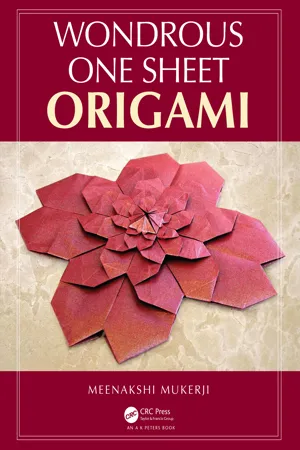
The word origami is based on two Japanese words: oru (to fold) and kami (paper). Although this ancient art of paper folding started in Japan and China, origami is now a household term around the world. Most people have probably folded at least a paper boat or an airplane at some point in their lives. However, origami has evolved immensely over time and is much more than just a handful of traditional models. That it is child’s play is quite a misconception; there are more and more people from a wide range of backgrounds immersing themselves into the joys of origami because it fulfills a certain craving for a unique kind of creativity that brings together both sides of the brain.
The origami symbols used here are standard. The symbols were pioneered by renowned origami master Akira Yoshizawa (1911–2005) [Yos84] and further developed by more recent creators, adding more symbols and terms leading to the current standard. Origami diagramming follows the convention that the execution of a current step results in what is diagrammed in the next step. Different artists may have slightly different ways of representing the same symbols essentially to mean the same moves. Usually every origami book will have their own glossary of symbols just in case there are any doubts or someone is folding for the first time.
I would like to emphasize precision in folding. It is the number one secret to successful finished models pleasing to the eyes. So, I would recommend that you fold as precisely as possible, slowing down instead of rushing. After all, origami is for relaxation, so why rush? Make sure that your work area is well lit so you can see the reference points and lines clearly. Oblique lighting is often more helpful than overhead lighting. If you cannot understand a step, looking ahead to the next step helps immensely.
Origami Paper and Tools
Origami can be folded from practically any type of paper. But most designs have some paper that works best for them, and mainly experience can tell you what to use. Some models might require sturdy paper, while some others might require paper that creases softly. Also, it is advisable to keep a small set of basic tools handy if you plan to do origami regularly.
Origami Tools
Creasing Tools. The most basic tool that is used in origami is a bone folder. It allows for making precise and crisp creases and prevents your nails or fingertips from becoming sore when folding excessively or folding many layers together. Substitutes are plastic cards or similar things.
Cutting Tools. Although cutting is prohibited in pure origami, cutting tools are required for the initial sizing of the paper. A great cutting tool would be a paper guillotine, but it is bulky and may not be readily accessible. I find a portable photo trimmer with replaceable blades to be a great substitute. They are inexpensive and easily carried anywhere. Scissors and blades may be used, but it is difficult to get straight cuts, especially if one is not experienced.
Other Tools. Tweezers, chopsticks, or stylus-like objects may be used to access hard-to-reach places such as in between layers of paper or to deal with paper that becomes too small during the folding process to maneuver with fingers. Chopsticks, screw drivers, or knitting needles are great for curling in designs that call for it.
Paper that you use need not necessarily be paper manufactured specifically for origami purposes. A vast range of papers from gift wrap to scrapbooking paper work very well. You just have to apply your imagination. Often times I reuse flier papers printed only on one side, which work well for designs that do not show both sides of the paper when finished. It’s a great way to recycle and reuse or simply to practice folds.
Commonly Available Origami Paper
Kami. This is the most readily available paper sold for origami. It is solidly colored on one side and white on the other with a weight thinner than common printer paper.
Duo. Paper that has different colors on the front and back sides is advisable for designs with color change, i.e., when both sides of the paper are visible in the finished model.
Printer paper. Often called copy paper, this is paper that is white or colored (usually the same on both sides) and is commonly used in home or office computer printers.
Mono. Such paper has the same color on both sides. Printer paper is an example of mono paper, and it may be available in other weights including kami weight.
Harmony. This paper has some harmonious pattern formed by various colors or shades blending into one another. This paper can have magical effects on certain designs.
Chiyogami. Origami paper with patterns, usually small, printed on it.
Washi. This handmade Japanese paper has plant fiber in the pulp that gives it texture. The fibers are often visible, giving a beautiful effect.
Foi...