While conventional technologies such as chilling and freezing are used to avoid deteriorative processes like autolytic and microbial spoilage of seafood, innovative technologies have also been developed as a response to economic and environmental demands. Innovative Technologies in Seafood Processing gives information on advances in chilling, freezing, thawing, and packaging of seafood and also updates knowledge of novel process technologies (high-pressure processing, irradiation, ultrasound, pulsed electric field, microwave and radio frequency, sous vide technology, novel thermal sterilization technologies, ozone and nanotechnological applications, and other innovative technologies such as cold plasma, ohmic heating, infrared heating supercritical carbon dioxide, and high-intensity pulsed light) for the seafood industry.
Features
Reviews novel process technologies applied in the seafood industry
Highlights processing effects on product quality and safety of treated seafood
Focuses on the development of safe and effective natural antimicrobials and additives
Assesses alternative techniques to utilize fish discards and waste as high value products
Further it highlights aspects related to quality of seafood treated with these innovative technologies, effect on food constituents, possible risk, security/safety both of seafood and consumers, the environmental impact, and the legislative aspects. The book also addresses the growing international environmental concern for fish discards and fish waste generated in the seafood processing industries by including a chapter, Advances in Discard and By-Products Processing, which assesses alternative techniques to utilize fish discards and waste as high value products. This book will be of value to researchers and technicians in the food technology area, especially those dealing with seafood.
1.2 Post-Mortem Changes in Fish at Chilled Storage Temperatures
1.3 Chilling of Fish
1.3.1 Conventional Chilling
1.3.1.1 Block Ice
1.3.1.2 Flake Ice
1.3.1.3 Slurry Ice
1.3.1.4 Chilled and Refrigerated Sea Water
1.3.1.5 Dry Ice and Ice/Gel Packs
1.3.2 Super-Chilling
1.3.2.1 Super-Chilling Technologies
1.4 Combination of Chilling with Natural Preservatives and Novel Technologies
References
1.1 INTRODUCTION
According to the latest available statistics from the Food and Agriculture Organization (FAO), the global annual capture of marine fish and aquaculture production exceeded 100 million tonnes. It is estimated that about 87% of the world fish production is used for direct human consumption and the rest is used for non-food products, mostly fish meal and fish oil for feed and pharmaceutical uses. FAO (2016) reports that in 2014, 46% (67 million tonnes) of the fish for direct human consumption was in the form of live, fresh, or chilled fish. Development of innovative chilling, packaging, and distribution technology for live, fresh and chilled fish has increased due to consumer demand and represented about 10% of world fish trade in 2014 (FAO 2016). Fish consumption has many benefits on human health; it is a source of high-quality proteins, polyunsaturated fatty acids and minerals such as iodine. However, high water and free amino acid contents and low content of connective tissue makes it also a perishable commodity whose quality is compromised with temperature abuse and hygiene during handling, storage, and transport. To support this, we evidence the loss of 30% of landed fish through spoilage (Ghaly et al. 2010). Fresh fish undergoes freshness and quality loss as a result of autolysis and bacterial activity. These changes start right after the fish dies, and spoilage evolves through a series of reactions affecting products’ sensory characteristics, nutritive quality, and safety. The extent of these changes with time determines shelf life of the product, and it is linked to the maintenance of the temperature during storage, transport, and sales (from the fisherman to the final consumer). Lowering the fish temperature with ice and mechanical refrigeration are the most common means of retarding biochemical and microbial spoilage. These techniques are applied on freshly caught seafood during distribution and marketing to prolong their relatively short shelf life. However, although widely spread, both techniques have some adverse effects on fish quality attributes, so in last decades improvements of traditionally used methods have been developed. Advances in the chilling process require technological improvement of the ice production, packaging material, and packaging methods. Temperature regime is of primary importance in shelf life of fresh fish, but packaging methods like modified atmosphere packaging (MAP) and vacuum packaging (VP) have become increasingly popular preservation techniques in seafood distribution and marketing. In combination with chilling, MAP and VP are capable of extending the shelf life of fish and shellfish. Besides, the obligatory adequate chilling, monitoring, and recording of the products temperature and traceability at all stages of the process are crucial for sustaining a system of continuous storage and transport of fresh fish at low temperature, called the temperature-controlled transportation chain, also known as cold chain. An unbroken cold chain is achieved when the food is transported, processed, stored, and sold at a cold storage temperature within a minimum of fluctuation (Bantle et al. 2016). Distribution is one of the most critical points of the cold chain, since the refrigeration systems used in most transport containers are not designed to chill the product but to maintain the temperature of the cargo. Hence, it is important that the fish is at the right temperature prior to loading (Duun 2008). This ensures the global trading of fresh fish, the usability of fish in worldwide production and increases economic value of the products.
1.2 POST-MORTEM CHANGES IN FISH AT CHILLED STORAGE TEMPERATURES
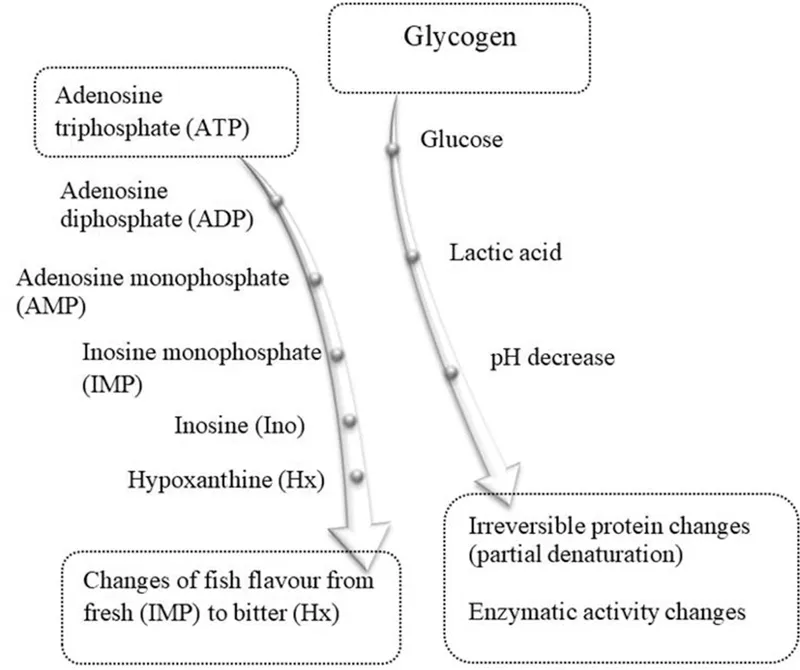
Following death, the supply of oxygen to the fish tissues stops and anaerobic conditions are established, disrupting balance between anabolic and catabolic processes, regardless if they take place under the influence of tissue enzymes, microorganisms, or other chemical processes. The character and dynamics, as well as the rate and nature of the post-mortem changes in the fish muscle during chilled storage differ between species and even between individuals of the same species. They are related to chemical composition, initial microflora, handling stress, storage temperature, as well as type of processing and packaging of the fish (Sivertsvik et al. 2002, Olafsdóttir et al. 2006, Šimat et al. 2015). After capture, fish starts post-mortem changes by secreting significant amounts of mucus. Opposite to mucus found on live fish that is clear and specific in odour, post-mortem mucus is opaque and contains albumins, lipoids, and phosphatides, which makes it a suitable medium for growth of microorganisms. Still, this process occurs on the surface of the fish skin, not in deeper layers. The endogenous enzymes in fish muscle are responsible for the initial loss of freshness. Inside the fish many anaerobic processes are activated, among them glycolysis is the most important (Figure 1.1). Glycolysis will proceed as long as glycogen is present in the muscle or until the pH drops so low that it decreases the activity of the glycolytic enzymes. It is a fermentative process of glycogen (stored carbohydrate) degradation that results in the production of lactic acid, thus it lowers the pH of the muscle.
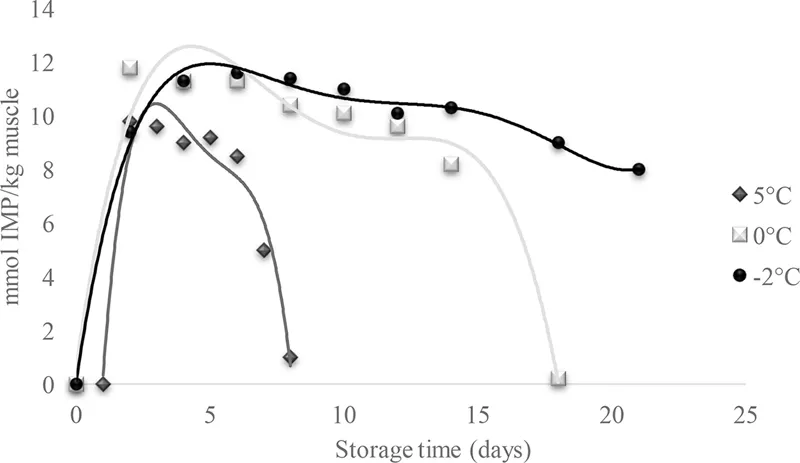
Reduction of pH can interfere with the structural properties of proteins and enzymes activities in fish muscle, resulting in lower water-holding capacity of proteins, softening of fish flesh, colour change, and increased incidence of fillet gaping (Huss 1995). Further, the decrease of pH in the fish muscle activates enzymes that facilitate phosphate hydrolysis. Firstly, creatine phosphate is depleted followed by adenosine triphosphate (ATP). Post-mortem ATP degradation is associated with the formation of ATP-related compounds and appearance of rigor mortis in the fish muscle. Certain nucleotide catabolites such as inosine monophosphate (IMP) and hypoxanthine (Hx) are used as freshness indicators, and they are considered responsible for desirable fresh fish flavour and perceived bitter off-flavour of spoiled fish, respectively (Figure 1.1). The ATP decomposition after the death of fish is an enzyme catalysed and temperature related process, thus the progress of the reaction tells the history of fish storage regarding time and temperature, indicating the degree of freshness. Recently, it was demonstrated that IMP degradation was delayed in flounder fillet stored at low temperatures, thus it occurred after 6 days at 5°C and 12 days at 0°C, and at −2°C it was suppressed (Figure 1.2).
FIGURE 1.1 Post-mortem changes in fish muscle due to autolytic degradation. (Modified from Huss, H.H., Quality and quality changes in fresh fish, FAO Fisheries Technical Paper, 348, FAO, Rome, Italy, 1995.)
FIGURE 1.2 Decomposition of IMP in flounder fillet stored at three storage temperatures. (Adapted from Konno, K. and Konno, Y., Superchilling storage of fish meat for keeping its freshness. 46th WEFTA Conference, October 12–14. Split, Croatia, 2016.)
In living animals ATP is a source of energy required for muscle contraction, and it enables the elementary muscle contractile proteins – actin and myosin – to remain in dissociated (separated) state. As the ATP concentration in the muscle is decreased below 1–2 μmol/g, the energy needed to break the bindings between actin and myosin filaments is insufficient, thus they stay cross linked, forming actin-myosin complex, and the muscle becomes increasingly stiff and enters rigor mortis. The progress and rate of rigor mortis varies between species and are affected by many factors such as temperature, handling (e.g., pumping, crowding), size, physical condition, and the biological state of the fish (Huss 1995). In cold-water fish, high storage temperatures accelerate onset of rigor mortis, whereas in fish living in warmer seas, the difference between the ambient temperature and the storage temperature has that effect. A more general rule should be that the bigger this temperature difference, the stronger the muscle contraction and the shorter the time before the onset of rigor (Jessen et al. 2014). From microbiological point of view, fish in this post-mortem phase have neutral to slightly acidic pH reaction which does not support bacterial and bacterial enzyme activity, thus this phase should be prolonged using low temperatures. However, the technological significance of rigor mortis is of major importance since processing of such fish results in low filleting yield, rough handling can cause gaping, and if removed from the bone, pre-rigor fillets tend to shorten (Huss 1995).
As rigor progresses, the pH of the fish flesh increases, the muscle is softening, and the autolytic changes involving proteolytic, lipolytic, and amylolytic enzymes are intensified. During this phase, the simplest components are formed such as amino acids, free fatty acids, glycerine, etc. Up to a certain point, protein and lipid degradation products are not harmful; however, the autolytic activity and products formed in this phase soften the muscle and make favourable conditions for microbial growth. In the new environment, especially if it is rich with non-protein nitrogen-containing compounds (ammonia, trimethylamine oxide), limited bacteria (specific spoilage microorganisms, SSO) invade the flesh of the fish and produce off-odours, off-flavours, and chemical changes associated with spoilage (Dalgaard et al. 1993), and also toxic compounds such as histamine, putrescine, cadaverine, trimethylamine, Hx, H2S, etc. are formed. When SSO increase to a certain level, their metabolism products can be detected and spoilage can be chemically identified. Fish spoilage can also be of non-bacterial nature. The two major quality deterioration reactions are related to lipid oxidation and hydrolysis, and they both result in the production of substances which have unpleasant rancid organoleptic characteristics.
1.3 CHILLING OF FISH
The chemical composition of fish varies greatly from one species and one individual to another depending on age, sexual changes in connection to spawning periods, environment, feed intake, migrations, and season. These changes interact with a variety of constantly changing interactive systems in live musculature of fish and reflect the post-mortem biochemical and chemical dynamics and quality of the fish. After capture and killing, these changes affect the eating and nutritive quality of the fish, but also influence the acceptability of the fish as food and its suitability for processing. Due to chemical compositions, presence of specific microflora, enzymes, and compounds such as, histidine and trimethylamine-N-oxide (TMAO), the ultimate pH reaction in the fish flesh, and high content of water and long-chain unsaturated fatty acids, fish is a highly perishable commodity and deteriorates very rapidly at normal temperatures. Loss of freshness and quality of fresh fish occur mainly as a result of autolytic and bacterial spoilage. Temperature changes have greater impact on microbiological growth than on enzymatic activity (Huss 1995). Factors affecting loss of quality in the fresh fish are as follows: biological variations, harvesting conditions, and post-harvest handling. Since species characteristics and biological states of the fish cannot be manipulated after harvesting, focus of keeping the fish fresh as long as possible has been set on the standard of hygiene during handling of fish, chilling, preservation techniques, and innovative packaging. As a consequence, efficient chilling technologies and their constant improving have been employed by fishermen, equipment producers, and researchers in order to postpone quality losses and obtain storage/transport stability of fresh fish to the final consumers or fish processors. The process by which temperature of the fish is lowered in range of the temperature of the melting ice (0°C) to the point near freezing, but not below it, by means of heat withdrawal is called chilling. The freezing point, otherwise known as cryoscopic point, for different fish species varies between −0.6°C and −2.8°C and depends on the bound water content. It is usually taken as equal to −1°C. Fish and fishery products preserved in this way are called chilled products. Preservation efficiency and shelf life prolongation of fresh fish is directly temperature dependent, but it differs among different chilling processes.
The preserving effect of chilling fish is generally due to the decrease effect of low temperatures on the rate of undesirable biochemical and chemical post-mortem changes and retardation of the growth and activity of the spoilage bacteria. Chilling is still a short-term preservation and it can be done using ice, cold air, immersion of the fish in chilled water, chilled brine or seawater, using slurry ice or dry-ice. In some cases a combination of the mentioned methods are applied, providing versatile and complementary advantages to ensure quality of the product. Technologies used in the seafood industry include high pressure processing, modified atmosphere packaging, active packaging, irradiation, use of additives, as well as application of new temperature regimes, such as super-chilling or chilling by use of ice slurries (Medina et al. 2009). Super-chilli...
Table of contents
Cover
Half Title
Title Page
Copyright Page
Table of Contents
Preface
Editor
Contributors
Chapter 1 Advances in Chilling
Chapter 2 Advances in Freezing and Thawing
Chapter 3 Advances in Packaging
Chapter 4 Applications of Edible Films and Coatings in Aquatic Foods
Chapter 5 High-Pressure Processing of Seafood
Chapter 6 Irradiation Technology
Chapter 7 Application of Ultrasonication in Seafood Processing
Chapter 8 Pulsed Electric Field Processing
Chapter 9 Innovative Dielectric Applications (Microwave and Radio Frequency) for Seafood Thawing
Chapter 10 Ozone Application in Seafood Processing
Chapter 11 Effect of Natural Preservatives on Chemical Changes Related to Quality and Shelf Life in Processed Aquatic Foods
Chapter 12 Application of Natural Antimicrobial Strategies in Seafood Preservation
Chapter 13 Sous Vide Technology
Chapter 14 Nanotechnological Applications
Chapter 15 Novel Thermal Sterilization Technologies in Seafood Processing
Chapter 16 Advances in Discard and By-product Processing
Chapter 17 Other Innovative Technologies in Seafood Processing
Index
Trusted by 375,005 students
Access to over 1.5 million titles for a fair monthly price.
Study more efficiently using our study tools.
Frequently asked questions
Yes, you can cancel anytime from the Subscription tab in your account settings on the Perlego website. Your subscription will stay active until the end of your current billing period. Learn how to cancel your subscription
No, books cannot be downloaded as external files, such as PDFs, for use outside of Perlego. However, you can download books within the Perlego app for offline reading on mobile or tablet. Learn how to download books offline
Perlego offers two plans: Essential and Complete
Essential is ideal for learners and professionals who enjoy exploring a wide range of subjects. Access the Essential Library with 800,000+ trusted titles and best-sellers across business, personal growth, and the humanities. Includes unlimited reading time and Standard Read Aloud voice.
Complete: Perfect for advanced learners and researchers needing full, unrestricted access. Unlock 1.5M+ books across hundreds of subjects, including academic and specialized titles. The Complete Plan also includes advanced features like Premium Read Aloud and Research Assistant.
Both plans are available with monthly, semester, or annual billing cycles.
We are an online textbook subscription service, where you can get access to an entire online library for less than the price of a single book per month. With over 1.5 million books across 990+ topics, we’ve got you covered! Learn about our mission
Look out for the read-aloud symbol on your next book to see if you can listen to it. The read-aloud tool reads text aloud for you, highlighting the text as it is being read. You can pause it, speed it up and slow it down. Learn more about Read Aloud
Yes! You can use the Perlego app on both iOS and Android devices to read anytime, anywhere — even offline. Perfect for commutes or when you’re on the go. Please note we cannot support devices running on iOS 13 and Android 7 or earlier. Learn more about using the app
Yes, you can access Innovative Technologies in Seafood Processing by Yesim Ozogul in PDF and/or ePUB format, as well as other popular books in Biological Sciences & Food Science. We have over 1.5 million books available in our catalogue for you to explore.