![]()
1 The fourth Industrial Revolution
This is the most exciting time in history to be alive. We are going through the fourth Industrial Revolution (Schwab 2017). Industrial Revolutions are exciting times of change that have huge impact on the human race. They transform how people live, work and communicate.
If we look to history and the time it took the human race to have its first Industrial Revolution, we would be amazed. It didn’t happen until 1765! Archaeological discoveries tell us that wheels were created to serve as potter’s wheels around 3500 B.C. (Gambino 2009) – 5265 years before someone figured out how to use them as a mechanical spinning wheel.
The first Industrial Revolution began with the emergence of mechanisation. The second Industrial Revolution began approximately a hundred years later in 1870 with the emergence of new sources of energy – electricity, gas and oil – and was the age of science and mass production. The third Industrial Revolution began a hundred years after that in 1969 with the emergence of nuclear energy – and the digital age began. We are now going through the fourth Industrial Revolution and it’s only 50 years on.
Today technological advancements are happening on a daily basis and they are unstoppable. I believe the big five well-known giants leading this transformation are Google, Microsoft, Apple, Facebook and Amazon. They are ploughing billions of dollars into the technological revolution. I recently returned from the technology festival TechXLR8 in London and I can confirm that there are many other lesser known companies biting at their heels to get some of the action.
This unstoppable change has been the case with every industrial revolution, beginning with the invention of the mechanical spinning wheel and the steam engine. I have found in my job, as a head teacher of a special school, that it is not only the students with autism who find change difficult. Ordinary humans do too. The advantage that we have today with the fourth Industrial Revolution is that we know far more than we did then and should be able to plan for change with better insight.
Education in Britain has been stuck in the rut of aiming for university for every child yet students’ strengths have always been very different. Universally, governments are that traditional instructional learning is not working with regard to future employment requirements.
Students who are neurodiverse can offer abilities and strengths to the future workforce. Many of the students in our school show strong abilities with computers and technology. Some of our students show above-average attention to detail and can think “outside of the box”.
If we looked back in the history books we would find that some people who were neurodiverse managed to help change history in spite of their education – Thomas Edison, for instance. Edison was schooled at home, having failed at an ordinary school. Today the classroom is no longer restricted to a location or certain hours in a day but is an experience that can happen virtually anywhere, at any time of the day or night. Online learning is already with us. The virtual classroom is already with us. Thomas Edison was a child of his time but I believe someone like him would thrive in this digital age.
The fourth Revolution will bring ethical dilemmas with its advances. Leaders in myoelectric prosthesis are providing highly functional bionic hands and arms for disabled people. The thinking is that if you are going to have a prosthesis then make it even better than an ordinary limb. 3D printing is widely applied in prosthesis development now, which significantly reduces the cost. They also use a rehabilitation system for using prostheses that applies VR.
Can you imagine a student with a prosthetic arm in class who cannot only do the same as any other ordinary student but will also have the advantage of wi-fi access, built-in-touch-screen, voice search and will be able to respond to messages, play music, shop, link to game consoles and a host of other possible advantages? No longer will that student be looked upon with sympathy or criticism for being different but that student may well become the most popular student in the class. But with advantage comes responsibility. Do we as teachers need to teach the student with the prosthetic arm to use those advantages responsibly? Do we as teachers need to teach all students to use the advantages of a mobile phone responsibly. Should we be prepared to teach all students in the future to use their smartglasses responsibly?
In the future the virtual world and the real world will be so entwined that people already call it mixed reality. Instead of using our hands to turn on a phone we will just need to move our eyes to make things happen. In fact, people are already having implants put in their eyes so that their brainwaves can take charge (Dube 2014). Already holograms are available to those who can afford the technology. In the near future instead of Skyping with family members it will be possible for their hologram to appear in the same room and we may even be able to touch them through haptic technology.
As this new technology takes over the world, it allows for flexibility in some workforces. In our school we have a good number of staff who work part-time to ensure they have the work/life balance that they want. Flexibility in the workplace is key to the wellbeing of staff. Today, technology allows some workers to work from home some of the time. How can we recreate this kind of flexibility in schools where for hundreds of years the school day has remained the same?
Should school opening times change? Should we give school staff the same kind of flexibility that other workforces take for granted? Or should we find ways that technology can support us in schools to make the job less stressful and more enjoyable? Virtual reality, augmented reality and artificial intelligence may well hold the keys. These technologies will support teachers in their role by the development of automating technologies that enable humans to be more effective and efficient.
Governments across the world are changing education policy and spending millions on reform and professional development. It is up to teachers to take up the training offered by the local authorities, governments and also by the tech giants already mentioned to ensure they know how to take advantage of this new technology.
These technologies combined with the many talents of teachers today provide opportunities to revolutionise education.
![]()
2 What is VR, AR and AI?
Virtual reality
Virtual reality (VR) can mean different things to different people. I was recently chatting with a mother and her son (who uses a wheelchair for mobility and attends a mainstream school). They were at our special school so that he could access the hydrotherapy pool. “John managed to raise a hundred pounds by walking up Snowdon yesterday,” she told me.
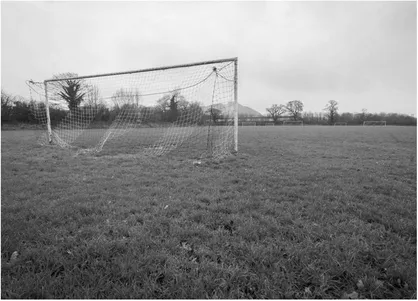
Figure 2.1 School football pitch 2018
I looked to John for confirmation. The 13-year-old told me, “I worked out the distance the other students would be walking and divided that by the perimeter of the school’s football pitch and then I wheeled myself around the pitch until I completed an equivalent challenge.” I call it the “virtual walk”. It takes tenacity to ensure that you are in some way involved in the same challenging experience as your fellow classmates and John was able to say he had taken part and raised money in the process.
Virtual reality from the technological perspective is the means for creating the illusion that you are in a different place. It is like being really present in a dream. Virtual reality can immerse us in totally new, synthetic worlds with 360° views. It replaces the real world with a simulated one that incorporates sensory feedback, mainly auditory, visual and haptic.
It is the means for helping people go to that unfamiliar place while on a treadmill, in an armchair, in a wheelchair, in the home or school or office without physically having to travel there because now there are apps available that are set up to follow along a virtual path via Google Maps or similar means.
Some apps work with your tablet or smartphone on these interactive scenic tours. There are also videos and DVDs you can use for your TV, tablet or via an app to give you a virtual walking experience.
Figure 2.2 Snowdon miner’s path 2018
The videos can take you on virtual scenic walks in gorgeous places around the world. These virtual experiences can detect your speed, so that your “walk” slows down and speeds up as you do. You can also learn facts about the different locales. If John’s school had had VR headsets, John could have had possibly an even better virtual experience. VR can also take you to the dinosaur Age, to the Moon, or a DC comic Universe, with or without superpowers. It is the means for taking you to a fantastical make-believe world waiting to be explored and for you to play a role, creating an experience that is not possible in ordinary physical reality. Robert Louis Stevenson, who wrote The Land of Counterpane1 in 1885 referring to his childhood imaginings whilst bedridden, may well have enjoyed the opportunity to enter the VR world.
The term “virtual reality” was coined by Jaron Lanier in 1987 during a period of intense research activity into this form of technology. Even though NASAs research into VR interested other researchers, virtual reality was not introduced to the general public until 1989. Jaron Lanier, the founder of VPL Research Company, defined it as “a computer generated, interactive, three-dimensional environment in which a person is immersed”. In his book Dawn of the New Everything (2017) he goes on to give 47 different definitions. Ironically VPL named it the eye- phone. In those days the eye-phone system, including the computers required to run it, cost upwards of $250,000.
Regardless of its cost, virtual reality captured the public imagination and lots of work has been done since 1989 to explore the possibilities of virtual reality in new areas of application such as military, medicine and the motor industry. Although virtual reality technology has been developing over this seemingly long period, the possibilities for education through this new medium have only recently taken off, partly due to the wait for Moore’s Law2 to allow computation to get cheaper and more available.
Computer scientist Ivan Sutherland developed the first VR headset in 1968. In 2016, nearly 89 million VR headsets were sold worldwide and 98% were of the mobile VR headset type.
The most talked about VR system on the market today is probably Oculus Rift. It was first launched as a Kickstarter project in 2012 and was acquired by Facebook in 2014.
Samsung partnered with Oculus in September 2014 to build a Samsung Gear VR which is powered by Samsung mobile phones. Samsung Gear VR sold around 2.317 million devices in 2017.
Sony have combined their VR headset with their famous gaming hardware PlayStation and named it Sony PlayStation VR.
HTC Vive launched in 2016 with the much-acclaimed Tilt Brush as one of its applications. Tilt Brush is a room-scale VR 3D painting application that presents the user with a virtual palette. Using a hand-held controller the user can create brush strokes of colour in the virtual environment.
Apple has a good selection of iPhone VR apps in its App store and these can be used on any iPhone that is running iOS 11.3 You also need to purchase a VR headset.
Google Cardboard headsets currently have the major share of the market and in 2016 had 84 million devices. Google Cardboard was initiated as an experiment to let people experience virtual reality. Google was able to corner the market due to its cheap price and early release. A mobile phone is also needed.
ClassVR was launched at the Bett Show in London in January 2017 by Avantis. ClassVR is now available in the UK, Middle East, Australia, China and the United States. ClassVR’s headset is a standalone, classroom-ready device, delivering a fully immersive VR experience under the teacher’s control.
Google, in partnership with others, have also brought out standalone headsets that understands your movement in space without the need to set-up any external sensors. Our school has purchased a set of these from RedBox.4
VR is probably most used in the games industry. The VR gaming market is now big business. There are gaming centres and eSport arenas opening up all over America. The events that they host can accompany or replace traditional sports. Parents accompany younger players and are amazed at the abilities their children have in the “sport”. The International eSports Federation (IeSF) claim that the Paris 2024 Olympic organisers are now in talks about including gaming as a demonstration sport at the Olympic Games (BBC 2018). The International Olympic Committee (IOC) president said gaming “could be considered a sporting activity” but “must not infringe” o...