As with other areas of human industry, it has been assumed that technological progress would improve all aspects of agriculture. Technology would increase both efficiency and yield, or so we thought. The directions taken by technology may have worked for a while, but the same technologies that give us an advantage also create disadvantages. It's now a common story in rural America: pesticides, fertilizers, "big iron" combines, and other costly advancements may increase speed but also reduce efficiency, while farmers endure debt, dangerous working conditions, and long hours to pay for the technology. Land, livelihood, and lives are lost in an effort to keep up and break even. There is more to this story that affects both the food we eat and our provisions for the future. Too many Americans eat the food on their plates with little thought to its origin and in blind faith that government regulations will protect them from danger. While many Americans might have grown up in farming families, there are fewer family-owned farms with each passing generation. Americans are becoming disconnected from understanding the sources and content of their food. The farmers interviewed in From the Farm to the Table can help reestablish that connection. Gary Holthaus illuminates the state of American agriculture today, particularly the impact of globalization, through the stories of farmers who balance traditional practices with innovative methods to meet market demands. Holthaus demonstrates how the vitality of America's communities is bound to the successes and failures of its farmers. In From the Farm to the Table, farmers explain how their lives and communities have changed as they work to create healthy soil, healthy animals, and healthy food in a context of often inappropriate federal policy, growing competition from abroad, public misconceptions regarding government subsidies, the dangers of environmental damage and genetically modified crops, and the myths of modern economics. Rather than predicting doom and despair for small American growers, Holthaus shows their hope and the practical solutions they utilize. As these farmers tell their stories, "organic" and "sustainable" farming become real and meaningful. As they share their work and their lives, they reveal how those concepts affect the food we eat and the land on which it's grown, and how vital farming is to the American economy.
eBook - PDF
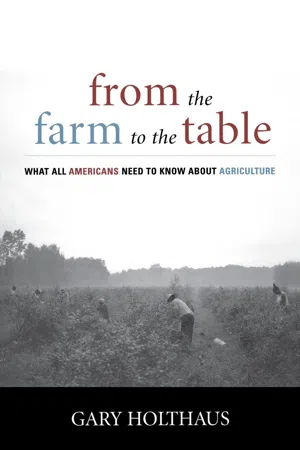
From the Farm to the Table
What All Americans Need to Know about Agriculture
- 392 pages
- English
- PDF
- Available on iOS & Android
eBook - PDF
About this book
Information
Publisher
The University Press of KentuckyYear
2014Print ISBN
9780813192260
9780813124193
eBook ISBN
9780813146652
Table of contents
- Cover
- Contents
- Acknowledgments
- Introduction
- PART I. IN THE BEGINNING
- PART II. FARMERS TALKING ABOUT FARMING
- PART III. FARMING IN AMERICA: WHO CARES?
- PART IV. IT ALL WORKS TOGETHER, OR IT DOESN'T WORK AT ALL
- PART V. ALTERNATIVE VISIONS, HOPEFUL FUTURES
- PART VI. AN ECOLOGY OF HOPE
- Notes
- Sources and Resources
- Index
- Photo gallery
Trusted by 375,005 students
Access to over 1.5 million titles for a fair monthly price.
Study more efficiently using our study tools.
Frequently asked questions
Yes, you can cancel anytime from the Subscription tab in your account settings on the Perlego website. Your subscription will stay active until the end of your current billing period. Learn how to cancel your subscription
No, books cannot be downloaded as external files, such as PDFs, for use outside of Perlego. However, you can download books within the Perlego app for offline reading on mobile or tablet. Learn how to download books offline
Perlego offers two plans: Essential and Complete
- Essential is ideal for learners and professionals who enjoy exploring a wide range of subjects. Access the Essential Library with 800,000+ trusted titles and best-sellers across business, personal growth, and the humanities. Includes unlimited reading time and Standard Read Aloud voice.
- Complete: Perfect for advanced learners and researchers needing full, unrestricted access. Unlock 1.5M+ books across hundreds of subjects, including academic and specialized titles. The Complete Plan also includes advanced features like Premium Read Aloud and Research Assistant.
We are an online textbook subscription service, where you can get access to an entire online library for less than the price of a single book per month. With over 1.5 million books across 990+ topics, we’ve got you covered! Learn about our mission
Look out for the read-aloud symbol on your next book to see if you can listen to it. The read-aloud tool reads text aloud for you, highlighting the text as it is being read. You can pause it, speed it up and slow it down. Learn more about Read Aloud
Yes! You can use the Perlego app on both iOS and Android devices to read anytime, anywhere — even offline. Perfect for commutes or when you’re on the go.
Please note we cannot support devices running on iOS 13 and Android 7 or earlier. Learn more about using the app
Please note we cannot support devices running on iOS 13 and Android 7 or earlier. Learn more about using the app
Yes, you can access From the Farm to the Table by Gary Holthaus in PDF and/or ePUB format, as well as other popular books in Biological Sciences & Agricultural Public Policy. We have over 1.5 million books available in our catalogue for you to explore.