First published in 1991. Routledge is an imprint of Taylor & Francis, an informa company.
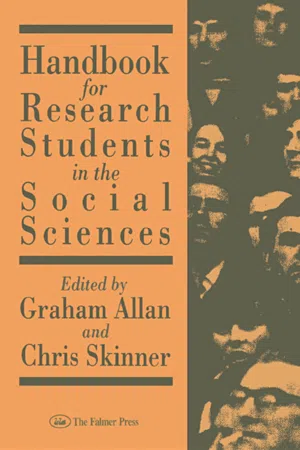
- 290 pages
- English
- ePUB (mobile friendly)
- Available on iOS & Android
eBook - ePub
Handbk Research Stud Socl Sci
About this book
Information
Chapter 1
Introduction
Graham Allan and Chris Skinner
Being a research student is a quite different experience to being a student on an instructional programme. The latter will comprise a number of separate courses, each with their own objectives defined by given syllabuses, examinations and course-work requirements. Basic resources for following each course are supplied to the student in the form of lectures, seminars and reading lists. With a research degree, on the other hand, you have the opportunity to investigate a single topic in considerable depth but without the guidance and signposting of taught courses. Being a research student can thus be quite a lonely experience. Apart from library and computing services and perhaps various forms of research training, your main ‘resource’ will be the individual guidance provided by your supervisor or supervisory group, supplemented by the support and friendship of other research students.
This book is not intended to compete with the advice offered by your supervisor. Rather it is meant to provide one further resource to assist you in your research by acting as a source of reference. It contains discussions of a wide range of topics which have been selected to be of most direct value to research students in the social sciences. Different parts of the book may be of greater relevance at different stages of your research. Because the book does not involve the linear development of a single theme, it is not expected that chapters be read in sequence. Rather we hope that you will find it useful to dip into different chapters when you find them most appropriate. Because of the obvious impossibility of including everything of relevance to a social science research student in a book of this length, most of the chapters are intended to act only as introductions, signposting you to further sources where you can read about the subject in greater depth.
The broad contents of the different parts of the book are as follows:
Part 1: The Nature of a Research Degree
This part of the book provides some orientation towards what a research degree entails and how it differs from an instructional course. The aim is to give you a flavour of what you can expect from a research degree as a personal experience and to offer some suggestions as to how to make the most of that experience. While the various rewards of research study are mentioned, there is inevitably an emphasis on the possible pitfalls and difficulties that may arise, since it is mainly in relation to these aspects that advice is relevant. We hope that such a focus on problems will not in any way dampen the enthusiasm with which you embark on research study!
Chapter 2 provides an introduction to the nature of a research degree. It draws on research on the experiences of research students and emphasizes, in particular, the importance of the student-supervisor relationship. Chapter 3 includes a number of personal accounts of postgraduate research by both students and supervisors. The students reflect on their own experiences and the strategies they have found most useful in research study. We have deliberately included accounts from students with a diversity of experiences, for example two are full-time and two are part-time. Following these accounts, the chapter includes advice from two experienced supervisors who use their knowledge of supervising research students to offer useful hints and guidance.
The final chapter in this section, Chapter 4, discusses what examiners are looking for in a thesis. While this chapter may seem most relevant nearer the time of submission, it should also be of interest to new students attempting to understand what a research degree entails in terms of the expected final product.
Part 2: Study Skills and the Management of Research
One factor which emerges from Part 1 as being vitally important in the success of research study is the effective management of the research. Clearly management concerns the strategy and design of your specific project (matters considered in Part 3), but it also involves the way you handle the different tasks and demands which any prolonged piece of academic research entails. It is these which are the focus of Part 2. In particular, this section includes discussions of a variety of the skills and crafts which will prove useful in carrying out your research.
Chapter 5 provides an introduction to the broad range of skills which you will need to develop in managing and organizing your project. Included in this is a discussion of the use of computing and information technology, such as word-processing and the
It is followed by two chapters on the use of libraries—obviously a significant component in most students’ research. Chapter 6 deals with computer-based methods of literature search and is likely to be of particular relevance in the early stages of your research when you are carrying out a literature review and trying to ensure familiarity with previous studies. Chapter 7 is a little more specialized. It provides a guide to official publications in Britain, which constitute a complex body of materials, though one which is of particular relevance to a good number of research students in the social sciences.
Next come two chapters concerned with the skills required in communicating your ideas to others. The focus of Chapter 8 is on writing skills. These are of course of major importance in the actual production of your thesis. However, as the personal views in Chapter 3 indicate, they will be essential throughout your time as a student for you will need to be able to express your ideas clearly at all stages of your work. The presentation and communication skills discussed in Chapter 9, while not quite so fundamental, can nevertheless be very helpful in order to communicate your work to persons other than your supervisor and hence achieve broader feedback on your research.
Chapter 10 is concerned with using documentary sources in the social sciences. Different projects will rely to a greater or lesser extent on such sources, but nearly all research makes some use of them, at least in the context of reviewing previous approaches. The aim of this chapter is to highlight some of the more important issues you need to address in using documentary material.
The following three chapters are more directly concerned with the management and conduct of research than with specific skills. Much empirical research conducted by students in the social sciences takes place within the setting of an organization or agency, such as a business or the health or probation service. To gain access to such agencies and to achieve cooperation with individuals within the agency requires considerable care. This is the subject matter of Chapter 11. Chapter 12 is concerned with the sorts of ethical issues that are likely to confront research students. As is pointed out, much research in social science involves ethical questions, the answers to which are not always straightforward. Finally, the related issue of the relevance of equal opportunity considerations to research in the social sciences is discussed in Chapter 12. Again the point is made that these matters are of concern to all research students and not just those conducting research into discrimination and disadvantage.
Part 3: Research Strategies in the Social Sciences
It would be virtually impossible to provide a general discussion of research strategies which would be of value to all research students in the social sciences because the differences between the kinds of research undertaken are so great. For example, what advice would be relevant to both a laboratory-based study in experimental psychology, a theoretical study of the political philosophy of Hegel, an ethnographic study of ‘acidhouse’ parties and a computer-based study of the statistical properties of an econometric procedure? To make our task more manageable we restrict our attention in Part 3 to different forms of empirical research because of the great difficulty in offering general advice on theoretical research which would be relevant across disciplines.
Even within the restricted area of empirical research, there are very wide variations in research strategies. These variations are reflected by the range of books available on research methodology in the social sciences. You might ask whether our brief discussions in Part 3 can add anything useful to this literature. In reply we would point out that much existing research methods literature is addressed to the generic ‘researcher’, who often does not work under the same time and resource constraints as a research student. For example, texts on survey methods may discuss strategies which would be feasible for a government survey agency or a large organization but not for an individual research student. Thus the feature of Part 3 which is intended to distinguish it from more general methodology texts is that it specifically addresses the needs of research students. This has implications for our selection of topics. For example, a whole chapter is devoted to secondary analysis (Chapter 20) since this is a form of research which is particularly feasible for a research student. As a further example, there is some emphasis on interviewing skills (Chapters 17 and 19) since research students are themselves often involved in interviewing, but we include little discussion of issues related to the use of teams of interviewers since this is seldom an option for research students.
Even with a focus on the needs of research students conducting empirical research, we stress that the chapters in Part 3 can only provide brief introductions and that in this part of the book, even more than in Part 2, an important role of each chapter is to point to further literature where topics are considered in more depth.
Let us then turn to the contents of Part 3. Chapter 14 provides an introduction to the elements of the research process and to the strategic choices facing the research student. This is an important chapter for all students but especially for those who are currently involved in developing the research strategy they are going to pursue in their study.
The following chapters are separated into two broad groups concerning qualitative and quantitative research. While this distinction can be overemphasized, we hope it provides some loose structuring of the chapters for the benefit of the reader. Chapter 15 provides an introduction to qualitative research and offers an overview of some of the major issues raised by this type of research. The two chapters that follow are concerned more with specific approaches. Chapter 16 examines the nature and use of case studies, while Chapter 17 discusses qualitative interviewing and offers useful advice to research students undertaking this form of data collection.
Chapter 18 provides an overview of quantitative methods and introduces different types of quantitative research design. It also refers to some criteria by which these designs might be evaluated. It is followed by a chapter on survey methods which discusses the issues that need to be considered by research students collecting their own quantitative data by this means. Chapter 20 is concerned with secondary analysis. It outlines the different secondary sources of quantitative data available to research students and the considerations which should govern their use. Finally, Chapter 21 focuses on methods of statistical analysis of both primary and secondary quantitative data and again offers advice and guidance that should prove particularly useful to research students.
Part 1
The Nature of a Research Degree
Chapter 2
Undertaking a Research Degree
Haydn Mathias and Tony Gale
Introduction
In this chapter we present a broad overview of some of the main features of postgraduate research in the social sciences. We appreciate that our account is bound to be general while your experience of research work will be unique and special to you. Indeed, the concept of a social sciences research degree is something of a myth as the field comprises a wide variety of disciplines and even within each discipline a diversity of research traditions and methodologies exist. Nevertheless, what we have attempted to do is to draw upon both research and our own personal experience in order to offer some observations and insights which might help you to prepare for your role as a research student and to enable you to take more responsibility and control over the process of undertaking postgraduate research.
The New Research Student
Postgraduate research is different from undergraduate study. The undergraduate is one of many following a set of common paths. The undergraduate degree operates within a set structure in which there are identifiable and bounded units of learning, entitled courses, seminars and classes. The student occupies a shared world in which there are others, following a similar path, ahead of and behind them. Each year is seen as part of the whole and as a natural progression, from broader generalities to more specific interests and focuses of concern. Courses are bounded not only by time but by examinations and assessments; these landmarks in turn provide feedback about personal competence and performance. At the end of each year the undergraduate is aware of being classified within a particular category and of the classification tag they are likely to end up with when the course is over. They can compare themselves with others. Landmarks and feedback provide emotional security and remove ambiguity and doubt. The undergraduate degree is thus a shared experience in which other students are subject to common pressures and common concerns.
In contrast, postgraduate research can be seen as a period of uncertainty, ambiguity and lack of structure. The task is not really complete until the oral examination is over and the examiners’ verdict is given. It may make sense to talk in terms of years, but calendar years are unlikely to coincide with particularly important personal landmarks or stages. The future is therefore uncertain until it has become a fact of the past. You will rarely attend lectures or courses in which what is required of you is defined by someone in authority. Rather, you are largely dependent on your own resources and willpower.
You create your own curriculum. In exchange for such uncertainties, however, you derive certain intellectual and personal pleasures which the undergraduate would be lucky to encounter. You pursue your own academic interests; you no longer need to carry out work or follow aspects of the discipline which do not appeal to you; you acquire a sense of expertise, which very quickly becomes authoritative. Indeed within six months a postgraduate researcher could have more grip on the literature relating to their topic of choice than most people in the world. Given a good problem, you could well become an expert very quickly.
Analyses of working life (Jahoda, 1979) indicate that it is structure, the sharing of common experience, the identification with group goals and the exposition of personal skills, which are some of the latent properties which provide a major part of psychological satisfaction with work. It is hard to impose structure on postgraduate research; you are lucky to share experience, and group goals may or may not be present in your working environment. Personal skill may take time to develop and you may experience long periods of frustration when little seems to be happening and time seems to be running away.
An important aspect of the notion of a critical mass of research students within a department or faculty is that experience can be shared. The first-year postgraduate can discuss problems of research with second and third-year students. There is access to past theses. There are members of the academic staff with whom intellectual exchange is fruitful. The group can offer collegiality, conviviality and the informal set of networks which make living in a community of common purpose so satisfying and supportive. In such an environment it is more likely that others will have had problems similar to those you are encountering and survived them. Advice is available on coping strategies. Thus a large postgraduate cohort can offer some of the psychological supports that undergraduates enjoy by virtue of common shared experience. It is difficult to see how such supports can be enjoyed by the single, sometimes socially isolated, postgraduate student.
Finally there is role ambiguity. As a postgraduate the individual is a student and a learner. But if the person also acts as a tutor or demonstrator to undergraduates, they are also a teacher, a mentor and a model. Such mixed roles are often hard to handle, particularly if the organizational ethos of the department is one in which status, privilege and differential resource allocation are part of the process of social control.
The problems of transition and adjustment are accentuated in the case of the part-time research student. If you are such a student it is likely that you have not been in full-time education for some time and are having to hold down a demanding job while pursuing a higher degree. Your motivation might be exceptionally high as a result of a very deliberate and considered decision to become a research student, but you will be involved in travelling for supervisions and to use facilities, and it will take you considerably longer to feel part of your host institution. It is particularly important, therefore, to establish regular mechanisms for maintaining contact not only with your supervisor but also with other researchers.
Research into Postgraduate Study
There has been remarkably little research into the process and experience of postgraduate study in comparison to that into undergraduate study. Cuts in government funding of the Research Councils and the need for accountability in the expenditure of public money have put the spotlight on postgraduate research. Until very recently there has been no impetus to study the research process. However from the work which has been undertaken over the past thirty years or so we can gain some useful insights which might better prepare you for your task.
Postgraduate wastage and completion rates have been of concern not only to students but also to those who provide funding for them. Research students in the social sciences have not fared very well in these respects in comparison to their science colleagues. In one early study, for instance, the overall non-completion rate for a sample of 2,000 students was around 30 per cent but within subject areas the wastage rate for arts doctoral students was around 50 per cent in comparison to 15 per cent for scientists (Rudd and Hatch, 1968). Moreover for part-time students around 41 per cent had still to gain their degree after nine years.
In the 1980s the Economic and Social Research Council (ESRC) became concerned about the length of time it was taking doctoral students to submit their work and took steps to improve submission rates. Institutions were encouraged to introduce research training programmes and those which failed to achieve acceptable rates of submission within a given period had studentships withdrawn. The Committee of Vice-Chancellors and Principals (CVCP) also took steps to ensure that systematic arrangements were in place for the supervision of research students and for making more explicit the procedures for dealing with appeals against the academic judgment of the examiners on the grounds of prejudice, bias or inadequate assessment. It issued a code of practice on Postgraduate Training and Research (CVCP, 1985a) and a...
Table of contents
- Cover Page
- Title Page
- Copyright Page
- Foreword
- Preface
- Notes on Contributors
- Chapter 1
- Part 1 The Nature of a Research Degree
- Part 2 Study Skills and the Management of Research
- Part 3 Research Strategies in the Social Sciences
Trusted by 375,005 students
Access to over 1.5 million titles for a fair monthly price.
Study more efficiently using our study tools.
Frequently asked questions
Yes, you can cancel anytime from the Subscription tab in your account settings on the Perlego website. Your subscription will stay active until the end of your current billing period. Learn how to cancel your subscription
No, books cannot be downloaded as external files, such as PDFs, for use outside of Perlego. However, you can download books within the Perlego app for offline reading on mobile or tablet. Learn how to download books offline
Perlego offers two plans: Essential and Complete
- Essential is ideal for learners and professionals who enjoy exploring a wide range of subjects. Access the Essential Library with 800,000+ trusted titles and best-sellers across business, personal growth, and the humanities. Includes unlimited reading time and Standard Read Aloud voice.
- Complete: Perfect for advanced learners and researchers needing full, unrestricted access. Unlock 1.5M+ books across hundreds of subjects, including academic and specialized titles. The Complete Plan also includes advanced features like Premium Read Aloud and Research Assistant.
We are an online textbook subscription service, where you can get access to an entire online library for less than the price of a single book per month. With over 1.5 million books across 990+ topics, we’ve got you covered! Learn about our mission
Look out for the read-aloud symbol on your next book to see if you can listen to it. The read-aloud tool reads text aloud for you, highlighting the text as it is being read. You can pause it, speed it up and slow it down. Learn more about Read Aloud
Yes! You can use the Perlego app on both iOS and Android devices to read anytime, anywhere — even offline. Perfect for commutes or when you’re on the go.
Please note we cannot support devices running on iOS 13 and Android 7 or earlier. Learn more about using the app
Please note we cannot support devices running on iOS 13 and Android 7 or earlier. Learn more about using the app
Yes, you can access Handbk Research Stud Socl Sci by Chris Skinner in PDF and/or ePUB format, as well as other popular books in Education & Education General. We have over 1.5 million books available in our catalogue for you to explore.