Based on the UK Economic and Social Research Council advice on the training which students should undertake in preparation for postgraduate research, this book will be invaluable for all beginning researchers.
eBook - ePub
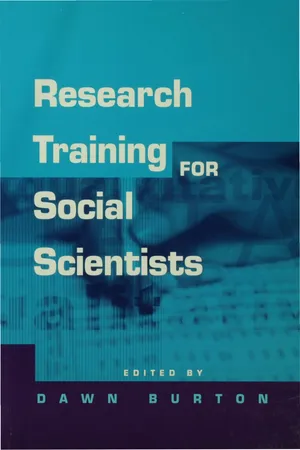
Research Training for Social Scientists
A Handbook for Postgraduate Researchers
- 528 pages
- English
- ePUB (mobile friendly)
- Available on iOS & Android
eBook - ePub
About this book
With indispensable advice for students from all social science backgrounds, this handbook provides the core conceptual and practical skills to embark on succesful research. The organization of the book reflects the knowledge that is required in order to become a competent and effective researcher. It follows the life-cycle of the research project: it begins with a discussion of ethical and philosphical issues; presents guides to both quantitative and qualitative data collection and analysis; provides help on using computers in research; and includes advice on how to write up and present a research project.
Information
Publisher
SAGE Publications LtdYear
2000Print ISBN
9780761963516
9780761963509
Edition
1eBook ISBN
9781446235515
PART I
PHILOSOPHY OF THE SOCIAL SCIENCES
Research students often question why they are required to have an understanding of the philosophy of the social sciences literature as part of their research training. Training is often associated with the acquisition of research skills that will help students collect, process and analyse data, and not to study philosophical issues which are often regarded as marginal and rather a waste of time. According to this interpretation, social science research skills should be acquired and then applied as though they were the skills of a craft. What this view fails to acknowledge is that philosophical assumptions about human nature and how society is conceptualized are directly related to issues about social research, whether that be the nature and status of data that is collected and the validity of the methods by which data is analysed, interpreted and understood. To quote Hughes (1993: 11) ‘Whether they may be treated as such or not, research instruments and methods cannot be divorced from theory; as research tools they operate only within a given set of assumptions about the nature of society, the nature of human beings, the relationship between the two and how they may be known.’
Methodological debates in the social sciences cannot be understood without reference to the wider cultural setting in which those discussions take place. It is also arguably the case that the social sciences have not been as successful in their ability to produce analyses of the social world as the natural sciences have of the natural world. It is therefore not surprising that a significant amount of energy has been devoted to comparing the methodology of the ‘natural’ and the social sciences. Whether the social sciences are in fact ‘sciences’ is a controversial issue. Peter Smith addresses this debate in the first chapter by assessing the philosophy of science literature and exploring its relevance for the social sciences. A number of features are discussed, specifically: what is meant by philosophy of science; whether social scientists can productively apply methods used by scientists, whether they can be modified in some way, or if they should be rejected outright.
The focus of Chapter 2 by Nick Stevenson is hermeneutics. Although rather a grand word, hermeneutics is simply another way of referring to the process of interpretation. Interpretavist or ‘humanistic’ views of social behaviour are in direct opposition to positivistic, ‘scientific’ notions of human behaviour which reduce social life to the interaction of variables. The negative consequences of the positivistic view of human behaviour are that it provides only a partial account of social life and distorts the nature of human interaction in profound ways. Nick discusses the ways in which understanding and interpretation are bound up with linguistic practices; the impact of symbolic culture on the nature of interpretation; and ways in which hermeneutics are likely to become more rather than less important in the future.
In Chapter 3 Sue Webb evaluates some of the main issues associated with feminist methodologies for social researching. Some of the main philosophical issues raised by feminists about social research and why feminist discussions should be perceived as an important contribution to contemporary debates are considered. How feminists have distinguished their research activities from others and reasons why they have taken this turn are also evaluated, along with feminist debates about quantitative and qualitative methods and the issue of methodological pluralism.
Peter Jackson’s chapter on race and racism provides a welcome contribution to the philosophy of the social sciences debate, since it is an area which is very often neglected. A focal point of the discussion involves evaluating essentialist versus social constructionist approaches to ‘race’. He argues against an essentialist view of ‘race’ which is highly biologically deterministic, in favour of understanding ‘race’ as being socially constructed across time and space. He suggests that the concepts of race and racism cannot be divorced from the wider politics of ‘race’ in society which in tum raises questions about the neutrality of social science researchers and the need for more committed approaches while simultaneously retaining intellectual integrity. This should be read in conjunction with Chapter 13 by Wanda Thomas Bernard, who deliberately chose participative research methods because of their emancipatory potential in her research with black men in Britain and Canada.
SUPPLEMENTARY READING
Anderson, R.J., Hughes, J.A. and Sharrock, W.W. (1986) Philosophy and the Human Sciences. London: Croom Helm.
Bauman, Z. (1978) Hermeneutics and Social Science. London: Hutchinson.
Hammersley, M. (1992) Social Research Philosophy, Politics and Practice. London: Sage.
Harding, S. (1987) Feminism and Methodolgy. Milton Keynes: Open University Press.
Hughes, J. (1993) The Philosophy of Social Research. London: Longman.
Miles, R. (1993) Racism After ‘Race Relations’. London: Routledge.
Norris, C. (1990) What’s Wrong with Post-modernism. London: Harvester.
Solomos, J. (1993) Race and Racism in Contemporary Britain. London: Macmillan.
Stanley, L. (1990) Feminist Praxis. London: Routledge.
Stanley, L. and Wise, S. (1993) Breaking Out Again: Feminist Ontology and Epistemology. London: Routledge.
| 1 | PHILOSOPHY OF SCIENCE AND ITS RELEVANCE FOR THE SOCIAL SCIENCES |
| Peter K. Smith |
Are the social sciences really sciences, or is this a misnomer? In the UK, the Social Science Research Council (SSRC) had to change its name to the Economic and Social Research Council (ESRC), in part because of a belief in government at the time that the social sciences were not sciences. And academics also debate these issues. This is not just a matter of a name – it affects how we carry out our research and what we think is the status of ‘facts’, ‘evidence’ and ‘theories’. These are issues which confront all researchers. At times, we may get by unthinkingly, doing as colleagues have done previously; but we may also be challenged – by new ideas or by other disciplines – and these issues will come to the forefront.
As part of such considerations, it is important for social scientists to understand something of the ‘philosophy of science’ even as it applies to the traditional ‘hard’ sciences, the physical sciences especially, and the biological and earth sciences. After all, a significant part of the debate about procedures in the social sciences is whether we can profitably apply – or whether instead we routinely misapply – methods and procedures from the physical sciences. Often, too, the procedures of the physical sciences are misunderstood. So, it is very relevant to know how the traditional sciences work, or are thought to work, whether we as social scientists then imitate these methods, modify them, or reject them.
In this chapter I will define what is meant by Philosophy of Science and give a brief historical survey of the main issues. I will review the traditional ‘inductivist’ view of science, the hypothetico-deductive view of Popper, and the alternative views of Kuhn and Lakatos, including more recent critiques and ideas (see also Chalmers, 1982; Hacking, 1981; Losee, 1980).
WHAT IS MEANT BY PHILOSOPHY OF SCIENCE?
The philosophy of science is concerned with questions such as:
- What characteristics distinguish science from non-science?
- What procedures should scientists follow?
- What conditions must be satisfied for a scientific explanation to be correct?
- What is the cognitive status of scientific laws and principles? (See Losee, 1980: 2.)
These are fundamental questions: (1) and (2) are definitional for the scientific method; (3) and (4) may seem more abstract, but they too are fundamental.
Question (4) was a matter of life and death in the case of Galileo. Traditionally (and following obvious perceptual information) people believed that the sun revolved round the earth. Following the work of Copernicus, Galileo (1564–1642) argued that in fact the earth revolved round the sun. This brought him into conflict with the Catholic Church at the time. In 1615 Cardinal Bellarmine corresponded with Galileo about this. It is permissible, he said to Galileo, for you to argue that the earth revolving around the sun is a possible mathematical model; in fact, it is even permissible for you to argue that it is the best model at the moment; but you must not say that it is actually, physically, true. Despite this warning, Galileo continued to assert that it was true. In 1633 the Inquisition condemned Galileo’s views, which he subsequently recanted. Only in 1992, after 359 years, did the Catholic Church admit it was wrong to condemn him. This was a debate about the status of a scientific law. Interestingly, most modem philosophers of science would accept the ‘best model’ compromise without qualms, rather than insisting on an actual physical truth which, ultimately, is provisional rather than certain.
As a discipline, the philosophy of science is related to other areas, notably:
- the history of science – how science has actually developed, whatever the ‘ideal’ science might do;
- the sociology of knowledge – how social structures and institutions, scientific societies and journals and the social networks of individual scientists affect the growth of science;
- the psychology of research – how individual scientists develop ways of thinking about and interpreting the world; pressures for conformity and bursts of creativity.
Of twentieth-century philosophers of science, Kuhn has reached out to the history of science and the sociology of knowledge. However, the origins of the philosophy of science go back long before the twentieth century.
HISTORICAL ORIGINS OF THE PHILOSOPHY OF SCIENCE
Systematic writing about the philosophy of science can be dated back to the ancient Greeks. Aristotle (384–322 BC) provided a foundation for speculating about ‘the nature of things’ which had an enduring influence. In particular, he had an ‘inductive-deductive’ view of how we obtained systematic knowledge. According to this, we first ‘induce’ certain regularities in the world around us. For example, we might notice the regularity of flowering plants in springtime; we ‘deduce’ that next spring the plants will flower again. This very simple example could be made more sophisticated by induced explanatory principles such as the effects of rain and sun on plants. We could then deduce that a drought or lack of sunshine will prevent or delay plant growth in the spring.
Aristotle also started the consideration of what is meant by causality. Looking at the regularities or ‘correlations’ in observed phenomena, he clearly distinguished between accidental correlations and causal correlations. As an example of an accidental correlation, at the time of year when plants start blossoming, birds start singing (plant blossom does not cause birds to sing; bird song does not cause plants to blossom; both are caused by the increase in temperature and hours of daylight during spring). As an example of a causal correlation, when we feel the wind blowing strongly, we see clouds scudding across the sky (the same wind which blows on us also causes the clouds to move). However, Aristotle was not an experimentalist. As we shall see, the role of experiments was a gradual, later development in the philosophy of science, linked to the greater importance given to deductivism.
The works of Aristotle and other Greek philosophers from the classical period were translated from Greek into Latin and Arabic (since Arab philosophers kept these works alive during the European ‘dark ages’). Latin translations of Aristotle’s writings on science became available to European philosophers as learning revived during the twelfth and thirteenth centuries.
Roger Bacon (1214–1292), for example, affirmed Aristotle’s ‘inductive-deductive’ pattern of scientific inquiry, but took it one stage further. Bacon argued that the factual base available for induction to operate on could be augmented by active experimentation on the world. At the time there was much interest in magnetism (and its possible uses in compasses and for navigation). What happens if you break a magnetic bar or needle? You get two magnets, each with its own N and S poles. These simple kinds of ‘experimentation’ would be useful, Bacon argued. Note, however, that Bacon was not testing any theory here; rather, this was experimentation to ‘see what happens’. Bacon and a few other philosophers at the time did begin to point to the need to test exploratory principles arrived at by induction, but this did not proceed very far.
In fact, another tradition from classical Greek writings laid the foundation for hypothesis testing and experimentation. Euclid (c. 300 BC) and Archimedes (287–212 BC) developed the idea of axioms, or hypotheses, in mathematics and geometry. Given certain axioms, then certain consequences follow – hypothesis and deduction. But this approach was used in the abstract realm of mathematics. In the seventeeth century, Descartes (1596–1650) elaborated this hypothetico-deductive method and laid the groundwork for its application in science. But it was not until the twentieth century that this hypothetico-deductive approach became central in the understanding of science, together with a full appreciation of the role of experimentation in actively testing hypotheses.
THE TRADITIONAL ‘INDUCTIVIST’ VIEW OF SCIENCE
Aristotle’s view came under more critical scrutiny as the philosophy of science developed in modern Europe. By and large, the inductivist view of science held sway and was further augmented. Among many contributions, we can take John Stuart Mill (1806-1873) as a prominent example from the nineteenth century. Mill argued that there were four primary inductive methods which could be used (for example, to distinguish accidental and causal correlations). These were agreement, difference, concomitant variations and residues.
As a fictional illustration of this in the social sciences, suppose we have induced a correlation between having the death penalty for murder and a reduced number of homicides. According to Mill, we could infer causation – that hanging deters homicides: if there are few homicides at times/places where the death penalty is enforced (agreement); there are many homicides at times/places where the death penalty is not enforced (difference); there are fewer homicides when the death penalty is enforced strictly and more when it is interpreted more leniently (concomitant variations); and presence/absence or variation in other possible causes (e.g. unemployment, marital instability) do not affect the number of homicides (residues).
Mill argued that the processes of inference and induction, could lead us to deduce causal relations. If these were verified – if they explained observations and other causal relations did not – then we could regard the hypothesis as verified. Mill cited Newton’s inverse square law of force (that the gravitational attraction between two bodies reduces as the square of the distance between them – a crucial part of explaining planetary motion) as an example of a completely verified law. This law could then be considered ‘true’ in some absolute sense.
Mill’s work epitomizes the ‘traditional’ or ‘inductivist’ view of the scientific method. In briet this holds that science proceeds by collecting factual data through observation and by experimentation which serves to increase the observational data base. By inductive methods, generalizations and causal laws could be arrived at. In principle, induced laws could be completely verified if all the deductions from them were correct. This view held sway in many quarters well into the twentieth century. For example, Karl Pearson (who developed the well-known product–moment correlation coefficient) wrote: ‘the classification of facts and the formation of absolute judgments upon the basis of this classification . . . essentially sum up the aim and method of modern science’ (1892: 6; author emphasis).
A crucial part of the traditional view is that hypothesis follows observation (this refers to procedures, question 2 of our four questions at the start of the chapter). It also argues that we can achieve completely verifiable, ‘true’ theories (this refers to questions 3 and 4). Yet few modern philosophers of science accept either of these conclusions. In fact, most would argue that hypothesis precedes observation and that we cannot achieve completely verifiable, ‘true’ theories. Thus, the ‘traditional’ view has come to be radically overthrown.
THE HYPOTHETICO-DEDUCTIVE VIEW OF POPPER
Karl Popper (1902–1994) has been one of the most well-known philosophers of science to attack the traditional view and to establish an alternative, hypothetico-deductive view (Popper, 1959, 1963, 1976, 1979, 1986; s...
Table of contents
- Cover Page
- Title Page
- Copyright Page
- Contents
- Notes on contributors
- Acknowledgements
- Foreword by Robert G. Burgess
- Introduction
- Part I Philosophy of the Social Sciences
- Part II Ethical and Legal Issues in Social Science Research
- Part III Getting Started
- Part IV Qualitative Methods: Design, Data Collection and Analysis
- Part V Using Computers for Qualitative Data Analysis
- Part VI Survey Research in the Social Sciences: Design and Data Collection
- Part VII Quantitative Data Analysis
- Part VIII Finishing Off: Writing, Presenting and Publishing
- References
- Index
Trusted by 375,005 students
Access to over 1.5 million titles for a fair monthly price.
Study more efficiently using our study tools.
Frequently asked questions
Yes, you can cancel anytime from the Subscription tab in your account settings on the Perlego website. Your subscription will stay active until the end of your current billing period. Learn how to cancel your subscription
No, books cannot be downloaded as external files, such as PDFs, for use outside of Perlego. However, you can download books within the Perlego app for offline reading on mobile or tablet. Learn how to download books offline
Perlego offers two plans: Essential and Complete
- Essential is ideal for learners and professionals who enjoy exploring a wide range of subjects. Access the Essential Library with 800,000+ trusted titles and best-sellers across business, personal growth, and the humanities. Includes unlimited reading time and Standard Read Aloud voice.
- Complete: Perfect for advanced learners and researchers needing full, unrestricted access. Unlock 1.5M+ books across hundreds of subjects, including academic and specialized titles. The Complete Plan also includes advanced features like Premium Read Aloud and Research Assistant.
We are an online textbook subscription service, where you can get access to an entire online library for less than the price of a single book per month. With over 1.5 million books across 990+ topics, we’ve got you covered! Learn about our mission
Look out for the read-aloud symbol on your next book to see if you can listen to it. The read-aloud tool reads text aloud for you, highlighting the text as it is being read. You can pause it, speed it up and slow it down. Learn more about Read Aloud
Yes! You can use the Perlego app on both iOS and Android devices to read anytime, anywhere — even offline. Perfect for commutes or when you’re on the go.
Please note we cannot support devices running on iOS 13 and Android 7 or earlier. Learn more about using the app
Please note we cannot support devices running on iOS 13 and Android 7 or earlier. Learn more about using the app
Yes, you can access Research Training for Social Scientists by Dawn Burton in PDF and/or ePUB format, as well as other popular books in Social Sciences & Social Science Research & Methodology. We have over 1.5 million books available in our catalogue for you to explore.