Follow from start to finish the creation of an animated short from the pre-production thought process to story development and character design. Explore the best practices and avoid the common pitfalls of creating two to five minute shorts. Watch a specially created animated short, demonstrating the core techniques and principles at the companion website! Packed with illustrated examples of idea generation, character and story development, acting, dialogue and storyboarding practice this is your conceptual toolkit proven to meet the challenges of this unique art form. The companion website includes in-depth interviews with industry insiders, 18 short animations (many with accompanying animatics, character designs and environment designs) and an acting workshop to get your animated short off to a flying start! With all NEW content on script writing, acting, sound design and visual storytelling as well as stereoscopic 3D storytelling, further enhance your animated shorts and apply the industry best practices to your own projects and workflows.
eBook - ePub
Ideas for the Animated Short
Finding and Building Stories
- 259 pages
- English
- ePUB (mobile friendly)
- Available on iOS & Android
eBook - ePub
Ideas for the Animated Short
Finding and Building Stories
About this book
Information
Chapter 1
Story Background and Theory
We live in story all of the time. We all have stories to tell every day. But telling our personal stories to each other and constructing a story from scratch are two very different things. Usually when we tell stories on a daily basis, we are relating events to one or two other people. When constructing story, we are trying to communicate with a mass audience. When we tell stories to a friend it is because it is important to us or to them. When we construct story, we are moving not just an individual, but an audience. The goal then becomes to make the personal universal.
Before we can begin, we need to understand the background of story and how that background lays the foundation for what we want to make: a story for an animated short film.
What is a Story?
Screenwriter Karl Iglesias has a very simple definition of story: “A story has someone who wants something badly and is having trouble getting it.”1
This definition determines the three base elements necessary for a story: character, character goal, and conflict. Without these elements, story cannot exist.
- Character. This is whom the story is about and through whose eyes the story is told.
- Goal. This is what the character wants to obtain: the princess, the treasure, the recognition, and so on.
- Conflict. Conflict is what is between the character and his goal. There are three forms of conflict:Character vs. Character
 Character vs. EnvironmentCharacter vs. SelfConflicts create problems, obstacles, and dilemmas that place the character in some form of jeopardy, either physically, mentally, or spiritually. This means that there will be something at stake for the character if they do not overcome the conflict.
The other elements of story include:
- Location. This is the place, time period, or atmosphere that supports the story.
- Inciting Moment. In every story, the world of the character is normal until something unexpected happens to start the story.
- Story Question. The inciting moment will set up questions in the mind of the audience that must be answered by the end of the story.
- Theme. Themes are life lessons. Stories have meanings. A theme is the deeper meaning that a story communicates. Common themes include: be true to yourself; never leave a friend behind; man prevails against nature; and love conquers all.
- Need. In story there will be what a character wants—his goal. Then there will be what the character needs to learn or discover to achieve his goal.
- Arc. When a character learns there will be what is called an emotional arc or change in the character as the character moves from what he wants to what he needs.
- Ending/Resolution. The ending is what must be given to the viewer to bring emotional relief and answer all of the questions of the story. The ending must transform the audience or the character.
Why Do All Stories Seem the Same?
With so many different story elements and seemingly infinite ways to combine them, why do all stories seem familiar? Nearly every story told follows the same structure and formula with similar characters, themes, and conflicts.
The Universal Story
From the turn of the nineteenth century on, there are documented discussions between writers and theorists who noticed that the similarities in story went beyond specific regions, cultures and time periods.2 Some of them theorized that this was because mankind had similar natural phenomena that needed to be explained. This might be the reason for similarities in theme, but didn’t explain the similarities in story and plot.
All of these stories followed a three-act structure that Aristotle, nearly 2,300 years ago, called plot. Plot is the sequence of events and the emotions necessary to move the audience through the story. In the first act, pity and empathy must be established for the hero so that the audience cares about him and will engage in his pursuit. The second act is the scene of suffering and challenge, creating fear and tension surrounding the hero and his challenges. In the final act, fear and tension are released by catharsis, the emotional release that allows for closure to end the story.3
In the twentieth century, Joseph Campbell, an American mythology professor, writer and orator, found that there were universal images and characters in one story shared by all cultures over time. Because this story occurred again and again, he called it the monomyth—the one story, the universal story.
The monomyth is appropriately called the Hero’s Journey. Campbell’s theory has many stages, but they can be summarized as follows:4
- Introduce the Hero. The hero is the character through whom the story is told. The hero is having an ordinary day.
- The Hero has a Flaw. The audience needs to empathize with the hero and engage in his pursuit of success. So the hero is not perfect. He suffers from pride or passion, or an error or impediment that will eventually lead to his downfall or success.
- Unexpected Event. Something happens to change the hero’s ordinary world.
- Call to Adventure. The hero needs to accomplish a goal (save a princess, retrieve a treasure, and so forth). Often the hero is reluctant to answer the call. It is here that he meets with mentors, friends, and allies who encourage him.
- The Quest. The hero leaves his world in pursuit of the goal. He faces tests, trials, temptations, enemies, and challenges until he achieves his goal.
- The Return. The hero returns expecting rewards.
- The Crisis. Something is wrong. The hero is at his lowest moment.
- The Showdown. The hero must face one last challenge, usually of life and death against his greatest foe. He must use all that he has learned on his quest to succeed.
- The Resolution. In movies this is usually a happy ending. The hero succeeds and we all celebrate.
Example:
Table 1.1 Feature Film Plots Against the Hero’s Journey
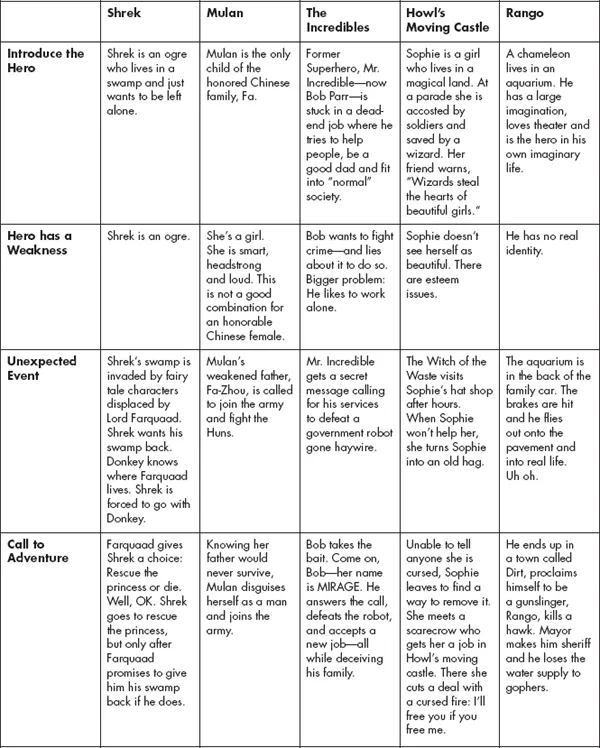
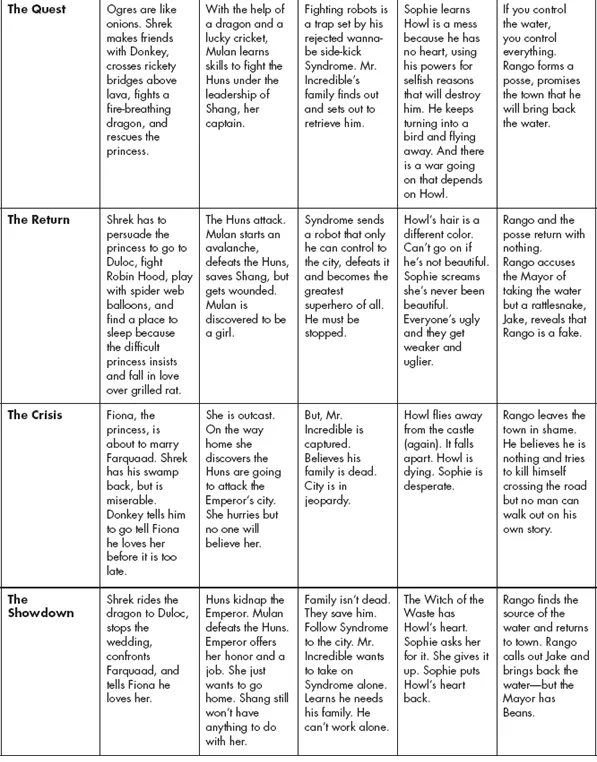
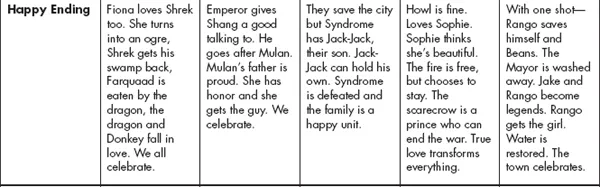
Disney films have driven home the opportunity of the individual to succeed, and above all, it is personal success that we celebrate. In Disney films there is a clear hero who fights a clear villain. Nearly all of the classic Disney movies are excellent case studies of the hero’s Journey.
On the other hand, Pixar films follow every aspect of the structure except that of the hero. If we define a hero simply as the eyes through which the story is told, then Pixar, too, more or less fits the formula. If we define the hero as the one who succeeds and whose success we celebrate then this changes the dynamics when we look at a Pixar film.
In Pixar films, from A Bug’s Life on, the role of hero is more often played as if it were a baton passed among characters.5 For example, in Finding Nemo, it is Marlin’s quest to find Nemo. But Marlin fails. He begins to return home without his son. It is Nemo who brings himself home and it is Dory’s role to reunite Nemo with his dad. At different times, Gill is the hero and Dory is the hero.
Miyazaki also orders the events in a classic structure. However, in most of his stories, the identification of good and evil is not clear. For Miyazaki and Studio Ghibli, evil, if it can be called that, is that which dwells within us. His stories have conflict that is often more internalized. Success comes through personal resurrection. Through the character’s personal transformation, the peace in society is restored.
Character Archetypes
In movies there are definite character roles that appear repeatedly in all of the stories. These roles come from character archetypes. An archetype is a pervasive idea or image that serves as an original model from which copies are made. For our purposes, this means that there are baseline character traits that any surface or costuming can be placed upon. The hero is a baseline that can be an obvious superhero (Mr. Incredible); or a more subtle hero (an ogre, Shrek; a girl, Mulan; a woolly mammoth, Manfred); or a character that grows into a hero (an iron giant; a boy, Hiccup; a lizard, Rango, and so on).
The term first comes from Carl Jung, a twentieth-century psychoanalyst who studied dreams and the unconscious. Jung found that there were recurring images and themes running through the dreams of his patients that were so similar that they could not come from individual conflicts. He believed that these images originated in the collective unconscious of all men. And he called these images archetypes.
Jung’s four archetypes, attributes common in everyone, are: the female, the great mother; the male, the eternal child; the self, a hero, wise old man; and the shadow, which might be a trickster, and so forth. They were the different ways in which the individual would see themselves. And these formed the basis for the stories that his patients would tell.
In the stories of feature films we find the same thing. There are archetypes that form the basis of nearly all characters we watch. Chris Vogler, in his book The Writer’s Journey, identifies seven archetypal characters found in most feature films:
- The ...
Table of contents
- Cover
- Half Title
- Title Page
- Copyright
- Contents
- Foreword: John Tarnoff, Former Head of Show Development, DreamWorks Animation
- Preface: Karen Sullivan
- Acknowledgments
- Chapter 1: Story Background and Theory
- Chapter 2: Finding Ideas
- Chapter 3: Acting: Exploring the Human Condition
- Chapter 4: Building Character and Location
- Chapter 5: Building Story
- Chapter 6: Off the Rails: An Introduction to Nonlinear Storytelling
- Chapter 7: The Purpose of Dialogue
- Chapter 8: Storyboarding
- Chapter 9: Staging
- Chapter 10: Developing a Short Animated Film with Aubry Mintz
- Appendix: What’s on the Web
- Index
Trusted by 375,005 students
Access to over 1.5 million titles for a fair monthly price.
Study more efficiently using our study tools.
Frequently asked questions
Yes, you can cancel anytime from the Subscription tab in your account settings on the Perlego website. Your subscription will stay active until the end of your current billing period. Learn how to cancel your subscription
No, books cannot be downloaded as external files, such as PDFs, for use outside of Perlego. However, you can download books within the Perlego app for offline reading on mobile or tablet. Learn how to download books offline
Perlego offers two plans: Essential and Complete
- Essential is ideal for learners and professionals who enjoy exploring a wide range of subjects. Access the Essential Library with 800,000+ trusted titles and best-sellers across business, personal growth, and the humanities. Includes unlimited reading time and Standard Read Aloud voice.
- Complete: Perfect for advanced learners and researchers needing full, unrestricted access. Unlock 1.5M+ books across hundreds of subjects, including academic and specialized titles. The Complete Plan also includes advanced features like Premium Read Aloud and Research Assistant.
We are an online textbook subscription service, where you can get access to an entire online library for less than the price of a single book per month. With over 1.5 million books across 990+ topics, we’ve got you covered! Learn about our mission
Look out for the read-aloud symbol on your next book to see if you can listen to it. The read-aloud tool reads text aloud for you, highlighting the text as it is being read. You can pause it, speed it up and slow it down. Learn more about Read Aloud
Yes! You can use the Perlego app on both iOS and Android devices to read anytime, anywhere — even offline. Perfect for commutes or when you’re on the go.
Please note we cannot support devices running on iOS 13 and Android 7 or earlier. Learn more about using the app
Please note we cannot support devices running on iOS 13 and Android 7 or earlier. Learn more about using the app
Yes, you can access Ideas for the Animated Short by Karen Sullivan,Gary Schumer,Aubry Mintz,Kate Alexander in PDF and/or ePUB format, as well as other popular books in Media & Performing Arts & Programming Games. We have over 1.5 million books available in our catalogue for you to explore.