1
Principles of sponsorship management
Over the course of the past 30 years, sponsorship has evolved immensely both at the strategic and operational levels. Analysis of the evolution of this market trend enabled us to identify three periods. Initially, sponsorship was conceived as a communication technique with potential for integration into the communication strategy of companies. The second defined period saw companies seeking to exploit synergies between their sponsorship strategy and other variables of the marketing mix in an effort to ensure the best possible return on investment. Currently, the sponsorship trend is twofold. On the one hand, the trend consists in integrating sponsorship in the various strategies of the company; on the other hand, it is based on leveraging the brand of the sponsor with the various targets of the company. Analysis of the current trend allows us to understand the basis and dynamics of sponsorship and it enables us to better control the strategic and operational stakes.
FIRST STAGE: EXPLORING AN INNOVATIVE AND ACTIVE COMMUNICATION TECHNIQUE
In the 1980s, we saw the rapid development of sporting events with the support of increased media exposure. Many companies dissociated themselves from traditional modes of communication by engaging in operations of sponsorship in order to develop a closer relationship with their targets, to enhance their public image and to increase their awareness (UDA 1986). The sponsorship market grew considerably as sporting organizations (i.e. federations, clubs, event organizers, etc.) sought sponsors. For the majority of companies, sponsorship emerged as a new source of financing. They focused on the sale of this new service but had not yet adopted a marketing approach. Most organizations did not have a notion of how to approach and negotiate with the sponsors, nor did they conceive of a sponsorship offer aimed at satisfying the expectations of the sponsors. Organizations disappointed many of their customers by failing to analyse the expectations of the sponsors and by not conceiving a strategy to satisfy these expectations.
Thus, after a phase of enthusiasm, decision makers started questioning the efficiency and the selection of sponsorship operations. During this ‘learning’ stage, the actors sought to understand this means of communication and rationalized their strategy better.
The strategic bases of sponsorship
Sponsorship is difficult to define due to the broad variety of situations characterizing this type of operation (Saporta 1985). Nevertheless, most authors who have defined sponsorship while testifying to their experience in this field focus on one of the aspects of this system of communication. In this very diverse context, we approach sponsorship from its three principal bases: a means of communication, an association of a company with a sporting or cultural event, and as an economic relationship between the sponsored entity and the sponsor. We will then go beyond the strictly operational perspective in an effort to understand the sponsorship procedures.
The association of a company with a sporting event, an athlete or a sporting team
In the majority of definitions, sponsorship is based on the concept of relationship and/or association. For example, Sahnoun (1986: 24) regards it as ‘a tool of communication that makes it possible to directly link a brand or a company with a gravitational event for a given public’. According to Piquet (1985: 15), sponsorship ‘refers to a particular system of communication implemented by a sponsor that aims at associating the sponsor’s brand in the minds of consumers through the spirit of the sporting or cultural event’. Furthermore, the Howell report (1983), states that sponsorship is the ‘support by a person or organization unrelated to a sport, sporting event, sporting organization, or a participant in a competition, for the mutual benefit of the two parties’.
The event, social in nature, provides energy to the system
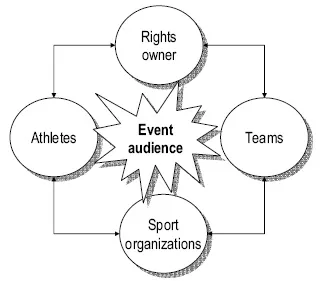
These definitions highlight the great diversity in terms of potential sponsorship combinations. However, it is the event which provides energy to this system (see Figure 1.1). The etymology of the term ‘event’ testifies that it is likely to have a strong impact on social groups. With this point of view, Piquet (1985: 104) considers that an ‘event is primarily a gravitational social occurrence, a place where men and women gather in a sort of collective celebration to attend a sporting or cultural spectacle. The event is subjectively perceived as an opportunity for carrying out an achievement’. What would be the impact of the athletes, teams and sport without an event?
Figure 1.1 The event as a focus point for attracting the public
The sporting event has a socio-cultural anchor possessing an identity of its own. Bourdieu (1979), Pociello (1983) and Bromberger et al. (1987) studied in depth these particular social phenomena. They analysed the sporting event as a subject of social identity and as a vehicle of values and social representations. According to Bromberger et al. (1987), the differentiated characteristics displayed in a sporting event would incline specific groups of spectators to invest themselves in that event. Indeed, the distribution of individuals inside a stadium is a function of a complex combination of criteria where contrasting sociological universes emerge and where particular social identities are affirmed.
The social sharing of the emotions and interest for the event
Emotion is the cornerstone of an event. According to Maffesoli (1988: 68), ‘the common sensitivity . . . results from the fact that one takes part or relates, in the strict and perhaps mystical meaning of these terms, to a common ethos’. Thus, what is privileged is not so much that which each individual will voluntarily adhere to (contractual and mechanical perspective), but rather that which is emotionally common to all (significatory and organic perspective). It is thus a fundamental mechanism by which the sporting event produces an experience of identification within what could be called ‘emotional communities’ (Maffesoli 1988: 68). The sporting event is a socially shared mode of expression. It offers the optimal conditions essential for creating an emotional contagion. This mechanism operates on the spectators directly but also via the media, particularly through the most powerful of all: television. The use of live and elaborate technical means enables the producer to reinforce the spectacular side of a sporting competition. Television and in a broader sense, the media, make it possible to create virtual communities. In a society that is being increasingly dominated by communications, this offers a new means to provide individuals’ participation in a relational and social existence.
The socio-emotional impact of a sporting event results in stimulating the interest of the direct or distant audience. In a broad sense, the audience of an event constitutes an important quantitative indicator. Interest is a dimension of commitment and is therefore a relevant indicator that enables appreciation of the social impact of an event. This interest can be distributed from the general scope to more specific provisions: for sport in general, a specific sport, an event, a team, or for an athlete, etc. From this standpoint, the Summer Olympic Games constitutes the events with the strongest impact worldwide (see Table 1.1).
The interest of the direct or indirect public depends on cultural factors. Thus, each particular sport, i.e. baseball, American football, cricket, rugby, etc., has a precise sociocultural anchoring. In addition, certain characteristics either reinforce, or alternatively, attenuate the level of interest. At times, sporting organizations arrange the regulations and format of the competition in order to reinforce the interest of the public and to make the sport more appealing. For example, the International Federation of Volleyball changed its rules of the game for the Sydney OG.
Table 1.1 Comparative interests in viewing the Olympic Games on TV in 1999
The uncertainty factor
The uncertainty of the sporting outcome is paramount since the interest and emotion vanish if the result is foreseeable. For example, when the winner of a football match is obvious, the spectators leave the stadium earlier to avoid traffic jams. By contrast, spectators or viewers remain focused on a game with a tied score, as a goal may change the end result of the game at any time. In 1991, the television audience record for a football match in France was surpassed during the finals of the European Cup, where Olympic Marseilles competed against Belgrade Red Star at Bari. No goal had been scored during allotted time and overtime. The viewer coverage total reached its maximum peak at the end of the overtime, during a penalty shoot out, with 18 million viewers. By contrast, the domination of Michael Schumacher and Ferrari during the 2002–3 F1 season caused a decline in the television audience. To restore the uncertainty factor and public interest in the Federation Internationale de l’Automobile (FIA) championship, the Formula One Constructors Association (FOCA) modified the rules of the competition.
A unique image
An image relates to the subjective representation that people have in relation to an event. The representation is socially shared given the social impact of the event. At the operational level, it is considered that the image of an event relates to all the connotations associated with that event. To assess the image of the Olympic Games, a survey was conducted on which words people associate with the Olympic Games.
Research carried out by the IOC shows that the words most often associated with the Olympic Games in 1998 and 1999 were as shown in Table 1.2. A content analysis of these terms reveals the image of the Olympic Games is structured into four dimensions:
- Hope: The Olympic Games are symbolic of the hope for a better world. The games set an example and lesson of discrimination-free competition.
- Dream and inspiration: The Olympic Games provide the inspiration essential to materializing personal dreams through the effort, sacrifice and determination of the athletes.
- Friendship and fair play: The Olympic Games offer tangible examples of how humanity can overcome political, economical and racial obstacles through the values inherent to sport.
- Joy through effort: The Olympic Games celebrate the participation and the universal joy ensuing from individual efforts without concern for the result.
Table 1.2 Words most often associated with the Olympic Games in order of importance
Definition and typology of sporting events
This set of characteristics positions the sporting event in the nucleus of the sponsorship system. Thus, the following definition is proposed: ‘a sporting event is a powerful social act associated with a specific image, generating collectively shared emotions, and whose outcome is uncertain’.1
Note that its media strategies generally emerge from the aforementioned characteristics. Indeed, the media are interested in the events which mobilize an audience corresponding to their target market. The event generally consists of a ‘pull’ strategy, i.e. the ability to attract an audience. However, certain media sometimes use a ‘push’ strategy. In this latter case, the media push certain events onto their public while hoping to find an audience. The French channel Canal+ provides us with an example of a ‘push’ strategy, presenting its audience with American football and in particular the Super Bowl.
From a quantitative standpoint, sporting event differentiation is a function of the power and legitimacy of the rights holder(s), the audience size, the geographical impact, the sporting legitimacy, and the primary2 stakeholders’ alliances through relationship marketing programmes.
The criteria presented in Table 1.3 are proposed with a view to establishing a typology. This typology is illustrated based on three events with different characteristics: the Summer Olympic Games, the Street Hockey World Championship 2003 in Sierre (Switzerland) and the English Premier League (Table 1.4).
Table 1.3 Dimensions relating to the typology of sporting events
Table 1.4 Profiles of three differentiated events
An active technique integrated into the communication strategy
In the early 1980s, marketing managers understood the benefit they could derive from association with a brand, a sporting event, an athlete or a team within an event, thus the use of the phrase ‘event-driven communication’. However, sponsorship, as with advertising, is a tool integrated into the communication strategy of a company, which Brochand and Lendrevie (1989) describe as the entire set of major and interdependent decisions in relation to the main objectives and means of implementation to reach these objectives.
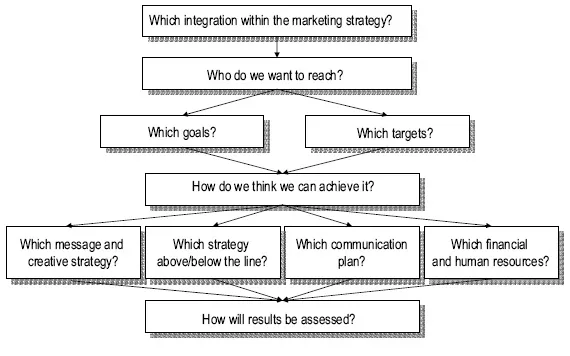
Figure 1.2 depicts the various phases of a communication strategy. There are three essential phases for implementing a communication strategy. The first phase consists of defining the objectives and which targets to reach. The second phase relates to the means of implementation to achieve the established goals. For this, it is necessary to consider the message to be transmitted, the chronology to be implemented and the required budget. The third phase relates to the results analysis.
As previously mentioned, sponsorship appeared as an innovative means of communication enabling a company to distance itself from the traditional and below-the-line advertising means. The strategy consisted in integrating sponsorship into the communication strategy of the company while distinguishing it from patronage. In this context, the approach was more focused on the objectives and targets, as well as on the most tailored option for sponsorship operations.
Figure 1.2 Phases of a communication strategy
Targets
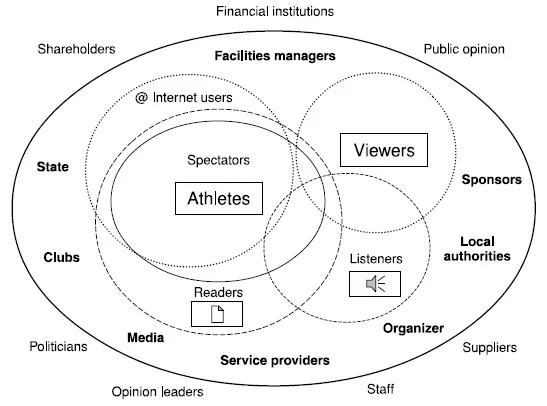
Since the event is a powerful social phenomenon for a given public, the sponsor targets its action of communication on the interested parties – that is, the ‘stakeholders’ introduced in Figure 1.3. In the middle, the participants and spectators are directly involved in the event. The distant audience is then tied to the event via the media. Furthermore, the event itself encompasses various organizations such as the organizer, local authorities, media, etc.3 The periphery contains the public opinion, politicians, opinion leaders (pundits), suppliers, personnel of the organizations involved, etc.
A company aims at a certain number of targets, some of which are more important than others, such as its current and potential consumers, suppliers, company personnel, public opinion, local communities, business world, financial institutions, shareholders, media and distributors. Rarely does a company want to communicate with this entire set of targets all at once using only one sponsorship programme. Rather, sponsors establish priorities. A study by Crowley (1991) made it possible to identify four types of sponsors, each one with a distinct orientation towards each of the following:
- the consumer;
- company personnel;
- public opinion;
- the business world.
Figure 1.3 The various stakeholders of a sporting event
Thus, to target an action of sponsorship properly, it is advisable to know the direct and indirect audience of an event thoroughly both from a quantitative and qualitative perspective, i.e. the socio-demographic characteristics, lifestyle, consumption habits, etc. Consequently, studies on audiences increased dramatically: TNS Sofrès, Sports Marketing Surveys, French Institute of Demoscopy, Sport Lab, Sport Research International, Eurodata TV, BVA, etc.
Sponsors analyse the compatibility of the audience of an event based on their communication and/or marketing targets.4 This refers to one of the dimensions of the convergence analysis relating to the sponsorship offer (called ‘fit’). The superimposing of the target...