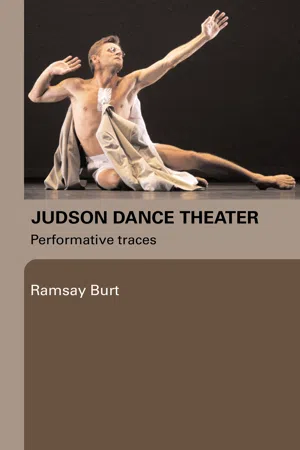
"The Judson Dance Theatre "explores the work and legacy of one of the most influential of all dance companies, which first performed at the Judson Memorial Church in downtown Manhattan in the early 1960s. There, a group of choreographers and dancers--including future well-known artists Twyla Tharp, Carolee Schneemann, Robert Morris, Trisha Brown, Yvonne Rainier, and others--created what came to be known as " postmodern dance." Taking their cues from the experiments of Merce Cunningham, they took movements from everyday life--walking, running, gymnastics--to create dances that influenced not only future dance work but also minimalism in music and art, as well as the wedding of dance and speech in solo performance pieces.
Judson's legacy has been explored primarily in the work of dance critic Sally Banes, in a book published in the 1980s. Although the dancers from the so-called "Judson School" continue to perform and create new works--and their influence continues to grow from the US to Europe and beyond--there has not been a book-length study in the last two decades that discusses this work in a broader context of cultural trends. Burt is a highly respected dance critic and historian who brings a unique new vision to his study of the Judson dancers and their work which will undoubtedly influence the discussion of these seminal figures for decades to come
"Performative Traces: Judson" "Dance Theatre and Its Legacy "combines history, performance analysis, theory, and criticism to give a fresh view of the work of this seminal group of dancers. It will appeal to students of dance history, theory, and practice, as well as all interested in the avant-grade arts and performance practice in the 20th century.
- 240 pages
- English
- ePUB (mobile friendly)
- Available on iOS & Android
eBook - ePub
About this book
Information
1
Introduction
Transatlantic crossings
In September 1985 a small incident occurred in Montréal during the first Festival International de Nouvelle Danse which participants have probably long since forgotten. During the same week, Merce Cunningham, Pina Bausch, Trisha Brown, and Anne Teresa de Keersmaeker were all presenting work in the festival and they, together with members of their dance companies, were all staying in the same hotel at the same time. One evening, the dancer Dena Davida, who runs Montréal’s experimental dance centre Tangente and was one of the organizers of the festival, was sitting in the hotel coffee shop talking to Trisha Brown and Stephen Petronio (who was still at that time dancing with Brown). Davida commented that Pina Bausch and a few of her dancers were sitting at the next table. When Brown said she knew of Bausch’s work but had not met her, Davida introduced them to one another and gradually members of different dance companies started to talk together.1
This chance meeting is the starting point for a book about Judson Dance Theater and its legacy because it represents a meeting of innovative dance artists from Europe and the US and raises questions about what they had in common. To anyone outside dance circles, such a meeting of leading international dance company directors might not seem remarkable, but within the English-speaking dance world, Brown and Bausch are almost set up as paradigmatic opposites where innovative dance practice is concerned. Brown, for many scholars and critics in the US, is seen as someone who is constantly refining her search for new, abstract ways of structuring pure, abstract dance. She is, perhaps, the founder member of Judson Dance Theater who appears to have made the most consistent and continuous choreographic development. For many of the same critics and commentators, however, Bausch is a bogey figure who seems to attack the very idea of dance which, in their view, Brown exemplifies. This book argues that innovative dance artists on each side of the Atlantic over the last forty years have had more in common with one another than most existing dance literature about them to date has suggested.
Antipathy towards Bausch’s work was evident in press reactions when a few weeks later Bausch’s company, Tanztheater Wuppertal, performed at the Brooklyn Academy of Music in New York as part of a festival of new German work. There they performed Bausch’s 1984 piece Auf dem Gebirge hat man ein Geschrei gehört (On the Mountain a Cry Was Heard). One moment in particular upset some audience members. In this, Josephine Ann Endicott repeatedly went down on all fours, pulled up her dress to bare her back; a man then marked a line on her with lipstick so that her back became inexorably crosshatched in red.2 The festival included a symposium on German tanztheater that was held at the New York Goethe Institute in November 1985. During this some American critics expressed incomprehension and condemnation of Bausch’s work. Moments such as the one described above provoked criticism that Bausch didn’t appear to be obviously critical of violence against women, and one participant complained that Bausch’s unrelieved and undeveloping repetitiousness seemed senseless (in Daly 1986).3 Anna Kisselgoff stated: ‘We rarely see pure dance coming out of West Germany [as it was then]. There must be some reason why there are directions being taken in America and Germany that are so opposite.’ Turning to Jochen Schmidt, she asked: ‘Do you feel that formal concerns are of no interest to German choreographers?’ to which Schmidt replied that he thought there was a lot of form in Bausch’s work (ibid.: 47–8). As Johannes Birringer observed, when Kisselgoff ‘asked Bausch whether she would be interested in working only with “pure form” and without the need to express feelings, the choreographer probably didn’t even understand the question’ (Birringer 1986:85). How many of those who criticized Bausch in 1985 for her reportedly un-American-looking work acknowledged that she had trained in New York at the start of the 1960s, performing at the time not only in work by Antony Tudor and Paul Taylor, but also in more experimental pieces by Paul Sanasardo and Donya Feuer?4 Although Trisha Brown’s work was not mentioned in these discussions, the implication of Kisselgoff’s position was that whereas choreographers such as Brown, who deal with movement in an abstract way, could fit into a formalist, modernist account of the progressive development of an implicitly American tradition of pure dance, Bausch’s supposed expressionism, in comparison, was anachronistic. To many in the symposium her work seemed derivative of issues that had already been addressed by the now old-fashioned American modern dance.5
What I believe Bausch and Brown have in common is the way that they both, in effect, offer a similar challenge to the sorts of ideas about ‘pure dance’ that Kisselgoff articulated in 1985, by framing the materiality of the dancing body in ways that force the spectator to acknowledge the materiality of the bodies of their dancers. In doing so, they contradict conventional aesthetic expectations. Such challenges are a major theme in this book. While Brown can be seen to do this through her deep research into the roots of motor functioning, Bausch uses a more Laban-based approach to space and effort along with mimetic and dramaturgical devices including repetitions of sometimes painful actions; but both use improvisation as a key part of their choreographic process. Each, in different ways, has presented challenges to their audiences to abandon naturalized and automated ways of viewing dance performances. Brown’s description of her 1970 piece Man Walking Down the Side of a Building exemplifies the way her work has critiqued conventional ideas about what dance is:
Man Walking Down the Side of a Building was exactly like the title – seven stories. A natural activity under the stress of an unnatural setting. Gravity reneged. Vast scale. Clear order. You start at the top, walk straight down, stop at the bottom. All those soupy questions that arise in the process of selecting abstract movement according to the modern dance tradition – what, when, where and how – are solved in collaboration between choreographer and place. If you eliminate all those eccentric possibilities that the choreographic imagination can conjure up and just have a person walk down an aisle, then you see movement as activity.
(in Livet 1978:51)
An avoidance of the eccentric possibilities and soupy questions inherent in the modern dance aesthetic permits the performer to realize, and the spectator to perceive, the clarity and directness of movement as unembellished activity, and the dancer’s actual weight and physicality. Around the time Brown said this in 1978, Pina Bausch expressed a similar distaste for existing dance, and with it a need for new ways of moving, in an interview with Jochen Schmidt: ‘I’m always trying. I keep desperately trying to dance. I’m always hoping I’m going to find new ways of relating to movement. I can’t go on working in the previous way. It would be like repeating something, something strange’ (in Servos 1984:230). When Schmidt asked her whether she therefore needed to use words in her pieces, Bausch replied:
It is simply a question of when is it dance, when is it not. Where does it start? When do we call it dance? It does in fact have something to do with consciousness, with bodily consciousness, and the way we form things. But then it needn’t have this kind of aesthetic form. It can have quite a different form and still be dance.
(ibid.)
Bausch’s need to find new ways of relating to dance parallels Brown’s need to move away from the soupy problems of the modern dance tradition. Both dance artists were articulating the difficulties that came between them and how they wanted to dance, and both, in an avant-garde way, were exercising the right to refuse to comply with existing ways of doing this. Here, then, in their different searches for new movement possibilities, is a point of comparison between Bausch and Brown, whose chance meeting in Montréal is the starting point for this book. It is not my intention here to minimize the evident differences between works by Bausch and Brown, merely to point out that on a conceptual level both were creating work that set comparable challenges to audiences to abandon conventional expectations and develop new structures of perception. Both dance artists identified the body and bodily consciousness as the site at which to try to find something that offers liberation from good old or bad old ways. For Brown they were unequivocally bad old ways and she wanted to move on. Bausch, too, was motivated by a need to move on but the fact that she called her attempt desperate indicates her concern about the loss of what had previously appeared to be certainties.
To create and present work that does not conform to the known and familiar but challenges audiences can have negative consequences. Not only did some audience members walk out of performances by Tanztheater Wuppertal at Brooklyn Academy of Music in 1985, but, as Josephine Ann Endicott (1999) has recalled, some members of the German audience during the first few years at Wuppertal reacted just as negatively. Brown has written about the need to be prepared to make work that challenges audiences:
The result of choreography that goes beyond what the audience is familiar with is that you find out what you can do, and what your own personal limitation edges are. In that arises the possibility of doing that which is not interesting to your audience, not up until now thought of as acceptable to an audience. There is also a question of the tension in the relationship between an audience and a performer.
(Brown 1978:45–6)
Referring to this tension, Brown has spoken of her feelings of vulnerability and exposure when performing the spare, minimal movements of her choreography during the early 1970s. She has told Marianne Goldberg that, although at that time she was working towards ‘objectivity in movement … I remember feeling emotion and internal commotion while performing those early deductive, systematized, withheld pieces’ (Goldberg 1991:6). Susan Sontag has observed:
The view that dance should not express emotion does not, of course, mean to be against emotion. Valéry defined the poem as a machine whose function is to create a distinctively poetic feeling: it does not ‘express’ emotion, it is a method for creating it.
(Sontag 1983:103)
So, to expand on Birringer’s point mentioned earlier, the idea that either Bausch or Brown could separate feeling from form is surely mistaken.
Modernist dance theory and postmodern dance
To find such common ground between European and American dance is to depart radically from the view of postmodern dance developed by Sally Banes. In her view postmodern dance was a ‘largely United States phenomenon’ (Banes 1987: xxxvi), American choreographers having made their breakthrough by ‘reacting against the expressionism of modern dance which anchored movement to a literary idea or a musical form’ (Banes 1980:15). This was something that, in Banes’s view, Pina Bausch failed to do. For Banes, Bausch’s work was ‘expressionist rather than analytical’ and seemed ‘more influenced by imagistic avant-garde theatre than by either German or American dance traditions’ (1987: xxxvi). Either Banes was unaware of the influence of Jooss and Tudor on Bausch’s work, and of her time with Taylor, Sanasardo, and Feuer, or she couldn’t understand its relevance to Bausch’s choreography. In order to trace the development of radical, experimental dance on both sides of the Atlantic, I have to disagree with Banes’s assessment of Bausch’s work, and challenge beliefs about the separateness and exclusivity of postmodern dance in the United States.
Sally Banes’s work on American dance since 1960 is enormously important and has been highly influential. My work in this book would not have been possible without it. Her 1980 book Terpsichore in Sneakers: Post-Modern Dance, about Yvonne Rainer, Trisha Brown, Steve Paxton and others associated with Judson Dance Theater, was a key work in the development of dance studies as an academic discipline. Although Banes may not be the only scholar to have written about postmodern dance,6 she has written at greater length and in more detail than anyone else. Her first book, which defined the terms in which American postmodern dance is still discussed, has been followed by five others. Banes has not only provided invaluable, detailed information about key choreographers of the 1960s and 1970s but shifted discussions of dance history from artist- or company-centred critical studies to discussions of theoretical aspects of contemporary dance practice. Banes developed a framework for discussing theatre dance by drawing on art theory. There were particularly close connections in the 1960s between experimental dance and radical developments in the other arts, particularly the visual arts, and between dancers and visual artists within Judson Dance Theater. In developing her theoretical framework for discussing postmodern dance, Banes drew on the view of modernist painting and sculpture proposed by the extremely influential art critic Clement Greenberg (1909–94) and subsequently developed by the art historian Michael Fried. She was neither the first, nor the only, dance scholar to do this. David Michael Levin (1973), Noël Carroll (1981, 2003), Marshall Cohen (1981), and Roger Copeland (e.g. 1983, 1985) have developed modernist accounts of contemporary dance along similar lines; however, Banes has provided the most thorough and comprehensive account. In doing so, she has introduced many of the issues and themes that inform my discussion in the present book. Because of this, it is necessary to consider her ideas about modernism and postmodernism here in some detail.
In retrospect it is now possible to see that although Greenberg’s ideas were dominant during the 1960s, there were a number of other ideas about the nature of modernist art circulating among the visual artists whose work was closest to that of the dancers in Judson Dance Theater. There were, indeed, substantial disagreements with Greenberg’s views. Art Historian Jack Flam, writing in the mid-1990s, proposed:
It now seems clear that Greenberg’s definition of modernism was not in fact synonymous with the practices of the artists who...
Table of contents
- Contents
- Illustrations
- Acknowledgements
- 1 Introduction
- 2 Cunningham, Judson, and the historical avant-garde
- 3 Minimalism, theory, and the dancing body
- 4 Allegories of the ordinary and particular
- 5 Before and after 1968
- 6 Repetition
- 7 Traces of intimacy and relationless relations
- 8 The Judson tradition at the start of a new century
- Notes
- Bibliography
- Index
Trusted by 375,005 students
Access to over 1.5 million titles for a fair monthly price.
Study more efficiently using our study tools.
Frequently asked questions
Yes, you can cancel anytime from the Subscription tab in your account settings on the Perlego website. Your subscription will stay active until the end of your current billing period. Learn how to cancel your subscription
No, books cannot be downloaded as external files, such as PDFs, for use outside of Perlego. However, you can download books within the Perlego app for offline reading on mobile or tablet. Learn how to download books offline
Perlego offers two plans: Essential and Complete
- Essential is ideal for learners and professionals who enjoy exploring a wide range of subjects. Access the Essential Library with 800,000+ trusted titles and best-sellers across business, personal growth, and the humanities. Includes unlimited reading time and Standard Read Aloud voice.
- Complete: Perfect for advanced learners and researchers needing full, unrestricted access. Unlock 1.5M+ books across hundreds of subjects, including academic and specialized titles. The Complete Plan also includes advanced features like Premium Read Aloud and Research Assistant.
We are an online textbook subscription service, where you can get access to an entire online library for less than the price of a single book per month. With over 1.5 million books across 990+ topics, we’ve got you covered! Learn about our mission
Look out for the read-aloud symbol on your next book to see if you can listen to it. The read-aloud tool reads text aloud for you, highlighting the text as it is being read. You can pause it, speed it up and slow it down. Learn more about Read Aloud
Yes! You can use the Perlego app on both iOS and Android devices to read anytime, anywhere — even offline. Perfect for commutes or when you’re on the go.
Please note we cannot support devices running on iOS 13 and Android 7 or earlier. Learn more about using the app
Please note we cannot support devices running on iOS 13 and Android 7 or earlier. Learn more about using the app
Yes, you can access Judson Dance Theater by Ramsay Burt in PDF and/or ePUB format, as well as other popular books in Media & Performing Arts & Dance. We have over 1.5 million books available in our catalogue for you to explore.