This best-selling book takes a practical look at how improvements can be made in any school.
It cuts through the jargon of the specialist and shows how ideas and intentions can be turned into direct actions that will help a school improve its performance and effectiveness.
As well as addressing headteachers and governors, the book will also provide invaluable guidance for all those who work in and with schools.
There are chapters on:
*effective schools and how they have achieved their goals
*leadership within schools
*teaching and learning effectively
*making critical interventions to secure improvement
*how schools involve others to aid improvement.
This is a book that no school will want to be without. It is essential reading for anyone involved in education.
Tim Brighouse is Chief Education Officer for Birmingham City Council and is a national figure in education. David Woods is a Senior Education Adviser at the DfEE.
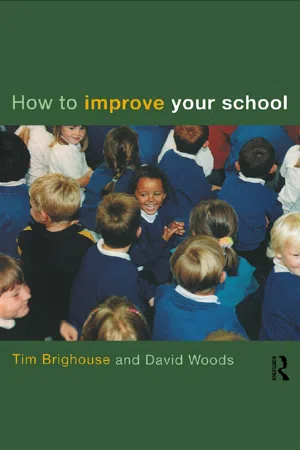
- 188 pages
- English
- ePUB (mobile friendly)
- Available on iOS & Android
eBook - ePub
How to Improve Your School
About this book
Information
1
EFFECTIVE AND IMPROVING SCHOOLS
Parallel fields of research and how they overlap
The enigma of successful and unsuccessful schools is that we can easily recognise them but we forget how their faces acquired the lines of hopeful optimism or pessimistic despair and how they became healthy or ill.
Everyone agrees that successful schools are desirable.
This chapter seeks to establish a language with which we can identify the characteristics of success and a map to guide us through the processes that we necessarily engage in when creating or destroying those characteristics. The rest of the book attempts first to examine two of those processes—the exercise of leadership and the practice of teaching and learning—in some practical depth and then to offer a set, or menu, of small and larger interventions which we have seen offer disproportionate advantage in schools making progress, before finally considering the contribution of stakeholders and partners to school improvement.
Until relatively recently that would not have been possible. Those running the system, headteachers, teachers and governors knew nothing of research into school effectiveness and school improvement. School was a place where something went on beyond the public or private gaze. Children were left at the school gate and stories of what went on inside grew or diminished with the telling, but, in this country at least, nobody much knew or cared what happened behind the classroom door. Strangely, until Michael Rutter published his Fifteen Thousand Hours in 1979, the conventional wisdom amongst social scientists was that schools didn’t make a significant difference to life’s chances. However, after Rutter’s work, first as a trickle, then with a rush, the tide of greater understanding of school success has meant that we have gained greater and ever more precise insights into the characteristics of that success and the means of achieving those characteristics.
For many years it used to be the case that for the busy headteacher and staff and for the school governor, the truism much bruited abroad on the Clapham omnibus was a correct one—namely that good schooling ‘is all down to the headteacher’. Even now, you will find widespread agreement that that is the top and bottom of it. But it is a bit more complicated than that.
Most people know when they are in a successful school, although it is only obvious after seeing or experiencing a school that is unsuccessful or complacent. The contrast then is stark.
A case of an unsuccessful school
The door bangs. Nobody thinks to hold doors open for the adults. There is litter and noise everywhere: the lavatories are locked; pupils are not allowed into the school at breaktime whatever the weather. Grim-faced adults pass each other in the corridor without a word and try to ignore what is going on, waiting for someone else to sort out the skirmishes that break out among pupils. They seek refuge in the staffroom and share stories, almost like warriors returning from the front. They talk about children not with them.
Everyone has become accustomed to being late for lessons and the attendance rate of staff nears that of the pupils. You know where the head’s study is: there is a long line of miscreants waiting for what the staff believe to be inadequate discipline and attention.
Energy has seeped away from the school. School for most children and staff is a collusive activity. Children are mainly engaged in aimless tasks to occupy their time in the name of consolidating their learning. Staff meetings are concerned with sharing information and the time of managers is taken up with behaviour referrals and awkward parents. All are tired.
OFSTED inspection reports offer less journalistic ways of describing either the unsuccessful school outlined above or the following contrasting successful one described below.
The successful school
Conversations multiply on the way into school. All children make their way, each in their own style, some busy and smart, others inarticulate and dishevelled, to their tutor group where the teacher silently ticks off their arrival while engaging in encouragingly casual conversation: ‘Shane—good to see you back! Your cold’s better? See you at practice tonight—got your boots?’ It is the same in all classrooms: the registration is the accumulation of special personal and social information locked into the database of the teacher, to be used to good effect in teaching and learning. Some reluctant ‘anoraks’ are shooed from the open learning centre by the senior teacher. Corridors are places where unconsidered trifles create the vital social cement and minute adjustments are quickly agreed to the school’s tactics for each child. There is a silent expectation at school assemblies—the chance acknowledged by the majority of participants for both a vivid shared tale which may involve adults, pupils or a mixture of the two together with music and a celebration of collective and individual achievements. The school visually gives a statement of its priorities, whether in the outstanding artwork or in the displays of pupil and adult achievement or in the news about school clubs or societies, or of language and maths policies, and most tellingly, of the shared behaviour code framed in the first person plural to incorporate adults and pupils alike. It is a place of optimism and pace; laughter abounds and can be relied upon to overcome the daily crises and the occasional tragedies.
Teachers recall good schools as places which punctuated the high points of their careers, where ideas and new experiences overcame exhaustion. Characters are vivid. Parents know them too, not just because their child has gained by meeting a teacher whose actions have gone far beyond what they had to do but also as places where the school collectively does far more than the minimum. So homework is set and marked; residential visits are organised and take place; celebratory occasions are the opportunity for a majority staff turnout and the car parks are always full of staff cars, early and late. Parents and communities soon notice.
Teachers recall them, parents recognise them: good schools are places where individuals grow by walking the extra mile.
There are, of course, many in-between schools.
School effectiveness: the nouns and adjectives of successful schooling
In the last 20 years, as though for the first time, someone has gradually begun to restore a painting by a hitherto unrecognised master. School effectiveness research has revealed the characteristics—the nouns and adjectives—of successful schooling, illuminating its various stages.
What does Tizard tell us about successful infant and nursery schools?
- pre-school attainments (especially knowledge of letter-sounds and the ability to use words)
- mothers’ levels of education
- teachers’ expectations (found to be consistently too low)
- parent-teacher co-operation
Peter Mortimore and others tantalise with the characteristics of successful junior schools:
- purposeful leadership by head
- involvement of deputy head
- involvement of teachers
- consistency among teachers
- structured sessions
- intellectually challenging
- work-centred environment
- limited focus in sessions
- maximum communication between teachers and pupils
- parental involvement
- record keeping
- positive climate
At secondary level too there has been guidance from David Smith and Sally Tomlinson on the characteristics of successful inner-city secondary schools:
- leadership and management in the school by:
the headteacher
the heads of departments (at secondary level we may have to talk about ‘effective departments’ rather than effective schools) - teacher involvement in decision making (in curriculum, methods, organisation, use of resources, wholeschool policies)
- climate of respect (teachers-teachers, pupil-pupils, pupils-teachers, teachers-parents, etc), including respect for other cultures, languages, religions, etc.
- positive feedback to and treatment of pupils
All this and much more sprang from the Rutter list of characteristics, which simply affirmed from a study of 12 inner-city London schools that ethos, leadership, staff attitudes and pupil involvement all made a difference.
By the late 1980s, however, people were becoming increasingly uncomfortable with the nouns and adjectives of schools’ success. Busy headteachers caught glimpses of the picture, even magnified details. But what they increasingly sought was a set of processes or a compass by which to navigate.
School improvement: the verbs of successful schooling
Increasingly, a school of researchers who had contributed to the nouns and adjectives was seeking to describe the processes—and in particular how to approach those processes—which schools necessarily engage in on a daily basis. The hope was that if we could learn more about how to tackle those processes in the most propitious way, it might be possible to supply some of the would-be successful schools’ needs and point the ways in which characteristics of success, on the one hand, could be achieved, and of failure, on the other hand, might be avoided. So, for example, it doesn’t take much imagination to spot that characteristics such as the ‘involvement of the deputy head’, or the ‘involvement of the staff’ relate to leadership being shared. So how leadership is exercised could be a complementary factor so far as the achievement of the characteristics is concerned.
In Birmingham we took the view that there were seven processes which encompassed most activities of school life:
- the practice of teaching and learning
- the exercise of leadership
- the practice of management and organisation
- the practice of collective review
- the creation of an environment most suitable for learning
- the promotion of staff development
- the encouragement of parental and community involvement
There is no sense in which we believe these processes to be the only configuration possible. Others may have better ones. Indeed, there is a need for standard English to replace our Birmingham dialect as soon as possible so that all schools in the United Kingdom have the chance to learn one from another in the ‘benchmarking’ processes we describe later in chapter 4.
Our purpose in describing these processes is to construct a map, so that schools might have a better chance of understanding:
- how to achieve the characteristics
- the practice of schools in similar or dissimilar circumstances that they might compare notes with—benchmarking
- the findings of researchers
We feel very strongly about the need for this and believe the precedent of the National Curriculum and its assessment arrangements proves the point. There is little doubt in our minds that one of the benefits of the introduction of the National Curriculum and the national framework of assessment has been the way that teachers have found themselves able to compare more precisely with each other what they have taught in terms of skill, competence and understanding, and even more significantly what they understand in terms of pupil progress. Of course the early benefits of the latter were evident to teachers who were fortunate enough to engage in Certificate of Secondary Education (CSE) moderation, and all secondary teachers engaged with this age group were similarly influenced for the better by the introduction of the General Certificate of Secondary Education (GCSE). But after 1989 the same benefits have been extended through Key Stage 1 to early years work. Small wonder, of course, that Key Stage 2 and Key Stage 3 remain points where there is most concern about quality in annual Office for Standards in Education (OFSTED) inspection reports, since they were the last to be affected by the introduction of the National Curriculum and its assessment arrangements and the benefits from mutual moderation and discussion.
So the establishment of a map by which whole-schools may learn from each other is the key both to spreading good practice and to avoiding the self-defeating cycle of painfully and painstakingly learning lessons, only for them to be forgotten, forcing the next generation to learn the same things all over again.
Of the seven processes listed in p. 11, leadership and teaching and learning, are focused on later in this book, so we content ourselves here with the briefest sketches of the other five processes.
The practice of management
Good management may be summarised in the cycle set out in Figure 1.1

Figure 1.1 The cycle of good management
Clearly, any one of the sub-processes (planning, organising, etc.) in this process is capable of much further elaboration. It will be seen that we have begun to have second thoughts about the cycle’s sixth process, evaluating. The problem, so clearly seen in the south-west sector of the quadrant, is an over-emphasis on the judgemental. A manager, whether at departmental, phase or school level, who is given to ideas, certainty and quick decisions might be inclined to undertake the monitoring themselves while the whole affected team remained in ignorance and therefore perhaps unconvinced and alienated by the process. The subsequent evaluation might guide decisions that nobody owned.
We now prefer to substitute the word ‘speculate’, not because we are opposed to evaluation—indeed, ideally both should be there—but to make a point that management should be as much about questions and promoting a lively debate about the results of the monitoring of evidence as it should be about providing answers.
Management is as much about questions as answers.
Indeed, we can’t rid ourselves of the image of the notice on the back of one manager’s door:
What, of course, the manager is constantly reminding him- or herself of is the danger of relieving others of work and responsibility so that in management terms the school becomes a place which exemplifies the unforgettable words of the visiting school inspector who debriefed a head with the devastating comment: ‘Well, the teachers are working very hard, but that is more than can be said for the children.’ Moreover, the notice may be a very timely reminder to the head on Friday afternoons not to be the dumping ground for other people’s worries as staff seek to unload their intractable problems before a weekend break!

So sharing of management tasks and ownership of the need for them is crucial to a successful school.
When OFSTED reports keep mentioning ‘monitoring is in need of development’ or even more seriously ‘planning’, they leave out the salient feature, namely the collective nature of the two sub-processes. One of our chosen ‘butterflies’ later in this book compares and contrasts the judgemental with the speculative—and therefore collective—quality of management.
Without all these sub processes in place, however, the school is adrift in a sea of value judgements and a cacophony of personal prejudice, both in assessing its own processes and in forming an adjustment to the new direction of its actions.
I take my stand on detail
The words of the Victorian provide a timely reminder to those who are non-completers of tasks and low on organisational skills. School practices and processes which are always ‘on a wing and a prayer’ are also energy sapping. Meticulous planning and organisation, whether of lessons, assemblies, examinations, school performances, external entries, school meals monies, trips or the myriad of other school activities, are essential. Much of a school’s work however, both in learning and teaching can be shared with the support staff of the school.
Attention to detail is immediate. A chronically banging door in the corridor can ruin lessons and therefore the proportion of time learners spend in being surprised into understanding or doing things they thought beyond them. The door needs to be fixed. We remain impressed by schools which are eternally attending to improvements in communication in a systematic way. Communication is never fixed: it’s always broken because some people don’t hear and others don’t listen.
The school staff handbook is therefore a necessary document nowadays, but how it is managed can vary. Most staff handbooks are similar. They encompass a simple mission or vision statement for the school, a list of policies, procedures and practices, some of them for information only. The problem is that most people lose them and they can sometimes become a ‘blame and shame’ opportunity when managers or leaders talk with each other about—not with—other members of staff. ‘Why didn’t they read the staff handbook? It is set out clearly…’ Schools can overcome that by chaining a couple of staff handbooks to the staffroom noticeboard, another to the foyer in the general office and another in each faculty area and meeting room. If the handbook is loose-leaf in a ring binder, colour coded for ease of reference and if each policy starts on a separate sheet, a start has been made in getting the detail right. The detail will be completely right if three further steps are taken. Each policy should have within it a mention of members of staff and the chair whose responsibility it is to convene the next review and the date for it. Second, the policy should be followed by a list of the practices that are carried out annually/termly/weekly/daily, with the initials for those responsible for maintaining this—usually members o...
Table of contents
- Cover Page
- Title Page
- Copyright Page
- Figures and Tables
- Acknowledgements
- Introduction
- 1 Effective and Improving Schools
- 2 Leadership
- 3 Teaching and Learning
- 4 Interventions
- 5 Stakeholders and Partners
- Appendix 1 School Improvement
- Appendix 2 The Early Years Guarantee (Outline)
- Appendix 3 The Primary Guarantee (Outline)
- Appendix 4 The Secondary Guarantee (Outline)
- Selected Reading
Trusted by 375,005 students
Access to over 1.5 million titles for a fair monthly price.
Study more efficiently using our study tools.
Frequently asked questions
Yes, you can cancel anytime from the Subscription tab in your account settings on the Perlego website. Your subscription will stay active until the end of your current billing period. Learn how to cancel your subscription
No, books cannot be downloaded as external files, such as PDFs, for use outside of Perlego. However, you can download books within the Perlego app for offline reading on mobile or tablet. Learn how to download books offline
Perlego offers two plans: Essential and Complete
- Essential is ideal for learners and professionals who enjoy exploring a wide range of subjects. Access the Essential Library with 800,000+ trusted titles and best-sellers across business, personal growth, and the humanities. Includes unlimited reading time and Standard Read Aloud voice.
- Complete: Perfect for advanced learners and researchers needing full, unrestricted access. Unlock 1.5M+ books across hundreds of subjects, including academic and specialized titles. The Complete Plan also includes advanced features like Premium Read Aloud and Research Assistant.
We are an online textbook subscription service, where you can get access to an entire online library for less than the price of a single book per month. With over 1.5 million books across 990+ topics, we’ve got you covered! Learn about our mission
Look out for the read-aloud symbol on your next book to see if you can listen to it. The read-aloud tool reads text aloud for you, highlighting the text as it is being read. You can pause it, speed it up and slow it down. Learn more about Read Aloud
Yes! You can use the Perlego app on both iOS and Android devices to read anytime, anywhere — even offline. Perfect for commutes or when you’re on the go.
Please note we cannot support devices running on iOS 13 and Android 7 or earlier. Learn more about using the app
Please note we cannot support devices running on iOS 13 and Android 7 or earlier. Learn more about using the app
Yes, you can access How to Improve Your School by Tim Brighouse,David Woods in PDF and/or ePUB format, as well as other popular books in Education & Education General. We have over 1.5 million books available in our catalogue for you to explore.