- 352 pages
- English
- ePUB (mobile friendly)
- Available on iOS & Android
eBook - ePub
Aboriginal Woman Sacred and Profane
About this book
First published in 1939 by Routledge, this classic ethnography portrays the aboriginal woman as she really is - a complex social personality with her own prerogatives, duties, problems, beliefs, rituals and point of view. This groundbreaking and enduring study was researched in North-West Australia between 1935 and 1936 and was written by a woman who truly pioneered the study of gender in anthropology
Information
CHAPTER I
WIELDERS OF THE DIGGING-STICK
PROLOGUE
Statistics of population, rainfall, and area are slender material out of which to build a picture of the Kimberleys, unless by their contrast they startle the mind into some realization of its vastness and scattered peoples. The Europeans will probably increase, the natives decrease: they are fluctuating features of a landscape that is itself unchanging. To the Europeans it is rugged, ugly, and uninteresting, and is largely valued for the freedom of life it offers, uncomplicated by world unrest, city conventions, and routine. It is a background for the pastoral industry, for profits and markets. To the native it is his world, and his horizon does not extend beyond it, At most he can name about half a dozen tribes on each boundary; the rest are unknown by name, and might to all intent and purposes be inhabitants of another planet. Yet, because he is a nomad and travels over his “world” of perhaps 4,000 square miles, his knowledge of it is possibly more extensive than that of the English farmer, who, during his lifetime, may rarely leave the confines of his village. Necessity sharpens the eye of the Aborigine to minutioe of his environment, and makes significant for him changes in weather, soil, and vegetation. But if he has mastered the secret of its hidden resources, taken his toll, and in one sense subjugated it to his needs, the environment has also intruded upon his social and spiritual existence, and indeed, provided one of the bases for it. The mountains, rivers, and natural features have shaped his mythology, and in turn have become projections of The Time Long Past into the present. Out of the conflict with natural forces, a relationship has emerged which is reflected in the social and religious organization.. If I describe the landscape in detail, it is not to add the inevitable touch of local colour, nor to afford a temporary respite from scientific and formal dissertation. Native culture to be grasped in its completeness must be seen through the country, which is no mere backcloth for tribal activities, but something much more vital and dynamic. The anthropologist and reader must come to grips with it before turning to a study of its inhabitants.
First impressions are valuable, because no matter how extraordinary the environment, its colour and contours, even its changes from season to season rapidly lose their power to imprint themselves vividly on the senses. The stranger soon strikes roots, and though one’s way of looking at things is perhaps different from that of others, yet it ceases to be an angle for oneself. Even where impressions need to be revised later, they tend to throw into sharper relief the facts with which they are inconsistent. Those I had of the country which I first viewed from an aeroplane, were intensified; but my conception of the natives and their life had to be changed in many respects.
As the aeroplane flies inland from Derby on the coast, following the course of the Fitzroy River, the country seems to be still untouched in spite of fifty years of European penetration. The soil has been turned and sown only around the white stunted homesteads, which appear as alien growths in the landscape every fifty or hundred miles or so. Extending into the distance, it has an almost timeless quality about it, with its hills rising like islands out of the plain that resembles the floor of some sea that has never known tides or men. Below, it stretches illimitable and motionless, but for the small shadow of the aeroplane and the cattle disturbed at their feeding beneath the scrub. In winter the ground is covered with yellowed grasses and is scarred by the bed of the Fitzroy, which will not come down in flood till the rains of October or November. Here and there a permanent water-hole gleams up through the white gums and paper-barks that shade it. As the crow flies, it is about seventy miles from Derby to Fitzroy Crossing, and by road it is over two hundred miles. At this point, sixty miles to the south is the desert, as yet holding the unknown as far as the anthropologist is concerned. On the northern side, the first big ranges sweep down from the mountainous region extending up to the Indian Ocean, and east well over towards the Northern Territory. Some of these, such as the Carboyd, can only be penetrated on foot, and afford no forced landing ground for the aeroplane. They are mostly sandstone, with occasional outcrops of limestone and basalt. They appear to be bare of all vegetation, and look as though they have been cast and fired in the earth’s centre, and then flung up in some upheaval to glint beneath a savage sun. Scarped and precipitous, they are gashed with valleys that from above are chasms of red light.
It seems an inhospitable, arid land for all its colour and immensity, particularly in the winter when it offers no apparent means of sustinence for any form of life. But in any case, most of the natives are now concentrated in the camps and humpies around the stations, and their fires will not be seen till the summer, when they go sometimes fifty or a hundred miles into the bush on their annual “walkabout” for inter-tribal meetings and ceremonies. Some of these natives are so “civilized” or detribalized, that they speak of going bush as a “holiday”, much as the city clerk goes into the country once a year to “rough” it for a time! Yet this country in the past carried a much larger native population than at present. At the outset then, the anthropologist is confronted with one of the incongruities that continually arise in studying these peoples. The sparseness of natural resources and the simplicity of the consequent economic system have to be reconciled with the complexity of ritual and social organization. There is the danger of emphasizing one at the expense of the other, of failing to see that it is in the urgency of existence rather than in its simplicity, that the key lies to a world of strange ancestral figures and the elaborate rites that centre around them.
Durkheim’s idea of native existence as one of monotony does not entirely tally with camp life as observed by a stranger stripped of all preconceptions of what does or does not constitute a full life. It is true that such ritual events rise to overshadow daily activities, break into established routine, provoke long preparations, bring together scattered groups, are eagerly anticipated, and create excitement and passions in onlookers and participants alike. But if this does occur we must not leap to the conclusion that in the intervening period, the Aborigines are apathetic, cease to take any more than a cursory interest in daily happenings, and withdraw into a shell of a mere grudging existence that satisfies primary needs alone. Granted all the factors mentioned above, they represent more than recreative compensation; totemism and its ceremonies reflect not so much the simplicity of economics but an unceasing struggle to maintain life even on a meagre level. But if totemism, as I shall show later, has emerged out of these conditions, the totemic ancestors have in their turn given to social existence an added richness and complexity, so that when the Aborigine reaches maturity, he does not merely acquire some control over his environment, but is also brought into contact with the spiritual forces on which his means of sustinence are believed to depend.
But to return to the land. To see it from the aeroplane is to perceive it with the eye of Thomas Hardy’s Spirit of the Years: to be aware of its jagged contours; to have a vision of its vastness and some understanding of the distances the Aborigines must travel from one fertile pool to another in a region which is bounded by desert on the south, by sea on the west, and by mountains on the north and east. It is to gain some idea of the colossal canvas on which the Aborigines have conceived the exploits of the totemic heroes of the past. But sooner or later we must come to earth, and if we lose thereby a sense of perspective and remote objectivity, there is compensation in the gradual revelation of hidden resources, and in vital contact with the inhabitants.
Close at hand, the country is not quite so arid, though the soil in winter is brown and cracked, covered with the spiked spinifex, cane, and other grasses on which the cattle feed. The trees, except by the river, are stunted, being mostly gum, beefwood, desert oak, kurrajong, corkwood, bauhinea, baobab, and an occasional pandanus near a pool in the mountains. Around the billabongs1 are depressions in the earth, each one a family hearth where food is prepared and eaten and much of the gossip, quiet talk, and arguments are carried on.
Close by are generally billies (formerly shells) for fetching water from the pool about a hundred yards away or more, for as a rule the natives do not camp by the edge of their water supply. In summer there will be floods, and at any time there are always snakes and insects in the rank grasses. Blankets that have never been washed, and women’s digging-and fighting-sticks lie scattered about. Perhaps there is a woman fashioning a fighting-stick, as she sits cross-legged, holding a piece of wood some four feet long, at an angle sloping towards her. With the other hand she takes off shavings with a tomahawk, till it is round and smooth, with both ends slightly pointed. Against a tree will be leaning spears for fishing, hunting, and fighting, and spear-throwers smeared with red ochre, and one or two boomerangs.
Early in the morning soon after sunrise, the men would have gone forth, armed with spears, and striding along with a free unhampered movement, with a dog or two at heel. The women trudge off in another direction, burdened with swags, moving like a string of pack mules off to market, and confirming the generally held opinion that they are a little better than drudges or chattels. Later only some old people and a few dogs will be in the camp. Here lies an old man prone, or an old woman most probably blind, crouching on her knees, back bent, now and again groping with twisted fingers for a pannikan of water. If the younger women have been successful, they will amble into the clearing, spindle-legged, ladenwith a paperbark swag slung over the left shoulder. One may begin to prepare a damper1 immediately from the lily seeds, which she gouges out from the buds with her fingers, then pounds on a flat stone, mixes with water and bakes for half an hour in the hot coals.
At midday more come in, perhaps a man with a kangaroo he has speared, and which he now proceeds to cook. And so through the afternoon most of the blacks come straggling in, the women with iguana (varanus lizard), lily-roots, wild-honey, and fish, and the men with larger game. Fires are made up, the evening meal is eaten, some of it being given to relatives. All settle down for a gossip, or if there is to be a corroboree,2 men, women, and children drift up to the cleared space a hundred yards away. Women gather the dried grasses into heaps, set light to them, so that they flare up to cast jagged shadows over the singers and dancers. By midnight, unless some ceremony is in progress, most will be asleep. Fires glow out of the darkness, the blacks and their dogs huddle by them, and the silence is only broken by the crackle of a falling log. At dawn one or two bestir themselves: the women fetch water and firewood, the men talk for a while, eat any of the food remaining from the previous night, sharpen their spears, and depart for the day’s hunting.
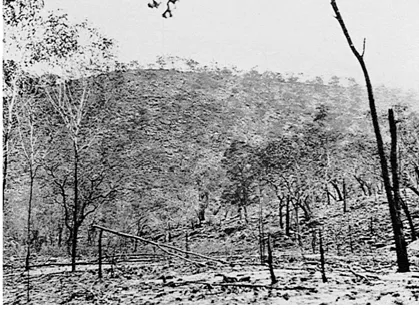
Kimberley landscape.
Face p. 4.
Face p. 4.
At first the camp seems to offer only the grey monotony of daily existence, of a precarious livelihood that is hunted for in the hills and grubbed for in the earth. In the Pacific Island community, the picturesqueness of the village camouflages temporarily the routine of daily tasks. Canoes drawn up on the beach fringed with palms, grass huts amongst the tropical undergrowth tend to confirm the ideas of the passing tourist that south sea savages lead the life of lotus-eaters. Such a community makes little demands on his or her powers of perception or understanding of anything but the obvious. On the other hand, the aboriginal camp, beginning with the dirty drab, assumes more and more complexity, variety, and interest. After one has become familiar with the background, attention at first tends to focus on the human actors, but as time passes, the camp ceases to be just a clearing littered with material objects of the simplest type. A deserted camp is just as significant as a peopled one: the depressions separated one from the other, reflect the pattern of family life: the spears are not merely primitive weapons, when one comes to realize the skill and delicacy of handling required for their making, the care lavished on them afterwards in the continual straightening of the hafts in hot ashes, and the resetting of the blade in wax, the efficiency with which they are used, and the fact that on their slender shafts the natives depend for much of their food and for defence in war. The fires, whether a few embers or blazing high, are indicative of what is perhaps happening two miles away. The dirt ceases to obtrude, and the whole scene takes on colour as it gains in significance. One detects changes, changes which give a certain rhythm that one is not constantly aware of, but which one misses after the return to the sybaritic attractions of the homestead for a while. One becomes absorbed in the questions of food-supply, in the chatter, gossip, and quarrels, and one no longer wonders at the absence of boredom among natives of the community.
But the encampment must not be conceived as an isolated place of settlement. Although it is the focal point, it is nevertheless the centre of a rough circle, within which is some pool providing the natives with fish, lily-roots, and mussels. It is a circle that stretches out for two or five miles: its ground is known for every tree, hillock, stump, antbed, crevice, and even plants. The women wander over this day after day in their search for food, and men may go farther afield in chase of a kangaroo. About two miles from the camp is some cleared space where the men foregather for their secret life, and in another direction is one for that of the women. In the late afternoon, scattered parties draw in towards the camp, but even then these are split up into kinship groups, and it is not until they go to the dancing ground close by that men, women, and children are massed together as the singers, whilst the dancers in front of them bring to the performance their youth, skill, and enthusiasm.
If we cannot then draw a plan of houses or huts and their occupants—in short of a village site—(unless we sketch the grouping of the depressions), we can at least conceive a circle some six miles in diameter over whose whole extent the daily activities are carried on, and within which there are certain points where the life is ceremonial, more emotional and intense. There ar...
Table of contents
- COVER PAGE
- TITLE PAGE
- COPYRIGHT PAGE
- LIST OF ILLUSTRATIONS
- PREFACE TO NEW EDITION
- FOREWORD
- INTRODUCTION
- CHAPTER I: WIELDERS OF THE DIGGING-STICK
- CHAPTER II: THE SOCIAL AND SPIRITUAL BACKGROUND OF THE ABORIGINAL CHILD
- CHAPTER III: CHILDHOOD
- CHAPTER IV: ON THE THRESHOLD OF MARRIAGE
- CHAPTER V: THE LAWS OF MARRIAGE AND THE NEEDS OF THE INDIVIDUAL
- CHAPTER VI: RIGHTS AND DUTIES OF WOMEN IN MARRIAGE
- CHAPTER VII: THE FUNCTIONS OF WOMEN IN THE LARGER SOCIAL GROUPS
- CHAPTER VIII: THE SPIRITUAL HERITAGE OF ABORIGINAL WOMAN
- CHAPTER IX: WOMEN’S CEREMONIES
- CHAPTER X: WOMEN’S SECRET CORROBOREES
- CHAPTER XI: ABORIGINAL WOMAN—SACRED AND PROFANE
- BIBLIOGRAPHY
Trusted by 375,005 students
Access to over 1.5 million titles for a fair monthly price.
Study more efficiently using our study tools.
Frequently asked questions
Yes, you can cancel anytime from the Subscription tab in your account settings on the Perlego website. Your subscription will stay active until the end of your current billing period. Learn how to cancel your subscription
No, books cannot be downloaded as external files, such as PDFs, for use outside of Perlego. However, you can download books within the Perlego app for offline reading on mobile or tablet. Learn how to download books offline
Perlego offers two plans: Essential and Complete
- Essential is ideal for learners and professionals who enjoy exploring a wide range of subjects. Access the Essential Library with 800,000+ trusted titles and best-sellers across business, personal growth, and the humanities. Includes unlimited reading time and Standard Read Aloud voice.
- Complete: Perfect for advanced learners and researchers needing full, unrestricted access. Unlock 1.5M+ books across hundreds of subjects, including academic and specialized titles. The Complete Plan also includes advanced features like Premium Read Aloud and Research Assistant.
We are an online textbook subscription service, where you can get access to an entire online library for less than the price of a single book per month. With over 1.5 million books across 990+ topics, we’ve got you covered! Learn about our mission
Look out for the read-aloud symbol on your next book to see if you can listen to it. The read-aloud tool reads text aloud for you, highlighting the text as it is being read. You can pause it, speed it up and slow it down. Learn more about Read Aloud
Yes! You can use the Perlego app on both iOS and Android devices to read anytime, anywhere — even offline. Perfect for commutes or when you’re on the go.
Please note we cannot support devices running on iOS 13 and Android 7 or earlier. Learn more about using the app
Please note we cannot support devices running on iOS 13 and Android 7 or earlier. Learn more about using the app
Yes, you can access Aboriginal Woman Sacred and Profane by Phyllis Kaberry in PDF and/or ePUB format, as well as other popular books in Social Sciences & Anthropology. We have over 1.5 million books available in our catalogue for you to explore.