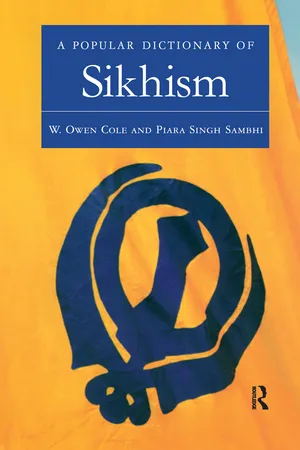
The word ‘sikh’ comes from the Punjabi verb ‘sikhna’, to learn. A Sikh is therefore a learner, that is, one who learns and follows the path of liberation taught by a man called Gur N nak and his nine successors, who lived in the Punjab region of India between 1469 and 1708.
The Sikh religion has only recently come to the academic attention of western scholars. There were a few books written earlier than M.A.Macauliffe’s monumental study of the lives and times of the Gur s, The Sikh Religion (Oxford 1909), but these were often the work of soldiers or administrators, like Macauliffe himself, who needed to understand something of the Sikhs for political reasons.
Three views, not necessarily mutually exclusive, tend to have been held of Sikhism by scholars writing during the first half of the twentieth century. One is that Gur N nak was a disciple of Kab r, and that the religion owes its theology largely to him. So G.H.Westcott, Kab r and the Kab r Panth, Cawnpore, 1907. This interpretation seems to have been accepted by J.N.Farquhar, Primer of Hinduism, London, 1912. This book still seems to influence many who write on the period of Indian religion from about the thirteenth century to the death of the last Sikh Gur in 1708. The source may be indirect, perhaps A.L.Basham, The Wonder that was India, Fontana edition, 1971. On page 481 he writes, ‘One great religious teacher of modern India, Kab r (1440–1518), a poor weaver of V r nas, taught the brotherhood of Hindu and Muslim alike in the fatherhood of God, and opposed idolatry and caste practices, describing that God was equally to be found in temple and mosque. Later, N nak (1469–1539), a teacher of the Punjab, taught the same doctrine with even greater force, and founded a new faith, that of the Sikhs, designed to incorporate all that was best of both Hinduism and Islam.’ Here the second view is present, that of Sikhism as a form of deliberate syncretism. It has gained some support among Sikhs themselves eager to portray Gur N nak as a forerunner of M hatm G ndhi, a reconciler of Hindu and Muslim. This leads to the third position, the view that Gur N nak was a social reformer, seeking to ameliorate the lot of the poor and outcastes of Indian society; again perhaps this idea owes something to the work of G ndhi.
Examining these interpretations briefly, it is necessary first of all to say that none of them gives any real scope for the insistence found time and again in Gur N nak’s hymns, that he was being used as a messenger of God. His own words describing his calling will be given later, but meanwhile it is necessary to insist that any interpretation of Sikhism finds a place for the consciousness which the Gur s had of being instruments of divine revelation. So, to take the third view expressed above first, Sikhism is more than a social reform movement prompted by concern for the plight of men and even more, women, in northern India five hundred years ago. At a time when the Gur s lacked the political power to bring about social change they were offering spiritual liberation to all, and criticizing forms of religion which were failing to do so either because they regarded some people as beyond the hope of salvation in their present lives, they must be reborn as men and into one of the castes through which liberation could be attained, or because the message which could bring hope was only offering ritualism. Gur N nak once said,
Union with God does not consist of standing outside the huts of ascetics or tombs, going into trances, roaming about, or bathing at pilgrimage places. The way of union is found by dwelling in God while remaining detached in the midst of worldly attachments ( di Granth 730).
Gur N nak makes many critical remarks about institutional religion and the priests, gur s, im ms, mullahs and pa
its, who make a living from it; he called at least some of them bloodsuckers! ‘If a garment is considered polluted and impure with a spot of blood, how can those who suck blood be considered pure?’ (AG 140).
Professor Basham’s assertion raises a number of issues, two of the more important being the criteria for determining the ‘best’ in any religion, and whether anyone could hope to produce a synthesis which would satisfy Muslims who, as a primary article of faith accept Muhammad as the seal of the prophets, and can only respect Gur N nak as a p r, a saintly person, or any Hindus for whom ideas of purity and pollution and the institution of caste had any significance. The evidence provided by Gur N nak’s hymns is that he had no wish to create a religion but wished to enable men and women to experience the truth which lay beyond religions and were often obscured by them. Sikhism itself emerged as a result of circumstances, not intent.
A kinship of ideas with Kab r cannot be denied, but the evidence of dependence is rejected by those who have studied it carefully (for example, W.H.McLeod ‘Kab r, N nak, and the Early Sikh Panth’, in David N.Lorenzen, Religious Change and Cultural Domination, Mexico 1981). Two hagiographies of Gur N nak, the Miharb n and Hind l ya janam s kh s, describe meetings between the two great teachers at V r nas. The Hind l ya account which Westcott used is the work of a breakaway movement led by Bidh Chand, the son of a respected Sikh, B b Hind l. He had no reason to refer favourably to the Gur s, and may have created a story of Gur N nak’s acknowledgement of Kab r as his gur because of Kab r’s Muslim connections. (Bidh Chand married a Muslim, his village of Ja
i l became a centre of opposition to the Gur s and, in the eighteenth century, the Hind ls supported the Afghan, Ahmad Sh h Abd l , against the Kh ls .) The Miharb n account has Kab r saying that Gur N nak is a jagat gur who has come to deliver the world and that Kab r is his slave! Asked the name of his Gur , Gur N nak replies that it is God.
Professor McLeod, in the article already mentioned and some years earlier in Gur N nak and the Sikh Religion, Oxford, 1968, linked Gur nak with the sant tradition of northern India. Among those associated together by the name ‘sant’ were N mdev, 1270–1350, a Mah h shtrian calico weaver or tailor, Ravid s (Raid s), an outcaste cham r, leather worker or cobbler, of V r nas , and Kab r himself. The samprad ya, or teaching tradition of the sants, had a number of important elements to it. They were monotheists. They rejected asceticism, celibacy and the worth of outward expressions of religion. They might use names such as ‘R m’ in addressing God, but they had no place for sectarian notions whether Hindu or Muslim. It has been said that they regarded the two systems as ‘radically wrong and ultimately futile’ (ibid. p. 153). The sants taught that spiritual liberation was open to all regardless of caste and sex. Usually they were men of low caste or outcastes, who rejected the authority of brahmins and the Vedas, and expressed themselves in what has become known as ‘sant bh
h ’ or ‘sadhukkar ’, a dialect spoken in the Delhi region of North India.
Sikhs have not always been receptive to the inclusion of Gur N nak among the sants, because it seems to detract from the individuality or uniqueness of his message, and it could be seen as yet another way of asserting his dependence upon Kab r. However, this is the group with which he had most in common, and if it can be accepted that the name refers only to a similarity of thought rather than the dependence of any one upon the others there need be no danger of diminishing the distinctive place and role of Gur N nak and his successors in the history of Indian religion.
Gur N nak was born on 15 April 1469 in a village called Talwa
i in what is now Pakistan. He was a member of the Bed z t, or subgroup, of the Khatr caste regarded by Sikhs as being of the K atria varna of Hinduism. His father was the revenue superintendent of the Muslim owner of the village. The accounts of his life which were written some time after his death, the janam s kh s, provide a portrait of a child and young man already devout but also sceptical of the ritualism of his parent religion and the status of the brahmins. In an unworldly way he gave money to feed poor beggars when his father told him to put it to good account, and when following his father’s occupation he experienced difficulties in counting beyond the number thirteen,
ra, which also meant ‘I am yours’, and produced a trance-like state of union with God. His marriage was arranged but the birth of two sons did not deflect him from piety. At the age of about thirty N nak underwent an experience which was to change his life. One morning he took his usual bath in the nearby river but failed to return. Three days later he reappeared but remained silent. When he did eventually speak he said, ‘There is neither Hindu nor Muslim so whose path shall I follow? I shall follow God’s path. God is neither Hindu nor Muslim, and the path which I follow is God’s’. The janam s kh accounts of this incident have indirect authentication in one of Gur N nak’s hymns, where he describes himself as an unemployed minstrel who was taken to the divine court, given a robe to show whose servant he was, initiated, commissioned and told what song to sing to the world. It reads,
I was an out of work minstrel, the Lord gave me employment.
The mighty one instructed me, ‘Sing my praise night and day’. The Lord summoned me to court, bestowed the robe on me of honouring and praising the Lord.
The Lord gave me nectar in a cup, the nectar of the true and holy name. Those who feast and take their fill of the Lord’s holiness at the Gur ’s bidding, attain peace and joy. Your minstrel spreads your glory by singing your word. N nak, by adoring truth we attain all-highest (AG 150).
From that day he began to preach a message of the oneness of God, the potential for anyone, regardless of caste or sex, to experience God’s grace and receive spiritual liberation, mukti, even in this present existence without waiting for death, the state of j van mukt, rejection of religious actions as a way of acquiring merit or salvation, and the replacement of the Hindu varn ramadharma with the householder, gristh , way of life. Spiritual development was to be concentrated upon the God-oriented and God-filled by keeping God in mind using a technique known as n m simran. This was to be accompanied by k rt karn , earning one’s living by doing honest socially acceptable work, and vand chakn , caring for the needy by deed or gift. There is a sense in which Gur N nak, as he should now be called, was helping people to make a virtue of their necessity. The way of sanny s, the fourth stage of Hindu life, renunciation of family and worldly ties, was not an option for most villagers, even if they belonged to one of the twice-born castes which alone were allowed to practise it. The Guru was saying that the drudgery of village existence was not to be despised, avoided, and willed away, it was the path ordained by God through which one could become j van mukt. Such teachings obviously won the support of many low-caste and outcaste Hindus but there is evidence that it also appealed to some twice-born Hindus, including brahmins, and Muslims.
Between about 1499 and 1521, Gur N nak undertook a series of journeys, known as ud s s, which, according to the janam s kh s, took him to such places as Tibet, Mecca, Sri Lanka, Burma, and many countries in between. The janam s kh pericopes have a fairly set form of encounter, conversion (or occasionally rejection), and conclusion usually in the form of a hymn which he composed to meet the particular situation. For example, as the Gur was walking along a road, a local robber, named Bhola,appeared and demanded him to hand over the only things he possessed, his clothes. Gur N nak asked him to find out from his family which he supported by his violent crimes, whether any of them would stand by him at the moment of death. Bhola returned in dismay, for they had told him that in his encounter with death they could not help him, despite their indebtedness; what they owed him could be repaid only in this life. Realizing the limitation of material and human attachment Bhola returned to the Gur grief and guilt stricken and asked how he might amend his ways and shed the karma of his evil deeds. Gur N nak replied, ‘What use is any service, virtue or wisdom other than the divine Name? Worship the Name, only thus shall your bonds be broken.’
Sometimes the Gur openly denounced hypocrisy as when he hid the begging bowl of a yog who claimed to be able to use his spiritual power to tell the future, but was unable to discover where the bowl was! Or he would refuse to pray with a Muslim not because he was critical of Islam but on the grounds that the Muslim had not...
Table of contents
Cover Page
Title Page
Copyright Page
Introduction
Trusted by 375,005 students
Access to over 1.5 million titles for a fair monthly price.
Study more efficiently using our study tools.
Frequently asked questions
Yes, you can cancel anytime from the Subscription tab in your account settings on the Perlego website. Your subscription will stay active until the end of your current billing period. Learn how to cancel your subscription
No, books cannot be downloaded as external files, such as PDFs, for use outside of Perlego. However, you can download books within the Perlego app for offline reading on mobile or tablet. Learn how to download books offline
Perlego offers two plans: Essential and Complete
Essential is ideal for learners and professionals who enjoy exploring a wide range of subjects. Access the Essential Library with 800,000+ trusted titles and best-sellers across business, personal growth, and the humanities. Includes unlimited reading time and Standard Read Aloud voice.
Complete: Perfect for advanced learners and researchers needing full, unrestricted access. Unlock 1.5M+ books across hundreds of subjects, including academic and specialized titles. The Complete Plan also includes advanced features like Premium Read Aloud and Research Assistant.
Both plans are available with monthly, semester, or annual billing cycles.
We are an online textbook subscription service, where you can get access to an entire online library for less than the price of a single book per month. With over 1.5 million books across 990+ topics, we’ve got you covered! Learn about our mission
Look out for the read-aloud symbol on your next book to see if you can listen to it. The read-aloud tool reads text aloud for you, highlighting the text as it is being read. You can pause it, speed it up and slow it down. Learn more about Read Aloud
Yes! You can use the Perlego app on both iOS and Android devices to read anytime, anywhere — even offline. Perfect for commutes or when you’re on the go. Please note we cannot support devices running on iOS 13 and Android 7 or earlier. Learn more about using the app
Yes, you can access A Popular Dictionary of Sikhism by W. Owen Cole,Piara Singh Sambhi in PDF and/or ePUB format, as well as other popular books in Social Sciences & Asian Religions. We have over 1.5 million books available in our catalogue for you to explore.