The religious landscape of South Asia is complex and fascinating. While existing literature tends to focus on the majority religions of Hinduism and Buddhism, much less attention is given to Jainism, Sikhism, Islam or Christianity. While not nelecting the majority traditions, this valuable resource also explores the important role which the minority traditions play in the religious life of the subcontinent, covering popular as well as elite expressions of religious faith. By examining the realities of religious life, and the ways in which the traditions are practised on the ground, this book provides an illuminating introduction to religion in South Asia.
eBook - ePub
South Asian Religions
Tradition and Today
- 272 pages
- English
- ePUB (mobile friendly)
- Available on iOS & Android
eBook - ePub
About this book
Information
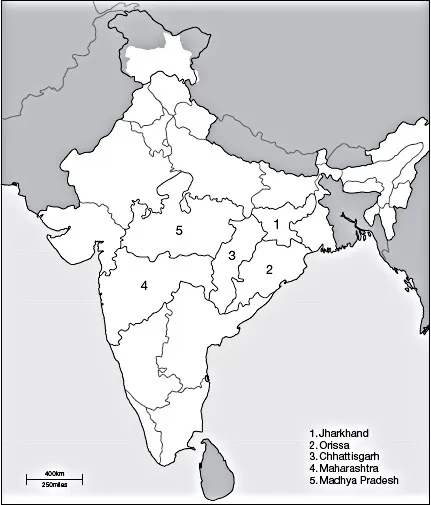
Map 1 Prominent places in Tribal Religions as practiced in India today
1 Tribal religions in India
Practicing tradition today
Practicing tradition today
Joseph Marianus Kujur
Introduction
The terms tribes, indigenous people, Adivasis, or the original settlers of the land are often synonymously used for what are believed to be the earliest populations in India, despite conceptual problems. Most commonly, the generic term for the religions of the tribes in India is “Adi,” which literally means “beginning.” Defining the religions of tribals, Ram Dayal Munda says,
By Adi-dharam we mean the basis, the roots, the beginnings (adi) of the religious beliefs of the Adivasis, the first settlers of India. Such beliefs have been variously known as: animism, animistic religion, primitivism, primitive religion, aboriginal religion, nature religion, adivasi or janjati dharam, sarna dharam, sari dharam, sansari dharam, jahera dharam, bongaism, etc.1
The Indian tribes, the indigenous people of the land (the widely used term for this is “autochthonous”—“of the land”), are believed to be the earliest settlers in the Indian peninsula. They are called “Adivasis” in some parts of India, which means “original inhabitants.” In spite of the diversity among tribes in India, most of them follow the traditional faith and thus have a similar pattern of religious beliefs and practices, which is very different from that of the non-tribes. Since there are innumerable tribal traditions, the focus here is on some major traditions in central and eastern India.
At the outset of this chapter, three assumptions need to be clarified: first, tribals, although demographically non-dominant in India, are culturally distinct from non-tribal groups and are threatened to be assimilated by dominant traditions; second, rather than their characterization by homogeneity, tribes are marked by their diversity and pluralism, and hence there are as many tribal religions in India as there are tribes; and third, religion is only one of the many aspects of tribal identity. Language, territoriality, social organization, economy, cultural ethos, philosophy, worldview, political consciousness, arts and aesthetics, are other aspects of their identity.
When the British ruled India as a colony, they tried to classify information about the tribals by conducting censuses in tribal areas. J. A. Bains, the Commissioner of the Census of 1891, classified in the report the castes according to their traditional occupation. He included a subheading called “Forest Tribes” under the category of “Agricultural and Pastoral Castes.” The number of tribals who were put in the category of “Forest Tribes” was estimated to be nearly 16 million during the census. In the Census Report of 1901, they were classified as “Animists” and in 1911 as “tribal animists or people following tribal religion.” In the Census Report of 1921, they were specified as “Hill and Forest Tribes” and their number was estimated to be 16 million. The Government of India Act of 1935 designated the tribal population as “Backward Tribes.” However, in the Census Report of 1941, they were classified as “Tribes” only and their total population was estimated to be 24.7 million.
In contemporary times, the term tribe, according to Western writers, generally means “an ethnic group, geographically isolated or semi isolated, identified with one particular territory and having distinct social, economic and cultural traditions and practices.” There are no criteria in the Constitution to define and specify the Scheduled Tribes. According to Article 36(25) of the Constitution, Scheduled Tribes means “such tribes or tribal communities or parts of or groups within such tribes or tribal communities as are deemed under Article 342 to be Scheduled Tribes for the purposes of this Constitution.” There is also provision in the law to authorize the Parliament to include or exclude from the list of Scheduled Tribes “any tribal community or part thereof in any State or Union Territory.” The concept of a tribe, in the post-independence period, has undergone a change from that of a political unit of olden days to a group of people identified with poverty and backwardness.2 The tribal population of the country, as per the 2001 census, was 84.3 million, constituting 8.2 percent of the total population of India. More than half of the Scheduled Tribe population was concentrated in the states of Madhya Pradesh, Chhattisgarh, Maharashtra, Orissa, Jharkhand and Gujarat.3
Tribal religions in India: Identity
Classification has been a major issue in understanding tribal populations. Sir Herbert Risley classified the Indian population into seven racial types, of which the three fundamental races are Dravidian, Mongoloid and Indo-Aryan. The other four secondary races are Cytho-Dravidian, Aryo-Dravidian, Mongolo-Dravidian and Pre-Dravidian. J. H. Hutton is of the view that Negrito races were the original occupants of India although the Negroid was absent from Risley's classification. According to the classification of the Indian people by Hutton, Guha and Majumdar, there are six main races with nine subtypes, namely the Negrito; the Proto-Australoid; the Mongoloid—Palaeo-Mongoloids, Tibeto-Mongoloids; the Mediterranean—Palaeo-Mediterranean, Mediterranean, Oriental; the Western Brachycephalis—Alpinoid, Dinaric, Armenoid; and the Nordic. B. S. Guha, in 1952, summed up his conclusions as regards the racial composition of tribal India in terms of first, Negrito strains, such as the Kadar, the Irula and the Paniyan of South India with frizzly hair; second, the Proto-Australoid group to which the tribes of Middle India belong; third, the Brachycephalic Mongoloids of North Eastern India with typical features of the face and eye; and a slightly different Mongoloid type with medium stature, high head and medium nose living in Brahmaputra valley. Majumdar, however, does not support the theory of an ancient Negrito strain in India as he finds no evidence for it.4
Taking a lead from the above classifications, Verma observes that the tribes in India can be broadly classified into three stocks, namely the Negritos, the Mongoloids and the Mediterranean. The Negritos, believed to be the most ancient inhabitants of the Indian Peninsula, have almost disappeared. Their traces are found among the Onge, the Great Andamanese, the Sentinelese, and the Jarwa tribes of the Andaman and Nicobar Islands, and also among the Kadar, the Irula and the Paniyan tribes in Kerala. They can be identified by their dark skin, curly hair, broad nose and medium height.
The Mongoloids are represented by the tribes of the Sub-Himalayan region. They may be further divided into two categories, namely, the Palaeo Mongoloids and the Tibeto Mongoloids. The Palaeo Mongoloids are represented by the tribes of Assam, Meghalaya, Mizoram, Nagaland and Manipur. The Tibeto Mongoloids are represented by the tribes of Sikkim and Arunachal Pradesh. They are believed to have migrated from Tibet. They belong to the Monkhmer and Tibeto-Burmese language families.
The third group of tribes, identified as the Mediterranean people, form a bulk of the tribal population in India. They are generally known as the Dravidians. However, Dravidian is also a name of the linguistic family spoken by these people. The tribes of the Dravidian stock, such as the Gonds, the Kandhs and others, are found in the Chotanagpur Plateau, the Rajmahal Hills region, the Aravalli ranges, the Central Vindhyachal, the Deccan Plateau region and in the Nilgiri Hills. Some of these groups are found in Bangladesh also. The Dravidian language in south India has Tamil, Telugu, Malayalam and Kannada as its representatives. In Central India traces of Dravidian language are found among the Oraons, the Gonds, the Mundas, the Malers, the Khonds and some other tribes. There are two stocks of the Dravidians: firstly, the Kolarians who speak a dialect called Mundari, and secondly, the Dravidians proper whose languages are represented by Tamil, Telugu, Malayalam and Kannada. The Mundas, the Santhals, the Oraons and other tribes inhabiting Chotanagpur Plateau region belong to the Kolarian stock.5
While a four-caste structure is the hallmark of the Hindu society, the tribals do not fit into the caste system. Due to factors such as the tribals' isolation in hills and forests, their subsistence-level agriculture, and their lack of contact with dominant cultures, they are widely viewed as economically and culturally backward people vis-à-vis the so-called advanced and cultured or civilized society in India.6 However, tribals themselves identify with their own distinctive religious and cultural beliefs and practices.
The origin of the tradition—The Oraon myth
In the beginning there was water everywhere. Hence, there was consultation of the heavenly court, including Dharmes (Supreme Being of the Oraon Tribe), old Mother Sita (Consort of Dharmes), and Mahado (Manifestation of Dharmes), on how to make the earth. A maid-servant was giving a massage to Mother's body and in the process some dirt came out. A Golden Kilkila (kingfisher bird) was created out of the dirt to go to the subterranean world in search of the seed of the earth. The Kilkila brought the seed of the earth. The earth was formed by churning the mud in the seven seas and sixteen currents. Sita asked Dharmes to take a walk on the earth. Dharmes went out on the back of the Hansraj horse. Sita asked Dharmes to make human beings. However, when Dharmes made the clay figures, the Hansraj horse trampled them. In order to guard the clay figure...
Table of contents
- Cover
- Half Title
- Full Title
- Copyright
- Contents
- List of illustrations
- List of contributors
- Introduction
- 1 Tribal religions in India: Practicing tradition today
- 2 Hinduism: Practicing tradition today
- 3 Jain traditions: Practicing tradition today
- 4 Buddhism in South Asia: Practicing tradition today
- 5 South Asian Judaisms: Practicing tradition today
- 6 South Asian Christianity: Practicing tradition today
- 7 Islam in South Asia: Practicing tradition today
- 8 Sikhism: Practicing tradition today
- Index
Trusted by 375,005 students
Access to over 1.5 million titles for a fair monthly price.
Study more efficiently using our study tools.
Frequently asked questions
Yes, you can cancel anytime from the Subscription tab in your account settings on the Perlego website. Your subscription will stay active until the end of your current billing period. Learn how to cancel your subscription
No, books cannot be downloaded as external files, such as PDFs, for use outside of Perlego. However, you can download books within the Perlego app for offline reading on mobile or tablet. Learn how to download books offline
Perlego offers two plans: Essential and Complete
- Essential is ideal for learners and professionals who enjoy exploring a wide range of subjects. Access the Essential Library with 800,000+ trusted titles and best-sellers across business, personal growth, and the humanities. Includes unlimited reading time and Standard Read Aloud voice.
- Complete: Perfect for advanced learners and researchers needing full, unrestricted access. Unlock 1.5M+ books across hundreds of subjects, including academic and specialized titles. The Complete Plan also includes advanced features like Premium Read Aloud and Research Assistant.
We are an online textbook subscription service, where you can get access to an entire online library for less than the price of a single book per month. With over 1.5 million books across 990+ topics, we’ve got you covered! Learn about our mission
Look out for the read-aloud symbol on your next book to see if you can listen to it. The read-aloud tool reads text aloud for you, highlighting the text as it is being read. You can pause it, speed it up and slow it down. Learn more about Read Aloud
Yes! You can use the Perlego app on both iOS and Android devices to read anytime, anywhere — even offline. Perfect for commutes or when you’re on the go.
Please note we cannot support devices running on iOS 13 and Android 7 or earlier. Learn more about using the app
Please note we cannot support devices running on iOS 13 and Android 7 or earlier. Learn more about using the app
Yes, you can access South Asian Religions by Karen Pechilis, Selva J. Raj, Karen Pechilis,Selva J. Raj in PDF and/or ePUB format, as well as other popular books in Theology & Religion & Buddhism. We have over 1.5 million books available in our catalogue for you to explore.