eBook - ePub
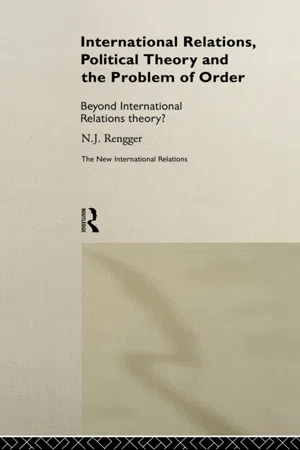
International Relations, Political Theory and the Problem of Order
Beyond International Relations Theory?
- 256 pages
- English
- ePUB (mobile friendly)
- Available on iOS & Android
eBook - ePub
International Relations, Political Theory and the Problem of Order
Beyond International Relations Theory?
About this book
At the turn of the millennium, and now after the fall of the Berlin wall, the best way to map the trajectories of contemporary international relations is hotly contested. Is the world more or less ordered than during the cold war? Are we on the way to a neo-liberal era of free markets and global governance, or in danger of collapsing into a new Middle Ages? Are we on the verge of a new world order or are we slipping back into an old one?
These issues are amongst those that have dominated International Relations Theory in the late 1980s and 1990s, but they have their roots in older questions both about the appropriate ways to study international relations and about the general frameworks and normative assumptions generated by various different methodological approaches. This book seeks to offer a general interpretation and critique of both methodolgical and substantive aspects of International theory, and in particular to argue that International Relations theory has seperated itself from the concerns of political theory more generally at considerable cost to each.
Focussing intially on the 'problem of order' in international politics, the book suggests that International Relations theory in the twentieth century had adopted two broad families of approaches, the first of which seeks to find ways of 'managing' order in international relations and the second of which seeks to 'end' the problem of order. It traces three specific sets of responses to the problem of order within the first approach, which emphasize 'balance', 'society' and 'institutions' and outlines two responses within the second grouping, an emphasis on emancipation and an emphasis on limits. Finally, the book assesses the state of International Relations theory today and suggests an alternative way of reading the problem of order which generates a different trajectory for theory in the twenty first century.
Information
Part I
Managing order?
1
Balance
From at least the mid seventeenth century, and arguably at least from the Renaissance onwards, one principle has been widely seen as the dominant way of securing ‘order’ in the chaotic and anarchic world of interstate politics, in Europe to begin with and later the world. This principle became known as the ‘balance of power’. As Hume famously remarked, however, ‘it is a question whether the idea of the balance of power be owing entirely to modern policy or whether the phrase only has been invented in these later ages’.1 Many have seen the operation of something like what we would today call the balance of power working in all ages, or at least in all ages and places where something resembling a’states system’ has existed.2 Whether that is true or not, however, it was certainly during the eighteenth, nineteenth and twentieth centuries that the principle reached its apogee as a response to the ‘problem of order’ in the context of the European states system and in the twentieth century in particular it became the centrepiece of the most protean and widely discussed approach to international relations of all, to wit, political realism.
Of course, the balance of power has not solely been the province of selfconfessed ‘realists’. As we shall see, many others recognize its force, however much they might also think that it was incomplete or were critical of the way it was deployed. Moreover, the ‘balance of power’ is not a concept that is limited to the ‘international’. Many aspects of ‘domestic’ politics can be seen in roughly these terms and a good deal of contemporary political science analyses them as such.3 Equally, it is by no means only ‘realism’—at least narrowly conceived— that has seen the concept of balance as central to the maintenance of world order. Both those who seek to preserve order in the context of a system of states and those (few though they may have been) who dreamt of replacing such an order with an imperial or hegemonic order—perhaps Napoleon in the immediately heady days after the first consulship or his elevation to the imperial title in 1804 is the most obvious candidate here—emphasized the significance of ‘the balance’ as the central feature of existing international order; whether, in other words, their aim was to maintain it, or overthrow it.
The centrality of ‘balance’ as a way of thinking about international order is thus made manifest in many aspects of the thinking and practice of international relations over the last 200 years. One of the most important traditions of thinking in this context, for example geopolitics, emphasized the importance of the notion of ‘balance’ from the start and sought to give advice on how to balance effectively given the ‘geopolitical’ realities.4 Despite various periods of eclipse, this tradition is still alive and vigorous at the dawn of the twenty-first century and, indeed, in some respects is enjoying something of a renaissance amongst Anglo-American scholars of international relations.5
Moreover, as I have already mentioned, and as I will discuss in more detail in the next chapter, perhaps the most influential British (or anyway British-based) theory of international relations, the so-called ‘English school’, also saw the balance of power as a central feature of the last 200 years of world politics. Two of its central figures, Herbert Butterfield and Martin Wight, both published independent essays on it,6 and in Wight’s more general work the concept also figured prominently, as a central ‘institution’ of international society.7 The very mention of that term, however, illustrates a subtle difference between English school usage and more traditional ‘realist’, geopolitical and machtpolitik uses; or so, at least, I shall argue.
Despite this widespread use, however, it is chiefly political realism that has argued, and continues to argue, that the balance of power is the primary, indeed perhaps the only, guarantor of order in a world of states; and it is realism—in some form or other—that has tended to dominate international relations (the external practice of states) as well as International Relations (the academic study of the external practice of states), throughout the twentieth century. Therefore, it is the realist framing of the notion of balance with which I shall primarily be concerned in this chapter.
To examine properly the appropriateness of the notion of balance as a response to the problem of order we will therefore need to look in some detail at the ways in which realists have deployed it. Thus, this chapter will have three main sections together with a short conclusion. To begin with, I shall look at a number of realist attempts to deploy the notion of balance as the central mechanism for sustaining international order. In the first section, I shall look at the so-called ‘classical realist’ account of the balance of power—the ideas usually associated with the likes of Hans Morgenthau, George Kennan and Rheinhold Niebuhr amongst others—and examine how they related the idea to the problem of order. In the second section, I shall then look at the currently most influential version of realism within academic International Relations—neo-realism—and examine how it deploys the concept in this context. In the third section, I shall then examine three attempts at rewriting and reconstructing realism and its view of the relations between balance and order; the ‘structural’ (and grand historical) realism of Barry Buzan, Richard Little and Charles Jones, the ‘evaluative political realism’ of Roger Spegele and the ‘Augustinian-pragmatic’ realism of Alastair Murray. The fourth and final section then offers a critique of these attempts and tries to point up some of the obvious problems the notion of balance has in dealing with order as I discussed it in the Introduction, closing with a view about the likely prospectus for realism which suggests two very different trajectories for realism in the twenty-first century.
Classical realism: ‘moral realpolitik’ and the balance of power
It is realism, then, that has sought to make this understanding of balance the ‘holy grail’, as it were, of IR theory, however much other thinkers accept its relevance. Of course, realists have long sought to argue that they stand in a long line of thinkers and practitioners to do so, running from Thucydides onwards. Such a list usually includes—as a minimum—Machiavelli and Hobbes as major intellectual figures, and the likes of Richelieu, Metternich and Bismarck as practical ones.8 It would quite often be expanded to include Augustine, say, and Rousseau.9 Whatever the validity of such claims—and I should say that I am pretty unconvinced by them—I am not going to discuss any of these worthies in what follows.10 The reason is very simple. At least as a self-conscious outlook, ‘realism’ is a creature of the nineteenth and—especially—the twentieth centuries and it is on the writers who have developed it in this context that I will concentrate here.11
Origins
As many have pointed out, it is Max Weber who is perhaps the first to state an identifiably ‘realist view’12 and it is largely Weber who sets the scene for the more usual—in International Relations anyway—figures who dominate the tradition. It is worth noting, in this context, that in terms of German domestic politics Weber was a liberal, a national liberal, to be sure, but a liberal nonetheless. It is not perhaps impossible, therefore, to combine some sense of liberalism with political realism, a link I shall come back to a bit later on in both this chapter and Chapter 3.
Of course, it is also true that the sources of twentieth-century realism are many and varied. A reaction against so-called ‘Idealist’ writing in the interwar period is perhaps the most widely cited ‘trigger’ for the self-conscious realist thinking and clearly there was a powerful negative reaction against some of the assumptions widely assumed (at any rate) to have been propagated by writers like Alfred Zimmern, Gilbert Murray, Robert Cecil, G.Lowes Dickinson, Leonard Woolf, Arnold Toynbee and, in the United States, James Shotwell.13 One of the allegedly canonical statements of realism—E.H.Carr’s The Twenty Years Crisis14 —was explicitly written with many of these writers as targets.
However, many of the leading realists—most obviously Morgenthau, Kennan and Niebuhr—came to realism from very different routes. In Morgenthau’s case, the most direct influence was, unquestionably, Weber, though other more subterranean influences may also have been at work. In Niebuhr’s, the most powerful influence would seem to have been the Augustinianism that developed in the course of his work for his Gifford Lectures, The Nature and Destiny of Man.
Unquestionably, too, the political events and experiences of the interwar period in particular also left their mark, as they did on many of the actors who were to become noted realist policymakers, particularly in the United States, most obviously on Kennan and on that ‘practitioner’ who, along with Henry Kissinger, is perhaps the best known advocate of realism in US politics, Dean Acheson.15
It is perhaps also not entirely irrelevant that the full flowering of twentiethcentury realist theory took place not in Europe (where perhaps it was regarded as too obvious to need ‘theorizing’) but in the United States, and specifically in the contexts both of the emergence of the United States as an unambiguous world power between 1940 and 1950 and of the requirements and needs of a number of US-based European exiles. A number of the most celebrated ‘realists’ were of European origin, émigrés who made their names and reputation in the United States but whose formative experiences and education had been European. This is true, for example, of Morgenthau and of Arnold Wolfers,16 and also of Kissinger, of course, though he was younger.
It is perhaps an interesting irony that realism became dominant in the academic study of international relations partly through the numerical dominance of USbased scholarship—Stanley Hoffmann’s celebrated ‘American Social Science’ of International Relations17—but partly due also to the influence of Europeantrained or domiciled thinkers who fled Europe in the run-up to the Second World War or just after.18
Obviously any attempt to summarize the views of all of these thinkers, writers and practitioners would be as impossible as it would be impolite and I shall not even attempt to do so here. Rather I shall look at the manner in which the balance of power is treated by realists in general, and in particular by the most influential ‘older’ realist theorists—usually termed the ‘classical’ realists— and especially by Morgenthau, unquestionably the most influential realist ‘theorist’ for the study of international relations.19 In the next section, I shall then contrast this with the currently most influential version of realism in academic circles—usually called neo-realism—where I will focus in particular on the arguments of Kenneth Waltz, who largely created this version of realism, though I shall also look at some recent reworkings of Waltzian themes in the hands of some of the more influential younger ‘neo-realists’, especially Stephen Walt and John Mearsheimer. Finally, I shall look at some contemporary re-evaluations of realist thinking that I call ‘revisionist realisms’.
Before I do any of this, however, I want to make one final point. ‘Realism’, in general discussions of international relations, even in some academic discussions, is perhaps most commonly seen as a version of what, in nineteenth-century German thought, was called Machtpolitik and which the Renaissance and early modern period called raison d’état, or reason of state.20 There is a lot that could and should be said about this. I will simply say that, as I understand them, and powerful though the influence of aspects of this tradition were on the realists, they must be seen as distinct from this tradition. As indicated above, a view of politics as simply about power—and thus wholly ‘explanatory’—could offer no real account of the problem of order and certainly not attempt a solution to it. Realism most certainly tried to do both. Ergo it must, at least superficially, develop a view of politics that goes beyond the simple machtpolitik made famous by Treitschke and so ably chronicled by Meinecke.
Framework
Classical realism is hardly all of a piece. Any body of thought which contains Acheson, Kennan, Morgenthau, Niebuhr, Kissinger—to say nothing of (allegedly) Metternich, Talleyrand, Castlereagh and Bismarck as well—could scarcely be seen as being so. However, to all intents and purposes there are a set of shared views which the twentieth-century realists at least tended, in broad terms, to share and which provide the general background for the way that they think about international order and the role of the balance of power in maintaining that order. As Michael Smith has said,
realism contains three main aspects, which various theorists emphasise differently First, and most broadly, realism purports to be a general theory explaining the essence of international politics. Second some writers draw on the precepts of realism—without necessarily regarding it as a general theory—to advocate, criticise or justify specific policies for a given state. Finally the notion of realism is often advanced as a particular solution to the vexed problem of the place of moral considerations in foreign policy.21
As he also points out, it is fruitless to look for ‘true’ realism (as fruitless as it would be to look for ‘true’ liberalism), though, as we shall see, neo-realism has elicited the claim that it is not, perhaps fully, ‘realistic’ in the sense meant by classical realist thought.
In Smith’s view, and it is one shared with some minor qualifications by most recent scholars of realism,22 there are four key components of the ‘general set’ of realist beliefs. First, the assumption that human nature is universal, however varied its manifestations may be, and that among the most important aspects of this universal human nature is a universal animus dominandi, a lust to dominate, whether such a view be put in theological terms (as it was by Niebuhr) or in more secular terms (as it has been more generally put). Second, ‘realists assume that the important unit of social life is the collectivity and that in international politics the only important collectivity is the state, which recognises no authority above it’.23 Third, they believe that power and its pursuit by individuals and states is both ‘ubiquitous and inescapable. From Weber to Kissinger [and one might add from Kissinger to Waltz] conflicts of power constitute the essence of international politics’.24 Fourth, it follows that the real issues of international politics can be understood in terms of the rational analysis of competing interests defined ...
Table of contents
- Cover Page
- Title Page
- Copyright Page
- Series editor’s preface
- Preface
- Acknowledgements
- Introduction
- Part I: Managing order?
- Part II: Ending order?
- Epilogue
- Select bibliography
Trusted by 375,005 students
Access to over 1.5 million titles for a fair monthly price.
Study more efficiently using our study tools.
Frequently asked questions
Yes, you can cancel anytime from the Subscription tab in your account settings on the Perlego website. Your subscription will stay active until the end of your current billing period. Learn how to cancel your subscription
No, books cannot be downloaded as external files, such as PDFs, for use outside of Perlego. However, you can download books within the Perlego app for offline reading on mobile or tablet. Learn how to download books offline
Perlego offers two plans: Essential and Complete
- Essential is ideal for learners and professionals who enjoy exploring a wide range of subjects. Access the Essential Library with 800,000+ trusted titles and best-sellers across business, personal growth, and the humanities. Includes unlimited reading time and Standard Read Aloud voice.
- Complete: Perfect for advanced learners and researchers needing full, unrestricted access. Unlock 1.5M+ books across hundreds of subjects, including academic and specialized titles. The Complete Plan also includes advanced features like Premium Read Aloud and Research Assistant.
We are an online textbook subscription service, where you can get access to an entire online library for less than the price of a single book per month. With over 1.5 million books across 990+ topics, we’ve got you covered! Learn about our mission
Look out for the read-aloud symbol on your next book to see if you can listen to it. The read-aloud tool reads text aloud for you, highlighting the text as it is being read. You can pause it, speed it up and slow it down. Learn more about Read Aloud
Yes! You can use the Perlego app on both iOS and Android devices to read anytime, anywhere — even offline. Perfect for commutes or when you’re on the go.
Please note we cannot support devices running on iOS 13 and Android 7 or earlier. Learn more about using the app
Please note we cannot support devices running on iOS 13 and Android 7 or earlier. Learn more about using the app
Yes, you can access International Relations, Political Theory and the Problem of Order by N. J. Rengger in PDF and/or ePUB format, as well as other popular books in Politics & International Relations & Political Philosophy. We have over 1.5 million books available in our catalogue for you to explore.