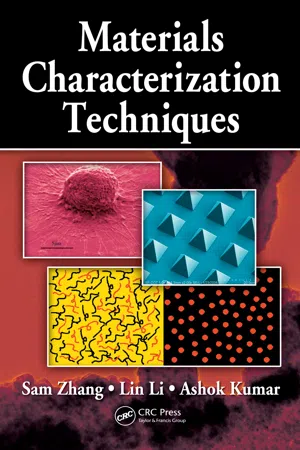
Experts must be able to analyze and distinguish all materials, or combinations of materials, in use today-whether they be metals, ceramics, polymers, semiconductors, or composites. To understand a material's structure, how that structure determines its properties, and how that material will subsequently work in technological applications, researche
- 344 pages
- English
- PDF
- Available on iOS & Android
eBook - PDF
Materials Characterization Techniques
About this book
Information

2
Materials
Characterization
Techniques
Infrared
spectroscopy
(IR)
is
introduced
in
Chapter
9
from
the
angle
of
molecular
vibration
and
resonance,
followed
by
advanced
IR
and
Fourier
transform
infrared
spectroscopy
(FTIR).
UV
absorption,
Beer-Lambert
law,
Ultraviolet/visible
spectroscopy
and
a
case
study
are
covered
in
this
chapter.
Chapter
10
gives
three
kinds
of
methods
of
macro
and
micro
ther-
mal
analyses:
differential
scanning
calorimetry
(DSC),
isothermal
titra-
tion
calorimetry
(ITC),
and
thermogravimetric
analysis
(TGA).
DSC
and
ITC
can
be
either
macro
or
micro-scaled.
A
variety
of
thermal
transitions
and
thermodynamic
interactions
can
be
determined
by
means
of
DSC
or
ITC.
On
the
other
hand,
TGA
is
used
to
determine
thermal
stability
or
thermal
reactions.
In
Chapter
11,
the
fundamentals
about
fluorescence
and
fluorescent
dyes
are
introduced,
followed
by
fluorescence
microscopy
and
principle
of
laser
confocal
fluorescence
microscopy
(LCFM).
Sample
preparation,
resolution
of
LCFM,
selection
of
objective
lenses
and
case
studies
are
covered.
Table of contents
- Front cover
- Contents
- Preface
- Chapter 1. Introduction
- Chapter 2. Contact Angle in Surface Analysis
- Chapter 3. X-ray Photoelectron Spectroscopy and Auger Electron Spectroscopy
- Chapter 4. Scanning Tunneling Microscopy and Atomic Force Microscopy
- Chapter 5. X-ray Diffraction
- Chapter 6. Transmission Electron Microscopy
- Chapter 7. Scanning Electron Microscopy
- Chapter 8. Chromatographic Methods
- Chapter 9. Infrared Spectroscopy and UV/Vis Spectroscopy
- Chapter 10. Macro and Micro Thermal Analyses
- Chapter 11. Laser Confocal Fluorescence Microscopy
- Index
- Back cover
Trusted by 375,005 students
Access to over 1.5 million titles for a fair monthly price.
Study more efficiently using our study tools.
Frequently asked questions
Yes, you can cancel anytime from the Subscription tab in your account settings on the Perlego website. Your subscription will stay active until the end of your current billing period. Learn how to cancel your subscription
No, books cannot be downloaded as external files, such as PDFs, for use outside of Perlego. However, you can download books within the Perlego app for offline reading on mobile or tablet. Learn how to download books offline
We are an online textbook subscription service, where you can get access to an entire online library for less than the price of a single book per month. With over 1.5 million books across 990+ topics, we’ve got you covered! Learn about our mission
Look out for the read-aloud symbol on your next book to see if you can listen to it. The read-aloud tool reads text aloud for you, highlighting the text as it is being read. You can pause it, speed it up and slow it down. Learn more about Read Aloud
Yes! You can use the Perlego app on both iOS and Android devices to read anytime, anywhere — even offline. Perfect for commutes or when you’re on the go.
Please note we cannot support devices running on iOS 13 and Android 7 or earlier. Learn more about using the app
Please note we cannot support devices running on iOS 13 and Android 7 or earlier. Learn more about using the app
Yes, you can access Materials Characterization Techniques by Sam Zhang,Lin Li,Ashok Kumar in PDF and/or ePUB format, as well as other popular books in Physical Sciences & Spectroscopy & Spectrum Analysis. We have over 1.5 million books available in our catalogue for you to explore.