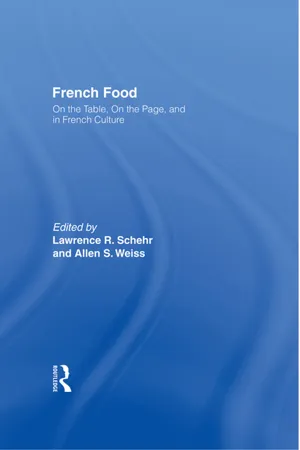
More than a book about food alone, French Food uses diet as a window into issues of nationality, literature, and culture in France and abroad. Outstanding contributors from cultural studies, literary criticism, performance studies, and the emerging field of food studies explore a wide range of food matters.
eBook - ePub
French Food
On the Table, On the Page, and in French Culture
- 288 pages
- English
- ePUB (mobile friendly)
- Available on iOS & Android
eBook - ePub
About this book
Information
1. A Cultural Field in the Making: Gastronomy in Nineteenth-Century France
PRISCILLA PARKHURST FERGUSON
Introduction—Cultural Fields
Although it has been applied to many enterprises, the concept of "field" has proved especially fruitful for the analysis of intellectual and cultural activities. Elaborated in its specifically sociological usage by Pierre Bourdieu (Bourdieu, "Intellectual"), "field" designates the state of a cultural enterprise when the relevant productive and consumption activities achieve a certain (always relative) degree of independence from direct external constraints (i.e., those of State and Church for the arts in premodern Europe). As a "particular social universe endowed with particular institutions and obeying specific laws," a field translates external economic or political phenomena into its own terms for its own use, or, rather, for the use of its occupants (Bourdieu, Field 162-63). To the extent that the norms governing conduct, the values inducing behavior, and the rewards determining production operate according to field-specific standards, a field is self-regulating, self-validating, and self-perpetuating.
Thinking in terms of cultural fields modifies our understanding of cultural enterprises. Against the functional divisions that tend to be drawn for such activity, a field constructs a social universe in which all participants are at once producers and consumers caught in a complex web of social, political, economic, and cultural relations that they themselves have in part woven and continue to weave. Against unilinear, univocal approaches that focus on discrete structures, historical incident, or individual producers and products, the complex, dynamic configuration of social and cultural relations proposed by a cultural field offers a model that can do justice to the many and diverse modes of cultural participation on the part of a broad range of individuals, institutions, and ideas. The foundations of the cultural field are laid by neither the singular cultural product nor the producer, but by a spectrum of products and practices that displays the workings of the field as a whole.
Cultural fields have an advantage over encompassing sectors like politics or the economy in that they focus our attention on tangible products and identifiable pursuits. A sustained concentration on cultural fields—their internal disposition as well as their external relations—stocks the sociological arsenal with the kind of controlled studies that integrate empirical, historical evidence into a conceptual framework. The more circumscribed the field, the more solid the ground for sociological scrutiny. It is not surprising, then, to find that the most successful studies work with the specifics of a given sphere of cultural production: the "literary field" proposes a delimited space for investigation; a vast, necessarily imprecise construct like the "field of power" invites speculation.1 The more limited focus facilitates situating the field as a historical entity as well as a sociological concept. The analysis below also demonstrates that this particularity of focus also furnishes useful analytical distinctions between related but distinct notions such as "field," "culture," and "world"—all of which have been invoked in contemporary sociological discussions, particularly, although not exclusively, for the arts.
A sharper use of the concept of "cultural field" and the power to focus inquiry go far to account for the specifically sociological interest of gastronomy in nineteenth-century France. As a relatively delimited cultural enterprise, the pursuit of culinary excellence that we call gastronomy enables us to address a number of problems that plague discussions of cultural fields. Most notably, it speaks to the sticky issue of antecedents. For, however good an idea we may have about how certain fields operate, we know rather less about how they got to be fields.2 It is true that any search for "causes" or even "origins" is doomed to fail. Yet the question must be put: At what point do structures and sensibilities, institutions and ideologies, practices and practitioners cohere to "make" the configuration that we designate a cultural field? To this question gastronomy proposes some answers. For, although the culinary arts in the West can be traced to the Greeks and especially the Romans, gastronomy as a modern social phenomenon is instituted in early-nineteenth-century France. It is then, I shall argue, that the culinary arts moved into public space and acquired a public consciousness that justifies identification as a "gastronomic field."
Gastronomy turns out to be a happy choice. On the one hand, it speaks to the broad controversy over the meanings of modernity, and, on the other, it addresses an issue that is unavoidable in almost any discussion of nineteenth-century French society, namely, the real or supposed effect of the Revolution of 1789. In what sense can a given cultural venture be considered "modern"? If debates over modernity and modernization, as well as assertions about cultural fields, tend to assume that the visibly changed and changing society of the nineteenth century favored the separation of cultural enterprises into relatively distinct and autonomous domains, it is not at all clear how this transformation occurred. To evoke literature for a moment, in what ways does the Republic of Letters—a term that recurs regularly in eighteenth-century French intellectual life as a designation for networks of writers and thinkers—differ from the literary field of the nineteenth? For the culinary arts, how is nineteenth-century gastronomy "modern," or distinct from elite culinary practices in the seventeenth and eighteenth centuries?
If the paradox of eating, as Simmel pointed out in a quirky but suggestive piece, is that this physiological activity shared by every human being should give rise to such extraordinary social differentiation, it is clear that modern gastronomy enriched the social order by exacerbating those distinctions. Gastronomy constructed its modernity through an expansive culinary discourse, and, more specifically, through texts. Gastronomic texts were key agents in the socialization of individual desire and the redefinition of appetite in collective terms. The "second-order" culinary consumption of textual appreciation was as crucial for the construction of the gastronomic field as it was (and is) for its operation. Such writings extended the gastronomic public or "taste community" well beyond immediate producers and consumers. Diners, thus converted into readers, became full-fledged participants in the gastronomic field. The public sustained the gastronomic field and the field determined the public. As with the performing arts, writing about food presupposes a different order of consumption inasmuch as the cultural product in question is at one remove from the base product—the work performed, seen or heard, and, in this instance, the food prepared and consumed. These culinary texts of indirection were indispensable for the gastronomic field because they stabilized the ephemeral culinary product within a network of nonculinary discourse and because they redefined the culinary as broadly cultural production. Texts, both instrumental and intellectual, are therefore critical in making food what Mauss (1) identified as a "total social phenomenon"—an activity so pervasive in society that, directly or indirectly, it points to and derives from every kind of social institution (religious, legal, and moral) and every type of social phenomenon (political, economic, and aesthetic). That food so penetrates the social fabric is the work of many factors, but pride of place surely goes to these texts and writings. To turn singular food events into a veritable cultural configuration, to transform a physiological need into an intellectual phenomenon, dictates powerful vehicles of formalization and diffusion. The gastronomic writings that proliferated over the nineteenth century supplied the mechanisms that brought the culinary arts into modern times.
In France, reflections on modernity further necessitate coming to terms with the Revolution. What responsibility for the institution of a recognizably modern social and cultural order can be ascribed to the many and varied phenomena associated with the Revolution and its immediate consequences?—the abolition of the monarchy, the elimination of traditional economic constraints on commerce, the foreign wars and domestic political turmoil, to list only the most obvious elements.3 Given that the theoretical model of the cultural field in no way demands that all fields have the same degree of coherence or follow the same logic, the connections of cultural fields to both modernity and the Revolution argue for comparative analysis, across fields as across societies. The sociological issue then becomes the identification of those factors that distinguish gastronomy in France—as a historical phenomenon and as a cultural practice. To what degree is this field anchored in, and therefore definable in terms of, distinctive cultural traditions and particular historical circumstances?
The gastronomic held took shape in two major phases: emergence over the first half of the nineteenth century, consolidation thereafter. The resulting cultural formation carried "French cuisine" well beyond a circumscribed repertoire of culinary products to comprehend the practices and products, values and behavior, rules and norms, institutions and ideas that are attendant upon the preparation and consumption of food in this particular social setting. The gastronomic field turned a culinary product into a cultural one. This cuisine became "French" as it had not been in the seventeenth and eighteenth centuries when the culinary arts were associated with the court and the aristocracy, not the nation. Nineteenth-century culinary institutions and texts effectively transformed the patently class-based culinary product and practices of the ancien régime into a prime touchstone of national identity.4 The consequent identificatory power of cuisine as a fundamental attribute of "Frenchness" and the high rank of the gastronomic field in the hierarchy of cultural fields in France are a function of the strength, the extent, and the multiple and prestigious associations of the gastronomic field, notably, its many and varied affiliations with the literary field.
Five structural factors signal the transformation of gastronomy into the gastronomic field. First, new social and cultural conditions stimulated production, sustained broad social participation, and encouraged a general cultural enthusiasm for the product in question. Second, specific sites came to be dedicated to cultural production and consumption. Third, the institution of standards and models of authority ensured an acute critical consciousness that focused and checked, yet also legitimated the expressions of cultural excitement. Fourth, subfields generated by continued expansion of the field assured the simultaneous concord and conflict of the parties involved, the consonance and dissonance of new positions and alliances. The resulting interlocking networks of individuals and institutions forged links with adjacent fields, and it is these linkages that were largely responsible for the social prestige of gastronomy.
As the formulation of these held qualities suggests, I conceive of gastronomy in nineteenth-century France as something of a template for the analysis of cultural fields more generally. Its lessons reach well beyond the kitchen and the dining table. Certainly, to appreciate a cultural field in the making is to grasp the concept and its use in a more rigorous way, but to do so raises an intriguing problem. To actually see a cultural field in the making requires a delicate conjunction of historical and sociological recognition. The emerging historical phenomenon and social structure must be apprehended, in a word, simultaneously.
The discussion below begins by locating the foundations of the gastronomic field in France in the complexity and the confluence of institutions, traditions, attitudes, events, and ideas. A second section then deals with the articulation of these phenomena in what I have termed culinary discourse. Without such a discouse, I argue, there can be no cultural field. The sociologist must, then, pay careful attention to the specific terms of the discourse. A third section and conclusion assess the validity of the gastronomic field as an analytic category by considering it against other, related cultural fields. We shall find here that the vitality of this particular cultural field depends absolutely on its relations to other fields.
I. Foundations of the Gastronomic Field
Taken as the systematic, socially valorized pursuit of culinary creativity, gastronomy began with the nineteenth century and it began in France. The very term came into public view in 1801,5 followed by gastronome two years later to designate a new social status of the consumer of elaborately prepared fine food.6 Like any new social practice gastronomy drew on a nexus of social, economic, and cultural conditions. It shaped to its own ends the standard exemplar of cultural communication linking supplies, producers, and consumers in a set of common understandings. For gastronomy, this model translates into: first, abundant, various, and readily available food stuffs; second, a cadre of experienced producers (chefs) in a culturally specific site (the restaurant), both of which are supported by knowledgeable, affluent consumers (diners); and third, a secular cultural (culinary) tradition.7 All of these elements—the food, the people and places, the attitudes and ideas—came together in early-nineteenth-century France with a force hitherto unknown and, indeed, unsuspected.
Foods
Paris has long been known for its profusion of foodstuffs and range of food providers—from butchers and caterers to pastry makers and cabaret owners—all of which prompted an appreciative Venetian ambassador in 1577 to report that "Paris has in abundance everything that can be desired." With food coming "from every country . . . everything seems to fall from heaven" (qtd. in Revel, Festin 150—51). Two centuries later the great urban ethnographer Louis-Sébastien Mercier showed a city even more intensely involved in satisfying the gustatory needs and desires of its inhabitants with an estimated 1,200 cooks at diners' beck and call (1:1011). Even so, the gastronomic level of nineteenth-century Paris was unmistakably of a different order, fueled, as it was, by more and more wealthy people as well as more and more varied foods brought faster from further away.
In Europe as a whole the eighteenth century saw the end of the cyclical famines that had regularly ravaged the continent for centuries and had been such a part of everyday life. In response to demographic pressures, production increased as the expansion of the transportation system transformed agriculture from a subsistence to a commercial enterprise geared to an increasingly broad market (Teuteberg and Flandrin, "Transformations" 725-26). Specifically for France, with the end of the food shortages of the immediate Revolutionary period, and despite the British naval blockade, the early century proved a period of alimentary abundance, certainly for the urban elites responsible for making gastronomy a distinctive social practice. The great chef Antonin Careme was especially sensitive to the deleterious effects of the "great revolutionary torment" on the "progress of our [culinary] art" for ten years or so, and breathed an audible sigh of relief over the far more favorable conditions in the following years (Pâtissier, 1: xxxii). As observers of the urban scene never tired of pointing out, every country now had its national foods in Paris, with the result that the adventurous diner could take a trip around the world without leaving the table (Briffault 180-81). When Brillat-Savarin observed with evident pride that a Parisian meal could easily be a "cosmopolitan whole" ([1839] 329), this acute observer of culinary mores meant what he said. In support of the claim that foods came from all over, the sixteenth-century visitor to Paris gave a list of the French provinces; nineteenth-century claimants were talking instead about Europe, Africa, America, and Asia.
Restaurants: Producers and Consumers in Public Space
The haute cuisine of the ancien régime served the court and the Parisian aristocracy, but modern culinary creativity centered in the restaurant. Although the restaurant antedated 1789—the first urban establishment by that name dates from 1765—the Revolution set the restaurant on its modern course of development. By doing away with all restrictions on which establishments could serve what foods in what form, the abolition of the guilds spurred culinary competition and prompted a number of former chefs to the now exiled members of the aristocracy to put their culinary talents in the service of a general elite public (as opposed to a private patron). The restaurants they opened became a notable feature of the urban landscape. Finally, the demise of the monarchy and the court ended the partition of political, commercial, and cultural life between Versailles and Paris, which was henceforth concentrated entirely in the capital. Politicians and businessmen, journalists, writers, and artists flocked to the city and to its restaurants. It was not simply the dramatic increase in population—Paris doubled in size between 1800 and 1850—that was so important a condition for the gastronomic field. The fluid population of largely middle-class transients moving in and out and around the city stimulated the development of eating establishments of many sorts; the hundred or so restaurants found in Paris in the late eighteenth century increased by a factor of six during the Empire, and by the 1820s numbered over three thousand (Pitte, "Naissance" 773). As Brillat-Savarin recognized at the time, competition became intense once it became clear that "a single well prepared stew could make its inventor's fortune." As a result self-interest "fired every imagination and set every cook to work" (Brillat-Savarin, Physiologie 1839,...
Table of contents
- Cover
- Title
- Copyright
- Contents
- INTRODUCTION Hors d'Oeuvres
- 1. A Cultural Field in the Making: Gastronomy in Nineteenth-Century France
- 2. Grimod de la Reynierè's Almanach des gourmands: Exploring the Gastronomic New World of Postrevolutionary France
- 3. Culina Mutata: Caremê and I'ancienne cuisine
- 4. Tastes of the Host
- 5. Agape and Anorexia: Decadent Fast and Democratic Feast
- 6. Colette's "Écriture gourmande"
- 7. Monsieur Marcel's Gay Oysters
- 8. Savory Writing: Marcel Rouff's Vie et Passion de Dodin-Bouffant
- 9. Diet and Ideology in Corps et âmes
- 10. Existential Cocktails
- 11. The Betrayal of Moules-frites: This Is (Not) Belgium
- 12. Eating Your Way Out: The Culinary as Resistance in Ferdinand Oyono's Le Vieux Négre et la médaille
- 13. The Politics of Food in Post-WWII French Detective Fiction
- 14. Film, Food, arid "La Francité": From le pain quotidien to McDo
- 15. Screening Food: French Cuisine and the Television Palate
- 16. Tractatus Logico-Gastronomicus
- BIBLIOGRAPHY
- CONTRIBUTORS
- INDEX OF NAMES
- INDEX OF CUISINE
Trusted by 375,005 students
Access to over 1.5 million titles for a fair monthly price.
Study more efficiently using our study tools.
Frequently asked questions
Yes, you can cancel anytime from the Subscription tab in your account settings on the Perlego website. Your subscription will stay active until the end of your current billing period. Learn how to cancel your subscription
No, books cannot be downloaded as external files, such as PDFs, for use outside of Perlego. However, you can download books within the Perlego app for offline reading on mobile or tablet. Learn how to download books offline
We are an online textbook subscription service, where you can get access to an entire online library for less than the price of a single book per month. With over 1.5 million books across 990+ topics, we’ve got you covered! Learn about our mission
Look out for the read-aloud symbol on your next book to see if you can listen to it. The read-aloud tool reads text aloud for you, highlighting the text as it is being read. You can pause it, speed it up and slow it down. Learn more about Read Aloud
Yes! You can use the Perlego app on both iOS and Android devices to read anytime, anywhere — even offline. Perfect for commutes or when you’re on the go.
Please note we cannot support devices running on iOS 13 and Android 7 or earlier. Learn more about using the app
Please note we cannot support devices running on iOS 13 and Android 7 or earlier. Learn more about using the app
Yes, you can access French Food by Lawrence R. Schehr,Allen S. Weiss in PDF and/or ePUB format, as well as other popular books in Littérature & Critique littéraire française. We have over 1.5 million books available in our catalogue for you to explore.