![]()
1
PREPARE/ENRICH Program for
Premarital and Married Couples
Amy Olson-Sigg and David H. Olson
The chapter details the two components of the PREPARE/ENRICH couple program: the online assessment and the relationship skill-building exercises. While this program is used with dating, engaged, and married couples, the clinical case study is that of a premarital couple. The program is designed so that it can be integrated into most other theoretical and therapeutic models for working with couples.
The fifth version of PREPARE/ENRICH, released in 2008, is called the Customized Version, since it tailors the assessment to each couple based on their responses to background questions (Olson & Larson, 2008). The Customized Version is designed for couples across various relationship stages—from premarital, cohabiting, engaged, and married—and various family structures, including those with children, stepchildren, or intergenerational issues. Based on their stage, the couple receives scales and items that are relevant for their relationship. To minimize couple collaboration in taking the assessment, the items are randomly presented to each person in a different order. After each person has completed the online assessment, the counselor can immediately view and print a comprehensive PREPARE/ENRICH Facilitator's Report (20–25 pages) on the couple relationship.
Theoretical Foundations and Assumptions
of PREPARE/ENRICH
PREPARE/ENRICH is rooted in systems and multidisciplinary theories of structural theory, personality, strengths, and communication. The first component of PREPARE/ENRICH is the assessment, which measures the personality of each person, the couple's interpersonal dynamics, their couple and family system (Circumplex model), their relationship strengths, and major stressors. There are 10 core scales in PREPARE/ENRICH and they are: communication, conflict resolution, partner style and habits, financial management, leisure activities, affection and sexuality, family and friends, children and parenting, relationship roles, and spiritual beliefs. The individual and couple are conceptualized as mutually dependent, interactive subsystems, and the variables assessed are also considered interactive and systemically interrelated.
The second component of PREPARE/ENRICH is theoretically psycho-educational, solution-focused, and structural as it attempts to teach relationship skills the couple needs based on the assessment findings. The program contains over 20 couple exercises that teach and build relationship skills while resolving problematic issues. Each couple receives a Couple Workbook that contains the 20 couple exercises. The six specific goals of the couple exercises are:
- Identifying and sharing strength and growth areas
- Strengthening communication skills—teaching assertiveness and active listening
- Helping the couple define and articulate what they desire for their relationship
- Understanding couple and family systems (based on the Circumplex Model of cohesion and flexibility)
- Identifying and resolving major stressors
- Comparing personalities and increasing compatibility
There are several assumptions of this program that relate to how the assessment and program were developed and how it is delivered. First, it is assumed that if a couple is taught relevant relationship skills, they will be able to deal more effectively with their current and any future problems. Second, it is assumed that the PREPARE/ENRICH couple assessment will significantly increase the effectiveness of the intervention and the couple relationship. This finding is based on several studies, including one completed using PREPARE/ENRICH (Knutson & Olson, 2003), which found that the assessment increased the impact of the program by about 30%. Third, it is assumed that the impact of the assessment and exercises are systemic, so that making a positive change in any component will have an impact on the entire system. This was in fact found in the study by Knutson and Olson (2003) that used six couple exercises, but found significant improvement in 15 major areas. A similar finding was reported in a study using the RELATE Couple Inventory, where skill-based training in addition to assessment and feedback resulted in the best relationship satisfaction and skill outcome (Halford, Verner, Wilson, & Larson, 2010). Lastly, it is assumed that the program empowers couples to take greater control over their own relationship and enables them to apply these principles to help their relationship grow over time.
Case Study
Treatment Process With a Premarital Couple: Early Phase
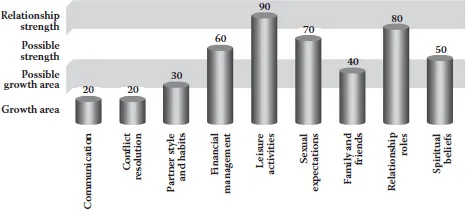
Daniel and Maria are a typical premarital couple in that they have some strengths and some issues (growth areas), and they are quite idealistic about their relationship. The PREPARE/ENRICH couple typology showed Daniel and Maria as being a “conventional” couple (see Figure 1.1). As a conventional couple, Daniel and Maria have several strength areas, including leisure activities, relationship roles, sexual expectations, and spiritual beliefs. Their growth areas (issues) are in communication, conflict resolution, partner style and habits, and family and friends.
FIGURE 1.1 Conventional couple type as determined by PREPARE/ENRICH couple typology.
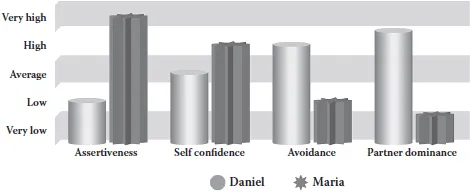
The Relationship Dynamics section of the Facilitator's Report indicated low assertiveness for Daniel and high assertiveness for Maria. Daniel also tends to minimize issues (high on avoidance) and is reluctant to deal with them directly, while Maria is generally able to identify and discuss issues they are having in their relationship. As a result, Daniel feels controlled in their lives together (high in partner dominance) and he has lower self confidence (see Figure 1.2).
The Personal Stress Profile section of the Facilitator's Report reveals Daniel's top stressors as being “current living arrangement” and “decisions about wedding details.” Maria's top stressors were “financial concerns,” “dealing with the wedding party,” and “decisions about wedding details.” Overall, Daniel reports very high levels of personal stress, and Maria reports moderate levels of personal stress.
FIGURE 1.2 Relationship dynamics section of the facilitator's report.
Background Information
Daniel and Maria are both 27 years old, have known one another for 1.5 years, and have been engaged for 6 months. Maria reports having broken off the relationship with Daniel once during the time of their courtship. Maria owns a home in the suburbs and rents to a roommate; Daniel rents an apartment in a city. Daniel works as a chemistry teacher in an urban high school; Maria is completing her MBA and is employed part-time. She receives financial assistance from her parents to help with bills while she finishes school. Maria is an only child and her parents are married. Daniel's parents are divorced, and he was reared in a blended family and is the second of two biological children and has also two stepbrothers and one stepsister.
Assessment and Case Conceptualization
PREPARE/ENRICH results show relationship dynamics that may be interfering with Daniel and Maria's ability to communicate effectively and resolve conflict. Daniel's low assertiveness and Maria's high assertiveness, along with Daniel's high avoidance tendencies, may be contributing to Daniel's very high levels of stress and frustration as well as low scores in conflict resolution and communication. Maria scored considerably higher in these areas, because it is believed that her assertiveness increases the likelihood she will get what she wants. Daniel may have learned avoidance in his family of origin as a way to cope with feelings of helplessness in his family.
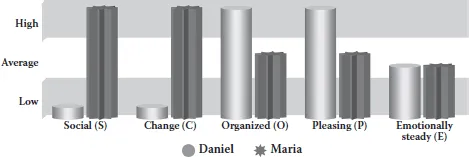
The SCOPE Personality scale reveals personality traits that may contribute to the stressors Daniel and Maria are currently experiencing (see Figure 1.3). Daniel scored very low on the “social” and “change” areas, but much higher than Maria in “organization” and “pleasing.” These differences in personality also are reflected in how they handle stress. Maria tends to get angry, while Daniel internalizes and becomes more anxious. It is theorized that Maria's high stress over wedding planning may be due to her lower level of organization and that shifting some of these responsibilities to Daniel may alleviate stress for Maria, increase Daniel's self-confidence, and allow a space to practice communication and conflict resolution skills.
FIGURE 1.3 SCOPE Personality scale.
Major Treatment Goals Established
The first goal of therapy was to improve Daniel and Maria's communication skills, specifically his lack of assertiveness and their difficulty with active listening. The second goal was to use their improved communication skills to help them reduce some of their current stress around the wedding and new living plans. The third goal was to help them better understand the relationship between their current couple relationship and their family of origin and to help them to be more proactive about not repeating destructive patterns from their families.
Treatment Process and Strategies: Middle Phase
Daniel and Maria met with their therapist for four 90-minute sessions. During these sessions they completed the core six PREPARE/ENRICH exercises in addition to two other exercises on “stress,” a “leisure” exercise, and three “financial” exercises. The exercises they completed were collaboratively determined by the therapist and the couple using PREPARE/ENRICH Report results as one data point. Daniel and Maria were given a Couple's Workbook (containing over 20 exercises) with additional exercises to complete on their own and with tips to continue building closeness and flexibility in their relationship.
The communication exercise (teaching assertiveness and active listening) is considered to be one of the core areas. The goal is to help Daniel gain control and structure in the relationship by expressing his feelings to Maria, particularly his negative feelings. Facilitating this process of assertiveness and active listening will allow Daniel to be heard and for Maria to demonstrate understanding. Daniel and Maria will establish goals and identify and deal with their immediate stressors using these communication skills.
During the first session, Daniel and Maria appeared hesitant, anxious, and uncomfortable. They laughed nervously when discussing their “strengths” and “growth areas,” and Daniel made several jokes, perhaps in an attempt to provide comic relief. Daniel was challenged by the assertiveness exercise and used explanative comments and humor to soften the effect of his assertiveness.
Daniel and Maria completed an exercise called “creating a wish list using assertiveness and active listening.” This exercise interrupts dysfunctional communication patterns by providing a new way to communicate. This process slows down communication and forces the speaker to use assertiveness and the listener to tune into both the content and feeling of the speaker's message. The therapist attends to body language and eye contact, redirecting the couple when necessary to speak to each other rather than to the therapist. Because Daniel and Maria had to attend to the structure of this new way to communicate, their behavioral sequences were altered. In the “wish list” exercise, Daniel and Maria each took turns being assertive in describing their hopes for the relationship and in being an active listener.
Transcript Segment From “Creating a Wish List” Exercise
Therapist: Let's take another wish that you would like to have happen more or less often.
Daniel: This doesn't affect us now as much as it will soon, but I wish that we could be more organized overall in our living situation, which is yet to happ...