In this book, authors Tenko Raykov and George A. Marcoulides introduce students to the basics of structural equation modeling (SEM) through a conceptual, nonmathematical approach. For ease of understanding, the few mathematical formulas presented are used in a conceptual or illustrative nature, rather than a computational one.
Featuring examples from EQS, LISREL, and Mplus, A First Course in Structural Equation Modeling is an excellent beginner's guide to learning how to set up input files to fit the most commonly used types of structural equation models with these programs. The basic ideas and methods for conducting SEM are independent of any particular software.
Highlights of the Second Edition include:
Review of latent change (growth) analysis models at an introductory level
Coverage of the popular Mplus program
Updated examples of LISREL and EQS
Downloadable resources that contains all of the text's LISREL, EQS, and Mplus examples
A First Course in Structural Equation Modeling is intended as an introductory book for students and researchers in psychology, education, business, medicine, and other applied social, behavioral, and health sciences with limited or no previous exposure to SEM. A prerequisite of basic statistics through regression analysis is recommended. The book frequently draws parallels between SEM and regression, making this prior knowledge helpful.
Chapter One Fundamentals of Structural Equation Modeling
DOI: 10.4324/9780203930687-2
What is Structural Equation Modeling?
Structural equation modeling (SEM) is a statistical methodology used by social, behavioral, and educational scientists as well as biologists, economists, marketing, and medical researchers. One reason for its pervasive use in many scientific fields is that SEM provides researchers with a comprehensive method for the quantification and testing of substantive theories. Other major characteristics of structural equation models are that they explicitly take into account measurement error that is ubiquitous in most disciplines, and typically contain latent variables.
Latent variables are theoretical or hypothetical constructs of major importance in many sciences, or alternatively can be viewed as variables that do not have observed realizations in a sample from a focused population. Hence, latent are such variables for which there are no available observations in a given study. Typically, there is no direct operational method for measuring a latent variable or a precise method for its evaluation. Nevertheless, manifestations of a latent construct can be observed by recording or measuring specific features of the behavior of studied subjects in a particular environment and/or situation. Measurement of behavior is usually carried out using pertinent instrumentation, for example tests, scales, self-reports, inventories, or questionnaires. Once studied constructs have been assessed, SEM can be used to quantify and test plausibility of hypothetical assertions about potential interrelationships among the constructs as well as their relationships to measures assessing them. Due to the mathematical complexities of estimating and testing these relationships and assertions, computer software is a must in applications of SEM. To date, numerous programs are available for conducting SEM analyses. Software such as AMOS (Arbuckle & Wothke, 1999), EQS (Bentler, 2004), LISREL (Jöreskog & Sörbom, 1993a, 1993b, 1993c, 1999), Mplus (Muthén & Muthén, 2004), SAS PROC CALIS (SAS Institute, 1989), SEPATH (Statistica, 1998), and RAMONA (Browne & Mels, 2005) are likely to contribute in the coming years to yet a further increase in applications of this methodology. Although these programs have somewhat similar capabilities, LISREL and EQS seem to have historically dominated the field for a number of years (Marsh, Balla, & Hau, 1996); in addition, more recently Mplus has substantially gained in popularity among social, behavioral, and educational researchers. For this reason, and because it would be impossible to cover every program in reasonable detail in an introductory text, examples in this book are illustrated using only the LISREL, EQS, and Mplus software.
The term structural equation modeling is used throughout this text as a generic notion referring to various types of commonly encountered models. The following are some characteristics of structural equation models.
The models are usually conceived in terms of not directly measurable, and possibly not (very) well-defined, theoretical or hypothetical constructs. For example, anxiety, attitudes, goals, intelligence, motivation, personality, reading and writing abilities, aggression, and socioeconomic status can be considered representative of such constructs.
The models usually take into account potential errors of measurement in all observed variables, in particular in the independent (predictor, explanatory) variables. This is achieved by including an error term for each fallible measure, whether it is an explanatory or predicted variable. The variances of the error terms are, in general, parameters that are estimated when a model is fit to data. Tests of hypotheses about them can also be carried out when they represent substantively meaningful assertions about error variables or their relationships to other parameters.
The models are usually fit to matrices of interrelationship indices— that is, covariance or correlation matrices—between all pairs of observed variables, and sometimes also to variable means.11 It can be shown that the fit function minimized with the maximum likelihood (ML) method used in a large part of current applications of SEM, is based on the likelihood function of the raw data (e.g., Bollen, 1989; see also section “Rules for Determining Model Parameters”). Hence, with multinormality, a structural equation model can be considered indirectly fitted to the raw data as well, similarly to models within the general linear modeling framework. Since this is an introductory book, however, we emphasize here the more direct process of fitting a model to the analyzed matrix of variable interrelationship indices, which can be viewed as the underlying idea of the most general asymptotically distribution-free method of model fitting and testing in SEM. The maximization of the likelihood function for the rawdata is equivalent to the minimization of the fit function with the ML method, FML, which quantifies the distance between that matrix and the one reproduced by the model (see section “Rules for Determining Model Parameters” and the Appendix to this chapter).
This list of characteristics can be used to differentiate structural equation models from what we would like to refer to in this book as classical linear modeling approaches. These classical approaches encompass regression analysis, analysis of variance, analysis of covariance, and a large part of multivariate statistical methods (e.g., Johnson & Wichern, 2002; Marcoulides & Hershberger, 1997). In the classical approaches, typically models are fit to raw data and no error of measurement in the independent variables is assumed.
Despite these differences, an important feature that many of the classical approaches share with SEM is that they are based on linear models. Therefore, a frequent assumption made when using the SEM methodology is that the relationships among observed and/or latent variables are linear (although modeling nonlinear relationships is increasingly gaining popularity in SEM; see Schumacker & Marcoulides, 1998; Muthén & Muthén, 2004; Skrondal & Rabe-Hesketh, 2004). Another shared property between classical approaches and SEM is model comparison. For example, the well-known F test for comparing a less restricted model to a more restricted model is used in regression analysis when a researcher is interested in testing whether to drop from a considered model (prediction equation) one or more independent variables. As discussed later, the counterpart of this test in SEM is the difference in chi-square values test, or its asymptotic equivalents in the form of Lagrange multiplier or Wald tests (e.g., Bentler, 2004). More generally, the chi-square difference test is used in SEM to examine the plausibility of model parameter restrictions, for example equality of factor loadings, factor or error variances, or factor variances and covariances across groups.
Types of Structural Equation Models
The following types of commonly used structural equation models are considered in this book.
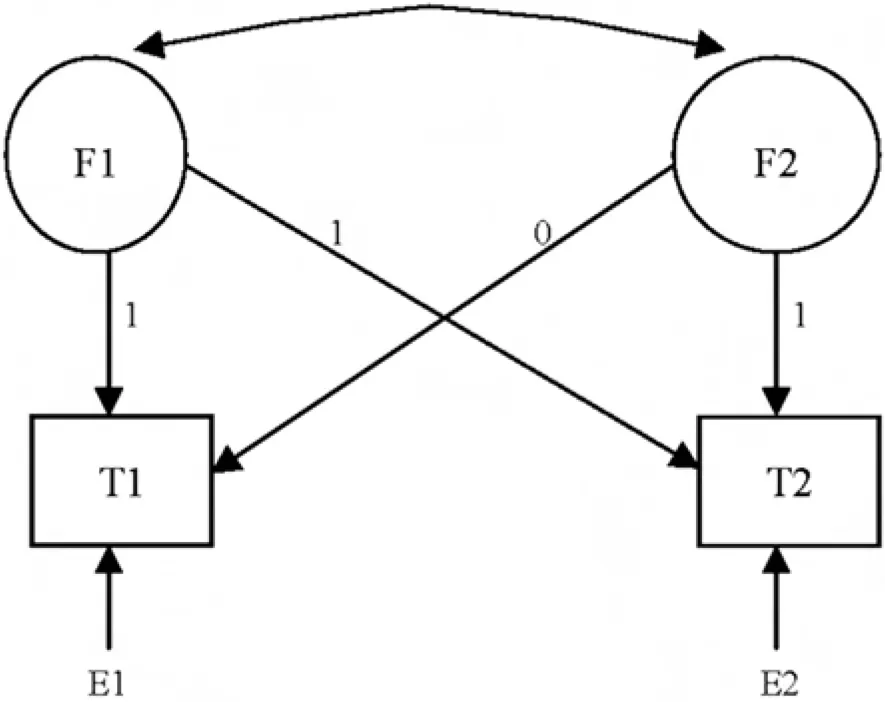
Fig.4A simple latent change model.
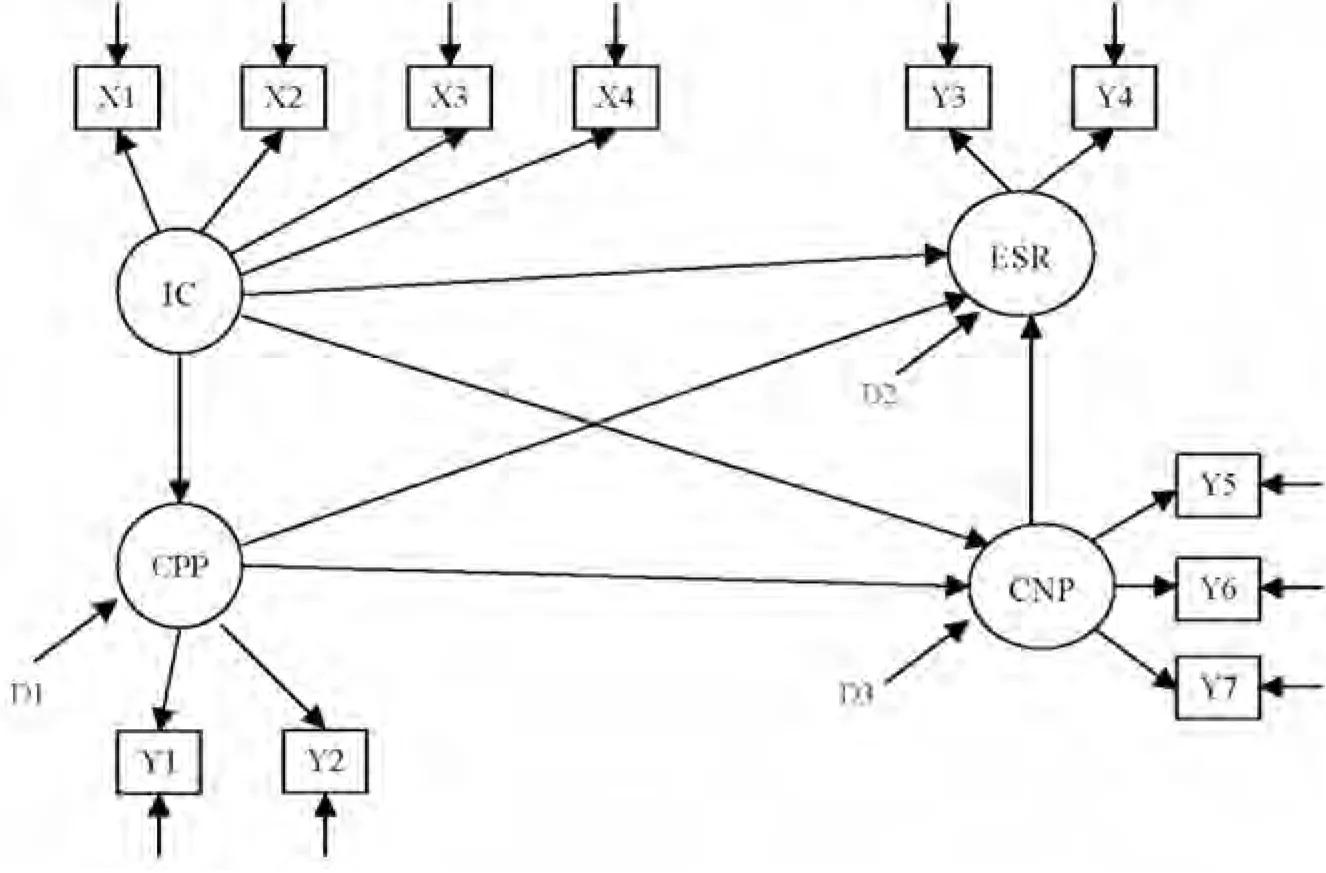
Fig.3Structural regression model of variables influencing return to promotion. IC = Individual characteristics; CPP = Characteristics of prior positions; ESR = Economic and social returns to promotion; CNP = Characteristics of new positions.
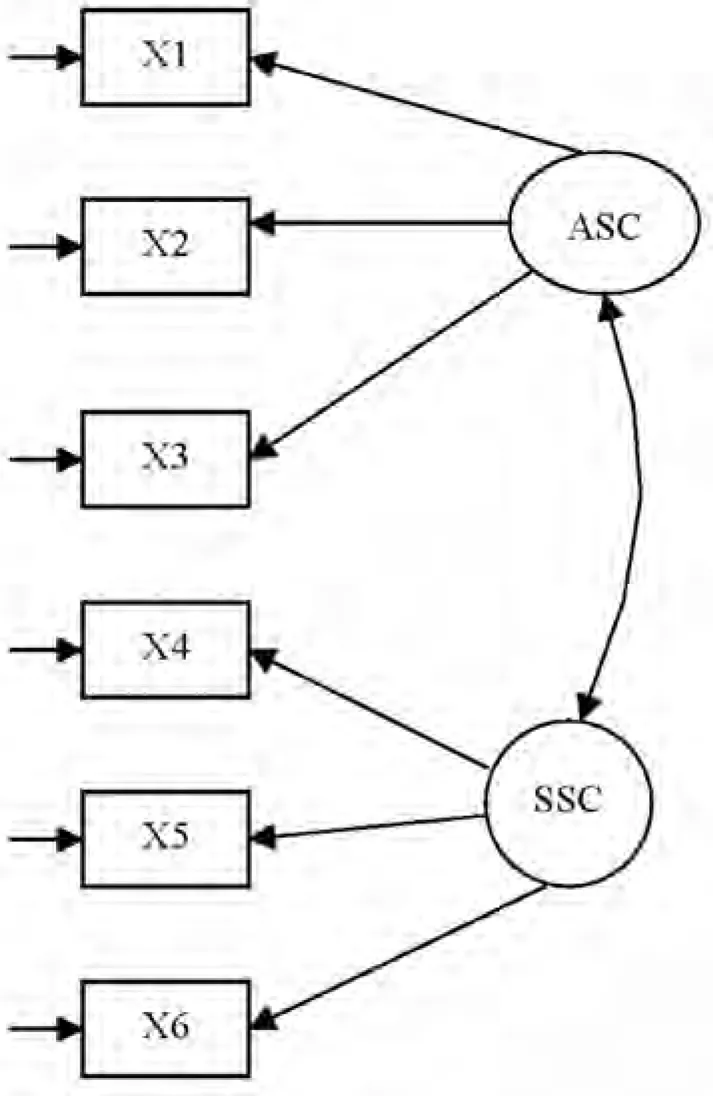
Fig.2Confirmatory factor analysis model with two self-concept constructs. ASC = Academic self-concept; SSC = Social self-concept.
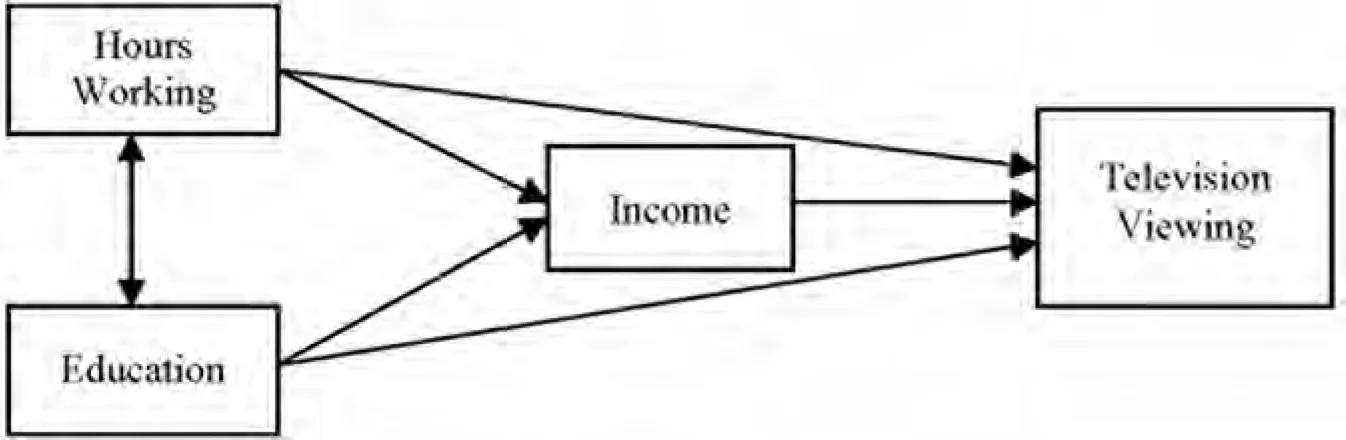
Fig.1Path analysis model examining the effects of some variables on television viewing.
Hours Working = Average weekly working hours; Education = Number of completed school years; Income = Yearly gross income in dollars; Television Viewing = Average daily number of hours spent watching television.
Path analysis models. Path analysis models are usually conceived of only in terms of observed variables. For this reason, some researchers do not consider them typical SEM models. We believe that path analysis models are worthy of discussion within the general SEM framework because, although they only focus on observed variables, they are an important part of the historical development of SEM and in particular use the same underlying idea of model fitting and testing as other SEM models. Figure 1 presents an example of a path analysis model examining the effects of several explanatory variables on the number of hours spent watching television (see section “Path Diagrams” for a complete list and discussion of the symbols that are commonly used to graphically represent structural equation models).
Confirmatory factor analysis models. Confirmatory factor analysis models are frequently employed to examine patterns of interrelationships among several latent constructs. Each construct included in the model is usually measured by a set of observed indicators. Hence, in a confirmatory factor analysis model no specific directional relationships are assumed between the constructs, only that they are potentially correlated with one another. Figure 2 presents an example of a confirmatory factor analysis model with two interrelated self-concept constructs (Marcoulides & Hershberger, 1997).
Structural regression models. Structural regression models resemble confirmatory factor analysis models, except that they also postulate particular explanatory relationships among constructs (latent regressions) rather than these latent variables being only interrelated among themselves. The models can be used to test or disconfirm theo...
Table of contents
Cover Page
Half Title Page
Title Page
Copyright Page
Table of Contents
Preface
1 Fundamentals of Structural Equation Modeling
2 Getting to Know the EQS, LISREL, and Mplus Programs
3 Path Analysis
4 Confirmatory Factor Analysis
5 Structural Regression Models
6 Latent Change Analysis
Epilogue
References
Author Index
Subject Index
Trusted by 375,005 students
Access to over 1.5 million titles for a fair monthly price.
Study more efficiently using our study tools.
Frequently asked questions
Yes, you can cancel anytime from the Subscription tab in your account settings on the Perlego website. Your subscription will stay active until the end of your current billing period. Learn how to cancel your subscription
No, books cannot be downloaded as external files, such as PDFs, for use outside of Perlego. However, you can download books within the Perlego app for offline reading on mobile or tablet. Learn how to download books offline
Perlego offers two plans: Essential and Complete
Essential is ideal for learners and professionals who enjoy exploring a wide range of subjects. Access the Essential Library with 800,000+ trusted titles and best-sellers across business, personal growth, and the humanities. Includes unlimited reading time and Standard Read Aloud voice.
Complete: Perfect for advanced learners and researchers needing full, unrestricted access. Unlock 1.5M+ books across hundreds of subjects, including academic and specialized titles. The Complete Plan also includes advanced features like Premium Read Aloud and Research Assistant.
Both plans are available with monthly, semester, or annual billing cycles.
We are an online textbook subscription service, where you can get access to an entire online library for less than the price of a single book per month. With over 1.5 million books across 990+ topics, we’ve got you covered! Learn about our mission
Look out for the read-aloud symbol on your next book to see if you can listen to it. The read-aloud tool reads text aloud for you, highlighting the text as it is being read. You can pause it, speed it up and slow it down. Learn more about Read Aloud
Yes! You can use the Perlego app on both iOS and Android devices to read anytime, anywhere — even offline. Perfect for commutes or when you’re on the go. Please note we cannot support devices running on iOS 13 and Android 7 or earlier. Learn more about using the app
Yes, you can access A First Course in Structural Equation Modeling by Tenko Raykov,George A. Marcoulides in PDF and/or ePUB format, as well as other popular books in Economics & Statistics for Business & Economics. We have over 1.5 million books available in our catalogue for you to explore.