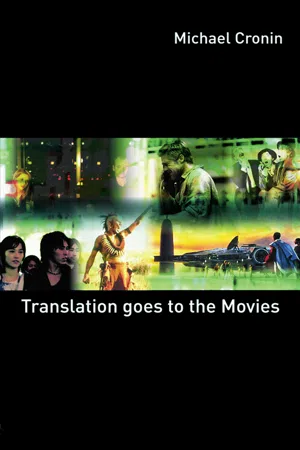
This highly accessible introduction to translation theory, written by a leading author in the field, uses the genre of film to bring the main themes in translation to life. Through analyzing films as diverse as the Marx Brothers' A Night at the Opera, The Star Wars Trilogies and Lost in Translation, the reader is encouraged to think about both issues and problems of translation as they are played out on the screen and issues of filmic representation through examining the translation dimension of specific films. In highlighting how translation has featured in both mainstream commercial and arthouse films over the years, Cronin shows how translation has been a concern of filmmakers dealing with questions of culture, identity, conflict and representation. This book is a lively and accessible text for translation theory courses and offers a new and largely unexplored approach to topics of identity and representation on screen. Translation Goes to the Movies will be of interest to those on translation studies and film studies courses.
- 150 pages
- English
- ePUB (mobile friendly)
- Available on iOS & Android
eBook - ePub
Translation goes to the Movies
About this book
Information
1 Translation
The screen test
David Llewelyn Wark Griffith was incensed. The acclaimed director of The Birth of a Nation (1915) and Intolerance (1916) had heard one of his actresses refer to a film as a ‘flicker’. Lillian Gish, another of Griffith’s actresses, noted his angry reaction,
He told her never to use that word. She was working in the universal language that had been predicted in the Bible, which was to make all men brothers because they would understand each other. This could end wars and bring about the millennium. We were all to remember that the next time we faced a camera.
(Gish 1973: 60)
Griffith’s belief that the picture that moves is a universal language, a way of undoing the mishap of Babel, was based on his intimate conviction that the picture was a universal symbol (Geduld 1971: 56). The supposed immediacy or accessibility of the image, the universal currency of the symbol, is closely linked to the rise of prestige of the visual and of the importance of visual evidence in the scientific revolutions of the sixteenth and seventeenth century (Rorty 1980). No longer would inquirers after knowledge depend on scholastic antecedent. They would not take previous generations at their word, but would confirm with their own eyes claims about the nature of the natural and material world.
Believing without seeing was a culpable blindness. Where the eyes were defeated by scale, unable to probe the infinitely large or the infinitely small, the new technologies of microscopes and telescopes, could come to the aid of the curious. Visual evidence had a persuasiveness, which appeared to mesh with the universal reach of Newtonian theory. The sanctity of the observable is a central tenet of nineteenth-century positivism but the universality of empirically verifiable truths is also an importance source for the universal ambitions of Enlightenment thought. If seeing was indeed believing, then seeing itself could become the pre-Babelian language of universal progress. The divisive languages of humanity would give way to the unifying spectacle of the moving image.
Integration
The millenarian hopes appeared to be borne out by the immense popularity of the new form of entertainment created in the closing decade of the nineteenth century. Here was a medium that could appeal to young and old, urban and rural, literate and illiterate, native and newcomer, rich and poor. In the country where cinema would enjoy the most spectacular success in the twentieth century and beyond, the United States of America, the cinema was seen to be the site of a bold project of national integration. As Miriam Hansen notes:
By and large, historiography of early American cinema reiterated the working-class spectator’s relation to cinema as a scenario of integration. Besides offering escape from the burdens of sweatshop labor and tenement life – as well as a chance to learn English by way of titles or lectures – the function of the cinema for its spectator was seen as that of an agency of acculturation, introducing newcomers to the social topography of the new melting pot.
(Hansen 1990: 228–29)
The new melting pot was not to be a uniquely national phenomenon. The film industry from its inception was a thoroughly international affair. The film scholar Michael Chanan has observed that ‘the film business was international from the very beginning’ (Chanan 1990: 187) and Tom Gunning claims that in the early period of the silent movie ‘film has an international distribution that is unparalleled in later history’ (Gunning 1990b: 89). In the German market, for example, shortly before 1914, the German share of films distributed on the market was around 15 per cent and the rest were sourced from France (30 per cent), the United States (25 per cent), Italy (20 per cent), Denmark and England, either through direct imports or through local subsidiaries such as Pathé Frères and Nordisk (Hansen 1990: 234). In 1907, only a third of the films produced in the United States were from domestic sources, the rest came from Europe and half of these were produced by one company, Pathé (Musser 1990a: 364, 412). George Méliès’s Voyage dans la lune (1902) was a spectacular hit in the United States and remakes such as Biograph’s Personal (1904) reappearing as Pathé’s Dix femmes pour un mari (1905), became increasingly common.
The demand for imports was driven by the phenomenal success of cinematography, which was originally viewed as a largely scientific curiosity. Even when companies realized that audience interest went beyond the technical novelty of their creations, they continued to believe that film was primarily a bait to sell new machines. Companies that dominated the film business up until the outbreak of war in 1914 including Pathé and Gaumont in France, Edison, Biograph and Vitagraph in the United States, and Messter in Germany, all began by manufacturing equipment. It soon became apparent, however, that it was the viewing of the films themselves rather than the exhibition of the technology that would draw in the crowds. Hence, the necessity of imports to feed an apparently insatiable demand for the new art.
Facilitating the international growth of the film business and the acceptability of imports was the fact that the films themselves did not contain dialogue. This was Griffiths’ credo, remove the spoken word, and there is no longer the barrier of language. No longer would the curse of translation dog the felicities of human communication. Images would circulate freely, the newly minted coins of a currency of humanitarian exchange. From Boston to Bombay, the same images could be shown to audiences otherwise separated by language, history and creed. This early belief in the messianic properties of the new medium reappears in some of the more exalted rhetoric of latter-day globalization theory (Friedman 2007), but was translation an issue for the silent era and did images before ‘talkies’ speak for themselves?
The sound of silence
A common misnomer about silent films is that they were silent. From the very first showings the Lumière Cinematograph had films accompanied by piano music. The vast majority of films shown between 1895 and 1927 had some form of accompaniment. This could take the form of live music, sound effects, synchronized dialogue spoken by actors behind the screen or a commentary provided by a lecturer filling out or explaining what was going on in the images (Gaudreault 1985: 25–29). The sounds or words were not recorded so that each event was a live performance, on the spot, with the participatory possibilities implied by such practices. The sound universe of silent cinema was, in part, bound up with the context in which cinema was originally received. The emergence of cinema in the United States, for example, was closely linked to vaudeville and other popular entertainments such as penny arcades, medicine tent shows and Magic Lantern tours (Musser 1990a). In other words, rather than considering cinema in terms of its relation to the high culture genres of the novel and, particularly, the theatre, it is important to situate its moment of emergence in a tradition of screen entertainments. Actors performing behind a screen or lecturers commenting on films already raises the question of language difference. They cannot be expected to hold forth in a language that neither they nor their audience understand. There is, however, another problem at this juncture in the development of cinema that has long-term consequences for how the notion of translation will relate to the moving image.
Part of the tradition from which cinema originates and in which it will be embedded is that of the Magic Lantern entertainments. Niamh McCole notes that,
Beginning with Christian Huygens 1659 invention of a lanterne magique, over a period of more than 200 years the Magic Lantern developed from basic projectors such as the Sturm Lantern, capable of producing small, dimly lit images, to elaborate trinunial lanterns, capable of simulating changes in time, climate and mood.
(McCole 2007: 248–49)
The projected images would deal with a variety of subjects, geographical, historical or political. The success of the projection would depend, in no small part, on the accomplishments of the speaker who would, in a sense, bring the pictures to life. One provincial newspaper in Ireland commented on the success of a lecturer who compared very favorably with his unfortunate predecessor:
Owing to the miserable failure on the part of a party who advertised himself as a lecturer[ … ]the people [were] rather wary of trusting another[ … ]But Mr Lynd as the opposite to the first fraud, for he knew what he was speaking about and could impart his knowledge in a most attractive and receivable form[ … ]Mr Lynd possesses all the characteristics of a popular lecturer.
(Cited in McCole 2007: 253)
As moving images become more and more sophisticated, the lecturer had not only to provide a running commentary on what the audience are seeing but also to help them make sense of the act of seeing itself.
One of the most popular genres in early cinema were actuality films. However, filming a live event automatically entailed a form of discontinuity. The film maker could not be everywhere at once, the action was non-repeatable and the camera at any one time could only hold a certain amount of film stock. Choices had to be made and these choices forced on the film maker by circumstances will be construed more positively as editing (Elsaesser 1990: 17). In G.A. Smith and James A. Williamson’s Henley Regatta (1899), for example, shots from the river bank are intercut with shots of waving crowds and the latter shots have been filmed from mid-river. The sequence of images does not reproduce an actual succession of events in real life but sets up a causal relationship that is independent of the reality of the event. In other words, there was no self-evident logic to the succession of images that spectators were viewing if they were not schooled in a new way of understanding images and their relationships in the emerging medium of cinematography. Film itself was a new language that demanded translation. From 1902 onwards, films became longer, their stories became more complex and, most importantly, the number of shots increased. This was hardly surprising as familiarity bred contempt for single-shot films or simplistic story lines. Audiences demanded more of the new medium.
The demands brought with them new problems. If there were several shots in the film, how would audiences follow the story from one shot to the next? If the scene or point of view changed, would they be able to relate one image to the next? For the film historian André Gaudreault, these increasingly sophisticated multishot films demanded that narrative continuity be retained in whatever way possible:
there were only two ways of ensuring some sort of continuity between the shots and enabling the spectator to grasp the meaning of what lay behind the cuts (camera hiatuses) on the screen: either to turn control of the story over to the narrative voice of the lecturer, or to use intertitles (which incidentally appeared in 1903). As there was no dialogue to help the spectator grasp what was happening in the diegetic universe, the need for a narrator began to be felt when films became longer and more complex. And – until the narrative faculties of editing had been further developed – this narrator could carry out the work of narration through the use of words, of articulated language, either in written form (intertitles) or oral form (speaker) [his emphasis].
(Gaudreault 1990: 277 (his emphasis))
Both of the methods employed involve the use of language and, if films were to be viewed in different countries, translation of written intertitles or the production of a commentary in a different language were inevitable. Most production companies offered ready-made prints with intertitles in three or four languages, but some companies were translating intertitles in up to a dozen languages. By the mid-1920s, Sidney Kent, the vice-president of Famous Players-Lasky, claimed that his company was shipping prints to the four corners of the globe with intertitles in 38 different languages (Nornes 2007: 98). The future director, Joseph Mankiewicz, for example, started in the film business translating intertitles for Universal Filmaktiengesellschaft (UFA) in Berlin (96). Externalizing the narrative instance was used mainly for ‘serious’ subjects, such as Passion films or digests of famous plays or novels, but would not be employed for trick films or burlesques. Not everything had to be explained, of course, as there was an assumption that American and European audiences in the case of Passion films, for example, would be familiar with the broad outlines of Biblical stories, an assumption that breaks down when the films are shown farther afield.
The use of intertitles, however, was a serious obstacle to the narrativization of cinema, either because they could not say enough and therefore left the audience perplexed or they said too much and removed the element of surprise. Similarly, reliance on oral commentary owed much to the individual abilities, stamina and performance of the lecturer. The translational devices, the intertitles and oral commentary used to translate the new medium into a language the audience could understand, were, in a sense, ultimately too cumbersome. The breakthrough of D.W. Griffiths and others of his generation from 1907 onwards was to make a much more sophisticated use of the way in which images were joined together on the screen so that the images could narrate themselves (Gunning 1990a). For example, his use of parallel editing, where sequences or scenes are intercut to suggest that they are taking place at the same time (already anticipated by earlier chase sequences) was just one of the many techniques used to more explicitly link images and allow for the development of a more complex narrative logic.
More adventurous editing leads to the internalization of the translational function, formerly devolved to external narrative instances. The use of naturalistic acting, close-up photography and medium shots, all had the express purpose of situating narrative motivation on the screen itself. In effect, the pictures should tell their own stories. What is striking, in this respect, is that different styles began to emerge on both sides of the Atlantic. Whereas European cinema in the pre-war period tended to emphasize deep staging, the complex arrangement of elements in a particular spatial setting, American cinema favors faster cutting rates, making European cinema appear ‘slower’ and more akin to theatre than its American counterpart (Brewster 1998). In other words, the internalization of these translation devices leads to emergence of different styles that warrant their own form of translation insofar as they increasingly correspond to the viewing expectations and interpretive grids of different viewing publics. So American cinema begins to appear more action-based and European cinema more ‘art-house,’ more beholden to competing artistic forms such as the theatre.
Film reception
The shift from external to internal narrative in the early twentieth century and the development of longer, feature-length films is paralleled by an equally momentous shift in the context of film reception. The shift brought with it noticeable consequences for the place of translation and language difference in audience responses to cinema. The opening of the Nickelodeon, a small, storefront theatre in Pittsburgh, Pennsylvania in June 1905 gave a further boost to the popularity of cinematography and ushered in the Nickelodeon boom. A fixed site that showed films continuously for an admission price of five cents, the Nickelodeon was an instant success and was soon copied in many other towns and cities throughout the United States and Europe. The Nickelodeon boom introduced the new cultural form to a wide audience and prompted the more ecstatic pronouncements on cinema as an element uniting people from diverse backgrounds. However, even as the number of Nickelodeons was beginning to burgeon, there was an increasing desire to make the cinema respectable and, more importantly for the film industry, to make the distribution of films more profitable by targeting a more affluent, middle-class audience. To this end, there was gradually a move to situate movie theatres close to city business districts or more upmarket shopping streets (Gomery 1982: 23–29; Merritt 1976: 59–70).
The theatres themselves became grander with the introduction of ‘picture palaces,’ containing bars, cloakrooms, orchestras and ushers. From 1914 onwards, with the increasing prevalence of feature-length films and an inexorable rise in admission prices, the twin drive towards respectability and profitability became more and more marked. Theatre owners anxious to attract a broader audience:
were advised to avoid ethnic vaudeville acts as well as nationally slanted programs and to eliminate sing-alongs in foreign languages. On the level of film production, the suppression of ethnic difference was imperative: no actor with distinctive ethnic features was to be cast in a leading role.
(Hansen 1990: 230; Merritt 1976: 67, 72)
It was not the images themselves that would perform the work of integration or acculturation, but the context in which they were produced and received. That is to say, it was not any quality inhering in cinematographic images that would translate the immigrant masses of the United States into a monoglot community of shared values but a change in the conditions of production and conditions of reception that would favor the promulgation of a particular national and linguistic ideal. Will Hays, President of the Motion Picture Producers and Distributors of America, Inc. (MPPDA), was effusive in proclaiming the assimilationist promise of the movies:
They [immigrants] are coming to a strange land to live among strange people. Their language in most cases is different from ours. Their customs are different. What is America like?, they ask themselves. The motion picture is able to answer that question, to teach them[ … ]The picture says to [them]: ‘Here is America. See what America, your new home, is like. Look at me and love America.’
(Cited in Maltby 2004: 6)
Cinema became translation by another means. In order to favor the translation of a multilingual and a multi-ethnic community into a mass body of consumers ready to respond to a product in one language, traces of particularism had to be carefully erased. What the cinema increasingly offered for immigrants was a public glimpse of private lifestyles that were promised by a utopia of unfettered social mobility (Mayne 1982: 32–41). Thus, the films were not silent on social aspiration and the imperative of monolingual acculturation. Mass consumer appeal and the creation of what was ultimately not simply a national but an international world of cultural consumption, meant that language difference could not be ignored. It demanded to be silenced even if, as the subsequent chapters will show, the repressed made many return visits to the fretful consciousness of mainstream Hollywood cinema.
The inclusiveness of this exclusiveness would become a powerful paradigm for the expansion of cinema itself and more particularly, for the decisive global dominance of US cinema from the early twentieth century. Already by 1916, a distribution system was being put in place that would eventually secure 80 per cent of the world’s screens for the benefit of American distribution companies (Maltby 2004: 16). By 1917, more than 50 per cent of the films shown in what was generally acknowledged to be a powerhouse of cinema production, France, were American in origin (de Beauregard and Stokes 2004: 26). The political and military fate of Europe was crucial to this evolution. The First World War gravely affected the fortunes of the French, German and British film industries in terms of both production and distribution. On the eve of the introduction of the talkies in 1927, the US Bureau of Foreign and Domestic Commerce estimated that approximately 75 per cent of the films shown on the world’s cinema screens were American in origin and 30 per cent of the revenues from all sources for American cinema came from foreign markets (Golden 1928: 41–57). Not only was the US not affected to any great extent materially by the conflict, but the immediate post-war period also saw an exponential growth in American overseas economic activity.
Part of this activity involved the construction of a worldwide communications network involving American radio and cable companies, airlines and wire services (Jarvie 1992; Higson and Maltby 1999; Trumpbour 2002). Owen D. Young, head of the Radio Corporation of America, in July 1930 spoke of the ‘economic integration of the world’ and in terms not dissimilar from those of D.W. Griffith, saw global communications and altruism as amenable bedfellows, ‘The power of communications is greater than that of the combined armies and navies of the world’ and ‘no international understanding can ever function adequately to preserve the peace of the world unless we can get communication so cheap, so free, that all of the peoples of all of the nations will understand all the questions and problems of the world’ (Costigliola 1984: 140, 153). On a less exalted plane, the economist Christine Frederick saw the domestic promise to US immigrants as a powerful rationale for US influence internationally. ‘Consumptionism’ was the ‘greatest idea that America has to give to the world.’ This idea was consistent with the idea that ‘wo...
Table of contents
- Cover Page
- Title Page
- Copyright Page
- List of film stills
- Acknowledgements
- Introduction: the full picture
- 1 Translation: the screen test
- 2 The frontiers of translation: Stagecoach to Dances with Wolves
- 3 Translation howlers: A Night at the Opera to Borat
- 4 The long journey home: Lost in Translation to Babel
- 5 The empire talks back: translation in Star Wars
- Bibliography
Trusted by 375,005 students
Access to over 1.5 million titles for a fair monthly price.
Study more efficiently using our study tools.
Frequently asked questions
Yes, you can cancel anytime from the Subscription tab in your account settings on the Perlego website. Your subscription will stay active until the end of your current billing period. Learn how to cancel your subscription
No, books cannot be downloaded as external files, such as PDFs, for use outside of Perlego. However, you can download books within the Perlego app for offline reading on mobile or tablet. Learn how to download books offline
Perlego offers two plans: Essential and Complete
- Essential is ideal for learners and professionals who enjoy exploring a wide range of subjects. Access the Essential Library with 800,000+ trusted titles and best-sellers across business, personal growth, and the humanities. Includes unlimited reading time and Standard Read Aloud voice.
- Complete: Perfect for advanced learners and researchers needing full, unrestricted access. Unlock 1.5M+ books across hundreds of subjects, including academic and specialized titles. The Complete Plan also includes advanced features like Premium Read Aloud and Research Assistant.
We are an online textbook subscription service, where you can get access to an entire online library for less than the price of a single book per month. With over 1.5 million books across 990+ topics, we’ve got you covered! Learn about our mission
Look out for the read-aloud symbol on your next book to see if you can listen to it. The read-aloud tool reads text aloud for you, highlighting the text as it is being read. You can pause it, speed it up and slow it down. Learn more about Read Aloud
Yes! You can use the Perlego app on both iOS and Android devices to read anytime, anywhere — even offline. Perfect for commutes or when you’re on the go.
Please note we cannot support devices running on iOS 13 and Android 7 or earlier. Learn more about using the app
Please note we cannot support devices running on iOS 13 and Android 7 or earlier. Learn more about using the app
Yes, you can access Translation goes to the Movies by Michael Cronin in PDF and/or ePUB format, as well as other popular books in Sprachen & Linguistik & Sprachwissenschaft. We have over 1.5 million books available in our catalogue for you to explore.