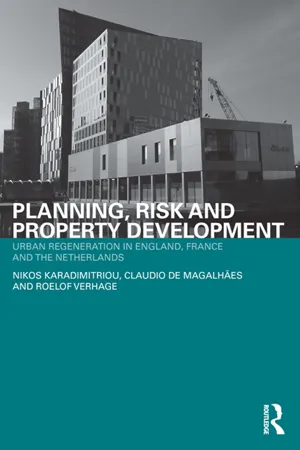
Urban regeneration schemes involving a wide range of actors and dependent on private investment are increasingly deployed in Europe's cities with the aim of delivering private, merit and public goods. This book explores the relationships, objectives and strategies of the actors engaging in these schemes in cities of three advanced European economies. It researches the outcomes of actor interactions as these transform under the influence of changing market circumstances and associated risks. The book focuses on the way this change is reflected in the provision of mixed-use developments within a context of increasingly polarised housing markets and urban growth patterns. It argues that although these schemes can and do deliver much-needed dwellings, their exposure to market risks may in many cases cause them to fall short of the desired socio-economically sustainable outcomes.
eBook - ePub
Planning, Risk and Property Development
Urban regeneration in England, France and the Netherlands
- 232 pages
- English
- ePUB (mobile friendly)
- Available on iOS & Android
eBook - ePub
Planning, Risk and Property Development
Urban regeneration in England, France and the Netherlands
About this book
Information
Chapter 1
Urban transformations and policy responses in Western European cities
Introduction
This book discusses on-going changes in the way in which demand for what could broadly be defined as merit and public goods, particularly but not exclusively for non-market housing,1 has been met in three Western European countries in the context of urban regeneration schemes. These schemes point to structures and mechanisms of provision that differ markedly from those that were established in the early post-war years. Where once this provision was closely associated with the duties of the (welfare) state, it is now increasingly contingent upon the outcomes of a much wider array of processes and actors. Moreover, whereas non-market housing, in particular, used to be part of strategies for coping with the growth pressures of manufacturing-based cities and national economies, it now often is a key element of efforts to regenerate declining urban areas in the internationally more porous economies of Western Europe.
Kemeny (2001) points out the four main pillars of welfare provision, namely housing, education, health and social security. He notes that housing is the most capital intensive of the four, which makes it rather unique and, in our view, hints at why it was linked to private property development via urban regeneration. He also argues that the state plays a complex role in the provision of housing that is difficult to untangle from the role of market actors. What also makes housing rather unique, as compared to the other three pillars, is the higher level of commodification and market involvement in its production (Harloe, 1995). Although this difference is less striking today than it was in 1995 it does indeed pose some difficulties in defining and researching housing within the context of welfare provision.
The effort of governments to achieve public policy goals whilst increasingly relying on market mechanisms and private actors for the provision of merit and public goods, typical of regeneration policies of the last 30 years or so, was based on specific assumptions about the role of private actors and the role of the state, as well as about the way they can pool resources in order to achieve public policy goals. Depending on the extent and scope of the partnerships that emerged, novel risk-/return-sharing arrangements between private, public and third sector actors have appeared that make the concept of public–private partnership a rather diffuse one (Miraftab, 2004).
The logic of the public–private partnership arrangements that gained momentum in the last few decades in all types of welfare provision suggested that the involvement of the private sector would offer increased effectiveness and efficiency gains, whereas state involvement could lower risk premia and thus would allow projects to be financed at rates closer to sovereign debt rates without necessarily expanding state expenditure. Arguably, however, offloading those liabilities from the state’s balance sheet is not the same as not expanding state expenditure.
One has to note here that the dichotomy between planning and markets can be rather misleading when taken as anything other than an analytical device. In several Western European countries, for example, the third sector played a crucial role in the delivery of public services throughout the post-war years and the concept of the social market economy draws on ideas which first appeared in Germany in the intra-war period. It is thus more illuminating to focus any inquiry on which governance mix could or should be chosen (Alexander, 2001). Insofar as welfare systems are concerned, this point has been iterated by Hamnett (1998) or Marcuse and van Kempen (2002), who argue that as the state continues to be ever present in the processes of urban transformation, the changes in its role with regard to welfare provision are as much an outcome of local political processes as they are a consequence of global restructuring and market forces.
Concerns about the potential consequences of the public–private partnership approaches to welfare provision pursued in the last three decades or so, especially so far as housing is concerned, have been raised throughout the period in question (for example, see Iglesias, 2009). These concerns obviously extend to the provision of public goods, like amenities and the public realm, which are crucial ingredients in place making and for human well-being. The crisis in the financial markets that started in 2007 and the subsequent downturn in many property markets provided a stark reminder of what these consequences may be and how likely the associated risks are. At the very least, the public–private risk/return arrangements underpinning regeneration schemes throughout Western Europe have had to be rethought and adjusted. In many cases, this adjustment has resulted in the partial or complete withdrawal of private sector actors from schemes and/or increased state intervention and expenditure in the name of social cohesion.
This chapter situates the transformations discussed above in the context of the recent socio-economic evolution of many Western European cities. For that, we introduce themes and concepts that underpin the book’s approach to the relationship between urban regeneration schemes and merit and public goods provision in Western Europe. We present a brief historical overview of the range of factors that has led to current forms of provision through urban regeneration schemes and summarise our understanding of the emergence of urban regeneration as an important field of policy. We also focus on changes in the practice of urban regeneration that reflect new forms of public–private cooperation away from the New Public Management approach (see for example Brandsen and Pestoff, 2006).
The argument pursued throughout the rest of this book highlights how these processes of production of the built environment mesh public policy objectives and the delivery of merit and public goods with the logic and the priorities of property developers and investors, especially linking them with the risks and uncertainties embedded in the property development process. The resulting forms and types of urban quarters in turn create path dependencies that further affect the achievement of public and private objectives and priorities. It is interesting to note that in each of the countries that the book looks into, the roles and ambitions of the actors engaging in the process, especially the roles of public sector actors, differ markedly between them. These differences highlight the deeply embedded cultural and ideological factors that affect the behaviour and worldview of the agents engaging in the regeneration process, as well as the institutional framework within which they operate.
The rise and decline of the European industrial city
In most of the world, and certainly in the three countries examined in this book, the process of industrialisation has led to massive growth of cities. In some cases, this has meant the rapid emergence of large urban centres where previously there were small towns, whereas in others it had led to the transformation of former merchant or administrative cities into industrial metropolises and sites for the transport infrastructure that accompanied industrial production. For many cities, it has meant the replacement of the pre-existing physical fabric with one more suited to the dynamics of manufacturing and its labour force. For others, particularly in European countries which industrialised late, it had meant the accretion of industrial suburbs to the pre-existing urban tissue. Thus, during the nineteenth and early twentieth centuries the needs of an industrial society were inscribed in the physical structure of many contemporary cities. Concentrations of manufacturing plants, workers’ housing, warehousing and transport infrastructure came to define a considerable proportion of a city’s fabric.
The problems that accompanied that spatial logic were acknowledged very early on. The insalubrious mix of industry and housing; the very low quality of much of the housing stock; the appalling environmental conditions in which the fast-growing numbers of industrial workers lived; all this came to form the background for a raft of public health legislation that by and large was the precursor of modern planning systems in many Western European countries. Slum-clearance programmes through the later part of the nineteenth century and first half of the twentieth century were also part of that approach, as were zoning policies and the newly created industrial districts. However, the logic of the European industrial city was part and parcel of nineteenth- and early twentieth-century capitalist space-economy and, as such, became associated with economic development, progress and modernity. By the eve of the Second World War, the industrial city was an integral part of the European landscape. Moreover, faith in the industrial city and the economic geography that supported it was very much a part of the thinking about cities and urban policies. The modernist project had it at its core, as did the reconstruction plans elaborated during and after the war years, which were to shape the contemporary city. The efforts to reconstruct war-damaged cities, to do away with the social, economic and spatial injustices of industrialisation, to build a more equitable society, were framed by a belief in the stability and permanence of an urbanised industrial economy and its attending spatial structure at a time when, compared to the present day, nation-states exerted significantly more control over capital and labour (Fraser, 2003a; Hall, 1990).
Much has been written about the broader changes in the world economy in the final decades of the twentieth century that ultimately led to the decline of whole sectors of manufacturing in the industrialised economies of Western Europe and to the concomitant growth of the service sector, often with a distinct geography (Beauregard, 2003; Castells, 1989; Sassen, 1991; Schoon, 2001). In spite of the many contested interpretations of the meanings of those changes, there is some consensus on what their elements are. Most accounts point to the growing internationalisation of the economy, to the emergence of global elites, to the increasing mobility of capital looking for lower production costs, and subsequently of labour too; to technological changes that have made labour redundant in the production process or have allowed the ‘down-skilling’ of blue-collar jobs and their replacement with low-skilled jobs elsewhere; to the reduction of the impact of distance, allowing for a much wider spread of production than previously; to the emergence of information technologies and their progressive incorporation into all stages of production and consumption, leading to new patterns of concentration and dispersal of people and activities; to the increasing proportion of value added by information and knowledge; and so on.
Whatever views one might hold on the relative importance of these changes, their social and spatial consequences are widely acknowledged: the decline of the economic basis of many places leading to loss of jobs, population and tax incomes, physical dereliction and a raft of social problems. Significantly, the capacity of the state to control its tax base and thus its incomes has also been undermined by increased capital and personal mobility. Increased mobility combined with changing demographics also poses new challenges for welfare provision systems.
Given the new circumstances, some of the mechanisms that were created during the growth era in order to improve life conditions through welfare provision were weakened and in some cases contributed to the entrapment of the very people whom they set out to support. Paradoxical situations arose whereby welfare structures often increased the risks and costs associated with re-entering employment, migrating etc. and thus reinforced the isolation of those less able to adapt or fit into the new economic structures (Forrest, 1987; Hills, 2007).
In some places, the economic decline and loss of jobs happened side by side with the growth in service-related activities, impacting differently on locations within a city or an urban region. In other places, it meant the demise of whole regional economies, like coal-mining areas or textile-production clusters everywhere in Europe, as well as larger industrial cities at a distance from preferred service industry locations, such as the industrial conurbations of Liverpool, Glasgow, Manchester, Lille or parts of the Ruhr area.
However, economic change in itself does not explain the intensity and acuteness of the problems that industrial cities have faced over the last decades. The growth and decline of places are not historically new processes: each cycle of growth and decline in the economy has depended on its own particular sets of dynamic and profitable economic activities with their own location requirements.
A prominent feature of late twentieth-century de-industrialisation is the relatively short period of time in which major changes have happened within a context of liberalisation of both intra-European and global flows of trade, capital and people. Although some cities in Europe had been experiencing a decline in their economic basis since much earlier – e.g. heavy engineering and ship building in Tyneside, in decline since the interwar period (Hudson, 2005) – for many industrialised cities and regions in Europe the loss of manufacturing jobs and the decline of long-established economic structures happened relatively rapidly after trade barriers were removed. For example, it took around 10 years, from the mid-1970s to the mid-1980s, for entire branches of the secondary sector to close down, and this exerted enormous pressure on planning and spatial policy frameworks that were predicated on the stability and growth dynamics of an industrial, manufacturing-based urban development.
The speed of the economic decline in places like the Midlands, Nord Pas de Calais, the Ruhr or Wallonia in the 1970s and 1980s stretched governance systems and welfare regimes alike and hindered an orderly transition that could have attenuated the economic and social consequences of that decline through a long-term process of adaptation.
The welfare state and urban decline
Cities are certainly more than buildings and physical infrastructure, but they are those too. Urban layouts, buildings and infrastructure have a long life and tend to outlast the economic and social context in which they were produced. Some European cities have developed along a basic design laid out by Roman roads two millennia ago and many still show evidence of medieval plot structure in the position and size of present-day land parcels. Many contemporary urban developments are therefore shaped by site parameters that derive directly from long-disappeared forms of land use that have been crystallised in the plot structure and the footprints of buildings and infrastructure.
The extensive and substantial urban growth in the last two centuries associated with industrialisation, of which the reconstruction of cities after the Second World War is a short but substantive episode, was therefore likely to produce physical structures that could shape cities for a long time to come. It is not surprising to find cities in post-industrial, service-based economies that have to contend with buildings and infrastructure networks that might have suited well the previous economic cycle, but will not necessarily suit the economic, social and environmental requirements of post-industrial economies. This applies to a variety of spatial scales, from parts of a city that might have thrived in a previous period but that are currently obsolete, to the region, the nation and the world (Couch, 2003). It is important to keep in mind this association between the nature of many of the urban problems of the late twentieth century and the transformation of the economy and of society, the consolidation of the spatial structure of European industrial cities and the urban policies of the post-war years. The interconnection of these different aspects can provide the basis for understanding the genesis and formulation of many current urban problems.
Another important development that helped to consolidate the physical structure of the industrial city, and thus define the nature of the challenges facing contemporary cities, was the emergence of the welfare state and the consequent growth of state-driven provision of a range of goods and services, partly because it was essential for the improvement of social welfare and social justice (and thus for maintaining a more equitable society and social peace) but also because it supported consumer demand as part of strategies for managing economic growth (Barlow and Duncan, 1994). Importantly, this included housing, as the provision of adequate accommodation had been historically problematic for a substantial proportion of the population.
The history here differs from country to country, but in general the activities of pre-existing networks of charitable providers of services such as education, health and housing for the poor (private charities, church organisations, trade associations, workers’ unions, etc.) were gradually complemented or absorbed and expanded to cover wider social strata by local and national governments in the late nineteenth century and the first half of the twentieth century (Leach and Percy-Smith, 2001). In England, for instance, state-driven housing provision became significant in the interwar years and reached its climax in the decades immediately after the Second World War when a fully developed state-based welfare provision emerged (Balchin, 1996). In France, it started in earnest in the 1950s, with a vast programme of state-subsidised social housing construction (Blanc and Bertrand, 1996).
The development of European welfare states took place in the context of economies and labour markets over which nation-states had more control than the case is today. The massive investment in social infrastructure in the post-war years happened within the framework of industrial economies with substantial blue-collar employment located in urban areas. Considerable amounts of national wealth were put into solving the urban problems of the pre-war years with mass production of social housing – often as large ensembles – relocation of polluting industries away from housing areas and into industrial estates at the fringe of cities, construction of a transport network connecting industries, workers’ housing and markets etc.
This investment was predicated on, and reciprocally reinforced, the assumption that the structure and trajectory of these economies would remain relatively stable in the long run. Such an approach, typical in investment appraisal, could therefore provide short- and long-term justifications for the significant commitment of social and economic resources. With hindsight, it also contributed to fixing that structure in the territory of cities and regions, helping to form the base conditions for some of the urban problems of the following decades (Couch et al., 2003; Hall and Tewdwr-Jones, 2011).
In parallel with the growth and later decline of the economic and tax bases of the industrial city, another factor has contributed to weakening the ability of cities to manage economic change: the long-lasting process of urban expansion, suburbanisation and peri-urbanisation of population and of businesses, compounded by insufficient re-arrangement of urban governance structures. This has been a prominent characteristic of North American and British patterns of urbanisation, but elements of it have been present in the evolution of cities elsewhere in Europe throughout the twentieth century. As a result, many areas in cities throughout Europe have been abandoned by businesses and higher-income residents who favour edge- and out-of-town locations. This gradual loss of population, employment and economic activity often left behind those who could not afford to move – often residents of public housing built closer to the manufacturing jobs they once depended upon.
In the UK, and to an extent in the Netherlands too, the outmigration of businesses and wealthier residents, combined with the loss of jobs and falling incomes for large parts of the population, meant that many of the areas where large social housing estates had been built became enclaves dominated overwhelmingl...
Table of contents
- Cover
- Halftitle
- Title
- Copyright
- Contents
- List of illustrations
- About the authors
- Preface
- Acknowledgements
- List of abbreviations
- 1 Urban transformations and policy responses in Western European cities
- 2 Urban regeneration and property market dynamics in the Netherlands, France and the UK
- 3 Actor strategies, risks and uncertainty in regeneration projects
- 4 Dutch case studies
- 5 French case studies
- 6 English case studies
- 7 Conclusions
- References
- Index
Trusted by 375,005 students
Access to over 1.5 million titles for a fair monthly price.
Study more efficiently using our study tools.
Frequently asked questions
Yes, you can cancel anytime from the Subscription tab in your account settings on the Perlego website. Your subscription will stay active until the end of your current billing period. Learn how to cancel your subscription
No, books cannot be downloaded as external files, such as PDFs, for use outside of Perlego. However, you can download books within the Perlego app for offline reading on mobile or tablet. Learn how to download books offline
Perlego offers two plans: Essential and Complete
- Essential is ideal for learners and professionals who enjoy exploring a wide range of subjects. Access the Essential Library with 800,000+ trusted titles and best-sellers across business, personal growth, and the humanities. Includes unlimited reading time and Standard Read Aloud voice.
- Complete: Perfect for advanced learners and researchers needing full, unrestricted access. Unlock 1.5M+ books across hundreds of subjects, including academic and specialized titles. The Complete Plan also includes advanced features like Premium Read Aloud and Research Assistant.
We are an online textbook subscription service, where you can get access to an entire online library for less than the price of a single book per month. With over 1.5 million books across 990+ topics, we’ve got you covered! Learn about our mission
Look out for the read-aloud symbol on your next book to see if you can listen to it. The read-aloud tool reads text aloud for you, highlighting the text as it is being read. You can pause it, speed it up and slow it down. Learn more about Read Aloud
Yes! You can use the Perlego app on both iOS and Android devices to read anytime, anywhere — even offline. Perfect for commutes or when you’re on the go.
Please note we cannot support devices running on iOS 13 and Android 7 or earlier. Learn more about using the app
Please note we cannot support devices running on iOS 13 and Android 7 or earlier. Learn more about using the app
Yes, you can access Planning, Risk and Property Development by Nikos Karadimitriou,Claudio de Magalhães,Roelof Verhage in PDF and/or ePUB format, as well as other popular books in Architecture & Aménagement urbain et paysager. We have over 1.5 million books available in our catalogue for you to explore.