Women on the Edge, a collection of Alcestis, Medea, Helen, and Iphegenia at Aulis, provides a broad sample of Euripides' plays focusing on women, and spans the chronology of his surviving works, from the earliest, to his last, incomplete, and posthumously produced masterpiece. Each play shows women in various roles--slave, unmarried girl, devoted wife, alienated wife, mother, daughter--providing a range of evidence about the kinds of meaning and effects the category woman conveyed in ancient Athens. The female protagonists in these plays test the boundaries--literal and conceptual--of their lives.
Although women are often represented in tragedy as powerful and free in their thoughts, speech and actions, real Athenian women were apparently expected to live unseen and silent, under control of fathers and husbands, with little political or economic power. Women in tragedy often disrupt "normal" life by their words and actions: they speak out boldly, tell lies, cause public unrest, violate custom, defy orders, even kill. Female characters in tragedy take actions, and raise issues central to the plays in which they appear, sometimes in strong opposition to male characters. The four plays in this collection offer examples of women who support the status quo and women who oppose and disrupt it; sometimes these are the same characters.
eBook - ePub
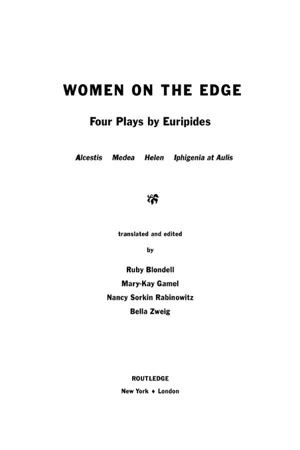
Women on the Edge
Four Plays by Euripides
- 512 pages
- English
- ePUB (mobile friendly)
- Available on iOS & Android
eBook - ePub
Women on the Edge
Four Plays by Euripides
About this book
Information
ALCESTIS

Translated and with an Introduction by
Nancy Sorkin Rabinowitz
I. INTRODUCTION
Alcestis must be crucial in any consideration of gender or women’s roles in classical Athens, for its main character is used to establish a model for female behavior. She is repeatedly called the “best of women”; moreover, her excellence is based on her willingness to give up her life so that her husband can live. As such an exemplar, she establishes that pattern as a criterion for excellence in womanhood. In part as a result of its deployment of this theme, the play also puts into question ideological assumptions about the relative strengths and virtues of men and women.1
The structure and plot are deceptively simple. The Olympian god Apollo, son of Zeus and Leto, most closely associated with prophecy, song, and light, opens the play; he speaks a prologue directly to the audience, informing us about the past and preparing us for the action. He tells us that he was once a servant to the mortal Admetos and that in gratitude for the good treatment he received, he won Admetos the chance to avoid his fated premature death, if he could find someone to take his place. Although even Admetos’ parents refused his request, his wife Alcestis agreed. The action proper begins with a confrontation between Apollo and Death; Apollo tries and fails to convince Death not to take Alcestis. He then flees the scene, because the underworld deities were a source of pollution to the Olympians. After a servant describes her private farewells, Alcestis enters to take her leave of Admetos and her children; she asks one thing of Admetos: that he not remarry. He agrees and vows eternal mourning. Soon, however, his friend Herakles2 arrives on his way to perform one of his labors, and despite his grief, Admetos welcomes him, keeping him ignorant as to who has died. In the next scene, Admetos engages in battle with his father, Pheres, insulting him for not being willing to die in his place; Pheres insults him in turn. Then, all exit to bury Alcestis.
When Herakles discovers who has really died, he rushes off to retrieve Alcestis from Death; he returns to offer her as a gift to Admetos, but pretends she is merely a prize he has won in a contest. The play ends with a protracted scene between Herakles and Admetos, in which the latter, attempting to be faithful to Alcestis’ dying wish, resists accepting the strange woman who, unbeknownst to him, is his wife. She stands, silent, covered, and unrecognizable, while Herakles convinces Admetos to welcome this “strange” woman into his home. He finally takes her with his own hand, and only then finds out who she is. Thus the play has an apparently happy ending.
What is the genre of this play? At the City Dionysia (above, p. 34), Alcestis was presented fourth after three tragedies, the position typically reserved for a satyr play; as a result, the play’s genre has been discussed at least since the time when the hypothesis (a brief prose introduction to the plays in the library at Alexandria) was added. The author of the paragraph remarks that “the play has a change of fortune rather of the comic kind…. The drama is of the satyric kind in that it turns to joy and pleasure at the end, contrary to the tragic kind.” Subsequent generations of scholars have puzzled over its form, calling it variously an anti-tragedy, a pro-satyr drama, or a tragicomedy.3 Alcestis is not an actual satyr play, i.e., it did not have a chorus of satyrs, but it is possible, nonetheless, that the placement of the play resulted from and had an effect on its form or plot (see below).
The Myth
This play depends on two separate story lines, one primarily involving Apollo and Admetos, the other Admetos and Alcestis, each with parallels to fairy tales (Conacher 1967:327–39).4 Euripides has tied the two together in a manner which seems to have been unique. In the extended version of the first story, Apollo begets Asklepios on the maiden, Coronis, who later betrays him with her cousin; Apollo then kills Coronis and rescues their child (see Pindar Pythian 3). Asklepios goes on to become a great healer, but when he dares to bring mortals back to life, Zeus kills him with the thunderbolt. The killing of Asklepios reestablishes the finality of death for mortals and thus defines the difference between mortal and immortal (see lines 112–31, 455–59, 962–90, and on Asklepios 122–29, 988–99).
Enraged at Zeus for killing his son, Apollo retaliates by attacking the Cyclopes, makers of the thunderbolt; he pays for his insubordination by having to serve Admetos as herdsman—as a god he cannot die, but he must be punished. Comparison with other myths indicates that Apollo’s servitude to Admetos is a symbolic form of death. The story of Apollo and Admetos, then, is imbricated in material that stresses the gods’ power over human life and death; more particularly, Zeus asserts his hegemony in this area. The conflict between Asklepios/Apollo and Zeus/Cyclopes is also about father-son rivalry; the fact that it centers on the thunderbolt, sign of Zeus’ authority, relates that rivalry to the son’s desire for phallic power. Not only does the son want to destroy the father’s weapon, as a male he arrogates to himself the biological power of women to give life. In this arena, too, Apollo is less successful than his father Zeus. Zeus blasted his mistress, the Theban princess Semele, with the thunderbolt and carried Dionysos to term (above, pp. 31–2); Apollo similarly rescues Asklepios from Coronis. But Dionysos lives, while Asklepios does not.
This masculine Olympic contest over life and death leaves its traces in the presence of Death in the play, although the charac...
Table of contents
- Cover
- Title
- Copyright
- Dedication
- Contents
- Preface
- Introduction
- Four Plays by Euripides
- Notes
- References
Trusted by 375,005 students
Access to over 1.5 million titles for a fair monthly price.
Study more efficiently using our study tools.
Frequently asked questions
Yes, you can cancel anytime from the Subscription tab in your account settings on the Perlego website. Your subscription will stay active until the end of your current billing period. Learn how to cancel your subscription
No, books cannot be downloaded as external files, such as PDFs, for use outside of Perlego. However, you can download books within the Perlego app for offline reading on mobile or tablet. Learn how to download books offline
Perlego offers two plans: Essential and Complete
- Essential is ideal for learners and professionals who enjoy exploring a wide range of subjects. Access the Essential Library with 800,000+ trusted titles and best-sellers across business, personal growth, and the humanities. Includes unlimited reading time and Standard Read Aloud voice.
- Complete: Perfect for advanced learners and researchers needing full, unrestricted access. Unlock 1.5M+ books across hundreds of subjects, including academic and specialized titles. The Complete Plan also includes advanced features like Premium Read Aloud and Research Assistant.
We are an online textbook subscription service, where you can get access to an entire online library for less than the price of a single book per month. With over 1.5 million books across 990+ topics, we’ve got you covered! Learn about our mission
Look out for the read-aloud symbol on your next book to see if you can listen to it. The read-aloud tool reads text aloud for you, highlighting the text as it is being read. You can pause it, speed it up and slow it down. Learn more about Read Aloud
Yes! You can use the Perlego app on both iOS and Android devices to read anytime, anywhere — even offline. Perfect for commutes or when you’re on the go.
Please note we cannot support devices running on iOS 13 and Android 7 or earlier. Learn more about using the app
Please note we cannot support devices running on iOS 13 and Android 7 or earlier. Learn more about using the app
Yes, you can access Women on the Edge by Ruby Blondell, Mary-Kay Gamel, Nancy Sorkin Rabinowitz, Bella Vivante, Ruby Blondell,Mary-Kay Gamel,Nancy Sorkin Rabinowitz,Bella Vivante in PDF and/or ePUB format, as well as other popular books in Literature & Ancient & Classical Literary Criticism. We have over 1.5 million books available in our catalogue for you to explore.