In the last twenty years, thousands upon thousands of the upper and middle classes have retreated into gated communities. In 2002 it is estimated that one in eight Americans will live in these exclusive neighborhoods. What has sparked this alarming trend?
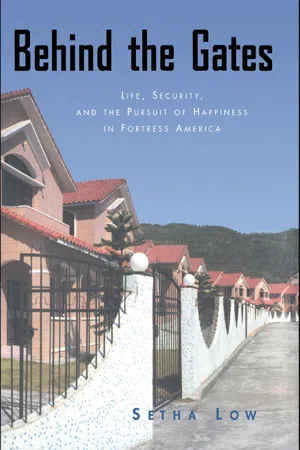
Behind the Gates is Low's revealing account of what life is like inside these suburban fortresses. After years researching and interviewing families in Long Island, New York and San Antonio, Texas, Low provides an inside view of gated communities to help explain why people flee to these enclaves. Parents with children, young married couples, "empty-nesters," and retirees express their need for safety, their secret fears of a more ethnically diverse America, and their desire to recapture the close-knit, picket-fenced communities of their childhood. Ironically, she shows, gated neighborhoods are in fact no safer than other suburbs, and many who move there are disheartened by the insularity and restrictive rules of the community.
Low probes the hopes, dreams, and fears of her subjects to portray the subtle change in American middle-class values marked by the emergence of enclosed communities in the suburbs.
eBook - ePub
Behind the Gates
Life, Security, and the Pursuit of Happiness in Fortress America
- 288 pages
- English
- ePUB (mobile friendly)
- Available on iOS & Android
eBook - ePub
About this book
Information
CHAPTER 1
Unlocking the Gated Community
FELICIA—“FEAR FLIGHT”: SAFETY, COMMUNITY, AND FEAR OF OTHERS
I climb into Felicia's Volvo station wagon, carefully setting my tape recorder on the dashboard. Outside, the twisted junipers and gray-green cottonwoods of San Antonio flash by. The six-lane highway posts a seventy-mile-per-hour speed limit, but we are doing eighty. New gated developments with partially constructed houses and bulldozers leveling wild grass fields stretching as far as I can see suddenly disappear, leaving countryside that looks like it's been untouched for the past hundred years. The contrast between the small-town past and suburban present is demarcated as we speed north.
Felicia is a tall, thin woman in her mid-forties who sits straight upright in the drivers seat. Her long fingers clutch the steering wheel as she drives; she is telling me about her college and graduate degrees. Even with the amount of education she has accumulated, she decided to stay home to take care of her seven-year- old daughter. They moved from California because of her husband's job and the opportunity to have a more comfortable life with a bigger house. They now live on an attractive cul-de-sac in a two-story, four-thousand-square-foot Scottsdale model located within a gated subdivision on the northern edge of the city.
She is articulate and gets right to the point. When they were shopping for a house, school district and aesthetics were important considerations. In fact, she had some reservations about living in a gated community, including the fact that it only has one exit if there is a fire. But they were concerned for their child's safety, and now feel that it was a good choice because it allows her to go outside and play. As Felicia puts it, “We’re in San Antonio, and I believe the whole country knows how many child kidnappings we’ve had…. My husband would not ever allow her outside to play without direct adult supervision unless we were gated.” It allows them the freedom to walk around the neighborhood at night, and their daughter and her friends from nongated neighborhoods are able to ride their bicycles safely. Felicia, however, thinks it has a flip side in that it produces a false sense of safety.
The guards aren't “Johnny-on-the-spot,” and anybody who wants to could jump the gate. There's a perception of safety among residents that may not be real and could potentially leave one more vulnerable “if there was ever an attack.” For instance, when she walks in the neighborhood, she does not look to see who is coming out of a driveway as she would on an open city street or in another suburban area. “You don't rely on your own resources so much,” she explains.
Their development is made up of people who are retired and don't want to maintain large yards, or people who want to raise families in a more protected environment. There is a lot “fear flight,” people who have moved in the last couple of years as the crime rate, or the reporting of the crime rate, has become such a prominent part of the news. She knows people who are building because they want to get out of their exclusive subdivisions that don't have gates; she mentions one family that was shopping for a house in the gated community because they had been robbed many times.
Their neighbors are upper middle and middle class, white, Christian, and, apart from one Jewish family, quite homogeneous —businessmen and doctors, with stay-at-home wives, many without college educations. On their street, they know everyone by sight and visit with neighbors who have children; but they no longer have a party when new people move in. The houses are “very nice,” architecturally designed and custom built, and she worries that the new ones will not be as tasteful or beautiful.
Felicia feels safe inside the community, but expresses considerable anxiety about living in San Antonio:
When I leave the area entirely and go downtown [little laugh], I feel quite threatened just being out in normal urban areas, unrestricted urban areas…. Please let me explain. The north central part of this city [San Antonio], by and large, is middle class to upper-middle class. Period. There are very few pockets of poverty. Very few. And therefore if you go to any store, you will look around and most of the clientele will be middle class as you are yourself. So you’re somewhat insulated. But if you go downtown, which is much more mixed, where everybody goes, I feel much more threatened.
Her daughter was four years old when they first moved, and I wonder about the psychological impact of moving from a rambling, unfenced Californian suburb to a gated community. Felicia says her daughter feels threatened when she sees poor people, because she hasn't had enough exposure:
We were driving next to a truck with some day laborers and equipment in the back, and we were stopped beside them at the light. She wanted to move because she was afraid those people were going to come and get her. They looked scary to her. I explained that they were workmen, they’re the “backbone of our country,” they’re coming from work, you know, but…
So living in a secured enclave may heighten a child's fear of others. It's unclear, though, whether Felicia's observation reflects many children's experience of growing up in a gated community, or simply her daughters idiosyncracy and modeling of her mothers anxiety.
Felicia and her husband wanted to buy the nicest house in the best school district, while providing a safe environment for their daughter, one where they can be cloistered from any class differences. They consider the neighborhood “a real community” where you know your neighbors, although it is not as friendly as where they used to live. For them, the gated community provides a haven in a socially and culturally diverse world, offering a protected setting for their upper-middle-class lifestyle.
Desire for safety, security, community, and “niceness,” as well as wanting to live near people like themselves because of a fear of “oth ers” and of crime, is not unique to this family, but expressed by most residents living in gated communities. How they make sense of their new lives behind gates and walls, as well as the social consequences of their residential choices, are the subjects of this book. The emergence of a fortress mentality and its phenomenal success is surprising in the United States, where the majority of people live in open and unguarded neighborhoods. Thus, the rapid increase in the numbers of Americans moving to secured residential enclaves invites a more complex account of their motives and values. Like other middle-class Americans, residents of gated communities are looking for a place where they feel comfortable and secure, but this seemingly self-evident explanation reflects different underlying meanings and intentions. And collectively, their individual decisions are transforming the American dream of owning a suburban home in a close-knit community with easy access to nature into a vision that includes gates, walls, and guards.1
Based on eight years of ethnographic research in gated communities in New York City, suburban Long Island, New York, and San Antonio, Texas, I present the stories of residents’ search for security, safety, and community in a globalizing world. Parents with children, young married couples, empty-nesters, singles, widows, and retirees recount the details of living in recently constructed gated developments. Their residential histories and daily experiences highlight the significance of this growing middle-and upper-middle-class lifestyle and the conflicting values embodied in its architecture.
One explanation for the gated community's popularity is that it materially and metaphorically incorporates otherwise conflicting, and in some cases polarized, social values that make up the moral terrain of middle-class life. For example, it reflects urban and suburban tensions in the United States regarding social class, race, and ethnicity and at the same time represents the perennial concern with creating community. The gated community's symbolic power rests on its ability to order personal and social experience.
Architectural symbols such as gates and walls also provide a rationale for the moral inconsistencies of everyday life. For instance, many residents want to feel safe in their homes and argue that walls and gates help keep out criminals; but gated communities are not safer than nongated suburban neighborhoods, where crime rates are already low.2 Instead, the logic of the symbolism satisfies conventional middle-class understandings of the nature of criminal activity—“it makes it harder for them to get in”—and justifies the choice to live in a gated community in terms of its moral and physical consequences—“look at my friends who were randomly robbed living in a nongated development.”
Living in a gated community represents a new version of the middle-class American dream precisely because it temporarily suppresses and masks, even denies and fuses, the inherent anxieties and conflicting social values of modern urban and suburban life. It transforms Americans’ dilemma of how to protect themselves and their children from danger, crime, and unknown others while still perpetuating open, friendly neighborhoods and comfortable, safe homes. It reinforces the norms of a middle-class lifestyle in a historical period in which everyday events and news media exacerbate fears of violence and terrorism. Thus, residents cite their “need” for gated communities to provide a safe and secure home in the face of a lack of other societal alternatives.
Gated residential communities, however, intensify social segregation, racism, and exclusionary land use practices already in place in most of the United States, and raise a number of values conflicts for residents. For instance, residents acknowledge their misgivings about the possible false security provided by the gates and guards, but at the same time, even that false security satisfies their desire for emotional security associated with childhood and the neighborhoods where they grew up. Living in a gated development contributes to residents’ sense of well-being, but comes at the price of maintaining private guards and gates as well as conforming to extensive homeowners association rules and regulations. Individual freedom and ease of access for residents must be limited in order to achieve greater privacy and social control for the community as a whole. These contradictions—which residents are aware of and talk about—provide an opportunity to understand the psychological and social meaning-making processes Americans use to order their lives.
DEFINING THE GATED COMMUNITY
A gated community is a residential development surrounded by walls, fences, or earth banks covered with bushes and shrubs, with a secured entrance. In some cases, protection is provided by inaccessible land such as a nature reserve and, in a few cases, by a guarded bridge.3 The houses, streets, sidewalks, and other amenities are physically enclosed by these barriers, and entrance gates are operated by a guard or opened with a key or electronic identity card. Inside the development there is often a neighborhood watch organization or professional security personnel who patrol on foot or by automobile.
Gated communities restrict access not just to residents’ homes, but also to the use of public spaces and services—roads, parks, facilities, and open space—contained within the enclosure. Communities vary in size from a few homes in very wealthy areas to as many as 21,000 homes in Leisure World in Orange County, California—with the number of residents indexed to the level of amenities and services. Many include golf courses, tennis courts, fitness centers, swimming pools, lakes, or unspoiled landscape as part of their appeal; commercial and public facilities are rare.
Gated communities are different from other exclusive suburban developments, condominiums, cooperatives, and doorman apartment buildings found throughout the United States. At the level of the built environment, the walls and gates are visible barriers that have social and psychological as well as physical effects. In practical terms, gated communities restrict access to streets and thoroughfares that would otherwise be available for public as well as for private transportation. And in some cases, gated communities limit access to open space and park land donated by the developer to the municipality or town in exchange for building higher-density housing than allowed by local zoning. Such land is designated as in the public domain, but is available only to people who live within the development.
HISTORY OF THE GATED COMMUNITY
Gated communities have been traced to the first permanent structures built by humans. Ancient walled towns were designed to protect inhabitants and their property, and the demands of defense required walls.4 Legend has it that Rome's founder, Romulus, defined his new city with a wall, indeed killed his brother Remus for insulting its height. Surviving courses of gray volcanic stone in today's city testify that Rome certainly built massive fortifications not many decades into its life. Roman armies at the end of each day's march secured their new camp (castrum) with a palisade of wooden stakes called vallum, from which the early English took the word wall.
Settled Roman camps (castra) gave rise to many British towns— for example, Chester, Worcester, and Lancaster. But the founding legend of both Romans and Greeks, Homer's narrative of the war at Troy, turns on the interplay between the inexpugnable city wall and the self-destructive pride of defenders and attackers alike.5
Walls, however, were costly to construct. Citizens living in towns that were not military command posts or imperial cities had to raise money to enclose the largest area with the least amount of brick or stone and thus built the smallest possible perimeter, a compact circular wall.6 Walls were used to protect against theft or destruction, but also to control entry and exit during peaceful times. Medieval town walls followed Roman tradition and included a wall, one to two meters thick and up to twenty meters high, a tower with openings for a maximum field of crossfire, and a gate, where you waited for the guards to inspect goods and collect a toll.7
Lewis Mumford writes that the medieval wall made the town seem like an island, and held deep symbolic value, not just military utility, representing the “wall of custom” that bound classes and “kept them in their place.”8 He adds that the psychological importance of the wall was also important, creating a feeling of unity and security when the gates were locked at sundown, shutting out the rest of the world.9
Systems of walls, spatial segregation, and class division are also deeply ingrained in Europe as a means for wealthy people to protect themselves from the local population. During the “long” sixteenth century, from 1450 to 1600, there was a rise in poverty documented by a drop in real wages and an increase in the percentage of people too poor to be taxed. The resulting polarization of rich and poor increased restrictions placed on poor people and vagabonds, partly because of a fear of social disorder, but also because of the risk of communicable diseases. Enforcing spatial segregation therefore became more important.10
In the United States, early colonists walled the settlements of Roanoke and Jamestown and Spanish fort towns to protect them from attack. But with the virtual elimination of the indigenous population, the need for defensive walls ceased to e...
Table of contents
- COVER PAGE
- TITLE PAGE
- COPYRIGHT PAGE
- ACKNOWLEDGMENTS
- PROLOGUE
- CHAPTER 1: UNLOCKING THE GATED COMMUNITY
- CHAPTER 2: ARRIVING AT THE GATES
- CHAPTER 3: SEARCHING FOR COMMUNITY
- CHAPTER 4: RE-CREATING THE PAST
- CHAPTER 5: PROTECTING THE CHILDREN AND SAFETY FOR ALL
- CHAPTER 6: FEAR OF CRIME
- CHAPTER 7: FEAR OF OTHERS
- CHAPTER 8: NICENESS AND PROPERTY VALUES
- CHAPTER 9: PRIVATE GOVERNANCE, TAXES, AND MORAL MINIMALISM
- CHAPTER 10: EASING THE WAY TO RETIREMENT
- CHAPTER 11: DON'T FENCE ME IN
- APPENDIX 1: METHODS
- APPENDIX 2: RESIDENTIAL HISTORY INTERVIEW SCHEDULE
- NOTES
- BIBLIOGRAPHY
Trusted by 375,005 students
Access to over 1.5 million titles for a fair monthly price.
Study more efficiently using our study tools.
Frequently asked questions
Yes, you can cancel anytime from the Subscription tab in your account settings on the Perlego website. Your subscription will stay active until the end of your current billing period. Learn how to cancel your subscription
No, books cannot be downloaded as external files, such as PDFs, for use outside of Perlego. However, you can download books within the Perlego app for offline reading on mobile or tablet. Learn how to download books offline
Perlego offers two plans: Essential and Complete
- Essential is ideal for learners and professionals who enjoy exploring a wide range of subjects. Access the Essential Library with 800,000+ trusted titles and best-sellers across business, personal growth, and the humanities. Includes unlimited reading time and Standard Read Aloud voice.
- Complete: Perfect for advanced learners and researchers needing full, unrestricted access. Unlock 1.5M+ books across hundreds of subjects, including academic and specialized titles. The Complete Plan also includes advanced features like Premium Read Aloud and Research Assistant.
We are an online textbook subscription service, where you can get access to an entire online library for less than the price of a single book per month. With over 1.5 million books across 990+ topics, we’ve got you covered! Learn about our mission
Look out for the read-aloud symbol on your next book to see if you can listen to it. The read-aloud tool reads text aloud for you, highlighting the text as it is being read. You can pause it, speed it up and slow it down. Learn more about Read Aloud
Yes! You can use the Perlego app on both iOS and Android devices to read anytime, anywhere — even offline. Perfect for commutes or when you’re on the go.
Please note we cannot support devices running on iOS 13 and Android 7 or earlier. Learn more about using the app
Please note we cannot support devices running on iOS 13 and Android 7 or earlier. Learn more about using the app
Yes, you can access Behind the Gates by Setha Low in PDF and/or ePUB format, as well as other popular books in Social Sciences & Human Geography. We have over 1.5 million books available in our catalogue for you to explore.