- 328 pages
- English
- ePUB (mobile friendly)
- Available on iOS & Android
eBook - ePub
French Theory in America
About this book
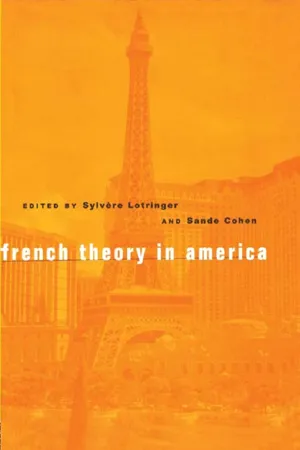
What does it mean to"do theory" in America? In what ways has "French Theory" changed American intellectual and artistic life? How different is it from what French intellectuals themselves conceived, and what does all this tell us about American intellectual life? Is "French Theory" still a significant force in America, raising conceptual questions not easily answered? In this volume of new work--including the French writers Julia Kristeva, Jacques Derrida, Jean Baudrillard, and Gilled Delezue, as well as essays by Sylvere Lotringer and Sande Cohen, Mario Biagoli, Elie During, Chris Kraus, Alison Gingeras, and Kriss Ravetto, among others--French theorists assess the impact and reception of their work in America, and American-based critics account for their effects in different areas of cultural criticism and art over the last thirty years.
Information
1
Some Views From France
Deconstructions: The Im-possible
JACQUES DERRIDA
Perhaps this time I will add an English subtitle to my French title, which Tom Bishop just pronounced for this conference whose posters have advertised, with a remarkable painting by Mark Tansey, that it would be given in French. The English subtitle will be the following. I pronounce it as best I can and you will understand it how you will: Falls. Or to return to French at its most untranslatable: comment tirer un trait.
It is autumn. Autumn for me is the season of the gracious hospitality of NYU, which always welcomes me “in the fall” and always welcomes a visitor immersed in his own gratitude. Last spring, in Paris, once again in friendship, Tom Bishop extended an invitation to attend a conference here, and he made it clear that my proposal, whatever freedom he would grant me, as he always so generously does, should be inscribed within a series of retrospective, if not melancholy, reflections on so-called French theory in America over the last twenty years. This is the theory that has, and I quote, “massively penetrated the American university and the American art-world”—thus runs the beautifully illustrated poster that I will shortly say a few words about. Well, last spring, before I answered Tom, I must have said to myself, someone in me must have instantly said: impossible. I will not talk on this impossible subject, whether because it is not feasible in an hour, or because, in a thousand different ways, here and there, and here often enough, we have already said so much about it. This inexhaustible subject has exhausted even us. It is becoming more than a topos or a common place: it is becoming a genre. It has its rites, its theater, its unavoidable characters, its laws, its law of genre. And since we mention law of genre and French theory over the last twenty years, allow me to remind Tom, and myself, that twenty years ago, in 1979, I think, the first conference that I attended here was entitled “The Law of Genre.” Already there was a superb poster, which you can admire in the French department. At that time, the poster did not yet show me in the process of getting ready for a fall, on the point of sinking into some abyss, mimicking a scene from the well-known detective novel The Death of Sherlock Holmes: Moriarty connected by some dance to a well-known partner, “Derrida queries de Man,” whom I am dragging or who is dragging me toward, toward what? The falls, precisely, in the fall. But a fall at the edge of a waterfall, a torrent. Falls. A fall at the edge of falls in the fall. As you have noticed, the landscape, the rocks are saturated with inscriptions, letters, hieroglyphs, a sort of text in stone: a somber and autumnal landscape, waterfalls like Niagara Falls. All of that is falls, false. This is the subtitle that I would give to the painting. Falls in the fall of the falls which remain at the edge of the falls, thus at the edge of itself, transfixed, photographed as in freeze-frame, in the imminence of a fall that does not come to an end, that in the end does not take place. Falls. Thus the fall will not take place, you see, there it is still. In any case, by all appearances, we are surely at the edge of the fall, as ever, as we have been from the beginning, but gripping the edge just enough to provoke the impatience, or the desire mixed with concern, of those observing this bizarre ballet, a dangerous pas de deux, and who no longer even know what they want. Like graffiti on the wall, this painting remains unreadable, somber as an autumn night, blue, blue-black, in the fall. For if in the end we ended up falling, things might fall out right. And no one knows who might get the upper hand, indeed raise himself up in the fall, from the very fall. Falls. I do not know what Mark Tansey meant to tell us; perhaps he himself does not know, and the only time we met, during a breakfast at the French Embassy, we hardly said a word to one another; I forgot to ask him what he meant to say, what he expected from all these Frenchmen that he puts on stage. In the shadow of this painting, next to Barthes, another representative of French theory, who they will talk to you about on October 27—next to Barthes I appear on this other painting entitled Mont Sainte Victoire. Because of this title and, to be sure, because of the fact that I find myself between Barthes and a bearded French veteran of the lastwar, we are in the French memory of Cézanne; the word victoire belongs to a landscape of war, but a war of the past, the first World War, and this surpassed war of the past, this victory both archived and pregnant with catastrophes to come, from the Treaty of Versaille to the Second World War, is perhaps an allegory of French theory in America. A victory pregnant with a menacing future. In any case, already or once again in Mont Sainte Victoire, whose reproduction you have just seen, I am put or see myself put on stage at the edge of an abyss, but this time a little like a tree at the edge of a river or lake, a reflective watery surface, wherein my image seems to have fallen to reflect itself before me, while I remain still on the edge, like a tree whose branches continue to grow. But the image that is reflecting me in the water is deformed, deforming: I am an other. You see, I would have preferred to run away or to talk around Tom Bishop's impossible proposition. And instead of talking to you about French theory in America over the last twenty years, I would have preferred to spend more than an hour reflecting on the desire and the work of Mark Tansey, who has me either dancing dangerously at the edge of a waterfall, or growing like a tree, but still at the edge of somber and menacing water, to the bottom of which, in the autumn, in the fall, I could sink. In the fall, into the falls, falling down into the false. Of course I will not do so, I mean, I will not speak of these simulacra any longer.
I could have, because this painting—seen in a certain light, of course—these paintings say everything, metonymically, that there is in my opinion to say, think, interpret, or overinterpret, about French theory in America over the last twenty years, at the edge of which all the equivocations and ambivalences can transfix or immobilize themselves as in a freeze-frame. Naturally, when I foolishly proposed the title in the plural, “Deconstructions: The Im-possible,” I did not just let speak, like a symptom, the spontaneous recoil that the program inspired in me: talk on this subject, pretend to talk on it? Again, no, impossible. Rather, I meant something else that I will try to explain.
After the fact, thus after having improvised this title, “Deconstructions: The Im-possible,” in my proposal to Tom Bishop, I realized that—so as not to play, not to deceive, once again at the edge—I had inscribed the word deconstruction in a title, undoubtedly for the first time in my life, in more than thirty years. And for the first time I had announced that I was going to talk, without subterfuge, about this thing and this name, this name in the plural of course, and in quotation marks, mentioning the name rather than using it, referring to it: to the effects of this name rather than to some improbable thing itself. Deconstruction in the singular does not exist and has never presented itself as such in the present, and the plural signifies first and foremost this: the open set of effects that one can, here or there, in the world and in America, associate with, invest in, love or hate to death under this name. The impossible is already this: identifying in the singular something that may present itself, that may be accessible as deconstruction. But I thought that, out of courtesy and a taste for hospitality and gratitude, I should talk as directly as possible, straightforward, without ruse or subterfuge, about this word deconstruction and what has happened to it, what has happened through it, with it, in spite of it, in this country and, above all, over the last twenty years.
First, allow me another preliminary reflection on this number, this sequence: twenty years. Why not thirty years, why not ten? I take this number quite seriously. Why twenty years? Twenty years ago the massive penetration that the poster mentions had already begun. It had been going on already for at least ten years. Ten years of penetration before twenty more years of penetration, that is a long time. It is long for a pleasure or for a suffering, or for a suffering at the edge of pleasure, or the opposite, and yet it is indisputable. Things had begun around October 1966, in the autumn, the fall, the date that classic historiographers generally record. In October ’66, the marker, the quasi-event, would be, would have been the famous autumnal conference in Baltimore at Johns Hopkins University that some have interpreted as the end of structuralism and the birth of post-structuralism, a purely American notion, moreover, as you well know, which I do not care for, and which I am eager to maintain as suspect and problematic; nevertheless, more than thirty years ago, the symbolic or symptomatic moment of this conference of 1966, in which I had the privilege of participating with my elders—Hyppolite, Lacan, Barthes, Vernant, Goldman, et cetera—will have marked the beginning of what some will call, depending on the figure, the desired trope: penetration, invasion, reception, welcome, alliance, assimilation, incorporation, injection, grafting: the transformation in America of this thing come from France and for which one created the name and the concept of “theory,” yet another purely American word and concept. In France, “theory” does not have an accredited conceptual equivalent any more than poststructuralism does. So why point out this difference of a decade between the thirty years I have just recalled and the twenty years alluded to in the title of this series, French theory over the last twenty years? Because from the beginning of the nineteen seventies, as far as deconstruction in the plural is concerned, they were already beginning the prognosis, indeed the diagnosis of the fall, its decadence and decline. They were already saying that it was damaged, that it was going over the dam. Falls, falling down, dead. The word they used was waning, on the wane. This was the mantra or the wishful thinking of the times. Falls: is that not the fall, decadence from the start, already in the nineteen seventies? In German fall means “case.” Fall, such is the case. Make no mistake. It is over.
The end is approaching, the time of the end keeps approaching, but that was already yesterday. And it has not stopped. This diagno-prognosis has not stopped resounding and echoing. I could give you a thousand examples, exhibit an entire dossier of references, but we do not have the time, and what is the point? In any case, it was and still is for me a source of astonishment and endless entertainment, as well as a subject for historical reflection, from at least two points of view: that of the diagno-prognosis, that is, the death notice, and from the point of view of the thing whose fall and then death one announces.
First, from the point of view of the diagnosis and prognosis. What happens when a fall does not stop? Falls and falls and falls in the falls from the beginning. Isn't this just like an inaugural fall or an original sin? The origin of sin or evil begins with the fall. And what happens when a death notice is rehearsed day after day for the same death in the same newspaper? Even for Diana it did not last so long, a week, two weeks (already an exception), and then it's over. What is dead is dead. The fall takes place once, and it's over. But when it comes to the end of deconstruction, of French theory, the fall lasts, it repeats itself, it keeps insisting, it keeps multiplying. Falls. Perhaps it is this suspended imminence, this suspense of the fall, the fall into the falls, that Tansey wanted to represent or immobilize or transfix in his painting. Like an instrument panel, perhaps he wanted to register the fall or the imminence of the fall, or the desire for the fall, in the spectator. It lasts and lasts endlessly. And the spectator, the one who watches without exerting any effort, and who grows impatient, who would like to get on with it, who wants it finally to fall, will say to himself: How long can this last! And the longer it endures, the harder the fall. But it lasts too long, it's not possible, it' intolerable, unbearable. It's impossible.
Secondly, from the point of view of the thing one is talking about, for example, a moribund deconstruction, we can ask ourselves what it means to begin, when all is said and done, from the very start by declining and deceasing, by wearing the joyful color of mourning, mourning for oneself, as the best protection against aging, even to the point of appearing invulnerable to the usual rites of fashion, the rites of passing, that the sociologist and historian of ideas or intellectual fads know so well. Regarding the question of fashion, longevity, or death, the question of an originary fall, I was saying to myself a little while ago as I came here that perhaps I envied the few French compatriots who have recently been shelved and swiftly classed in what one calls “the new French thought.” You know, the incredible artifact, editorial or academic, that they swiftly immortalize on the market after having announced in advance that this bricollage was new in order to ensure that the advertisement escape no one. At all costs, this novelty should become the new fashion. Well, I confess, I envy the ins and outs of this new French thought, for I am just about sure, and I am ready to bet on it, that they would not announce, that they will never announce the death of some new French thought. It will have been born immortal, deprived of any possibility of dying from its very first day. So, what can this mean: to be immortal from birth? You can perhaps guess. It is quite the opposite of the decompositions that would threaten the French theory associated with the deconstructions that I would like to speak to you about this evening.
Perhaps it is a certain impatience with the rebounding longevity of this thing that does not cease to fall and fall out so well, perhaps a feeling of impatience or resentment, that makes so many academic spectators sigh, so many idle passers-by, feeling annoyed, say: This is not possible. There, again, impossible. But it is these people who are impossible. That would thus be one possible sense of the word impossible, but it does not interest me very much, and as you suspect, it is something else that I have in mind by the title “Deconstructions” in the plural and “the Im-possible” as two words.
I fear that I will disappoint those who in reading the title may have come, mouth watering, to see someone contritely admit to the failure of a whole project, a whole lifetime, and confess with a tear in his eye:, “Contrary to what I had thought or tried to make others think, I must recognize that deconstruction is impossible. Please forgive me, that was a faux pas.” I just asked for a grand pardon, and now I must beg your pardon for not begging pardon.
I thus arrive at my subject. And instead of yielding to the temptation, a legitimate one, moreover, of a history, a sociology of ideas or currents or modes, I still have the desire to work and to speak to you about what is at work, hard work, about what endures, in the way of deconstructions, and about what works deconstructions through and through, in the very body, at the very brink, of the impossible—or through the impossible. The preceding remarks were not intended to speculate in specular or narcissistic fashion, self-indulgently, in a watery mirror, on the indefatigable longevity of deconstruction, which I never did believe in. I believe only in death and in death precisely as impossible, for which reason I am obsessed with, curious about, and convinced of mortality. Rather, it was a matter of preparing a reading of this dash that I thought it necessary to draw right in the middle of the word “im-possible,” of the im-possible. Perhaps there we find the reason for signing this autumn evening with the word falls, and of giving to a painting as blue as the falling of water its true title, falls. It is not a question of crossing out deconstruction with one stroke, nor of finding in de-construction or deconstructions features tired and drawn from a too long career, over the course of which one would have taken too much pleasure in penetrating a culture. Rather, it is a question of doing justice to a trait, a hyphen, a joining and thus a separation, a dash drawn in the heart of the impossible. In other words, this im-possible is everything but impossible; in any case, it calls for an other reflection on what possible, power, potentiality, dynamic, dynamis, “I can,” “I can be,” and “maybe” all mean. And the entire business of deconstruction seems to me more and more concerned precisely with deconstructing, with all its consequences, this semantics of the possible inherited from Greco-Christian, indeed biblical, thinking: the possible opposed to the impossible, the possible as virtual opposed to the actual or the act, the possible versus the real, dynamis opposed to energeia, and so on. There you go, and so now I begin, and since I have been invited to, I will improvise a historical periodization.
From the beginning, from the first decade, of which I spoke a little while ago, there existed a certain Americanization of a certain deconstruction, the one in any case that I was trying to put to work by that name. By Americanization I mean a certain appropriation: a domestication, an institutionalization, chiefly academic, that took place elsewhere in other forms as well, but here in a massively visible fashion, I mean, in this country. What they asked me to speak about tonight is this Americanization. From the first decade, it rested on the supposition of what I would call the becoming-possible of that which was already taking the form of the impossible. What does this mean? That often, here and there, most notably in the domain of literary theory and literature departments preoccupied in the first place with the concerns of reading and interpretation, with the method and epistemology of literary criticism, in all these places critics took pleasure in drawing on these texts or discourses that had apparently come from Fran...
Table of contents
- Cover
- Half Title
- Full Title
- Copyright
- Contents
- 0. Introduction: A Few Theses on French Theory in America
- PART ONE: SOME VIEWS FROM FRANCE
- PART TWO: FRENCH THEORY IN AMERICA
- SUPPLEMENTS
- Contributors
- Index
Trusted by 375,005 students
Access to over 1.5 million titles for a fair monthly price.
Study more efficiently using our study tools.
Frequently asked questions
Yes, you can cancel anytime from the Subscription tab in your account settings on the Perlego website. Your subscription will stay active until the end of your current billing period. Learn how to cancel your subscription
No, books cannot be downloaded as external files, such as PDFs, for use outside of Perlego. However, you can download books within the Perlego app for offline reading on mobile or tablet. Learn how to download books offline
Perlego offers two plans: Essential and Complete
- Essential is ideal for learners and professionals who enjoy exploring a wide range of subjects. Access the Essential Library with 800,000+ trusted titles and best-sellers across business, personal growth, and the humanities. Includes unlimited reading time and Standard Read Aloud voice.
- Complete: Perfect for advanced learners and researchers needing full, unrestricted access. Unlock 1.5M+ books across hundreds of subjects, including academic and specialized titles. The Complete Plan also includes advanced features like Premium Read Aloud and Research Assistant.
We are an online textbook subscription service, where you can get access to an entire online library for less than the price of a single book per month. With over 1.5 million books across 990+ topics, we’ve got you covered! Learn about our mission
Look out for the read-aloud symbol on your next book to see if you can listen to it. The read-aloud tool reads text aloud for you, highlighting the text as it is being read. You can pause it, speed it up and slow it down. Learn more about Read Aloud
Yes! You can use the Perlego app on both iOS and Android devices to read anytime, anywhere — even offline. Perfect for commutes or when you’re on the go.
Please note we cannot support devices running on iOS 13 and Android 7 or earlier. Learn more about using the app
Please note we cannot support devices running on iOS 13 and Android 7 or earlier. Learn more about using the app
Yes, you can access French Theory in America by Sylvere Lotringer,Sande Cohen in PDF and/or ePUB format, as well as other popular books in Literature & Art Theory & Criticism. We have over 1.5 million books available in our catalogue for you to explore.