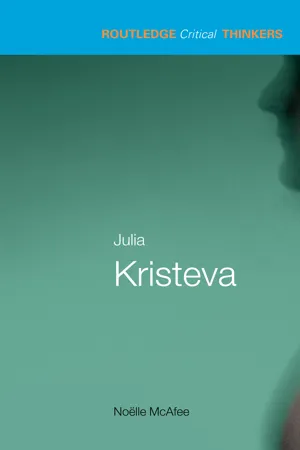
One of the most original thinkers of the twentieth century, Julia Kristeva has been driving forward the fields of literary and cultural studies since the 1960s. This volume is an accessible, introductory guide to the main themes of Kristeva's work, including her ideas on:
*semiotics and symbolism
*abjection
*melancholia
*feminism
*revolt.
McAfee provides clear explanations of the more difficult aspects of Kristeva's theories, helpfully placing her ideas in the relevant theoretical context, be it literary theory, psychoanalysis, linguistics, gender studies or philosophy, and demonstrates the impact of her critical interventions in these areas.
Julia Kristeva is the essential guide for readers who are approaching the work of this challenging thinker for the first time, and provides the ideal opportunity for those with more knowledge to re-familiarise themselves with Kristeva's key terms.
- 168 pages
- English
- ePUB (mobile friendly)
- Available on iOS & Android
eBook - ePub
Julia Kristeva
About this book
Information
| KEY IDEAS | |
| 1 | |
SEMIOTIC AND SYMBOLIC
This chapter covers key points in Kristeva's theory of language, including her notions of the chora, the semiotic, and the symbolic. She first articulated these in her early books, primarily in Semiotiké: Recherches pour une sémanalyse of 1969, of which only two chapters have been translated into English, and her groundbreaking text of 1974, La révolution du langage poétique, a third of which was translated into English and published in 1984 as Revolution in Poetic Language. The English-language version of Revolution contains the theoretical portion of the text and omits its critical application to the literary works of avant-garde writers. The thesis of Revolution in Poetic Language is this: the works of literary avant-garde writers produce a “revolution in poetic language.” That is, they contain elements that “shatter” the way we think that texts are meaningful. Meaning is not made just denotatively, with words denoting thoughts or things. Meaning is made in large part by the poetic and affective aspects of texts as well. This revolution is not limited to the language of artists, but is present in ways that ordinary human beings try to express themselves. All our attempts to use language neatly, clearly, and in an orderly way are handmaidens of our attempts to be neat, clearly demarcated, orderly subjects. But such attempts are continuously disrupted by certain elements of our signifying practice.
Throughout her writing, Julia Kristeva focuses on “speaking beings” – those who not only use language but are constituted through their use of language. Kristeva describes language as the discursive or signifying system in which “the speaking subject makes and unmakes himself” (Kristeva 1989b: 265, 272). In Kristeva's view, as the philosopher Kelly Oliver has noted, “any theory of language is a theory of the subject” (see Oliver's introduction to Kristeva 1997(: xviii)). Thus Kristeva folds two huge areas of inquiry – subjectivity and language – into one. This twofold aspect of her work makes writing this book on Kristeva difficult. I cannot begin to address her theory of language without also discussing her theory of subjectivity. Nor can I do the opposite. As we'll see, we cannot set her views on language apart from the beings who use it. In Kristeva's view, language is not a tool that we pick up from time to time. And there is not a speaking being to consider unless this being is speaking or using language in some way. To make matters all the more complex, we are engaging in this work using language ourselves.
THE SIGNIFYING PROCESS
One way to approach Kristeva's theory of language is to compare it to the other theories that were accepted when she wrote Revolution in Poetic Language. Kristeva's view of them is rather harsh: “Our philosophies of language, embodiments of the Idea, are nothing more than the thoughts of archivists, archaeologists, and necrophiliacs” (Kristeva 1984: 13). In other words, most non-post-structuralist theories of language treat language as a dead artifact, something that can be cataloged, archived, entombed – a formal object of study. They do this in keeping with larger socio-economic forces, namely capitalism, which treat people and their languages as isolable, static entities. In so doing, they deny the dynamic processes in which people generate meaning and experience.
Along with others in her circle on the Left Bank, Kristeva entered the field to change all that. Instead of treating language as a separate, static entity, Kristeva has seen it as part of a dynamic signifying process. Kristeva never explicitly defines this key term, but she seems to use it to mean the ways in which bodily drives and energy are expressed, literally discharged through our use of language, and how our signifying practices shape our subjectivity and experience: “linguistic changes constitute changes in the status of the subject – his relation to the body, to others, and to objects” (Kristeva 1984: 15). Kelly Oliver describes Kristeva's view of signifying practice this way:
Instead of lamenting what is lost, absent, or impossible in language, Kristeva marvels at this other realm [bodily experience] that makes its way into language. The force of language is [a] living driving force transferred into language. Signification is like a transfusion of the living body into language.(Oliver 1997: xx)
So we should not study language apart from “the subject of enunciation,” “the subject who ‘means,’” or, to put it more plainly, the person who is talking or writing and trying to express something. For this speaking being's own living energy infuses meaning into language. The best example of this phenomenon is a negative one: think of what it is like to talk with someone who lacks what psychiatrists call “affect,” that is, evident feeling or emotion. This is sometimes the case with someone who is severely depressed. Such a person's speech may be devoid of the usual rhythms and modulations that infuse speech with meaning. He or she speaks with no enthusiasm and seems to be nearly absent from the conversation. A listener would take away very little from the words that are uttered, for they do not seem to signify anything real or vital.
Interestingly, our everyday uses of language in social settings generally operate by trying to contain the “excesses” of language, that is, the potentially explosive ways in which signifying practices exceed the subject and his or her communicative structures (Kristeva 1984: 16). Some such excesses have been sanctioned in the arts, religion, and rites – realms in which passions that might disrupt the social order are channeled. But in “polite society” we are expected to “contain ourselves.” For most of us, we have to find a path between the two poles of language, devoid of affect and expressions that overwhelm order.
TWO MODES OF SIGNIFICATION
In fact, when we attend to language within the signifying process, Kristeva says, we may notice two ways or modes in which it operates: (1) as an expression of clear and orderly meaning; and (2) as an evocation of feeling or, more pointedly, a discharge of the subject's energy and drives. In other words, we may find ourselves using certain words because they get something across clearly or because they express some feeling, desire, or unconscious drive. The words she uses for these modes are, respectively, symbolic and semiotic. These terms draw on a rich background of linguistic and psychoanalytic theory, to which I will turn shortly. First, notice the following passage from Molly's soliloquy at the end of James Joyce's Ulysses:
the sun shines for you he said the day we were lying among the rhododendrons on Howth head in the grey tweed suit and his straw hat the day I got him to propose to me yes first I gave him the bit of seedcake out of my mouth and it was leapyear like now yes 16 years ago my God after that long kiss I near lost my breath yes he said I was a flower of the mountain yes so we are flowers all a womans body yes that was one true thing he said in his life and the sun shines for you today yes that was why I liked him because I saw he understood or felt what a woman is and I knew I could always get round him and I gave him all the pleasure I could leading him on till he asked me to say yes.(643)
Believe it or not, I've selected one of the more coherent passages from Molly's soliloquy. It expresses meaning in both modes that Kristeva discusses: (1) symbolically, i.e. through the use of logical terms; and (2) semiotically, through a breathless (punctuation-less) flow of words that are more emotive than logical. Clearly this passage partakes of the second mode more than the first, at least in so far as Joyce's semiotic signification helped produce Molly's stream of consciousness. Molly shifts back and forth in time and perspective. We get a keen sense of Molly's jouissance (one of Kristeva's favorite terms to signify both erotic and psychic pleasure). We read Molly's uncensored thoughts in her stream-of-consciousness recollections. This is an important part of semiotic signification: Molly's prose comes forth almost unbidden from a wellspring of internal desires and drives, or at least Joyce's writing seems to do so.
To help understand the distinction between semiotic and symbolic, the reader could imagine mapping that dichotomy onto more familiar dichotomies: such as the distinctions between nature and culture, between body and mind, between the unconscious and consciousness, and between feeling and reason. In the history of Western thought, these dichotomies are usually taken to be extreme opposites: either one is a savage brute or a civilized human being; either one is acting out of lust or using one's head; either one is driven by emotion or steered by reason. The difference with Kristeva's use of these kinds of polarities is that the former pole (semiotic/nature/body/unconscious, etc.) always makes itself felt – is discharged – into the latter (symbolic/ culture/mind/consciousness). Instead of holding to the dualistic thinking of the West, Kristeva is showing how the poles of these dichotomies are intertwined.
THE SEMIOTIC AND THE SYMBOLIC
In Kristeva's theory, the signifying process has two modes: the semiotic and the symbolic. The semiotic (le sémiotique, not la sémiotique, which means semiotics, the study of signs) is the extra-verbal way in which bodily energy and affects make their way into language. The semiotic includes both the subject's drives and articulations. While the semiotic may be expressed verbally, it is not subject to regular rules of syntax. Conversely, the symbolic is a way of signifying that depends on language as a sign system complete with its grammar and syntax (Kristeva 1984: 27). The symbolic is a mode of signifying in which speaking beings attempt to express meaning with as little ambiguity as possible. The expressions of scientists and logicians are paradigmatic examples of people trying to use symbolic language, whereas expressions found in music, dance, and poetry exemplify the semiotic. The semiotic could be seen as the modes of expression that originate in the unconscious whereas the symbolic could be seen as the conscious way a person tries to express using a stable sign system (whether written, spoken, or gestured with sign language). The two modes, however, are not completely separate: we use symbolic modes of signifying to state a position, but this position can be destabilized or unsettled by semiotic drives and articulations.
In a certain respect it may seem that the symbolic and the semiotic modes of signification are at odds with each other. This may be so, but certainly it is also true that the combination of Joyce's symbolic mode of signification (his words with clearly demarcated meaning) and his semiotic mode (a syntax that undercuts order) together signify something more than the sum of the parts of Molly's words. We have here neither pure logic nor pure music. What we have is a symbolic mode of signification (the words in whatever semantic order they are given) that is energized by a semiotic dimension. Molly says “that after that long kiss I nearly lost my breath” and the words are energized by the breathless semiotic rhythm of the text. This is Kristeva's point: the symbolic mode of signification is meaningful because of the way the semiotic energizes it. If it weren't for the bodily energy that speaking beings bring to (and put into) language, language would have little if any meaning for us.
THE SEMIOTIC CHORA
Well before the subject begins to use language symbolically – through the use of symbols, grammar, and syntax – she expresses herself with various intonations and gestures. Think of a baby's coos and babbles or her imitations of the rhythms of her parents' speech. This kind of signifying is part of what Kristeva calls the semiotic: “We understand the term ‘semiotic’ in its Greek sense:ðηµεῖov = distinctive mark, trace, index, precursory sign, proof, engraved or written sign, imprint, trace, figuration” (Kristeva 1984: 25). The semiotic aspect of signification signifies what is “below the surface” of the speaking being:
Discrete quantities of energy move through the body of the subject who is not yet constituted as such and, in the course of his development, they are arranged according to the various constraints imposed on this body – always already involved in a semiotic process – by family and social structures. In this way the drives, which are “energy” charges as well as “psychical” marks, articulate what we call a chora: a nonexpressive totality formed by the drives and their stases in a motility that is as full of movement as it is regulated(Kristeva 1984: 25)
By motile, Kristeva means the quality of exhibiting or being capable of spontaneous movement.
Kristeva borrows the term chora from Plato's Timaeus to “denote an essentially mobile and extremely provisional articulation constituted by movements and their ephemeral stases” (1984: 25). But even with Plato on her side, Kristeva's notion of the chora is extremely hazy: the chora is often translated as womb or receptacle, but Kristeva doesn't seem to mean that it is just a space; she says it is an articulation, a rhythm, but one that precedes language. Kristeva's ambiguity can be traced back to the Timaeus itself. Plato offered the terms receptacle and chora to describe a space in which the universe comes to reside. The chora is a space
which exists always and cannot be destroyed. It provides a fixed site for all things that come to be. It is itself apprehended by a kind of bastard reasoning that does not involve sense perception, and it is hardly even an object of conviction. We look at it as in a dream when we say that everything that exists must of necessity be somewhere, in some place and occupying some space.(Timaeus: 52b–c)
THE CHORA
The Greek philosopher Plato (427–347 BC) coined a term on which Kristeva draws. In one of his works titled the Timaeus, Plato gives his own explanation for how the universe was created. In the process he uses the word chora, meaning both receptacle and nurse, that is, the container and the producer, of what the universe is before and as anything exists. With the term chora, Kristeva describes how an infant's psychic environment is oriented to its mother's body: “Plato's Timaeus speaks of a chora, receptacle, unnamable, improbable, hybrid, anterior to naming, to the One, to the father, and consequently, maternally connoted to such an extent that it merits ‘not even the rank of syllable’” (1980: 133). Plato meant by the term the original space or re...
Table of contents
- Cover Page
- Half Title Page
- Series
- Title Page
- Copyright Page
- Contents
- Series editor’s preface
- Acknowledgements
- Why Kristeva?
- Key Ideas
- After Kristeva
- Further Reading
- Works cited
- Index
Trusted by 375,005 students
Access to over 1.5 million titles for a fair monthly price.
Study more efficiently using our study tools.
Frequently asked questions
Yes, you can cancel anytime from the Subscription tab in your account settings on the Perlego website. Your subscription will stay active until the end of your current billing period. Learn how to cancel your subscription
No, books cannot be downloaded as external files, such as PDFs, for use outside of Perlego. However, you can download books within the Perlego app for offline reading on mobile or tablet. Learn how to download books offline
We are an online textbook subscription service, where you can get access to an entire online library for less than the price of a single book per month. With over 1.5 million books across 990+ topics, we’ve got you covered! Learn about our mission
Look out for the read-aloud symbol on your next book to see if you can listen to it. The read-aloud tool reads text aloud for you, highlighting the text as it is being read. You can pause it, speed it up and slow it down. Learn more about Read Aloud
Yes! You can use the Perlego app on both iOS and Android devices to read anytime, anywhere — even offline. Perfect for commutes or when you’re on the go.
Please note we cannot support devices running on iOS 13 and Android 7 or earlier. Learn more about using the app
Please note we cannot support devices running on iOS 13 and Android 7 or earlier. Learn more about using the app
Yes, you can access Julia Kristeva by Noelle McAfee in PDF and/or ePUB format, as well as other popular books in Literature & Feminist Literary Criticism. We have over 1.5 million books available in our catalogue for you to explore.