- 240 pages
- English
- ePUB (mobile friendly)
- Available on iOS & Android
eBook - ePub
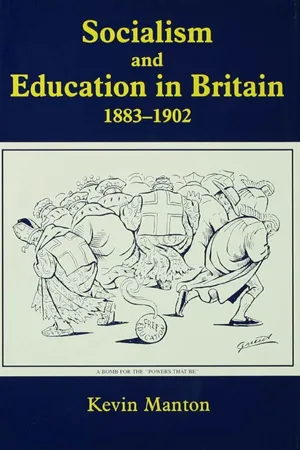
Socialism and Education in Britain 1883-1902
About this book
Examines the British socialist movement in the last two decades of the 19th century through its policies on children's education. The author reassesses the nature of these policies and comments on the validity of those historiographical models used in analyses of the socialism of this period.
Information
1
Socialism and the ‘Religion, Education, Family Question’
We defy any human being to point to a single reality, good or bad, in the composition of the bourgeois family. It has the merit of being the most perfect specimen of the complete sham that history has presented to the world. There are no holes in the texture through which reality might chance to peer. The bourgeois hearth dreads honesty as its cat dreads cold water.
(Ernest Belfort Bax, The Religion of Socialism, 1887, 141.)
There can be little doubt that the co-operative commonwealth towards which all late-nineteenth-century socialists worked would provide a good life for children. In this future age the object of all child care would be the drawing out of each child’s own unique attributes to produce fully-rounded individuals freed from the alienation of urban industrial capitalism. This socialism also argued that such a goal could never be reached by means that were inimical to it, for ‘brotherhood must not only be talked of but practised’.1 Therefore, the ideology placed the welfare of children high on its agenda and, commensurate with this, it raised serious questions about the material quality of life of ordinary working people and about the nature of the family as it was constituted in Britain at the end of the nineteenth century. These more general points led to a particular doubt over the suitability of parents to act as the educators of their children. This prioritising of children was given a fillip by other aspects of socialism.
The most notable of these was the rationalism of much socialist thought in the period. Many leading socialists seemed to operate under the belief that, because they accepted the new doctrines and because the truths about the social and political system that socialism laid bare were self-evident to them, these truths should also be self-evident, preferably upon first hearing, to anyone and everyone. This feeling may have been heightened in some socialists by the fact that they had turned their backs on their own middle-class origins to join the new religion only to find that the workers whom they intended to help resisted all offers of such help. In his novel,
The Ragged Trousered Philanthropists, Robert Tressell wrote of the hell on earth which his characters inhabited and commented that
the remedy was so simple, the evil so great and so glaringly evident that the only possible explanation of its continued existence was that the majority of … workers were devoid of the power of reasoning. If these people were not mentally deficient they would of their own accord have swept this silly system away long ago. It would not have been necessary for anyone to teach them that it was wrong.2
This theme was picked up by Thomas Ince in his poem ‘The People’:
When will the toilers use reason?
When will they show common-sense?…
Now is the chance and the season
To thwart the usurper’s pretence.3
This attitude was not the sole prerogative of the poet or fiction writer. James Bruce Glasier described the workers as ‘dunderheads and donkeys … sneaks, flunkeys, cowards, traitors and nincompoops’.4 Hyndman thought that they were ‘too ignorant and apathetic’. There was, he wrote, ‘nothing more discouraging … than their lack of initiative and go’.5 Robert Blatchford wrote of their ‘apathy, ignorance, stupidity, and meanness’.6 Fallows, secretary of the Birmingham Socialist Centre, saw their ‘moral stupidity and weakness’ as being ‘the chief hindrance to the realisation of reform’.7 John Trevor regarded them as ‘docile, idle and stupid’.8 Edward Carpenter was either being slightly more tolerant or more paternalistic when he, in turn, described them as ‘patient, broad-backed, good-humoured [and] simple’.9
This could be the creed of despair. James Leatham in Aberdeen told those who listened to his lecture The Class War that
you prefer the man with money to the man with brains and good intentions. You snub your political friends, and send them away sick at heart and despairing of you and your cause. It is little wonder if at times we get sick of you, get sick of talking to you.10
But equally it could be an inspiration to keep on struggling to save future generations from the crushing weight of such ignorance; as Robert Blatchford noted in 1893, ‘to be candid I don’t so much care about the stupid, selfish, ignorant British workman. But for the sake of the little children … 1 keep the field’.11 Four years later Justice, reporting on ‘The Coming Struggle at the School Board Elections’, made the same point: ‘Comrades, the more complete the apathy, the denser the ignorance of the mass of Englishmen around us, the greater the responsibility which falls to us.’12
Socialists did not assume the workers were naturally and inalienably ignorant, rather this ignorance was a product and a tool of the system that enslaved them. This, however, put socialists into a quandary. How could the class be emancipated when it was too ignorant to realise that it was enslaved and, on the basis of this ignorance, made immoral decisions which perpetuated its captivity? A dual track of short- and longer-term strategies was followed as the way clear of this morass. Propaganda was used to recruit as many adults as possible; this was coupled with a heavy emphasis on the education of children. Since the overriding view was that people were ignorant, the emphasis on education carried with it clear implications for the role of workers as parents; all of which pointed clearly to the strategy of changing this role. This goal, of restructuring the social and political nature of parenthood, was to be reached by way of the tactics of limiting parents’ roles or making them realise their duties as citizens. It is the aim of this chapter to examine, first, the socialist analysis of the position in which working-class parents found themselves in the last two decades of the nineteenth century and, second, how this position affected their children. This draws out the interconnected material and moral analysis of society deployed by socialists in the period and locates the family within this framework. The final section presents the role envisaged for the family in the future socialist state by examining its portrayal in socialist Utopian writings.
The System as it Affected Parents
The socialist analysis of, and prescriptions for changing, society fused the moral and the material elements of life which have since been viewed as separate spheres. However, given the current historiographical trend which denies that socialism was anything other than a moral revolt, it is worth taking some time to consider the material side of the analysis. This can be seen, for example, in the works of John Trevor. In a letter to a Labour Church congregation Trevor wrote that what the worker needed was not personal moral guidance but the ‘emancipation of labour’.13 This, as he wrote elsewhere, could only be based on the equal possession of the means of economic production.14 In Trevor’s Labour Church movement there were, according to the memory of one of its members, ‘loud and persistent’ cries for ‘the needed economic change’.15 Pete Curran was applauded for endorsing this view at Barrow Labour Church. This institution, he told his audience, was based on the ‘broad human principle’, which he supported, ‘of the welfare of people while they live in this world’. He urged them to ‘go down to the social basis and abolish the depredation of ignorance in the people, and develop them mentally and physically’.16 The headed note paper of Bradford’s Labour Church bore the caption ‘Object: The realisation of heaven IN THIS LIFE’.17 In the Fellowship of the New Life it was accepted that moral regeneration was vital but that it would be pointless unless it ‘immediately translated itself into a movement for a further political and economic evolution’.18
In the socialist view people compelled, by the monopolistic ownership of land, to work for others in order to survive had to take the wages they were offered.
What is the price the worker sells his labour at? A bare living!… What the capitalist squeezes out of the man over and above the latter’s bare living, he applies to his own wants, or turns into fresh capital, putting it either into his own business or some other profitable investment.19
The much-trumpeted freedom of contract between employer and employee was, in reality, not a free exchange between equal participants. The worker – with no resources – being offered, by the capitalist who was possessed of ‘the whole means of producing wealth and employing labour at his command’ a choice between just enough or starvation was, in reality, being given no choice at all.20 When he gave a lecture on ‘The Deficiencies of Radicalism’ to members of the Fellowship of the New Life, Maurice Adams, editor of Seed-time, told his audience that ‘a contract between a disinherited man and a monopolist can never be fair, and can only be free in the sense that a drowning man is free in giving all that he has for his life’.21
So systematically and inextricably were the two classes combined that it was impossible to explain the position of the one without reference to the other. Education was part and parcel of this system.
The theory of socialism is that the division of society into classes renders social warfare inevitable while the class divisions continue to exist. Socialism contends that the poverty of the poor is caused by the robbery on the part of the rich. The mansion explains the hovel… The factory, the foundry, the ship-building yard account for the shooting lodge, the yacht and the tours in foreign lands…The withdrawal from school at an early age of the worker’s son enables the guilded youth to put in years at college.22
Late-nineteenth-century Britain was characterised by a social system that all socialists despised and that some saw as being too corrupted to deserve the name society at all. Edward Carpenter was only the most notable to call modern society a disease: so riddled was it with the a...
Table of contents
- Cover
- Half Title
- Title Page
- Copyright
- Dedication
- Contents
- List of Illustrations
- Foreword
- Acknowledgements
- List of Abbreviations
- Introduction: The Character of Socialism, the Socialism of Character?
- 1. Socialism and the ‘Religion, Education, Family Question’
- 2. Socialism, Education and Teachers
- 3. Socialist Education: Ideals and Practice
- 4. Socialism, Work and Technical Education
- 5. Socialism, Education and Democracy
- 6. Socialism and the 1902 Education Act
- Conclusion
- Bibliography
- Index
Trusted by 375,005 students
Access to over 1.5 million titles for a fair monthly price.
Study more efficiently using our study tools.
Frequently asked questions
Yes, you can cancel anytime from the Subscription tab in your account settings on the Perlego website. Your subscription will stay active until the end of your current billing period. Learn how to cancel your subscription
No, books cannot be downloaded as external files, such as PDFs, for use outside of Perlego. However, you can download books within the Perlego app for offline reading on mobile or tablet. Learn how to download books offline
Perlego offers two plans: Essential and Complete
- Essential is ideal for learners and professionals who enjoy exploring a wide range of subjects. Access the Essential Library with 800,000+ trusted titles and best-sellers across business, personal growth, and the humanities. Includes unlimited reading time and Standard Read Aloud voice.
- Complete: Perfect for advanced learners and researchers needing full, unrestricted access. Unlock 1.5M+ books across hundreds of subjects, including academic and specialized titles. The Complete Plan also includes advanced features like Premium Read Aloud and Research Assistant.
We are an online textbook subscription service, where you can get access to an entire online library for less than the price of a single book per month. With over 1.5 million books across 990+ topics, we’ve got you covered! Learn about our mission
Look out for the read-aloud symbol on your next book to see if you can listen to it. The read-aloud tool reads text aloud for you, highlighting the text as it is being read. You can pause it, speed it up and slow it down. Learn more about Read Aloud
Yes! You can use the Perlego app on both iOS and Android devices to read anytime, anywhere — even offline. Perfect for commutes or when you’re on the go.
Please note we cannot support devices running on iOS 13 and Android 7 or earlier. Learn more about using the app
Please note we cannot support devices running on iOS 13 and Android 7 or earlier. Learn more about using the app
Yes, you can access Socialism and Education in Britain 1883-1902 by Kevin Manton in PDF and/or ePUB format, as well as other popular books in Education & Comparative Education. We have over 1.5 million books available in our catalogue for you to explore.