- 216 pages
- English
- ePUB (mobile friendly)
- Available on iOS & Android
eBook - ePub
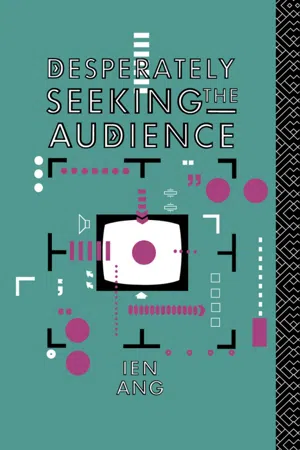
Desperately Seeking the Audience
About this book
Millions of people all over the world are avid members of the television audience. Yet, despite the central place television occupies in contemporary culture, our understanding of its complex and dynamic role in everyday life remains surprisingly limited. Focusing on the television audience, Ien Ang asks why we understand so little about its nature, and argues that our ignorance arises directly out of the biases inherent in prevailing official knowledge about it. She sets out to deconstruct the assumptions of this official knowledge by exploring the territory where it is mainly produced - the television institutions.
Ang draws on Foucault's theory of power/knowledge to scrutinize television's desperate search for the audience, and to identify differences and similarities in the approaches of American commercial television and European public service television to their audiences. She looks carefully at recent developments in the field of ratings research, in particular the controversial introduction of the `people meter' as an instrument for measuring the television audience. By defining the limits and limitations of these institutional procedures of knowledge production, Ien Ang opens up new avenues for understanding television audiences. Her ethnographic perspective on the television audience gives new insights into our television culture, with the audience seen not as an object to be controlled, but as an active social subject, engaging with television in a variety of cultural and creative ways.
Information
Part I
Conquering the audience: the institutional predicament
1
Institutional knowledge: the need to control
In ‘The Imaginary Signified’, film theorist Christian Metz (1975) has identified an acute problem for the film industry. The problem will come as no surprise to those who run the industry, for they are daily confronted with its practical repercussions. But its theoretical repercussions have been less charted. Here is how Metz has characterized the problem:
In a social system in which the spectator is not forced physically to go to the cinema but in which it is still important that he [sic] should go so that the money he pays for his admission makes it possible to shoot other films and thus ensures the auto-reproduction of the institution—and it is the specific characteristic of every true institution that it takes charge of the mechanisms of its own perpetuation—there is no other solution than to set up arrangements whose aim and effect is to give the spectator the ‘spontaneous’ desire to visit the cinema and pay for his ticket.
(Metz 1975:19)
Conjured up here is the problem of institutional reproduction. The cinema can only continue to exist if and when enough people are willing and prepared to be regular members of the film audience, but the film industry does not have the means to provide itself with a guarantee that people will not one day stop going to the movies. The problem seems to be a rather far-fetched one, because since the turn of the century, when the cinema first entered our cultural life, the world has obviously turned into a place full of filmgoing women, men and children. However, the principle of the problem is undeniable, and that it is not entirely hypothetical, is easily exemplified by the sharp and steady decline in cinema-going since the 1950s, when television made its entrance in people’s homes (Docherty et al. 1987; Gomery 1985).1 At stake, then, is the institution’s control—or better, lack of control—over the conditions of its own reproduction.
Broadcast television faces similar institutional problems: it too cannot take its audience for granted. Contrary to other social institutions such as the school or the family, television (as well as all other mass media) does not have the means to coerce people into becoming members of its audience. Television audience membership is not a matter of compulsion or necessity, but is principally voluntary and optional. Therefore, the television institution is ultimately dependent upon people’s unforced appetite to continue watching day after day. Again, the problem seems far-fetched given television’s manifest success in securing huge audiences for its transmissions, but this still does not mean that that success comes naturally and effortlessly. On the contrary, numerous institutionally orchestrated activities such as the publication of TV guides, advertisements and press interviews with TV personalities, as well as previews of forthcoming programmes during an evening’s flow, the use of teasing jingles, logos and so on, testify to the enormous amount of money and energy being spent to reinforce and update people’s desire to watch television (Ellis 1982; Ang 1985b). The very fact that these strategic institutional activities are of a continuous, never-ending character indicates that television networks and broadcasting organizations know that they cannot take the existence of an audience for granted: they can try to influence potential audience members, but they cannot control them in any direct manner.
A constant sense of uncertainty thus haunts television’s persistence and continuity as an institution. The audience, sine qua non for both television’s economic viability and cultural legitimacy, forms its ultimate insecurity factor because in principle there is no way to know in advance whether the audience will tune in and stay tuned. It is not surprising then that a constant need is felt within the institution to ‘catch’, ‘capture’ or ‘lay hold of’ the audience. Audiences must constantly be seduced, attracted, lured. How-to-get-an-audience is, willy-nilly, the institution’s key predicament, even though this is not always acknowledged as such.
The seriousness of this predicament is deeply ingrained in the very structure in which television as an institution is formally organized in our societies. Television’s dominant institutional arrangement is embodied within the framework of broadcasting, a framework whose basic configuration has been extended, without any radical changes, to cable and satellite television. According to Raymond Williams (1974:30), the broadcasting framework is characterized by a ‘deep contradiction between centralized transmission and privatized reception’. This ‘deep contradiction’ refers to the circumstance that while television is generally seen as a form of ‘mass communication’, no true communication—in the ‘ritual’ sense of that word: exchange of meanings that is both collective and interactive (Carey 1989)—between the television institution and the television audience generally takes place. Broadcast television transmission is both adamantly intentional and resolutely non-interactive: the diffuse and dispersed television audience, locked in its condition of privatised reception, is an invisible and mysterious interlocutor.2 This makes the task of how-to-get-an-audience a particularly difficult one for television institutions (Gans 1957; McQuail 1969; Hirsch 1972; Elliott 1972, 1977; Cantor 1980; Ettema et al. 1987).
Over the years, a range of risk-reducing techniques and strategies of regulating television programming such as serial production, usage of fixed formats and genres, spin-offs, horizontal scheduling, and so on, have been developed (Ellis 1982; Gitlin 1983). These strategies do not only serve as a way to facilitate the organization and co-ordination of the industry’s production practices, but are also aimed at the codification, routinization and synchronization of the audiences’ viewing practices, to make them less capricious and more predictable (cf. Rojek 1985:154–5). But all these strategies can only help to manage, not remove the basic uncertainty with which the television institution has to live. There are no guarantees that actual audiences will comply to the codes, routines and synchronities of viewing behaviour as designed by the institutions. Ultimately, then, the problem of (lack of) control amounts to one thing: the impossibility of knowing the audience—in the sense of knowing ahead of time exactly how to ‘get’ it.
This does not mean that no knowledge about the audience is produced in the multi-layered organizational process of television broadcasting. On the contrary, both formal and informal knowledge about the audience is constantly operative in the complex decision-making procedures which determine the shape and content of television’s daily output of programmes. ‘Know the audience’ is the first basic principle every handbook for commercial broadcasting teaches the would-be television programmer (e.g. Howard and Kievman 1983; Tyler Eastman et al. 1985). The production of this knowledge does not only take place in the specialized, knowledge-producing activity of ‘audience research’; it also emerges and comes into circulation more or less spontaneously through a whole range of concrete discursive practices—board meetings, informal conversation and interviews, discussions about programme ideas, scheduling principles, policy statements, research reports, and so on; practices that, in one way or another, ultimately revolve around one main objective: to come to terms with television’s invisible addressee.
One such discursive practice is the ‘story conference’, a key event, in American commercial television at least, in which producers, writers, and other creative personnel (story editors, directors and so on) gather together to come to a shared understanding of what the television programme they are creating should look like. Paul Espinosa’s (1982) analysis of a number of typical story conferences indicates that their unfolding is governed by the implicit application of a number of rules of thumb that articulate institutional perceptions about the audience. In the course of such story conferences the participants tend to display an intense preoccupation with the need to engage the audience, to consider the audience’s presumed knowledge of the world, to meet the audience’s expectations for the programme, and not to ‘divide’ the audience. Statements made during a story conference such as ‘America has to embrace your characters’ and ‘I think we have to keep this non-racial’ evince the sense producers have of what viewers will or will not accept. According to Espinosa (ibid.: 84), such ‘perceptions of the audience function as an internalized, restraining mechanism which [the producers] bring into play at appropriate moments in the story conference’. How these perceptions come into being, however, is a rather elusive question. As he notes,
these images [of audience] are the subjective, intuitive beliefs of producers. These images are not empirically generated by market research or any formal quantitative method. Rather the ‘audience’ is a cultural category for producers, a category which they form from a number of sources, including their experiences with audiences from previous programs, their personal projections about who their audience is, and their knowledge of the industry they work in.
(ibid.: 85)
Despite their ‘unscientific’ nature, however, these images and perceptions serve as true knowledge for the producers because they empower them to reduce the extreme complexity of the process which the making of a programme entails: they are discursive tools that enable them to make choices, evaluate proposals, and so on.
Espinosa’s study refers to the central role of informal, if not speculative knowledges about the audience in the creative sector of institutional activity, where development of programmes is the main task (Pekurny 1982; Newcomb and Alley 1983). But producers do not have the power to decide whether their productions will be put on the air; that power—that is the power to select programmes for transmission—lies in the hands of those occupying the administrative and managerial echelons of the television institution (Ettema et al. 1987). At this level, the problem of how-to-get-an-audience is not primarily the craftman’s one of how to steer or constrain creativity in order to come to a finished aesthetic product (the programme), but is related to the more encompassing problem of overall organizational policy, which is ultimately aimed at creating and securing the institutional conditions in which a relationship with the audience can be established and maintained. It is at this level that having (and keeping) an audience tout court forms the single most important goal, and here too knowledge about the audience, both formal and informal, is used to help managers to make the decisions needed to reach that goal.
Consider, for example, the perspective of network executive Brandon Tartikoff, president of NBC Entertainment and responsible for airing much-acclaimed series such as Hill Street Blues, Cheers and Miami Vice. As a result, he acquired the distinctive reputation of being a programmer with an eye for ‘quality’—something which, in what has been called the ‘vast wasteland’ of American commercial television (Boddy 1990) is quite a feat indeed. But this does not hold him from setting his standards within a definite idea of ‘what the audience wants’. He asserts: ‘I probably have more esoteric tastes than the average television viewer. I’ll go to see Amadeus and pay my five dollars and fifty cents, but when the salesman from Orion [a production company] comes and asks me to buy it for the networks, I’ll say no, because it’s going to get a twenty-two share’, which is, he implies, not enough because ‘as a programmer I had to ask myself if it was something that would get a thirty share or better’ (in Levinson and Link 1986:256–7).
Thus separating personal taste and market judgement, Tartikoff extemporaneously adheres to the principle of ‘audience maximization’, which reigns so supreme in the operations of American commercial television. The language in which this principle is expressed is the quantitative one of ‘shares’—a language that is only made possible by the existence of a very formalized procedure of knowledge production: audience measurement.
As a form of systematic research in which empirical information is gathered through quantifying scientific methods, audience measurement supplies a technical and formal kind of knowledge whose mode and status differs fundamentally from the intuitive, all-but-immaterial knowledges about the audience put forward and used by programme creators during events such as the story conference. For one thing, knowledge gained through research is produced by experts, whom Harold Wilensky (1967) has called facts-and-figures men, while the subjective and informal forms of knowledge circulating within the creative community remain largely implicit in the creative process itself. The first kind of knowledge holds the official status of ‘organizational intelligence’ (ibid.) within the industry because it enables managers such as Tartikoff to speak about the audience in tangible, apparently objective terms, and as I will show in Part II, it is precisely this sense of objectivity that accounts for audience measurement’s centrality as a power/knowledge device in the structural operations of commercial television. Even the creative community ultimately has to submit, often grudgingly, to the regime of truth established by audience measurement, the truth of ‘shares’ and ‘ratings’, because it is this regime of truth that has the final say over what counts as ‘success’ and ‘failure’ (Cantor 1980; Gitlin 1983). Thus, within the television industry a hierarchy of diverse forms of knowledge about the audience has been established: the contextualized and more or less instinctive knowledge that is inherent in the savoir-faire of programme creation is ultimately subordinated, qua knowledge about the audience, to the stipulated, official and generalized knowledge produced by the discourse of audience measurement.
In fact, not only audience measurement, but research in general, with its aura of scientific rationality, has acquired an entrenched position in the institution as a whole. The elevated status of research as a means of providing the institution with ‘seemingly systematic, impersonal, reliable ways to predict success and failure’ (Gitlin 1983:31) is exemplified by the career of Frank Stanton, who was hired as a researcher by CBS in 1935 and subsequently rose to become president of the corporation for twenty-five years. As Todd Gitlin (ibid.: 43) has remarked, ‘Stanton embodied the postwar legitimacy, indeed the necessity, of facts-and-figures research in the culture industry’. Stanton was a pioneer in the field of audience research; together with Paul Lazarsfeld, the father of American mass communication research, he developed the Lazarsfeld-Stanton Program Analyzer, the first device for measuring audience reactions to radio and still the basis for CBS’s television pre-testing system—a system aimed at testing programmes before they get on the air (Levy 1982). The three national networks of American commercial television, ABC, CBS and NBC, all routinely engage in this practice of pre-testing which, in Gitlin’s (1983:32) cynical words, consists of the production of ‘numbers to predict numbers’, that is, the creation of ‘artificial test markets in hothouse settings where audience reactions can be cheaply reduced to numerical measures that they hope might predict eventual ratings’.
Research is often motivated and legitimized for its role in rationalizing managerial decision-making procedures. Indeed, where uncertainty or disagreement about the chance of success is particularly marked, resort to a neutral, non-subjective, facts-and-figures discourse, which pretends to provide the most explicit and systematic knowledge about the audience, is preferred in order to manage intra-industry relationships and mobilize support for unpopular or controversial decisions. Thus, pre-testing results can be capitalized upon in negotiations between creators and managers—something which is especially useful when opinion is divided: ’Network executives find it convenient to tell producers that their shows aren’t being picked up because of low test scores, thereby deflecting some of the supplier’s anger onto the hapless research department’ (ibid.: 45). Such use of the rhetoric of quantitative justification is a well-known phenomenon in modern complex organizations (Gephart 1988), and suggests that the aura of ‘scientific rationality’ that facts-and-figures knowledge possesses is primarily useful for its rhetorical aptness in institutional practices: more often than not, research is a tool for symbolic politics rather than for rational decision-making. Therefore, research itself does not go uncontested within the institutions. As Gitlin (1983:45) has noted, ‘Valued but scorned, cited but patronized, [the] ambiguous position [of research] represents the culture industry’s uneasy attempt to accommodate its industrial reality’.
Yet the importance of research can only be understood precisely in the light of this institutional uneasiness. Against this background, we should not only look at the differences in modalities of knowledge about the audience that circulate within television institutions, but also at their common conditions of production, their shared institutional context and function. No matter whether they are formal or informal, explicit or implicit, scientific or intuitive, ‘objective’ or ‘subjective’, they are all forms of interested knowledge, aimed at inducing strategic know-how: their purpose is to clarify what one should do in order to sustain a hold over the audience. It is this goal-directed requirement that binds all forms of institutional knowledge (including research) together, and that determines their common discursive construction of ‘television audience’ as a category of others to be controlled.
The pragmatic logic of this construction is evocatively recited by Brandon Tartikoff. In 1970, when he first explored the possibility of starting a career within the television industry, the programme director of a local television station gave him some extraordinary advice. Tartikoff recalls:
He asked me if I had an Instamatic camera and I said I did. He said, ‘Why don’t you go down to New York, go to the Port Authority Bus Terminal, and take pictures of the first hundred people who get off the buses? Take those pictures, blow them up to eight-by-ten glossies, and wherever you go down to work in television, put those photographs up on the wall somewhere. And every time you have to make a decision, look at those pictures and ask yourself, will they like it?’ If I did that, he said, I’d be very successful in the business.
(In Levinson and Link 1986:247)
Tartikoff did not literally follow the rather unusual advice, but the anecdote is telling enough because it clearly illustrates the general discursive operation that underpins all institutional pursuits of knowing the audience. Central to this discursive operation is the construction of a set of binary oppositions: production versus consumption, ‘sender’ versus ‘recipient’, institution versus audience. As a consequence, a relationship of confrontation is constituted. From the point of view of the institution, the audience appears in this discursive structure as a distinct category of others that stands against itself: ‘us’ versus ‘them’. As Tartikoff’s adviser wondered: ‘Will they like it?’
This subject/object dichotomy reveals the structural position assigned to the audience from the institutional point of view: the position of object to be conquered. The audience must, in one way or another, be imagined as addressable, attainable, winnable, in short, a manoeuvrable ‘thing’. In this respect, it is not for nothing that the audience is as often referred to as ‘it’ as it is as ‘they’. It is through this discursive objectification that the nexus of power and knowledge exhibits its effectivity.
In his book Orientalism, Edward Said (1985) has demonstrated a similar intertwining of power and knowledge in what he calls the discourse of ‘orientalism’: a systematic discourse, inextricably linked to European colonialism and neo-colonialism, in which the ‘Orient’ is imagined and represented in ways which always buttresses and nourishes the superiority and hegemony of the West. Western observers have, consistently and persistently, pursued the aim of gaining knowledge about the Orient. But this knowledge inevitably articulates a power relationship. As Said remarks,
Knowledge means rising above immediacy, beyond self, into the foreign and distant. The object of such knowledge is inherently vulnerable to scrutiny; this object is a ‘fact’ which, if it develops, changes, or otherwise transforms itself in the way that civilizations frequently do, nevertheless is fundamentally, even ontologically stable. To have knowledge of such a thing is to dominate it, to have authority over it.
(Said 1985:32)
The television audience can be seen as similarly ‘orientalized’ from the institutional point of view (cf. Hartley 1987). Institutional knowledge is produced as a result of the symbolic travels that are initiated and orchestrated by the institutions into the obscure territory of the audience; they lead to a capturing of ‘television audience’ as object of knowledge, object of scrutiny, object of control. The trip to Port Authority that Tartikoff was advised to take in order to take some pictures of bus passengers which he should then hang full-blown in his office, is an almost too fitting metaphorical illustration of this process, a discursive process in which the television business aims to ‘freeze’ the audience into a durable and factual thing, an object consisting of manipulable people.
The aggressive connotations are purposefully invoked here: television institutions need to know the audience because the latter is, in a manner of speaking, the wild savage which the former want to tame and colonize. One could obje...
Table of contents
- Cover Page
- Title Page
- Copyright Page
- Preface and acknowledgements
- Introduction
- Part I Conquering the audience: the institutional predicament
- Part II Marketing the audience: American television
- Part III Serving the audience: European television
- Conclusions
- Notes
- Bibliography
Trusted by 375,005 students
Access to over 1.5 million titles for a fair monthly price.
Study more efficiently using our study tools.
Frequently asked questions
Yes, you can cancel anytime from the Subscription tab in your account settings on the Perlego website. Your subscription will stay active until the end of your current billing period. Learn how to cancel your subscription
No, books cannot be downloaded as external files, such as PDFs, for use outside of Perlego. However, you can download books within the Perlego app for offline reading on mobile or tablet. Learn how to download books offline
Perlego offers two plans: Essential and Complete
- Essential is ideal for learners and professionals who enjoy exploring a wide range of subjects. Access the Essential Library with 800,000+ trusted titles and best-sellers across business, personal growth, and the humanities. Includes unlimited reading time and Standard Read Aloud voice.
- Complete: Perfect for advanced learners and researchers needing full, unrestricted access. Unlock 1.5M+ books across hundreds of subjects, including academic and specialized titles. The Complete Plan also includes advanced features like Premium Read Aloud and Research Assistant.
We are an online textbook subscription service, where you can get access to an entire online library for less than the price of a single book per month. With over 1.5 million books across 990+ topics, we’ve got you covered! Learn about our mission
Look out for the read-aloud symbol on your next book to see if you can listen to it. The read-aloud tool reads text aloud for you, highlighting the text as it is being read. You can pause it, speed it up and slow it down. Learn more about Read Aloud
Yes! You can use the Perlego app on both iOS and Android devices to read anytime, anywhere — even offline. Perfect for commutes or when you’re on the go.
Please note we cannot support devices running on iOS 13 and Android 7 or earlier. Learn more about using the app
Please note we cannot support devices running on iOS 13 and Android 7 or earlier. Learn more about using the app
Yes, you can access Desperately Seeking the Audience by Ien Ang in PDF and/or ePUB format, as well as other popular books in Social Sciences & Media Studies. We have over 1.5 million books available in our catalogue for you to explore.