- 222 pages
- English
- ePUB (mobile friendly)
- Available on iOS & Android
eBook - ePub
About this book
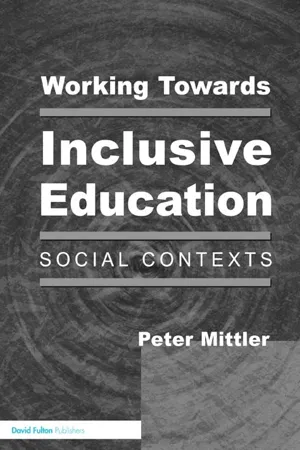
This book provides a clearly written, wide-ranging overview of current key issues and challenges arising from the implementation of more inclusive policies and provision in education in this country and internationally. The author sets policies for inclusive schools in the broader contexts of current policies which aim to reduce poverty and social exclusion, and the wider global background of the United Nations drive to promote 'Education for All'. The book draws a distinction between integration and inclusion and provides a critical analysis of the government's Program of Action and the revised National Curriculum and their implications for schools, pupils and families.
Information
Chapter 1
From Exclusion To Inclusion
Children of below average ability are badly served by our education system. The less academically able continue to suffer disproportionately from whatever acute or chronic problems affect the education service.
(Department of Education and Science (DES) 1991: 2).
The challenge of social and educational inequality
These words from Her Majesty's Chief Inspector of Schools for 1989 and 1990 highlight the failure of the education system to meet the needs of children whose attainments and abilities are below average. Although this analysis still has the ring of truth a decade later, it makes no reference to the fact that most children who are underachieving or academically less able are also living in areas of social and economic disadvantage.
We are far from understanding why and how children from poorer backgrounds so often underachieve in school, far less what can be done to reduce or eliminate such disparities. There is no single or simple explanation. Some blame the children for being less intelligent or less ready to learn. Others criticise parents for failing to take an interest in their children's development and for not providing an environment conducive to development and learning. Schools are blamed for having low expectations and too easily accepting that poor children are more likely to do badly in school than others. Nearly everyone blames the government for not spending enough money on children or for spending it in the wrong way.
One thing is clear: schools and the education system do not function in isolation. What happens in schools is a reflection of the society in which schools function. A society's values, beliefs and priorities will permeate the life and work of schools and do not stop at the school gates. Those who work in schools are citizens of their society and local community, with the same range of beliefs and attitudes as any other group of people; so are those who administer the wider education system, including appointed and elected members of local government, school governors or professional administrators.
In the past few years, there have been encouraging signs that politicians are beginning to think in wider terms about the social context in which schools find themselves but the process has barely begun (Dyson 1997; Mittler 1999). Families living in poverty, whose children are more likely to experience educational failure or exclusion, are also at risk of poorer health, more frequent hospitalisation and higher mortality rates, inferior housing, family breakdown and long-term unemployment (Acheson 1999). Moreover, children from Afro-Caribbean families are much more likely to be excluded from school than other children from the same community.
There is now strong encouragement — and money to back it — for a joint approach to the alleviation of poverty, involving not only schools and LEAs but also the National Health Service (NHS), social services and social security and job centres, as well as the voluntary and private sector and business and industry. This is an example of the new ‘joined up planning’ at both central and local level.
The government has expressed a strong commitment to a more inclusive society and a more inclusive school system. Can this be reconciled with the unequal and divisive education system that they have inherited, and that in some measure they themselves support? Can this tension be resolved? Is it even being faced? For example, is it possible to work towards a more inclusive school system when thousands of pupils are excluded from school each year because of unacceptable behaviour?
Inclusion and school reform
The aim of ‘inclusion’ is now at the heart of both education and social policy. Although official definitions are hard to find, there are some useful points of departure.
In the field of education, inclusion involves a process of reform and restructuring of the school as a whole, with the aim of ensuring that all pupils can have access to the whole range of educational and social opportunities offered by the school. This includes the curriculum on offer, the assessment, recording and reporting of pupils' achievements, the decisions that are taken on the grouping of pupils within schools or classrooms, pedagogy and classroom practice, sport and leisure and recreational opportunities.
The aim of such reform is to ensure access to and participation in the whole range of opportunities provided by a school to all its pupils and to avoid segregation and isolation. Such a policy is designed to benefit all pupils, including those from ethnic or linguistic minorities, those with disabilities or learning difficulties and children who are frequently absent or those at risk of exclusion.
Shifting paradigms: from defect to social model
This concept of inclusion involves a radical rethink of policy and practice and reflects a fundamentally different way of thinking about the origins of learning and behaviour difficulties. In formal terms, we are talking about a shift from a ‘defect’ to a ‘social model’. These models have been widely discussed by writers and activists in the field of adult disability for many years but have rarely been directly applied to education, despite the close similarities in the two fields.
It is important to avoid polarising these models as though they are mutually incompatible, because we need to think of them in a state of constant and complex interaction. There is no reason why a within-child model must necessarily be incompatible with a social and environmental model. Indeed, their cooperation and co-existence may be in the interests of the child.
A defect or ‘within-child model’ is based on the assumption that the origins of learning difficulties lie largely within the child. According to this view, it follows that in order to help the child we need to find out as much as possible about the nature of these difficulties by means of a thorough assessment of the child's strengths and weaknesses, to make a ‘diagnosis’ where possible and to plan a programme of intervention and support based on such an analysis. The aim is to help the child to fit the system and to benefit from what the school has to offer. There is no assumption that the school needs to change in any way to accommodate any particular child or to respond to a greater range of diversity in its student population.
The social model of disability is based on the proposition that it is society and its institutions that are oppressive, discriminatory and disabling and that attention therefore needs to be focused on the removal of obstacles to the participation of disabled people in the life of society, and in changing institutions, regulations and attitudes that create and maintain exclusion (Campbell and Oliver 1996). In the context of education, the restructuring of schools along inclusive lines is a reflection of the social model in action.
Although the defect model per se is rejected as a single explanation, it remains highly influential and profoundly affects policy, practice and attitudes. It has deeply influenced generations of teachers, parents and legislators and is still part of the general consciousness of almost everyone who works in education. It is not going to ‘go away’ merely because academics and activists argue that it is obsolete and discriminatory.
Some aspects of the ‘within-child’ view are clearly relevant, particularly for children whose difficulties arise in large measure from major impairments of sensory organs or the central nervous system. But these impairments, however severe, in no way explain all their difficulties, and there is plenty of scope for environmental interventions at a variety of levels: teaching, parenting, peer supports and friendships, positive attitudes from neighbours, removal of barriers of all kinds.
In addition to children with clear evidence of specific impairments, the past decade has seen a spate of ‘new’ diagnostic categories where an organic aetiology has not been clearly established, even though research might in due course identify such a link. Obvious examples include dyslexia, attention deficit disorder (with or without hyperkinetic behaviour), autism and Asperger's syndrome. So far, there is little convincing evidence that accurate diagnosis of these or similar conditions necessarily calls for syndrome-specific types of educational interventions. By the same token, although we now have a great deal more information about the characteristic learning styles of children with Down's Syndrome, fragile X or tuberous sclerosis, these are again not unique to such children. What is agreed is that they all need good teaching, which takes account of their individual patterns of learning.
The very title of the Code of Practice on the Identification and Assessment of Special Educational Needs (DfE 1994) reflects a within-child model. The individual education plan (IEP) programme that it prescribes is based on a similar assumption and has been criticised as a device that could isolate and segregate (Ainscow 1999), and that in practice has been found to be problematic (Tod 1999). Furthermore, despite the official abandonment of categories, the Code of Practice provides advice on pupils with moderate learning difficulties, specific learning difficulties, emotional and behavioural difficulties and sensory impairments, although the advice given within these sections reflects more overlap than specificity. It will be interesting to see whether this categorical advice survives the revision of the Code, which will come into operation in 2001. The possibility of removing these headings was not even considered in the consultation document, possibly because schools still feel the need for advice along categorical lines.
Despite this categorical element, the essence of the Code of Practice also reflects a social model because it proposes major environmental modifications and changes of professional role with the aim of enabling children with special educational needs to remain in ordinary schools. The Code outlines a range of ways in which the organisation and structure of schools and the work of teachers should change to accommodate a greater diversity of pupil need. The appointment of a SENCO to every school is designed to support mainstream teachers in carrying out their responsibilities. SENCOs are catalysts, facilitators and managers. They are not appointed to carry out additional one-to-one remedial teaching.
The head teacher, governors and SENCO are, in different ways, responsible for ensuring that all pupils have access to the whole curriculum and the whole range of experiences provided by the school. But, as we have seen, inclusion demands more than this. It is not enough for pupils to be supported in having access to what is available. The essence of inclusion is that there must be scrutiny of what is available to ensure that it is relevant and accessible to the whole range of pupils in the school. Sooner or later, this range will include many or all of the pupils who are now in special schools or special classes.
Although there is a great deal that schools can do to work for inclusion, there are limits to what any one school can achieve on its own. There has to be systemic change and a national policy. The creation of a National Curriculum in 1988 could have offered such an opportunity in England and Wales. Unfortunately, it was introduced in such a hurry that children with special educational needs were initially overlooked in an avalanche of demands for a ten subject curriculum, each with its programmes of study, attainment targets (ATs) and multiple assessment procedures tied to key stages.
The Dearing review (Dearing 1993) provided some relief for all teachers in beginning the process of slimming down the National Curriculum but was particularly welcomed by teachers working with pupils with special educational needs because it provided a special needs presence on every working party and listened to special needs interests during a genuine consultation process. The Dearing report also reflected a degree of understanding of the resourcefulness and sheer inventiveness shown by teachers in both mainstream and special schools in working more flexibly within the framework provided by the National Curriculum. This was complemented by a series of guidelines and ‘worked examples’ provided by teacher working parties (e.g. Fagg et al. 1990) and by the National Curriculum Council (NCC), some of these discussing the whole range of pupils with special educational needs (e.g. NCC 1989a) but many focusing on children with severe learning difficulties (e.g. NCC 1992; School Curriculum and Assessment Authority (SCAA) 1996a).
The new National Curriculum, which is to be implemented in September 2000, has incorporated the concept of inclusion as a fundamental principle from the outset and this was reflected in the work of every subject committee. If this new version of the curriculum is genuinely more accessible to a wider range of pupils than its predecessors, a major step will have been taken in working towards inclusive education (see Chapter 7).
Influences from the adult disability movement
It is significant that the disability movement, which has traditionally concerned itself with the rights of adults, is now turning its attention to children and, more specifically, joining forces with organisations campaigning for inclusive education. In some countries (e.g. Lesotho) it was the disability movement that initiated a demand for inclusive schools and joined forces with organisations of parents to put pressure on government to launch a pilot project, which has since been extended (Khatleli et al. 1995). In the UK, the British Council of Organisations of Disabled People (BCODP) is also working with other organisations to advocate the phasing out of special schools — a more radical model of inclusion than that favoured by the government (Campbell and Oliver 1996).
In common with world-wide groups such as Disabled Persons International (DPI), BCODP are tireless in their fight to achieve full civil rights and to outlaw discriminatory practices at every level. For example, DPI has played a key role in UN organisations and in the development and monitoring of the Standard Rules on the Equalisation of Opportunities for Disabled Persons (UN 1993). Another major concern at present is the rapid growth of biotechnology and genetic research, which raises issues about ‘designer babies’ and the elimination of ‘imperfect’ foetuses (Rioux and Bach 1994).
The disability movement has a comprehensive agenda, including:
- the passing and enforcement of anti-discrimination legislation;
- the abolition of laws and regulations that permit segregation and restrict access to goods, services and ordinary entitlements available to other citizens;
- campaigns to increase public awareness of the rights and responsibilities of disabled persons; and
- involvement of disabled persons and their chosen representatives in all decisions relevant to their full and equal participation in society.
In the UK, the struggle to achieve anti-discriminatory legislation has been long and painful. Successive governments have consistently blocked attempts to pass anti-discrimination legislation, despite all-party agreement and determined advocacy in both Houses of Parliament. The Disability Discrimination Act was finally passed in 1995, amid much controversy between those who wanted to reject it because it lacked teeth and those who argued that it should be used as a springboard for further advocacy. Since then, the Labour government elected in 1997 has set up the Disability Rights Commission, which began work in April 2000. The commission will work for the enforcement of the legislation and also seek to enlarge its scope to include most employers and all sectors of education, starting with higher and further education.
Human rights
The advocacy of disabled people themselves has transformed the debate about inclusion and localised it firmly as a fundamental issue of human rights. These rights derive from a range of UN Declarations and Conventions, the latter embodying a legally binding commitment to imple...
Table of contents
- Cover
- Full Title
- Copyright
- Contents
- Dedication
- Acknowledgements
- Introduction
- 1 From Exclusion To Inclusion
- 2 Global Dimensions
- 3 Early Years
- 4 Social Exclusion
- 5 Can Schools Prevent Learning Difficulties?
- 6 Towards Inclusive Policies
- 7 Curriculum and Assessment
- 8 Towards Inclusive Practice
- 9 Preparing all Teachers to Teach all Pupils
- 10 Parents and Teachers
- 11 Into the Future: Tensions and Dilemmas
- Abbreviations
- References
- Index
Trusted by 375,005 students
Access to over 1.5 million titles for a fair monthly price.
Study more efficiently using our study tools.
Frequently asked questions
Yes, you can cancel anytime from the Subscription tab in your account settings on the Perlego website. Your subscription will stay active until the end of your current billing period. Learn how to cancel your subscription
No, books cannot be downloaded as external files, such as PDFs, for use outside of Perlego. However, you can download books within the Perlego app for offline reading on mobile or tablet. Learn how to download books offline
Perlego offers two plans: Essential and Complete
- Essential is ideal for learners and professionals who enjoy exploring a wide range of subjects. Access the Essential Library with 800,000+ trusted titles and best-sellers across business, personal growth, and the humanities. Includes unlimited reading time and Standard Read Aloud voice.
- Complete: Perfect for advanced learners and researchers needing full, unrestricted access. Unlock 1.5M+ books across hundreds of subjects, including academic and specialized titles. The Complete Plan also includes advanced features like Premium Read Aloud and Research Assistant.
We are an online textbook subscription service, where you can get access to an entire online library for less than the price of a single book per month. With over 1.5 million books across 990+ topics, we’ve got you covered! Learn about our mission
Look out for the read-aloud symbol on your next book to see if you can listen to it. The read-aloud tool reads text aloud for you, highlighting the text as it is being read. You can pause it, speed it up and slow it down. Learn more about Read Aloud
Yes! You can use the Perlego app on both iOS and Android devices to read anytime, anywhere — even offline. Perfect for commutes or when you’re on the go.
Please note we cannot support devices running on iOS 13 and Android 7 or earlier. Learn more about using the app
Please note we cannot support devices running on iOS 13 and Android 7 or earlier. Learn more about using the app
Yes, you can access Working Towards Inclusive Education by Peter Mittler in PDF and/or ePUB format, as well as other popular books in Education & Education General. We have over 1.5 million books available in our catalogue for you to explore.