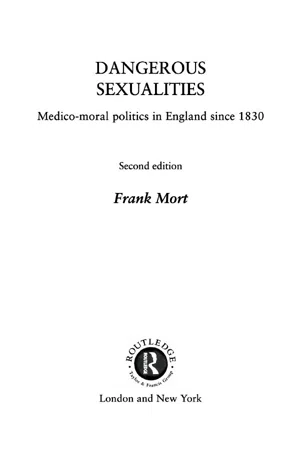
Dangerous Sexualities takes a look at how our ideas of health and disease are linked to moral and immoral notions of sex. Beginning in the 1830s, Frank Mort relates his social historical narratives to the sexual choices and possibilities facing us now.
This long-awaited second edition has been thoroughly updated to include new discussions of eugenics, race hygiene and social imperialism in the late nineteenth and early twentieth centuries. With a new and extended bibliography, introduction and illustrations, this second edition brings a classic into the 21st Century.
- 296 pages
- English
- ePUB (mobile friendly)
- Available on iOS & Android
eBook - ePub
About this book
Part One
MORAL ENVIRONMENTALISM
1830–1860
1 CHOLERA
Asiatic cholera, or cholera morbus, spread to Britain from India in a series of epidemics which engulfed much of Europe in the 1820s. The symptoms and the rapacity with which the disease struck must have been alarming even to a population used to the sight of typhus, scarlet fever and smallpox. The Central Board of Health issued a vivid description of the symptomatology:
The attack of the disease in extreme cases is so sudden, that, from a state of apparent good health…an individual sustains as rapid a loss of bodily power as if he were suddenly struck down or poisoned; the countenance assuming a death-like appearance, the skin becoming cold…. The pulse is either feeble, intermitting, fluttering or lost; a livid circle is observed round the eyelids…. Vomiting soon succeeds; first some of the usual contents of the stomach, next a turbid fluid like whey…or water gruel…. Spasms, beginning at the toes and fingers soon follow…. The next severe symptoms are, an intolerable sense of weight, and constriction felt upon the chest …a leaden or bluish appearance of the countenance…the palms of the hands and soles becoming shrivelled…. At length a calm succeeds and death…. The powers of the constitution often yield to such an attack at the end of four hours, and seldom sustain longer than eight.1
The epidemic broke out in northern England in the autumn of 1831. In Sunderland, where the approaching threat had become serious as early as April, a local board of health had been meeting to discuss preventive measures.2 It was chaired by Dr Reid Clancy who, as senior physician to the Sunderland Infirmary, was the closest to an official medical officer of health that the town possessed. On the night of Sunday 16 October twelveyear-old Isabella Hazard was taken violently ill with vomiting, cramps and general fever. At four in the morning the local doctor, Mr Cook, was called. He returned later to find the child weakening. By the following afternoon Isabella was dead. The symptoms seemed unmistakable—Isabella’s mother asked the doctor, ‘What makes the child so black?’ But Cook either missed the diagnosis or tried to ignore it. When William Sport died of similar symptoms on the nineteenth it was clear that cholera had arrived. On 1 November official notification of the presence of the disease in England was sent by Dr Clancy in a special report to the newly established Board of Health at Whitehall. Thereafter, the disease spread to Scotland, the north and Manchester and later to the midlands and London. Mortality for the first outbreak was estimated at 23,000.
There was of course no question of cure; the cholera bacillus was not isolated until 1884. The King’s parliamentary speech for 1831 directed that ‘precautions should be taken against the introduction of so dangerous a malady.’3 These amounted to recommendations issued by the Board of Health authorising the creation of local boards, which were to be responsible for the monitoring and control of the disease. Beyond that there were a host of popular remedies, prayers and moral homilies administered by the local clergy. In the summer of 1831 special services of intercession were organised to plead for divine mercy:
O Almighty God, who has visited the nations with the sudden death of pestilence, spare, we beseech thee, this thy favoured land, the wrath which to our sins is justly due.4
The newly founded medical journal, the Lancet, along with other leading periodicals, carried numerous articles on the causes of cholera and the steps to be taken for prevention. Evidence was conflicting and contradictory, reflecting current medical divisions on the origins and transmission of disease. But though there was no agreement about causation, medics, clerics and other local officials were all agreed that the urban poor were the human agents responsible for spreading the contagion. As more sporadic outbreaks were reported throughout the summer of 1831, medical evidence sent to the hastily constituted Board of Health confirmed that the environment and the physical and moral habits of the poor actively stimulated the disease.
In the metropolis it was in Bermondsey, Southwark and among ‘those afloat on the river’, rather than in stately Hanover Square or semi-rural Kensington, that cholera was seen to be taking the greatest toll.5 In July the board had received disturbing accounts of an outbreak at a flax mill in Port Glasgow. Nancy Kitchen, a mill girl, had been living ‘very perniciously’ with an Irishman named Murray, who habitually spent his ‘idle time’ with the girl. Both had been struck down by the disease. The local doctor suggested that the couple’s irregular conduct, ‘living in the closest intimacy’, had acted as a stimulus to infection.6 When Dr Mahony reported from Hull in August that a soldier serving in the Fusiliers had contracted cholera, Dr Dawn at the Central Board wrote back: ‘You will be good enough to make most explicit…as to the habits of the soldier in question, the circumstances immediately preceding his illness.’7 Mahony reported that the man had been in the regiment for twenty years as an officer’s servant and was generally of sober habits. But three days prior to his death he had been absent from camp for two nights and had returned ‘not absolutely drunk, yet not sober’.8 On visiting Hull, Dawn concluded that the soldier had been ‘living in debauchery’ and that his dissolute behaviour had contributed to the onset of the illness. The Central Board, many of whose members had by now fled to the purer air of the country, minuted ominously: ‘should this disease ever make its appearance in the country (which God forbid) its first appearance will be among the squalid parts of the population.’9
When reports from the north east in November forced Whitehall officials to admit to an epidemic, the condensation of immorality, poverty and the spread of disease became even more pronounced. The first case in North Shields involving a ‘mendicant of intemperate habits’, Dennis McGair, occurred on 10 December. McGair’s wife, also intemperate, died a few days later.10 More alarming still was the discovery that the disease spread from the dissolute to the sober and industrious. At the height of the outbreak in the north, the Mayor of York wrote to Lord Melbourne, the Home Secretary, alerting him to the large numbers of vagrants and other disorderly persons who were bringing cholera into the city. They arrived at common lodging houses and began to commit acts of vagrancy and indecency; thereby infecting the native population.11 Equally, the Westminster Review warned the city fathers of the danger of hundreds of starving paupers who came to London for relief, and were compelled to herd together ‘in much less cleanliness and comfort than the lowest orders of Indians’.12 All this was not just the metaphoric evocation of pestilence at a moment of panic. Nor was it a simple search for a scapegoat in the absence of any cure. The logic which twinned poverty and immorality with contagion was made through a specific language—the discourse of early social medicine—and was circulated at key institutional sites within the central and local state. The intentions were clear; greater surveillance and regulation of the poor.
The proposed solution was twofold: to isolate the human sources of infection, subjecting them to a regime of compulsory inspection and detention, combined with propaganda to educate the poor into a regime of cleanliness and morality. In Sunderland the Board of Health used the bylaws to isolate vagrants and paupers from the community.13 The Cholera Gazette, the weekly bulletin on the disease, stressed a more educative approach. It advised issuing handbills to impress on the poor the importance of clean, temperate and moral habits as the only sure means of prevention.14 Local residents in London were warned about the dangers of dissipation; they were told to keep regular hours, strict attention to hygiene and a comfortable and nutritious diet.
Yet from the outset the general response to the epidemic was sporadic and revealed how ill-equipped the central and local state were to deal with public health measures. This was not just an effect of rudimentary medical knowledge. The threat of epidemic disease precipitated heated political arguments about the extent of state intervention, which became condensed with wider debates over reform. The new Board of Health had no legislative powers. It was in effect only a consultative committee—one of those peculiarly English bits of nineteenth-century administrative ad hocery, with an unclear relation to Parliament and statutory authority. Designed to avoid accusations of government expansion, and to side-step the full glare of political scrutiny, it was shunted off to the Privy Council.
Almost immediately its members came under fire from the radical wing of the medical profession, keen to extend their status and authority. In the campaigns leading up to the 1832 Reform Act, Thomas Wakley, editor of the Lancet, had been polemicising for the wholesale reform of the medical establishment, as part of the more general scheme of parliamentary and social reform to replace the ‘tyrannical ruling oligarchy’.15 The new board, he claimed, was yet another illustration of the way the profession was being led by drones, sycophants and titled imbecility, most of whom had no personal experience of treating disease, nor any understanding of how infection was transmitted.16 Far from avoiding contention, the new public health machinery was becoming caught fast in the tangled web of professional politics.
Underlying the battle for control of public health was a fundamental argument about the validity of state intervention. The proposals for compulsory local powers and the whole issue of funding were highly contentious. When the disease began to reach epidemic proportions in the winter of 1831, the Central Board was inundated with desperate letters from local officials, demanding clarification of the extent of their powers. Civic dignitaries in Birmingham asked if money from the parish rates could be used to combat the disease. Mine owners in the north east petitioned for increased state intervention, not on humanitarian grounds but to alleviate losses to capital.17 The Privy Council replied that they could not authorise the reckless outlay of public money but would apply to the Cabinet for further powers. Whereupon they received a piece of cautionary advice from Spring-Rice, Financial Secretary to the Treasury. He emphasised that while the Exchequer would be ready to assist local efforts, money should be given ‘with extreme discretion’, lest it repress rather than stimulate voluntary exertions.18
State intervention not only meant increased financial expenditure, it also contravened implicit assumptions about the role of government shared by both Whigs and Tories. Pressure from the new professional men, especially medics, for the state to take fuller responsibility for public health was severely qualified by dominant political and administrative ideologies. Government was to be kept cheap, and the central state was not to take on statutory powers for issues which were essentially the province of local authorities and voluntary initiatives.
As the epidemic died down, it became increasingly clear that this new system of health administration was a temporary measure only. There was little notion of a permanent public health network. During 1833 the Privy Council announced that they would not re-apply for the renewal of compulsory powers, advising local medics that henceforward the management of the disease would be left ‘to the prudence and good feeling of those communities where it may occasionally show itself’.19 Voluntary self-help rather than any state-backed public health network remained the watchword.
Britain was again ravaged by cholera epidemics in 1848–1849, 1853– 1854 and 1866. The history of the disease is largely preserved within the narrative of the public health and other reform movements in early Victorian Britain. Health, housing, sanitation, the emergence of preventive medicine, the foundations of a national system of education, the reform of industrial conditions—these objects have formed the classic terrain for histories of government and public administration. Official history, whether in its fabian or tory variants, has been written as a celebratory progress from the early nineteenth-century origins of the welfare state, to its full flowering in the post Second World War period. Such narratives have been carried by their own heroes, the dedicated civil servants and administrators, and by an unswerving commitment to the ideology of professional expertise. But there is another history to be written here. Official transformations at the level of the state defined a new field of social intervention and consolidated a particular regime of moral disciplining. Representations of sexual immorality were constructed through institutional programmes which linked the habits and environment of the urban poor with medico-moral concepts of health and disease. It is this specific domain of sexuality—of sensitive social groups targeted by professional experts and their knowledge—which forms the basis of our history.
2 JAMES PHILLIPS KAY
When cholera reached Manchester in the early summer of 1832 James Kay was senior physician at the Ardwick and Ancoats dispensary, an area chiefly inhabited by Irish labourers and textile workers. Kay was typical of the new type of expert who was instrumental in coordinating plans for state intervention. Like many of his contemporaries he came from a strong nonconformist background, with direct links to the industrial bourgeoisie— the family’s capital was in cotton, calico, printing and blacking.20 Trained as a medical practitioner, in 1826 he was appointed assistant at the Edinburgh New Town dispensary and clerk to the fover hospital, Queensforry. His early work was characteristic of the way many early nineteenth-century intellectuals combined theoretical research with a commitment both to evangelical religion and to the politics of state administration. In the late 1820s and early 1830s he published research on diseases of the brain and the circulatory system, but like Wakley he saw no division between medical inquiry and politics. Research into the causes of infoction led inexorably to a wider field of action. As Kay put it, the development of a strategy for the ‘mitigation of sufforing’ had to take in fundamental questions of economic, political and moral causation.21 He was personally motivated by a nascent profossionalism and by the culture of his own native dissenting religion, which stressed the importance of practical good works for self-validation and eventual salvation. In a typical passage from his autobiography, written in 1877, Kay showed how he moved from the particular concerns of physical health, through mental and moral considerations, to a full conception of social intervention:
I came to know how almost useless were the resources of my art to contend with the consequences of formidable social evils. It was clearly something outside scientific skill or charity which was needed…. Very early therefore, I began to reflect on this complex problem. Were this degradation and sufforing inevitable? Could they only be mitigated? Were we always to be working with palliatives? Was there no remedy? Might not this calamity be traced to its source, and all the resource of a Christian nation devoted through whatever time, to the moral and physical regeneration of this wretched population? Parallel therefore with my scientific reading I gradually began to make myself acquainted with the best work on political and social science, and obtained more and more insight into the grave questions affocting the relations of capital and labour and the distribution of wealth, as well as the inseparable connection between the mental and moral condition of the people and their physical well-being.22
The sets of relations posed here were recurrent in Kay’s work, as they were in the writings of many early social reformers. Physical degeneracy and mental and moral deterioration demanded scientific solutions, but they were also framed in relation to questions of Christian morality, political economy and social science. Moving beyond mere palliatives, Kay became convinced that it was necessary to intervene in the arena of social and political debate—to abandon ‘the purely scientific spirit’ in favour of a career in public administration.23 This change of direction was backed by a utilitarian belief that the health and strength of the great mass of the population was the key to good government, and the indispensable basis for preserving social and political order. In 1833 Kay was appointed an assistant commissioner to the new Poor Law Board, and the following year he served as a major witness to the Select Committee on the Education of the Poorer Classes in England and Wales. As secretary to the new Privy Council committee on education from 1839, he was central to implementing the programme for public education.
A number of distinct elements are brought together in Kay’s biography. Through his family background he was linked with industrial capital. But in no sense was he a direct representative of its interests, his specific formation was within the field of preventive medicine. It was this profossional discourse which provided Kay with the impetus to scrutinise the physical and moral health of the labouring classes. Here was a programme which was simultaneously medical and moral, directed both at the reform of the environment and at the training of the mind. Sexual immorality was integral to these concerns.
Kay’s own early contribution to the debate on the immorality of the urban poor was set out in his pamphlet The Moral and Physical Condition of the Working Classes Employed in the Cotton Manufacture in Manchester, 1832. Written in direct response to the problems of cholera, it was dedicated to his mentor, the Scottish political economist the Rev Thomas Chalmers. Chalmers, drawing on his work as a Glasgow minister, always stressed the supremacy of the moral over the physical.24 Kay’s plan for the improvement of the population twinned material and moral reform si...
Table of contents
- Cover Page
- Title Page
- Copyright Page
- Illustrations
- Note on the Second Edition
- Introduction to the Second Edition
- Acknowledgements to the First Edition
- Introduction: Narratives of sex
- Part One: Moral Environmentalism 1830–1860
- Part Two: The Sanitary Principle in Dominance: Medical hegemony and feminist response 1860–1880
- Part Three: From State Medicine to Criminal Law: Purity, feminism and the state 1880–1914
- Part Four: From Purity to Social Hygiene: Early twentieth-century campaigns for sex education
- Epilogue
- Notes
- Selected Bibliography
- Additional Bibliography
Trusted by 375,005 students
Access to over 1.5 million titles for a fair monthly price.
Study more efficiently using our study tools.
Information
Publisher
RoutledgeEdition
2Year
2002Topic
GeschichtePrint ISBN
9780415167345
9780415167338
Subtopic
SozialgeschichteeBook ISBN
9781134705146
Frequently asked questions
Yes, you can cancel anytime from the Subscription tab in your account settings on the Perlego website. Your subscription will stay active until the end of your current billing period. Learn how to cancel your subscription
No, books cannot be downloaded as external files, such as PDFs, for use outside of Perlego. However, you can download books within the Perlego app for offline reading on mobile or tablet. Learn how to download books offline
Perlego offers two plans: Essential and Complete
- Essential is ideal for learners and professionals who enjoy exploring a wide range of subjects. Access the Essential Library with 800,000+ trusted titles and best-sellers across business, personal growth, and the humanities. Includes unlimited reading time and Standard Read Aloud voice.
- Complete: Perfect for advanced learners and researchers needing full, unrestricted access. Unlock 1.5M+ books across hundreds of subjects, including academic and specialized titles. The Complete Plan also includes advanced features like Premium Read Aloud and Research Assistant.
We are an online textbook subscription service, where you can get access to an entire online library for less than the price of a single book per month. With over 1.5 million books across 990+ topics, we’ve got you covered! Learn about our mission
Look out for the read-aloud symbol on your next book to see if you can listen to it. The read-aloud tool reads text aloud for you, highlighting the text as it is being read. You can pause it, speed it up and slow it down. Learn more about Read Aloud
Yes! You can use the Perlego app on both iOS and Android devices to read anytime, anywhere — even offline. Perfect for commutes or when you’re on the go.
Please note we cannot support devices running on iOS 13 and Android 7 or earlier. Learn more about using the app
Please note we cannot support devices running on iOS 13 and Android 7 or earlier. Learn more about using the app
Yes, you can access Dangerous Sexualities by Frank Mort in PDF and/or ePUB format, as well as other popular books in Geschichte & Sozialgeschichte. We have over 1.5 million books available in our catalogue for you to explore.