![]()
1
Heritage in Asia
Converging Forces, Conflicting Values
Tim Winter and Patrick Daly
Some say it looks like an old Chinese official’s cap. Some say it’s a kind of ancient Chinese cooking vessel. Some even say it’s a grain barn. No matter what they think the image is, they all think it is very Chinese. That’s what I wanted.
(He Jingtang, Chief Architect, China National Pavilion, Shanghai Expo, quoted in Yuan 2010)
In 2010 the city of Shanghai hosted the largest, most spectacular and most expensive World’s Fair ever. The Shanghai Expo attracted a staggering 70 million visitors, ensuring China and the host city remained in the global spotlight for the six-month duration of the event. Costing around US $45 billion, and with its theme of Better City, Better Life, the Expo was held in a country experiencing a level of urban growth unparalleled in history. With more than half of the world’s population now living in cities, many of which face uncertain futures, this mega event confronted the multitude of challenges now converging on the all-pervasive notion of ‘sustainability’. To this end, 190 countries, more than fifty non-governmental organisations, and a variety of multi-national institutions involved in urban governance addressed such issues.
The history of World’s Fairs tells us much about the major events and changes that have shaped the world over the last one hundred and fifty or so years. Ever since they began in 1851 with The Great Exhibition in London, World’s Fairs have stood as important markers of history, charting the rise and fall of empires, and on-going shifts in the global ordering of power. As public events reaching huge audiences, they have also reflected the aims and anxieties, beliefs and values of their time. No exception, Shanghai 2010 was framed by a moment in history defined by China’s rise as a global superpower, and by the multiple challenges associated with sustaining life on an ever-warming planet. More specifically, the event provided a window onto the historically significant shifts now occurring, as global capital moves east and new economic superpowers come to the fore. Together with the Beijing Olympics, held just two years previously, the 2010 Expo delivered a definitive statement about the economic, developmental and geo-political pathways China is now pursuing.
In this regard, Shanghai 2010 struck distinct parallels with London 1851. The Great Exhibition harvested the success, ambition and optimism of a Britain entering the Victorian era and an age of industrialised modernity. The event was ground-breaking in a number of ways, thereby capturing the imagination of scholars and bureaucrats as well as the general public, creating a legacy that would influence Britain, its empire and other European colonial powers for decades to come. One of the event’s most remarkable features was an architectural design that used an elaborate cast iron structure, across which vast expanses of glass were stretched. The ‘Crystal Palace’, as it came to be known, enabled light to be shed — both metaphorically and literally – onto sprawling displays of machinery; the material culture of a new age of industrial might and technological modernity. This radical use of iron and glass demonstrated for the first time how buildings could be constructed on an industrial scale, and the power of engineering as a new form of knowledge. Hosts of subsequent World’s Fairs across Europe and the United States would use a similar language of bold, experimental architecture to claim the future as theirs (Greenhalgh 2000; Geppert 2010). It was a demonstration of national power and confidence that found its zenith in the Exposition Universelle in Paris, 1889, through the construction of the thousand-foot-high Eiffel Tower as the event’s centrepiece.
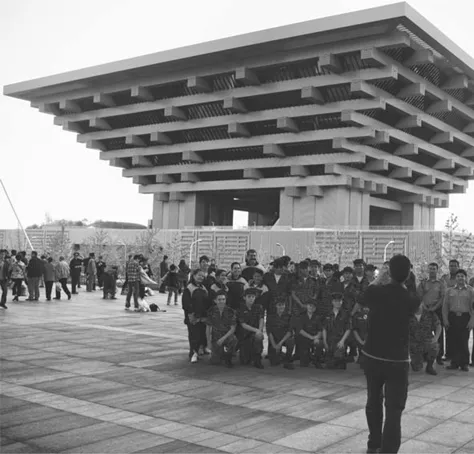
When it came to designing the centrepiece for Shanghai 2010, however, the Chinese chose an architectural style that expressed altogether different values. Rather than conveying the sense of a nation embracing modernity and the future, the China National Pavilion took its inspiration from the past and tradition. Designed to be three times the height of all other pavilions at the Expo, the building was dubbed ‘The Oriental Crown’ because of its resemblance to an emperor’s crown. The grand scale of the structure demanded modern technologies and the reinforced concrete, steel and glass familiar to the modern construction industry. In its symbolism though, the pavilion integrated and foregrounded different elements of a cultural heritage distinct to China. Most explicit was the nod to ‘dougong’, a unique element of traditional Chinese architecture in use for almost 2,000 years (see Figure 1.1). Dougong is a system of multiple interlocking bracket sets that help support the weight of wooden horizontal beams and large overhanging eaves. Both artistic and functional, it is found on many of China’s most historically significant buildings. Beyond this signature feature, the pavilion also took inspiration from ‘ding’, a style of ancient Chinese vessel recognisable by its squat legs and round handles.1Calligraphy adorned the façade of the building and when seen from the air it took the form of a ‘sudoku’ grid, or nine-square grid layout: an urban planning feature distinct to ancient Chinese cities (Schinz 1996). Finally, hues of red were preeminent; a colour associated with honour, courage, loyalty, success, fortune, happiness and passion in Chinese culture. In interviews, He Jingtang, the chief architect of the pavilion, explained the intended symbolism of the building:
Figure 1.1 Shanghai Expo, China National Pavilion (Photo T. Winter)
The China Pavilion integrates lots of Chinese elements. If it were specific to one particular thing then it couldn’t represent Chinese culture broadly. From the architecture perspective, I feel that we used a traditional framework – a dougong, which is a system of brackets unique to traditional Chinese architecture. An upturned dougong is meant to give off a feeling of our country’s self-reliance and our national rejuvenation.
(He Jingtang, quoted in Chi and Xia 2010)
We mean to show the spirit and face of the Chinese people against the background of a rising nation. We hope visitors will feel the changes of the country, and the glory and confidence of the Chinese people […] It is the first time that I dared to use red on such a large-scale building. We collected every kind of red color that we needed and tried to find the right Chinese red from these colors, such as the red of Tiananmen, the Forbidden City and the Chinese national flag.
(He Jingtang, quoted in Yuan 2010)
The decision to select a tradition-oriented design from among the hundreds that were submitted for consideration reveals much about the ways in which China imagines itself as a modern, forward looking nation. Fully confident in its project of modernity, China is able to present itself on the international stage and to its Asian neighbours as a country where simultaneous presents co-exist; a civilisation seemingly comfortable with one foot in the future and one in the past. Modernisation and the challenge of becoming a ‘first world country’ in both its own eyes and the eyes of others is no longer driven by desires to shed unwanted pasts or abandon anachronistic traditions. Instead, through a language of national heritage, the past is embraced as part of the future. It is an ‘imagineering’ of the community of nation, to rework Benedict Anderson’s (1991) oft coined expression, that explicitly looks to the past for inspiration and guidance, a theme reproduced across many of the host nation’s exhibits.
In the Joint Provincial Pavilion, the majority of the country’s twenty-two provinces oriented their displays around a combination of pre-modern architecture, pristine landscapes, and the traditional practices of culturally or ethnically distinct groups. In a celebration of heritage predicated on the ideology of ‘unity through diversity’, Tibet and Xinxiang were absorbed into a rendering of Chinese culture as cosmopolitan, wherein they became part of the peoples of China. For Hong Kong, Macau and Taiwan, the cultural integration was unequivocally expressed in the location of their stand-alone pavilions, each carefully positioned in the shadow of The Oriental Crown’s overhanging eaves. It was a mise en scène in which the imperative for culture and nature to perform particular social and political functions was clearly discernible. Intriguingly, the architecture of the pavilions – together with the material culture displayed inside – of Cambodia, India, Indonesia, Malaysia, Thailand and various other Asian countries also self-identified through a language of heritage. While countries like Canada, Denmark,United Kingdom, United Arab Emirates and the United States all presented futurity via bold,experimental architecture or large-screen immersive video displays, the majority of Asian countries chose to celebrate tradition and the inherited, emphasising how culture-natures inherited from previous generations are now integral to the values and aspirations of contemporary society.
Visitors to the Shanghai Expo were thus offered a valuable window onto much larger, complex processes now shaping much of Asia. The event spoke of the dramatic shifts that have occurred in recent years regarding the way states in the region negotiate their national histories and how they appropriate cultural pasts and natural environments within strategies of governance and identity making; a theme returned to later in this chapter. Seen together, the Asian national pavilions also raised a host of intriguing questions. Does the use of tradition and the traditional suggest ‘alternative modernities’ are in play here? Is the arena of heritage mobilising new discourses of primitivism and pre-modern exotica? Or is the language of sustainability producing a new era of coloniality, as nations are hierarchically ordered on the international stage, with some looking backwards to the past and others to progressive futures? In all its complexity then, the Shanghai Expo provided an important glimpse into some of the reasons why heritage – as a concept, an arena of policy and as an expression of identity, confidence or anxiety – has gained such traction in Asia in recent years. As we shall see throughout this book, the language and idea of heritage, both cultural and natural, now reaches across multiple aspects of social and private life, such that it has become an important theatre of respect and harmony, beauty and pain, discord and abuse, and optimism and despair.
Together, the twenty-three chapters in this book follow these multiple pathways. The volume is divided into four parts: Part I: Challenging Conservation: the View from Asia; Part II: The Politics and Governance of Heritage; Part III: Rethinking Relationships, Remembrance and Loss; and Part IV: Negotiating Modernity and Globalisation. While chapters that focus on quite different issues are pulled together under particular thematic or conceptual umbrellas to define these four parts, certain analytical threads run through and across the book as a whole. To provide navigation through the Handbook, each Part begins with a summary of the chapters contained therein. This opening chapter offers further pointers to the content of specific chapters, but is primarily concerned with laying out the intellectual landscape that has framed and given shape to this project as it has unfolded over a number of years. The scale and scope of the topic in hand – heritage in Asia – means we have approached it with both caution and ambition. Throughout the process, we have been committed to constructing a text that crosses disciplines and challenges boundaries, but at the same time respects and draws on previous scholarship.
We have felt it particularly important to deliver an analytically and thematically expansive volume, rather than delimiting the discussion to particular heritage ‘sectors’. Given the book’s geographic and conceptual scope, however, we have remained mindful of the inevitable gaps and omissions that arise with such an approach. For reasons of timing, practicality, availability, not to mention our limitations as editors, not all countries are covered and neither are all the topics that could quite easily fall within the scope of this book. We make no claims of analytic, thematic or geographic comprehensiveness. And for those seeking insights into the technical aspects of conservation or preservation, or models for heritage management, the following pages might appear to offer few insights. Whilst that may well be true, given these are not our points of focus, it is our belief that an understanding of the socio-political linkages between residual pasts and projected futures is critical for anyone interested and working in the field. To this end, the book aims to offer alternative ways of thinking about the production, conservation, and governance of culture-natures in Asia by exploring the unfolding complexities that surround the use of heritage as a term, set of values or concept today. This opening chapter is designed to both orient the reader analytically for the chapters that follow, and simultaneously address a series of issues and complexities, that – we believe – warrant a greater level of attention and critical discussion than they have received previously. We begin by briefly considering some of the parameters of ‘Asia’ and ‘heritage’, as they pertain to the themes under investigation here.
‘Asian’ Boundaries
There is a long tradition of scholarship that considers the boundaries of regions and continents. One of the most revealing texts in this field is The Myth of Continents, by Lewis and Wigen (1997). As the authors illustrate, the term ‘Asia’ has a long history of contestation, fluidity and ambiguity. Given that political terrains rarely map onto features of the natural world, the boundaries of Asia have continually shifted back and forth, as expedient geographies have been evoked within particular contexts.
Definitions have, in themselves, been defined by partial knowledge, misunderstandings, political appropriation and competing ontologies. The idea of Asia has also been the subject (and object) of a discourse of meta-geography, whereby notions of East and West come with deeply rooted inflections and generalisations. Rabindranath Tagore, for example, one of India’s most renowned nationalists in the late nineteenth and early twentieth century, saw India as a bridge between a materialist West and spiritualist East. For Mark Ravinder Frost (2010), the technological advances of print media and maritime communications at this time enabled an ‘idea of Asia’ to emerge among intellectuals living in different parts of the region. Tracing an intellectual sociability, which saw literati in Calcutta linked with others as far apart as Ceylon and Japan, he argues the closing years of the nineteenth century were pivotal in the formation of a pan-Asian idealism, one that was often defined in civilisational terms:
Asian civilisation was derived from the key elements of Hinduism, Buddhism, and, to a lesser extent, Confucianism. Buddhism took pride of place and was crowned as ‘that great ocean of idealism’ – the primary means by which cultural exchange and common ideals had generated regional unity. In the Tagore circle’s discussions of Asian civilisation, Islam was particularly conspicuous by its absence.
(ibid.: 267)
While Indian intellectuals overlooked Islam in their imaginings of Asia, in China, prominent intellectuals of this period such as Hsu Chi-yu and Liang Qichao, helped shape public ideas about an Asia that had China at its historical and cultural heart. Liang asserted that the region, and China in particular, was the origin of all the world’s civilisations, and that China’s superiority stemmed from its rich cultural and technological past.2 Decades later, the implications of such meta-geographical generalisations would be rendered visible through the seminal work of Edward Said (1993, 1995). His notion of Orientalism set in train a discussion that continues to this day regarding the ways in which the East, in European eyes, solidified as a series of tropes and fantasies. In tracing the knowledge, power relations through which the Orient came to be known from afar, Said’s analysis was deeply significant in revealing how the cultural and political processes by which Asia was constructed historically extended far beyond its physical boundaries.
Lewis and Wigen (1997) have also illustrated how the borders and margins of Asia have frayed and shifted in accordance with the context of definition. The case of Australia provides an interesting example of how Asia expands and contracts depending on the political, institutional or legal forces at play (see Hall 2008). ...