- 304 pages
- English
- ePUB (mobile friendly)
- Available on iOS & Android
eBook - ePub
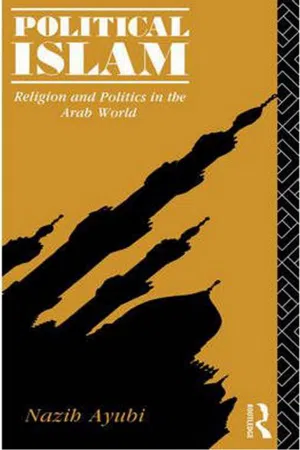
About this book
Islamic theocracy is now firmly established in fundamentalist Iran, and waves of fundamentalism are sweeping the entire Islamic world, and its diaspora.
This book examines the claim of those Islamists who contend that, as a belief system and a way of life, Islam carries with it a theory of politics and the state which should be applied unquestioningly. Ayubi traces both the intellectual sources and the socio-economic bases of Political Islam, arguing that it is a modern phenomenon, dating back only to the inter-war period. He describes its major proponents as urban, educated and relatively young people, whose energies were mobilised, but whose expectations were not fulfilled by the post-independence `populist' regimes in the Arab World.
Islamic movements in six countries are studied in detail. Ayubi's distinctively broad definition of politics encompasses innovative material on sex and the family, and on the emerging alternative economic and social networks of Islamic banks, schools, and hospitals in the countries discussed.
Ayubi stresses the traditional concern in Islam for the collective enforcement of morals, but argues that there is no case for the commonly held misconception that politics begins from theological principles in the Arab world: the historical connection between Islam and politics can be explained as an attempt by the rulers to legitimise their actions. He suggests that radical Islamists are reversing this position by subjecting politics to their specific religious views, so their movement is in some senses an anti-state one. He concludes by discussing possible intellectual responses to fundamentalism, drawing on the thinking of contemporary Muslim liberals.
1
The theory and practice of the Islamic State
It is often suggested that contemporary attempts at ‘Islamic revival’ are seeking to retrieve and to reinstall a type of religious state that had existed at some point in the history of Muslim societies. Implicit in this suggestion is the view that Islam has a specific theory on politics and the State, and that the Islamic revivalists are attempting to implement anew this existing theory of the State. The impression that such a theory exists is usually reinforced by the fact that the contemporary Islamists repeatedly invoke the religious and the juridic texts, as well as certain historical precedents of ‘Islamic government’, in their attempt to prove the ‘obligatoriness’ of an Islamic State. It is therefore necessary for any work on the contemporary discourse of ‘political Islam’ to delve to some extent into the juridic text and into historical precedence in order to trace some of the origins of the Islamists’ argument. I should hasten at this point, however, to warn the reader that I am not setting out here to offer a potted history of the Muslim State or a concise review of the history of Islamic thought. Readers unfamiliar with this material would do better to refer first to some of the more systematic treatments available in some of the books which are mentioned in this chapter (e.g. Rosenthal, Watt, Lambton, etc.) 1 Rather, the purpose of this chapter is to deal with some of the concepts and the precedents which would shed light on our subsequent treatment of the subject of political Islam. It is therefore highly eclectic and interpretive, as well as structurally rather complex, since it deals with several loosely related themes rather than with one integrated thesis. For these reasons, it would perhaps be convenient to highlight in advance some of the main pursuits of this chapter.
IS ISLAM A ‘POLITICAL’ RELIGION?
It will be argued in this chapter that the original Islamic sources (the Quran and the Hadith) have very little to say on matters of govern ment and the State. However, the first issue to confront the Muslim community immediately after the death of its formative leader, Prophet Muhammad, was in fact the problem of government, and Muslims had therefore to innovate and to improvise with regard to the form and nature of government. Indeed, the first disagreements that emerged within the Muslim community (and which led to the eventual division into Sunnis, Kharijites, Shi’is and other sects) were concerned with politics. But theorising about politics was very much delayed, and most of the Islamic political literature available to us seems to have emerged when the political realities that it addressed were on the decline. Furthermore, most of what emerged, at least within the Sunni tradition, was also produced ‘in the shadow of the State’. The State had sanctioned a certain ‘methodology’ of writing, based on linguistic explanation (bayan) and on reasoning by analogy (qiyas), and had also sponsored the juridic elite that wrote on political subjects. The result was an elegant and elaborate body of jurisprudence, and a formal theory of the caliphate that, through monopoly and repetition, had become altogether entrenched in the ‘Arab mind’.
With the passage of time, subsequent generations have found it extremely difficult to distinguish between what was meant as description and what was meant as prescription within this literature. Furthermore the elegant body of jurisprudence has been elevated almost to the level of the Shari’a (religious law) itself. Today, when most salafis and some fundamentalists (for definitions see Chapter 3 and the Glossary) call for the implementation of shari’a, what they really have in mind is the implementation of the jurisprudence formulated by the early jurists. This jurisprudence has now been extracted from its historical and political context, and endowed with essentialist, everlasting qualities. The point is thus overlooked that this jurisprudence was in the first place a human improvisation meant to address certain political and social issues in a certain historical, geographical and social context. What is also often overlooked is that the main body of the official jurisprudence fulfilled a certain political function by imparting religious legitimacy to the government of the day, which had usually come to rule by force or intrigue and which, in its daily conduct, was not generally living up to the Islamic ideal.
A point not elaborated upon in this chapter, but for which the material in this chapter provides the necessary background, is that the neo-fundamentalists, or the proponents of political Islam, have actually introduced some novel, and radical, changes in the way the Islamic political tradition is understood. While they want to preserve the close link between religion and politics that the traditional jurisprudence had developed, they want to reverse the order within this link. The traditional jurists had forged a link between politics and religion by giving a religious legitimacy to political power. The political Islamists maintain that religion and politics cannot be separated, but because they are now in the position of resisting the existing State, not of legitimising it, they are seeking the politicisation of a particular vision of religion that they have in mind. To achieve this purpose, the contemporary Islamists are often inclined to be more innovative and less textual in their approach. They do, of course, invoke the text and quote the source, but in doing so they are highly selective and remarkably innovative. Political precedence is of practically no interest to them, neither is the main body of official jurisprudence, apart from a few exceptions such as Ibn Taimiya. Indeed, in spite of being Sunnis, they seem to have no qualms about borrowing concepts and practices from the anti-Sunni sects: their major concept of hakimiyya seems to be of kharijite inspiration, and their frequently practised taqiyya seems to be of Shi’i inspiration.
We shall argue throughout this book that political Islam is a new invention—it does not represent a ‘going back’ to any situation that existed in the past or to any theory that was formulated in the past. What it keeps from the past is the juridic tradition of linking politics and religion. But even then, it seeks to transform the formalistic and symbolic link that the jurists had forged between politics and religion into a real bond. Furthermore, political Islamists want to reverse the traditional relationship between the two spheres so that politics becomes subservient to religion, and not the other way round, as was the case historically.
One of the themes that this chapter also explores concerns precisely this last point: i.e. why was there a certain fusion between religion and politics throughout the history of the Islamic State? One familiar answer to this question is that Islam is by its very nature a ‘political’ religion. This is a proposition—widely held in both Western ‘and Muslim circles—that we endeavour to refute throughout this book. It is about time that this Orientalist/fundamentalist myth was dispelled once and for all. Even the common interpretation of the term umma, familiar in Western and Muslim circles alike, as a specifically Islamic community, should be subjected to serious scrutiny, for neither in the Quran itself nor in subsequent writings by Muslim authors was this term given such an unequivocally religious connotation. The impression in Western circles that Islam is a political religion may be an extension of the view that Islam was a religion that established itself by military conquest. The now widely held opinion among Muslims that Islam is both ‘a religion and a State’ (din wa dawla) is a measure of the extraordinary intellectual influence of the modern fundamentalist thesis on mainstream Muslim opinion. Far from being a conventional piece of wisdom, this thesis is indeed quite new, dating, as we illustrate in this book, to the third decade of this century at the earliest.
Islam is indeed a religion of collective morals (as we argue in Chapter 2), but there is very little in it that is specifically political—i.e. there is very little in the original Islamic sources on how to form states, run governments and manage organisations. If the rulers of the historical Islamic states were also spiritual leaders of their community, this was not because Islam required the religious leader (imam) to be also a political ruler. Indeed, quite the reverse—Islam had spread in regions where the modes of production tended to be control-based, and where the State had always played a crucial economic and social role. The ‘monopoly’ of a certain religion has always been one of the State’s usual instruments for ensuring ideological hegemony. The historical ‘Islamic’ State inherited this tradition.
In the earlier phases of the Islamic State the mere fact of being Muslim was rewarding enough from an economic and political point of view: for initially the expanding conquests and the imposition of poll taxes (jizya) on the non-Muslims of the conquered lands had guaranteed financial incomes and military/administrative positions for the Muslims, who were still a minority in these newly opened-up regions. However, at a subsequent point, during the time of ‘Umar, the influx of Muslims from Arabia to the amsar (conquered lands) had become so rapid and so extensive that not all the newcomers could be put on the register (diwan) for regular payment. It was these frustrated groups, usually from the minor or peripheral Arabian tribes, which were to form the first religio-political opposition movement against the State, that of the Khawarij. Eventually, too, extensive territories were conquered in and around Persia, where large populations embraced Islam but did not become Arabised. It was the social and political exclusion of such communities that eventually led to the emergence of the second major religio-political opposition movement against the State, that of the Shi’is. Both the Khawarij and the Shi’is attempted to use religious arguments to shed doubt on the legitimacy of the government and the rulers. It was precisely at this stage, and by way of a counter-argument against the claims of the protest movements, that the official juridic theory of the State was to emerge.
By now, the State incorporated large Muslim but non-Arabic-speaking communities, as well as ever-increasing numbers of Arabic-speaking Muslim converts. Thus it had to confront not only a problem of security and order (represented by the protest movements) but also a growing financial crisis. Gone were the days when being Muslim involved receiving a regular income, gone even were the days when being Muslim exempted one from paying tax to the State. The jizya imposed on the dwindling numbers of non-Muslims was no longer sufficient to support a State that was both larger and more complex and that was also threatened by various protest groups. The new official theory had to justify and legitimise, in religious terms, the increasing necessity for imposing various types of tax on the Muslims themselves. This was the historical origin of the convergence between religion and politics. Ideologically, it was expressed in a body of writing that was produced by the State-employed jurists with the implicit intention of conferring religious legitimacy on the political rulers. This was not only part of the ‘traditions’ of the region, required by the nature of the dominant modes of production, but was also, more urgently, a response to a growing political and financial crisis of the State.
Religion and politics were thus brought together in the historical Islamic State by way of the State appropriating religion. This is, of course, the reverse of the European experience where, historically, it was the Church which appropriated (or at least interfered in) politics. Secularism in the West has involved a gradual exclusion of the Church from the domain of politics. It was a relatively ‘easy’ process because religion was institutionalised; once you removed the Church, you had also removed religion from politics. In the modern Arab State, secularism was introduced by ‘emulation’, and it could not in any case exclude religion simply by excluding the Church, because there is no Church as such in Islam (with the partial exception of Shi’ism). Such factors have given the contemporary movement for political Islam its distinctive features. As we shall see later in the book, the fact that the contemporary State lays claim to secularism has enabled some forces of political protest to appropriate Islam as their own weapon. Because the State does not embrace Islam (except in a ‘defensive’ reactive way), it cannot describe its opponents as easily as the traditional State could as being simply heretic cults. Political Islam now reverses the historical process—it claims ‘generic’ Islam for the protest movements, leaving to the State the more difficult task of qualifying and justifying its own ‘version’ of Islam.
Without anticipating the full content of the book any further, I think that it would be possible now to consider in more detail the various aspects of the theory and practice of the historical Islamic State that might prove useful to our eventual understanding of the contemporary movements of political Islam.
The most important elementary point to remember is that the Quran did not stipulate a specific form for the State or the government, nor did the Prophet Muhammad appoint a successor for himself even though he knew his demise was imminent (cf. e.g. Shalabi, 1983:151ff; cf. also the authors quoted in Chapter 9). The fact that Islam had emerged in a ‘stateless tribal society’ led Muhammad to establish a politico-religious community, which was based on faith as the main criterion for membership, although it nevertheless subjected the believers to the authority of a certain political leadership (Rodinson, 1971: Ch. 6). Unfortunately, hardly any political or administrative correspondence pertaining to internal affairs was recorded in the time of the Prophet. It is believed that inscription was confined to covenants and agreements that concerned the propagation of the religion and the organisation of external relations; it is reported that for this purpose the Prophet— being illiterate—had to use the services of more than thirty literate scribes (al-Harawi, 1986:349ff).
The main piece of political literature inherited from the Muhammadan period is the document (al-sahifa) often known as the ‘Constitution’ of Madina, the text of which is attributed mostly to the hijra episode from AD 622 to 624 (Watt, 1968:4–5, 130–134). The ‘Constitution’ speaks of the believers as forming one community (umma) which also includes the Jews of Madina. Although composed of tribes, each of which is responsible for the conduct of its members, the umma as a whole is to act collectively in enforcing social order and security, and in confronting enemies in times of war and peace. The document is very interesting because, although it establishes the foundations for a trans-tribal and basically religious community, it does not negate sub-units completely, nor does it exclude non-Muslims from the envisaged political dominion (cf. Baydun, 1983:106–108). It is in fact the source of a ‘corporatist’ tradition based on ‘unity in diversity’ which, with its multiple religious communities (milal) and varied functional associations (asnaf), was to characterise the Islamic state for centuries to come.
Given the limited nature of political stipulations in the Quran and Hadith (sayings of the Prophet), Muslims have had from the start to borrow and to improvise in the developing of their political systems, inspired (i) by the shari’a as represented in the Quran and the Sunna (traditions of the Prophet including his Hadith); (ii) by Arabian tribal traditions and (iii) by the political heritage of the lands they conquered, especially Persian and Byzantine traditions. The influence of the first source was more noticeable during the era of the first four Rashidun (wisely-guided) caliphs, the second during the Umayyad dynasty, and the third during the Abbasid and Ottoman dynasties.
Muslims had indeed been state builders, in the practical sense, in fields such as military expansion, government arrangements and administrative techniques—in this respect they probably preceded Europeans (Tachau, 1985:3). But these were not really ‘states’ in the modern sense of the term: they were ‘externally’ imperial systems, and ‘internally’ dynastic systems, akin to many other ancient and mediaeval systems that are normally distinguished from the modern state (compare Eisenstadt, 1969). In our opinion, therefore, it is of little use to try, as some Arab constitutional lawyers have done, to survey the elements recognised in contemporary constitutional theory as defining a state, and then to attempt to prove that if these elements were present in the Islamic system, it was thus, theoretically and legally speaking, a ‘state’ (cf. e.g. Basyuni, 1985:14ff; ‘A.‘Abdalla, 1986: esp. Chs 1 and 2). Nor is it useful to identify key issues pertaining to the subject of the state in Western political thought and then to try to locate similar ideas in the writings of Muslim thinkers in the hope that they will be helpful in pinning down a concept of the Islamic State (cf. e.g. Nasr, 1963:15–66).
Since the ‘State’ is a Western concept, representing a European phenomenon that developed between the sixteenth and twentieth centuries in relation to such phenomena as the Renaissance and the growth of capitalism and individualism, it is natural not to find such a concept in Islamic thought prior to the modern era. However, Islamic political thought did have much to say about the body-politic and, of course, about rulers and governments; this, when examined and reconstructed, can give us an understanding of what is the closest thing to the concept of the State in traditional Islamic thinking. If it can be argued that the concept of the State in Europe cannot be understood in isolation from the concepts of individualism, liberty and law, I shall be endeavouring in this chapter to illustrate that the Islamic concept of the body-politic cannot be understood in isolation from the concepts of the group (jama’a or umma), justice (‘adl or ‘adala) and leadership (qiyada or imama).
Many writers, both in Arabic and in European languages, speak about the ‘Islamic theory of the State’. On close examination, however, one finds that in reality they are addressing themselves specifically to the problem of government and especially to the conduct of the ruler, and not to the state as a generic category or to the body-politic as a social reality and a legal abstraction. For the category of ‘politics’ in traditional Islamic thought is a classification of types of statesmanship, not of types of state. If the ‘State’ is to enter into such literature it appears at a lower point of the ‘royal hierarchy’: it will be as a ministry or chamberlainship or judiciary attached to the chief ruler, and the monarchy (mulk) in turn will appear only as a specific practice of a specific individual, that is, as a ‘personal monarchy’ and not as a total abstracted State (al-‘Azmah, 1987:48– 49). Even when the Islamic bureaucracy developed and became quite complex, officials and other ‘public’ personnel appointed to certain jobs or dismissed from them, never signed a contract with the ‘State’ or any other ‘moral personality’, but simply with a certain individual employer (al-muwalli) (cf. Tabliyy...
Table of contents
- COVER PAGE
- TITLE PAGE
- COPYRIGHT PAGE
- PREFACE
- 1. THE THEORY AND PRACTICE OF THE ISLAMIC STATE
- 2. THE POLITICS OF SEX AND THE FAMILY, OR THE ‘COLLECTIVITY’ OF ISLAMIC MORALITY
- 3. THE VARIETY OF MODERN ISLAM: INTELLECTUAL EXPRESSIONS AND POLITICAL ROLES
- 4. THE ISLAMIC MOVEMENTS: SOME COUNTRY STUDIES—PART 1
- 5. THE ISLAMIC MOVEMENTS: SOME COUNTRY STUDIES—PART 2
- 6. POLITICAL ISLAM: INTELLECTUAL SOURCES
- 7. POLITICAL ISLAM: SOCIO-ECONOMIC BASES
- 8. ISLAMIC BANKS, COMPANIES AND SERVICES, OR THE RISE OF A NATIVE COMMERCIAL BOURGEOISIE
- 9. THE ISLAMIC LIBERALS ANSWER BACK
- 10. POLITICAL ISLAM: WHY, AND WHERE TO?
- NOTES
- GLOSSARY
- BIBLIOGRAPHY
Trusted by 375,005 students
Access to over 1.5 million titles for a fair monthly price.
Study more efficiently using our study tools.
Frequently asked questions
Yes, you can cancel anytime from the Subscription tab in your account settings on the Perlego website. Your subscription will stay active until the end of your current billing period. Learn how to cancel your subscription
No, books cannot be downloaded as external files, such as PDFs, for use outside of Perlego. However, you can download books within the Perlego app for offline reading on mobile or tablet. Learn how to download books offline
Perlego offers two plans: Essential and Complete
- Essential is ideal for learners and professionals who enjoy exploring a wide range of subjects. Access the Essential Library with 800,000+ trusted titles and best-sellers across business, personal growth, and the humanities. Includes unlimited reading time and Standard Read Aloud voice.
- Complete: Perfect for advanced learners and researchers needing full, unrestricted access. Unlock 1.5M+ books across hundreds of subjects, including academic and specialized titles. The Complete Plan also includes advanced features like Premium Read Aloud and Research Assistant.
We are an online textbook subscription service, where you can get access to an entire online library for less than the price of a single book per month. With over 1.5 million books across 990+ topics, we’ve got you covered! Learn about our mission
Look out for the read-aloud symbol on your next book to see if you can listen to it. The read-aloud tool reads text aloud for you, highlighting the text as it is being read. You can pause it, speed it up and slow it down. Learn more about Read Aloud
Yes! You can use the Perlego app on both iOS and Android devices to read anytime, anywhere — even offline. Perfect for commutes or when you’re on the go.
Please note we cannot support devices running on iOS 13 and Android 7 or earlier. Learn more about using the app
Please note we cannot support devices running on iOS 13 and Android 7 or earlier. Learn more about using the app
Yes, you can access Political Islam by Nazih Ayubi in PDF and/or ePUB format, as well as other popular books in Histoire & Politique. We have over 1.5 million books available in our catalogue for you to explore.