- 208 pages
- English
- ePUB (mobile friendly)
- Available on iOS & Android
eBook - ePub
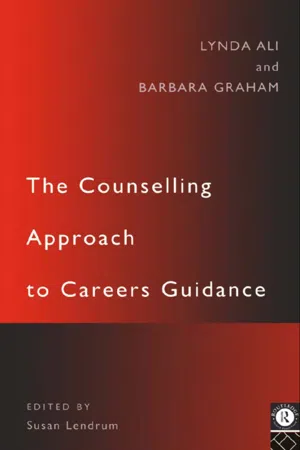
The Counselling Approach to Careers Guidance
About this book
Through detailed case material the authors show how to use counselling strategies with clients seeking careers guidance to enable them to change unhelpful patterns of thought and to move towards achievable goals.
This book:
* offers a series of tasks for structuring interviews and assesses materials available to careers counsellors
* discusses important issues affecting their training and development within the public sector.
This is a useful handbook for experienced advisers and trainees in the careers service and a range of professional settings.
Information
Chapter 1
Introduction to counselling in careers guidance
In a world in which the concept of ‘a career’ is becoming increasingly fluid, careers guidance is not a once-in-a-lifetime injection of wisdom which orients a person in a particular direction for all time. As life enters new phases and external circumstances add fresh dimensions to a person’s situation, so the need for guidance arises at various times in an individual’s life.
Because the need for guidance is associated with uncertainty about future steps, people who seek guidance may regard it as a remedy for a crisis and may expect a ready-made solution from the lips of an expert. Guidance practitioners, on the other hand, recognise guidance as a process to be worked through by the client over time, with support and encouragement from the careers adviser.
Since there is potential for the two participants in a careers interview to approach it with such divergent expectations, it is vital that the adviser should make the client aware at an early stage in the discussion of the respective roles of the client and the adviser. It is also important to clarify what can and cannot be achieved during a careers interview. This book therefore begins with a definition of guidance and a look at the people involved in giving and receiving it.
WHAT IS GUIDANCE?
Effective careers guidance is a process which aims to equip individuals with a clearer understanding of themselves and their potential for future career development. In particular, careers guidance helps individuals to:
- assess their career development needs at various points in their lives;
- understand the process of effective choice of a career;
- clarify their objectives for the future;
- take appropriate action to implement these objectives.
People who are approaching a decision about their future often benefit from speaking to a skilled and informed listener, who can help them to put the many factors affecting their career development into perspective so that they can choose an appropriate direction for the next phase of their lives.
WHO GIVES GUIDANCE?
Careers guidance is not the exclusive preserve of careers officers in the Careers Service and careers advisers in higher education. A recent study1 has shown that the most influential factor in young people’s choice of degree course is advice from parents. Other informal sources of advice include friends, employers, teachers, librarians, community workers and voluntary agencies such as the Citizen’s Advice Bureaux.
Some of the advice from these sources may be sound, well-researched and appropriately targeted, but this is not always the case. Because such ‘advice givers’ are not specialists in careers work and may deal with careers enquiries infrequently, the advice which they give may be, at best, limited and, at worst, out of date, erroneous and misleading. Despite these limitations, informal sources of advice will continue to be used for careers guidance, perhaps because of their very accessibility. The challenge to guidance practitioners is to try to be equally accessible and to demonstrate the benefits of well informed professional careers guidance. Through their contacts with employers, careers advisers are in a unique position, enabling them to interpret, for jobseekers, employers’ recruitment needs and their expectations of applicants. This knowledge anchors their advice in an appreciation of the real world of work which may not be apparent to their clients.
Every individual – irrespective of age and ability to pay – should be entitled to up-to-date, accurate, unbiased careers information and guidance delivered by trained, competent, professional guidance practitioners. This ideal has not yet been translated into reality, although it is close to being achieved for learners in schools and universities and the situation is improving in further education since charters for further and higher education pointed out students’ right to careers guidance alongside other basic entitlements. For adults outside of education, however, provisions are extremely patchy and access to sound careers guidance may depend upon geographic location, ability to pay or the fortunate coincidence of working for an enlightened employer with a strategy for the career development of staff.
It is therefore worth clarifying the sources of help on careers issues to which people in the post-16 age group can turn with the expectation of receiving professional guidance. The following list also represents the target audience for this book.
GUIDANCE PRACTITIONERS
The term ‘guidance practitioner’ covers the following groups of people:
- Careers officers employed in the Careers Service within local authorities, or, following reorganisation of the Careers Service, local enterprise companies or training and enterprise councils.
- Careers advisers in higher education institutions.
- The growing number of careers advisers in further education institutions.
- Careers counsellors in private practice.
Although the settings and circumstances in which they work may differ in certain respects from those of the groups mentioned above, other practitioners are also involved in some aspects of careers guidance. These include:
- Careers and guidance teachers working with pupils over the age of 16 in schools.
- Educational guidance workers who help adults to select courses which will have a direct bearing on their future career planning.
- Out-placement counsellors dealing with people whose jobs are redundant.
- Personnel managers who specialise in the career and management development of members of their workforce.
- Guidance specialists in training agencies who help their clients to choose training courses appropriate to their future career aspirations.
This book is about good practice in guidance, and will be of interest to students, probationers and trainers involved in training for the Careers Service as well as those who are directly responsible for advising clients in a whole range of professional settings.
WHO RECEIVES GUIDANCE?
While guidance may be associated primarily with people who are setting out on a career path after leaving education or those who have been forcibly evicted from their employment by redundancy, the need for guidance can occur for anyone at any time. The following are among the groups of people who can be identified as guidance seekers and whose case histories will be encountered in this book:
- People leaving education at secondary or tertiary level.
- People wishing to return to education in order to improve their employment prospects, acquire new skills or update their knowledge and skills after a career break.
- Returners from career breaks who wish to know about options open to them in resuming or changing their careers.
- People whose jobs are redundant or insecure.
- Workers who are achieving little job satisfaction and want to find more rewarding employment.
- People whose jobs are too stressful or have become too demanding physically.
- Staff whose hopes of promotion have not been fulfilled and who want to stimulate their career development by being proactive.
- People who want to switch from full-time to part-time work and vice versa.
- People contemplating setting up their own business.
- Older workers who are approaching retirement, but want to find meaningful occupations in the broadest sense, which will lead to selffulfilment and a sense of being valued by the community.
The guidance needs of all of these people and the timescales in which they want to operate vary, but they have in common a need to:
- take stock of their present circumstances;
- understand the factors influencing their decision making;
- appreciate more realistically what they have to offer;
- review and evaluate the options available to them;
- identify preferred options;
- formulate an action plan which will result in the achievement of their objectives.
The primary purpose of guidance is to assist individuals in their exploration of these complex issues, to make greater sense of their current situation and to build confidence in their ability to complete the review process and move forward from the point at which they seek help.
ADOPTING A COUNSELLING APPROACH
All of the people described above are encountered by guidance practitioners at a time when they are going through or are on the brink of a major transition – literally moving from one state of being to another. The decisions which they make about themselves in relation to work or education – or the absence of these activities – often have a significant impact on other aspects of their lives and the people around them. Effective careers guidance therefore cannot be given in a vacuum. It must take into account the life circumstances in which the next phase of a person’s career will be set.
It is this approach to the whole person which distinguishes the work of the skilled guidance practitioner from that of givers of information on careers. In order to function in this way, a careers adviser will find it helpful to focus on an individual client’s needs by using a counselling approach to guidance which is built upon a highly developed, inter-related set of communication skills. Used appropriately, these skills can help free a client from unhelpful patterns of thought and facilitate progress towards a solution both within and beyond the time spent together in the interview.
The counselling approach also distinguishes careers advisers from other professionals who are concerned with the interface between people and work (e.g. personnel officers, recruitment consultants and occupational psychologists). Whereas these other specialists are primarily concerned with the selection, training and maintenance of an effective, skilled workforce for an organisation, the focus of the careers adviser is on the individual, with a view to helping him or her to find the most appropriate career path out of all the options which are available. The careers adviser is aided in the discussion by knowledge of the needs of the labour market, but also contributes to the interview a greater understanding of human development and how people respond to others. The adviser can also help the client by finding parallels between the skills and temperament required for specific occupations and the client’s self-description of his or her abilities and personality.
HOW THIS BOOK IS STRUCTURED
The next chapter explores some fundamental questions about the nature of the counselling approach to careers guidance. What is meant by counselling skills and how do they work in careers guidance? What attributes enable careers advisers to use the counselling approach? What are the distinctive features of counselling in the careers guidance context? When is it appropriate to make referrals to other counsellors?
Chapter 3 gives a succinct overview of some theories of occupational choice and of counselling which have influenced the model of counselling in careers guidance described in this book. The theories are related to problems which clients commonly encounter and are linked to specific case studies which follow in other chapters. This chapter also outlines key influences which affect a client’s outlook on life and his decision on career options.
Chapter 4 offers an integrated model for a practical approach to counselling in careers guidance. The four-stage model demonstrates how a guidance practitioner can assess and prioritise a client’s needs, and draws upon theories of counselling and occupational choice in order to provide a client with a framework for exploration of career issues and options before reaching a well-reasoned decision and constructing a realistic action plan.
Chapter 5 then shows how the range of skills is actually used when applying the model. Each skill is defined and illustrated by examples from relevant situations, and ways in which careers advisers can develop these skills are explored.
Chapter 6 demonstrates certain strategies which careers advisers can use to help clients with specific difficulties to become ‘unstuck’ and to move forward through the phases described in the model. The examples given show how a careers adviser can employ the various counselling skills identified in Chapter 5 in order to achieve the desired outcome of a particular strategy.
Chapters 7 and 8 examine the impact of external circumstances on clients who seek guidance, focusing first on their immediate family and social circle and second on social and economic factors which have a bearing on individuals and their potential career development. Brief case studies demonstrate ways of working which take these background circumstances into account.
Chapter 9 looks at various tools which the guidance practitioner can use within the model. These include pencil and paper exercises, computeraided guidance, aptitude tests, personality questionnaires, practice interviews, contact with practitioners in occupations and the wealth of written and video careers information to which the clients have access. It also considers ways of working with tools which enhance the client’s responsibility.
Chapter 10 follows the case history of one client, Carol. It outlines her life experiences, including sociological and psychological influences, and explores her previous experiences of guidance which have coloured her later experiences. Taking Carol’s ‘world’ into account at the moment of a university careers guidance interview, this chapter then outlines the process with the client from the counsellor’s perspective. The dialogue between the client and counsellor is presented, together with the dilemmas and decisions the counsellor has to face as the interview progresses.
Chapter 11 examines important issues regarding the training and support of guidance practitioners. These relate to both initial training in counselling skills and the development of expertise in the counselling approach through a careers adviser’s continuous professional development.
Finally, at the end of the book readers are given the means of pursuing further their interest in counselling in careers guidance via useful contact addresses and a select bibliography.
A NOTE ABOUT TERMINOLOGY
‘Guidance practitioner’ and ‘careers adviser’. These terms are both used to describe people who give careers guidance in a professional capacity. These primarily include people for whom giving guidance is a main function but, within specific contexts, the term guidance practitioner is also used to refer to other professionals (for example, personnel officers) for whom careers guidance is a partial but none the less important remit.
‘The client’. In the contexts which we describe, the individual seeking help may be referred to as a student, pupil, worker, graduate or client. The word ‘client’ has been used throughout to cover all these terms, although we are aware that it is not in common use in some settings.
‘The interview’. The exchange which occurs between the adviser and the client is described in a number of ways, depending on the setting – e.g. discussion, appointment, consultation, interview. None of these seem quite right – ‘consultation’ confers an ‘expert’ status on the adviser, and ‘discussion’ implies a certain lack of purpose. ‘Interview’ has unfortunate connotations of selection, but this has been chosen as the most appropriate and most commonly used term in this context.
GENDER
Advisers and their clients may be male or female. In the examples in the book, we have sometimes used ‘he’ and sometimes ‘she’ to describe them – and in most situations the positions could equally well have been reversed, except in circumstances which tend to apply more to men or to women.
A COMMONSENSE APPROACH TO COUNSELLING
The aim of this book is to try to remove any mystique from counselling in careers guidance. In the spirit of this philosophy, the authors have tried to keep the text free of jargon and circumlocutions so that readers can concentrate on the concepts described and the potential application to their own work without any additional impediments of language. Although the issues encountered in careers guidance are often complex and interwoven, the key skill of a guidance practitioner is to clarify all the important factors for a client and to communicate options for consideration.
The strength of the counselling approach to guidance is that it enables the practitioner to work alongside the client, taking into account individual needs, abilities and expectations in the context of the labour market. The following chapter explores in some detail the nature of the counselling approach to careers guidance.
Chapter 2
The counselling approach
THE CONCEPT OF COUNSELLING IN A CAREERS SETTING
Counselling and guidance clearly share aims of enhancing selfunderstanding and communicating appropriate options for the next phase in a person’s life. The differences between them are largely those of function and can perhaps be understood through the use of an analogy. The relationship betwe...
Table of contents
- Cover Page
- Title Page
- Copyright Page
- Acknowledgements
- Chapter 1: Introduction to Counselling in Careers Guidance
- Chapter 2: The Counselling Approach
- Chapter 3: Theoretical Background to Counselling
- Chapter 4: The Model for a Counselling Approach
- Chapter 5: Counselling Skills
- Chapter 6: Application of the Model and Skills in the Careers Interview
- Chapter 7: The Immediate Environment
- Chapter 8: The Impact of the Labour Market
- Chapter 9: Tools Available to the Careers Adviser
- Chapter 10: Carol: The Context of Guidance and the Guidance Interview
- Chapter 11: Training and Development for Guidance Practitioners
- Notes
- Useful Addresses
- Select Bibliography
Trusted by 375,005 students
Access to over 1.5 million titles for a fair monthly price.
Study more efficiently using our study tools.
Frequently asked questions
Yes, you can cancel anytime from the Subscription tab in your account settings on the Perlego website. Your subscription will stay active until the end of your current billing period. Learn how to cancel your subscription
No, books cannot be downloaded as external files, such as PDFs, for use outside of Perlego. However, you can download books within the Perlego app for offline reading on mobile or tablet. Learn how to download books offline
Perlego offers two plans: Essential and Complete
- Essential is ideal for learners and professionals who enjoy exploring a wide range of subjects. Access the Essential Library with 800,000+ trusted titles and best-sellers across business, personal growth, and the humanities. Includes unlimited reading time and Standard Read Aloud voice.
- Complete: Perfect for advanced learners and researchers needing full, unrestricted access. Unlock 1.5M+ books across hundreds of subjects, including academic and specialized titles. The Complete Plan also includes advanced features like Premium Read Aloud and Research Assistant.
We are an online textbook subscription service, where you can get access to an entire online library for less than the price of a single book per month. With over 1.5 million books across 990+ topics, we’ve got you covered! Learn about our mission
Look out for the read-aloud symbol on your next book to see if you can listen to it. The read-aloud tool reads text aloud for you, highlighting the text as it is being read. You can pause it, speed it up and slow it down. Learn more about Read Aloud
Yes! You can use the Perlego app on both iOS and Android devices to read anytime, anywhere — even offline. Perfect for commutes or when you’re on the go.
Please note we cannot support devices running on iOS 13 and Android 7 or earlier. Learn more about using the app
Please note we cannot support devices running on iOS 13 and Android 7 or earlier. Learn more about using the app
Yes, you can access The Counselling Approach to Careers Guidance by Lynda Ali,Barbara Graham in PDF and/or ePUB format, as well as other popular books in Sciences sociales & Éducation en psychologie. We have over 1.5 million books available in our catalogue for you to explore.