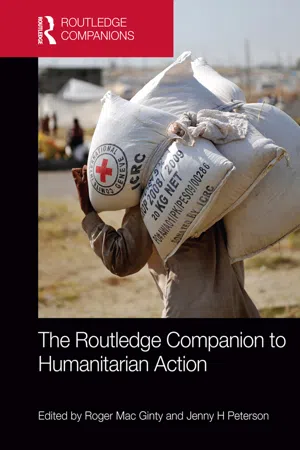
The Companion on Humanitarian Action addresses the political, ethical, legal and practical issues which influence reactions to humanitarian crisis. It does so by exploring the daily dilemmas faced by a range of actors, including policy makers, aid workers, the private sector and the beneficiaries of aid and by challenging common perceptions regarding humanitarian crisis and the policies put in place to address these. Through such explorations, it provides practitioners and scholars with the knowledge needed to both understand and improve upon current forms of humanitarian action.
The Companion will be of use to those interested a range of humanitarian programmes ranging from emergency medical assistance, military interventions, managing refugee flows and the implementation of international humanitarian law. As opposed to addressing specific programmes, it will explore five themes seen as relevant to understanding and engaging in all modes of humanitarian action. The first section explores varying interpretations of humanitarianism, including critical historical and political-economic explanations as well as more practice based explorations focused on notions needs assessments and evaluation. Following this, readers will be exposed to the latest debates on a range of humanitarian principles including neutrality and sovereignty, before exploring the key issues faced by the main actors involved in humanitarian crisis (from international NGOs to local community based organizations). The final two sections address what are seen as key dilemmas in regards to humanitarian action and emerging trends in the humanitarian system, including the increasing role of social media in responding to crises.
Whilst not a 'how to guide', the Companion contains many practical insights for policy makers and aid workers, whilst also offering analytical insights for students of humanitarian action. Indeed, throughout the book, readers will come to the realization that understanding and improving humanitarian action simultaneously requires both active critical reflection and an acceptance of the urgency and timeliness of action that is required for humanitarian assistance to have an impact on vital human needs. Exploring a sector that is far from homogenous, both practitioners and scholars alike will find the contributions of this book offers them a deeper understanding of the motivations and mechanics of current interventions, but also insight into current changes and progress occurring in the field of humanitarian practice.
- 458 pages
- English
- ePUB (mobile friendly)
- Available on iOS & Android
eBook - ePub
The Routledge Companion to Humanitarian Action
About this book
Information
PART I Interpretations
DOI: 10.4324/9780203753422-2
1 Wonderful Work
Globalizing the ethics of humanitarian action
DOI: 10.4324/9780203753422-3
Introduction
It is a wonderful development that there is now a global system of humanitarian action that can reach people suffering from armed conflict and disaster in any part of the world. The system does not reach everyone in need but it does succeed in reaching millions of people every year, delivering $18 billion of aid in 2013, and in monitoring the predicament of those it does not reach (Global Humanitarian Assistance (GHA) 2013). The humanitarian system is spearheaded by United Nations (UN) agencies, the Red Cross Movement and major non-governmental organizations (NGOs) that fit into, or alongside, national governments and local civil society as operational partners or additional capacity. The vast majority of humanitarian financing that drives the system currently comes from OECD governments, but over a quarter comes from private individuals who give regularly to NGOs or respond generously to emergency appeals (Stirk 2014). Alongside these strictly humanitarian agencies, human rights agencies and conflict resolution organizations act as outriders to the system. The former report human rights violations and the latter try to initiate peace negotiations to reduce the violence that is causing so much devastation.
My image of a mobile international humanitarian system with human rights outriders is deliberate because the current humanitarian system is still largely expeditionary. The system has also often been called a humanitarian circus, or crisis caravan (Polman 2010). Its organizations are still mainly exogenous and come from outside the affected country, rather than being indigenously built from within the society facing conflict or disaster. Humanitarian operations still tend to push outwards from the West even though more than 95 per cent of their employees are people in the countries facing disaster and war (People in Aid 2013). Many major humanitarian organizations, such as UNICEF, UNHCR, Save the Children, Oxfam, Care and IRC, have their ideological and operational roots in Western wars, European colonialism and the UN’s post-colonial drive for international development. The centre of gravity in the current system, therefore, is still Occidental in its thinking, finance, capacity and geographical origin. Because of this, it makes sense to look at global humanitarian action through a post-colonial lens but only up to a point. Fixed in such a retrospective frame, one would miss the ethical change and innovation that humanitarian agencies are generating in people’s individual lives, in national political cultures and in global society.
The current model of global humanitarian response is thought by many to be more like a network of competing agencies than a fully integrated system (Weiss 2013). In reality, it seems to embody elements of both. Most people within its various agencies agree that it is a dysfunctional network, a dysfunctional market and a dysfunctional system. Consequently, it lives with the added turbulence of a constant obsession with ‘reform’ and ‘improved coordination’ (Inter-Agency Standing Committee (IASC) 2014). At the heart of these reforms, there is always a tension between a government and UN culture that would like to run international humanitarian action as an effective international civil service, and an NGO culture that sees humanitarian action as a more informal manifestation of civic activism. Despite its structural troubles, there is significant moral support for the ethical goals of humanitarian action across global society. The system’s expanding global humanitarian capability has a major impact on reducing people’s suffering in armed conflicts and disasters. Simultaneously, it does represent some nascent and constructive form of global governance as well as new patterns of humanitarian solidarity across global society (Slim 2006).
In this chapter, I will describe the values and principles of humanitarian action as a global field and discuss three of the main critiques of humanitarian action at large today. In deliberate contrast to critical theory, I will tend towards appreciative theory as an equally good means of unveiling the realities of humanitarian action, and one that leaves a more positive point from which humanitarian practitioners can proceed towards improvement. Saving people’s lives in armed conflict and disaster is a truly wonderful achievement when it happens, and there are many other important spin-offs of humanitarian action that can also be very positively valued. I will start by looking at the emergence of humanitarian power, which I consider to be largely a good thing. I will then review the current moral consensus around humanitarian goals in international relations, which I also view positively. I will then move to examine the ethics that have been elaborated to drive humanitarian action, before disagreeing with much of the moral criticism of this expanding field of international relations.
Humanitarian power
This globalization of humanitarian action is a genuine novelty in international relations. It results from the emergence of new global norms, the creation of new institutions and the investment of many billions of dollars. These developments have all come together to form unprecedented levels of humanitarian power in the late twentieth and early twenty-first centuries. Much of this power is truly wonderful. It saves lives and undermines the traditional logic and cruel practices of war. It means that millions of people who experience the pain, impoverishment and displacement of war now live through their experiences rather than die from them. However, as with all power, new levels of humanitarian power bring new dangers too. Unless the sun remains forever at its height over a new edifice of human endeavour, there will always be shadows surrounding it at different points. Many critics of humanitarian action are only too ready to focus on these shadows while overlooking the brighter elements of humanitarian effect in people’s lives. Yet, the shadow side is potentially problematic and must be treated with constant ethical vigilance.
Humanitarian power has led to the consolidation of an international humanitarian regime that has created new global and national elites and established a set of humanitarian practices such as camps, food distributions, clean water supplies, public health care and other forms of what some critical theorists like to call bio-political governance. Following Foucault, many humanitarian scholars now see humanitarian aid as an increasing field of state power over individual bodies. Other humanitarian practices include cash transfers, protection programming, shelter, family reunification, agricultural recovery, business continuity and humanitarian advocacy. These humanitarian structures and projects often sit parallel to national government, and some can be degrading to people as well as life-saving when they involve long queues, confinement in camps and a loss of autonomy. Humanitarian programming also runs a continuous risk of being manipulated and instrumentalized in the political strategy of warring parties (Donini 2012). Although over-dramatized by critical theorists, all these dangers are genuine and can become new failures in human kindness. Such failures of care are similar to those we see from time to time in all advanced welfare institutions and come about from poor design, perverse incentives or rogue operators. These system failures are not intentionally malevolent and not always within the power of agencies themselves. The greatest failure in humanitarian action, of course, remains its frequent inability to reach the hardest places (such as Bosnia, Rwanda and Syria) at the time when the worst things are happening. These are not usually moral failures by humanitarian agencies but cases in which humanitarian power is simply overwhelmed by anti-humanitarian power that is prioritizing killing, and resists humanitarian action while it does so.
Increasing moral consensus on global humanitarian norms
There is significant international consensus about the ethical legitimacy of humanitarian goals in armed conflict and disaster. Most contemporary international discourse around war prioritizes life over winning. Deep principles about the humane conduct of hostilities and the rights of the individual that were often submerged during Cold War politics have bubbled to the surface of international relations since 1990 to spread a renewed culture of humanitarian compassion in the policies and institutions of the UN, regional organizations and many individual states.1 New consensus within the UN Security Council from the early 1990s saw a flourishing of UN concern for protecting civilians in armed conflict, for increasing humanitarian access into conflict areas, for increased use of peacekeeping forces and for greater investments in peace negotiations to end conflicts (Slim 2004a; Ramsbotham et al. 2005). New and old humanitarian treaties of various kinds became more central to international politics. The norms and rules of International Humanitarian Law (IHL) have been referred to regularly in a range of UN Security Council resolutions on armed conflicts. At the heart of this move was a normative shift towards the rights of the individual to be protected from violence, against the right of the state and armed groups to use violence. This was notably summed up in a phrase from Boutros Boutros-Ghali’s landmark 1992 document for the Security Council, An Agenda for Peace, in which he affirmed that: ‘the time of absolute sovereignty has passed’ (Boutros Boutros-Ghali 1992). From this shift the concept of the Responsibility to Protect (R2P) was born and agreed by the UN in 2005 (Bellamy 2009).
These high levels of humanity in international mood and geopolitical discourse are, of course, not matched in the domestic discourse of most wars. In recent wars in Democratic Republic of Congo (DRC), Sudan, Sri Lanka, Côte d’Ivoire, Libya, Syria, Central African Republic (CAR) and South Sudan, in the drugs wars of Mexico, and in communal violence in Kenya and Iraq, military and political talk prioritizes winning over life. In these conflicts, political and military policy on the ground is fiercely anti-humanitarian. Here, in the rub between an increasingly humanitarian international policy and determinedly inhumane national policies, is the fundamental political challenge for globalizing humanitarian action. In some conflicts, such as the DRC, Kenya, Libya, Côte d’Ivoire, CAR and South Sudan, the UN and international politics is able to secure humanitarian traction to limit death and enhance peace negotiations. In others, such as Sudan, Sri Lanka and Syria, it is too divided to intervene effectively, or rightly cautious about doing so (Keating 2013). It is within these varying contexts of national humanitarian mood – some eas...
Table of contents
- Cover Page
- Other
- Half-Title Page
- Title Page
- Copyright Page
- Table of Contents
- List of illustrations
- List of contributors
- Glossary
- Introduction
- Part I Interpretations
- Part II Principles
- Part III Actors
- Part IV Dilemmas
- Part V PartTrends
- Index
Trusted by 375,005 students
Access to over 1.5 million titles for a fair monthly price.
Study more efficiently using our study tools.
Frequently asked questions
Yes, you can cancel anytime from the Subscription tab in your account settings on the Perlego website. Your subscription will stay active until the end of your current billing period. Learn how to cancel your subscription
No, books cannot be downloaded as external files, such as PDFs, for use outside of Perlego. However, you can download books within the Perlego app for offline reading on mobile or tablet. Learn how to download books offline
We are an online textbook subscription service, where you can get access to an entire online library for less than the price of a single book per month. With over 1.5 million books across 990+ topics, we’ve got you covered! Learn about our mission
Look out for the read-aloud symbol on your next book to see if you can listen to it. The read-aloud tool reads text aloud for you, highlighting the text as it is being read. You can pause it, speed it up and slow it down. Learn more about Read Aloud
Yes! You can use the Perlego app on both iOS and Android devices to read anytime, anywhere — even offline. Perfect for commutes or when you’re on the go.
Please note we cannot support devices running on iOS 13 and Android 7 or earlier. Learn more about using the app
Please note we cannot support devices running on iOS 13 and Android 7 or earlier. Learn more about using the app
Yes, you can access The Routledge Companion to Humanitarian Action by Roger Mac Ginty,Jenny H Peterson in PDF and/or ePUB format, as well as other popular books in Social Sciences & International Law. We have over 1.5 million books available in our catalogue for you to explore.