Grand strategy is one of the most widely used and abused concepts in the foreign policy lexicon. In this important book, Hal Brands explains why grand strategy is a concept that is so alluring—and so elusive—to those who make American statecraft. He explores what grand strategy is, why it is so essential, and why it is so hard to get right amid the turbulence of global affairs and the chaos of domestic politics. At a time when "grand strategy" is very much in vogue, Brands critically appraises just how feasible that endeavor really is.Brands takes a historical approach to this subject, examining how four presidential administrations, from that of Harry S. Truman to that of George W. Bush, sought to "do" grand strategy at key inflection points in the history of modern U.S. foreign policy. As examples ranging from the early Cold War to the Reagan years to the War on Terror demonstrate, grand strategy can be an immensely rewarding undertaking—but also one that is full of potential pitfalls on the long road between conception and implementation. Brands concludes by offering valuable suggestions for how American leaders might approach the challenges of grand strategy in the years to come.
eBook - ePub
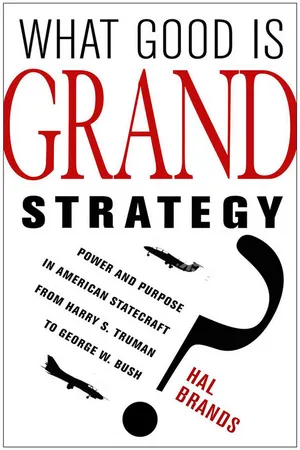
What Good Is Grand Strategy?
Power and Purpose in American Statecraft from Harry S. Truman to George W. Bush
- 288 pages
- English
- ePUB (mobile friendly)
- Available on iOS & Android
eBook - ePub
What Good Is Grand Strategy?
Power and Purpose in American Statecraft from Harry S. Truman to George W. Bush
About this book
Information
CHAPTER 1
The Golden Age Revisited
The Truman Administration and the
Evolution of Containment
The Truman years are often thought of as the golden age of American grand strategy, a time when farseeing officials laid down lasting policies for containing Soviet power and stabilizing the global order. Dean Acheson famously titled his account of these years Present at the Creation, while Clark Clifford, another of Truman’s advisers, later opined that “we saved Europe and we saved the world.”1 Since the end of the Cold War, pundits and policy makers have similarly described the Truman era as a time of unmatched grand strategic vision and innovation, and invoked it as a model for present-day foreign policy. The search for a new grand strategy in the early 1990s was commonly referred to as the “Kennan sweepstakes”; calls for a concept as clear and enduring as containment have been ubiquitous ever sense. “The Truman team’s strategy marked the golden age of U.S. foreign policy,” wrote former Council on Foreign Relations president Leslie Gelb in 2009, “as glorious in our history as the founding fathers’ creation of the Constitution.”2
This chapter revisits Truman-era grand strategy, examining the relationship between planning and policy, goals and tactics, and means and ends during the early Cold War. As this analysis makes clear, the Truman years were certainly a time of great purpose and accomplishment. As the Cold War unfolded, Truman and his advisers grasped that containment represented a desirable middle ground between appeasement and war, that containing Soviet power meant maintaining a favorable geopolitical balance, and that maintaining that balance primarily meant securing and rehabilitating the key industrial regions of Western Europe and Northeast Asia. The administration placed these insights at the heart of its grand strategy, and gradually translated them into the specific policies—the Marshall Plan and the North Atlantic Treaty Organization (NATO), the revival of Japan and West Germany, the eventual buildup of Western military strength during the Korean War—that harnessed America’s great power in the service of these worthy ends. By the time the administration left office in 1953, it had largely stabilized the Western world and created “situations of strength” that would redound to American benefit for years to come. This, as Melvyn Leffler has argued, was Truman’s chief grand strategic legacy, and it is one that is eminently worthy of admiration.3
Yet the “golden age” tag can also be misleading, for it obscures just how messy and vexatious a process Truman-era grand strategy could be. Containment was not a program that took shape all at once; it was a concept that had to be developed, refined, and adjusted amid a seemingly ceaseless flow of events. Although the administration’s basic goals and geographical priorities remained largely constant from 1947–48 onward, its tactics evolved considerably as the period went on. “Any policy must rest on principles,” Kennan himself acknowledged, “but its application must be in a constant state of flux.”4 And while Truman’s team was generally successful in blending tactical flexibility with strategic vision, the evolution of containment nonetheless occasioned a number of potent dilemmas—about the appropriate level of military spending, the proper extent of U.S. commitments, the relationship between rhetoric and policy, and other issues—that the administration was never able to resolve. In the end, the Truman era testified not just to the possibilities of grand strategy, but to the inherent complexity and limits as well.
The basic grand strategic problem of the Cold War flowed directly from the hot war that preceded it. World War II transformed America’s geopolitical position. The United States emerged from that conflict with half of the world’s manufacturing capacity and an economy roughly five times larger than its nearest competitors. The U.S. military position was no less commanding. America accounted for nearly three-quarters of world military spending in 1945, and it alone possessed the atomic bomb, an air force with global striking power, and a navy that outclassed all of its peers combined. In 1941, Henry Luce had predicted the dawning of an “American Century,” but even he could not have foretold the extent of American power at the end of World War II.5
In other ways, however, the war left a deeply unsettling legacy. The attack on Pearl Harbor in 1941 had demonstrated that enemies could reach across the oceans to strike the United States at home, and advances in airpower and missile technology raised the prospect of even more devastating attacks in the future. More broadly, the entire experience of the 1930s and 1940s seemed to show that aggressive authoritarian regimes had to be confronted before it was too late, and that global economic health and peace were inextricably intertwined. It would not be enough, then, to safeguard the Western Hemisphere once the war was done; the United States would henceforth have to define its security in global terms. “We are now concerned with the peace of the entire world,” said Army Chief of Staff George Marshall.6
During and after World War II, American officials were therefore determined to put the nation’s power to good use. The Roosevelt and Truman administrations worked to create an open, liberal economic order that could prevent another slide into depression and war, and an international organization—the United Nations—that might be used to confront aggressors. More unilaterally, military planners emphasized the need for assured access to vital raw materials and resources, and for an enlarged “strategic frontier” composed of military bases from which American forces could project power and interdict approaching enemies. Above all, they argued that the United States must prevent any unfriendly country from dominating the Eurasian landmass. This vast area contained immense economic and industrial capabilities, and if any rival controlled these assets, it could generate military power that might render the American homeland insecure. In any future conflict, wrote military officials in 1947, “We must have the support of some of the countries of the Old World unless our military strength is to be overshadowed by that of our enemies.”7
This was an expansive conception of America’s postwar interests. The problem, however, was that World War II also occasioned just those developments that seemed likely to imperil this vision. The war left much of Europe and Asia devastated militarily, economically, and politically, shattering the international balance of power and raising the specter of upheaval and even revolution from France to China and beyond. The conflict virtually bankrupted Great Britain, leaving it unable to play its traditional role as global stabilizer. Additionally, World War II undermined the colonial order throughout the developing regions, setting off waves of nationalist ferment and radicalism in points from the Korean peninsula to the Middle East. The world was faced with “social disintegration, political disintegration, the loss of faith by people in leaders who have led them in the past, and a great deal of economic disintegration,” warned Acting Secretary of State Dean Acheson in 1945.8
Looming amid this instability was the Soviet Union, a brutal tyranny with a sharp ideological hostility to the West. World War II had already brought the Red Army deep into Europe and parts of the Middle East and Asia as well, and the postwar upheaval threatened to carry Soviet influence—ideological, political, perhaps even military—much farther still. “Russia will emerge from the present conflict as by far the strongest nation in Europe and Asia—strong enough, if the United States should stand aside, to dominate Europe and at the same time to establish her hegemony over Asia,” predicted the Office of Strategic Services in April 1945.9 Whether Joseph Stalin harbored such grandiose ambitions remained uncertain, but what was clear was that the natural geopolitical barriers to Soviet expansionism had largely been destroyed. Having just faced one totalitarian challenge to the international system, the United States and the Western world now had to reckon with the possibility of another.
Wartime planning notwithstanding, this challenge was not one for which American officials were especially well prepared. As noted above, U.S. military officials had certainly given a great deal of thought to the general requirements of postwar security. Yet the top levels of the Roosevelt administration—notably the president himself—had not developed any systematic approach to a possible competition with the Soviet Union specifically. In reality, many of Roosevelt’s wartime policies were more likely to undercut such a program than advance it. The president was more concerned about the evils of colonialism than the probable advance of communism, and he often worried that London and Paris—not Moscow—would pose the greatest obstacles to a harmonious international system. Nor did Roosevelt have a meaningful plan for filling the power vacuum that was sure to emerge in Europe. He was willing to leave Germany economically prostrate, and he resisted British requests for a postwar strategic commitment to the continent. For all the virtues of Roosevelt’s wartime leadership, his preparation for postwar diplomacy remained remarkably superficial.10
This shortcoming might not have been so problematic had Washington and Moscow managed to sustain a productive relationship after the fighting ended. Roosevelt had staked his wartime diplomacy on the premise that Stalin could be integrated into a peaceful world community, and Harry Truman—his occasionally confrontational rhetoric aside—initially believed the same thing. To be sure, Truman and his aides hardly overlooked U.S. interests, and in mid- and late 1945 they sought to make Stalin more pliable through the use of sticks—such as the power implicit in the atomic monopoly—as well as carrots like the promise of a postwar loan. Yet the assumption remained that superpower cooperation was possible. Stalin, Truman remarked, “was a fine man who wanted to do the right thing.”11
By early 1946, however, Truman’s views had changed. In the months prior, Stalin had installed subservient governments in parts of Eastern Europe, pushed for territorial concessions from Turkey, and sought Kremlin trusteeships over former Italian colonies in the Mediterranean. Soviet troops lingered in Iran and Manchuria, raising fears that Stalin desired these territories as well. U.S. officials interpreted these actions as threats to the open global order they envisioned, and as troubling precedents in a world where there were few natural checks on Kremlin power. For their part, the Soviets felt threatened by America’s massive economic and military power, and by its objections to what Stalin saw as Moscow’s legitimate security requirements. When all this was added to the inevitable ideological tensions, the result was a series of bilateral disputes and a downward spiral in the relationship. “Unless Russia is faced with an iron first and strong language another war is in the making,” Truman wrote in January 1946. “I do not think we should play compromise any longer.”12
The incipient Cold War mind-set was best expressed in George Kennan’s “Long Telegram” from Moscow in February. The Soviets, Kennan argued, were incapable of long-term cooperation with the West. Driven by traditional Russian insecurity, Marxist-Leninist ideology, and the need to legitimize ruthless repression at home, they viewed the outside world as implacably hostile and were determined to “seek security only in patient but deadly struggle for total destruction of rival power.” “We have here,” he wrote, “a political force committed fanatically to the belief that with U.S. there can be no permanent modus vivendi, that it is desirable and necessary that the internal harmony of our society be disrupted, our traditional way of life be destroyed, the international authority of our state be broken, if Soviet power is to be secure.” Moscow would work ceaselessly to subvert and enfeeble the capitalist world; the only answer was an equally determined response. Soviet power was “impervious to logic of reason,” Kennan wrote, but “highly sensitive to logic of force. For this reason it can easily withdraw—and usually does when strong resistance is encountered at any point.”13
Kennan’s Long Telegram, and his subsequent “X Article,” were immensely influential documents. They helped define American views of the Soviet threat, and they laid out the intellectual premises for a strong but measured response. The Kremlin was determined to destroy its rivals and achieve a dominant world position, Kennan argued, but it was in no hurry to do so. Badly weakened by the war, and conscious of America’s superior overall power, the Soviets would retreat when met with determined resistance. Outright military conflict could therefore be avoided; it should be possible to check Soviet advances through “a policy of firm containment, designed to confront the Russians with unalterable counter-force at every point where they show signs of encroaching upon the interests of a peaceful and stable world.” Over the long term, such a policy would do more than just stymie the threat. It would weaken the Soviet system, discredit its leaders and dogma, and thereby bring about “either the breakup or the gradual mellowing of Soviet power.”14
Scholars still debate whether Kennan’s writings adequately captured the complexities of the Soviet worldview, but there is little question that his analysis contained real geopolitical insight. Kennan was fully attuned to the frailties of the Soviet system, particularly its economic backwardness and its nonconsensual, totalitarian nature. He understood that the United States was the stronger party in the unfolding strategic competition, and that if it acted wisely it could eventually turn Moscow’s own weaknesses against it. Above all, he saw that there was no need for rash or precipitate action, and that a combination of patience, prudence, and firmness would be crucial in the years ahead. Here, in very broad terms, were the central intellectual tenets of U.S. policy over the next four decades. As Henry Kissinger later put it, Kennan “came as close to authoring the diplomatic doctrine of his era as any diplomat in our history.”15
As the Cold War began, however, that doctrine remained gauzy in the extreme....
Table of contents
- PREFACE
- Introduction The Meaning and Challenge of Grand Strategy
- CHAPTER 1 The Golden Age Revisited The Truman Administration and the Evolution of Containment
- CHAPTER 2 Travails of the Heroic Statesmen Grand Strategy in the Nixon-Kissinger Years
- CHAPTER 3 Was There a Reagan Grand Strategy? American Statecraft in the Late Cold War
- CHAPTER 4 The Dangers of Being Grand George W. Bush and the Post-9/11 Era
- Conclusion Grappling with Grand Strategy
- NOTES
Trusted by 375,005 students
Access to over 1.5 million titles for a fair monthly price.
Study more efficiently using our study tools.
Frequently asked questions
Yes, you can cancel anytime from the Subscription tab in your account settings on the Perlego website. Your subscription will stay active until the end of your current billing period. Learn how to cancel your subscription
No, books cannot be downloaded as external files, such as PDFs, for use outside of Perlego. However, you can download books within the Perlego app for offline reading on mobile or tablet. Learn how to download books offline
Perlego offers two plans: Essential and Complete
- Essential is ideal for learners and professionals who enjoy exploring a wide range of subjects. Access the Essential Library with 800,000+ trusted titles and best-sellers across business, personal growth, and the humanities. Includes unlimited reading time and Standard Read Aloud voice.
- Complete: Perfect for advanced learners and researchers needing full, unrestricted access. Unlock 1.5M+ books across hundreds of subjects, including academic and specialized titles. The Complete Plan also includes advanced features like Premium Read Aloud and Research Assistant.
We are an online textbook subscription service, where you can get access to an entire online library for less than the price of a single book per month. With over 1.5 million books across 990+ topics, we’ve got you covered! Learn about our mission
Look out for the read-aloud symbol on your next book to see if you can listen to it. The read-aloud tool reads text aloud for you, highlighting the text as it is being read. You can pause it, speed it up and slow it down. Learn more about Read Aloud
Yes! You can use the Perlego app on both iOS and Android devices to read anytime, anywhere — even offline. Perfect for commutes or when you’re on the go.
Please note we cannot support devices running on iOS 13 and Android 7 or earlier. Learn more about using the app
Please note we cannot support devices running on iOS 13 and Android 7 or earlier. Learn more about using the app
Yes, you can access What Good Is Grand Strategy? by Hal Brands in PDF and/or ePUB format, as well as other popular books in Politics & International Relations & North American History. We have over 1.5 million books available in our catalogue for you to explore.