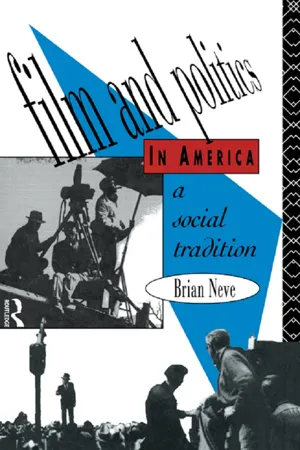
In A Social Cinema: Film-making and Politics in America, Brian Neve presents a study of the social and political nature of American film by concentrating on a generation of writers from the thirties who directed films in Hollywood in the 1940's. He discusses how they negotiated their roles in relation to the studio system, itself undergoing change, and to what extent their experience in the political and theatre movements of thirties New York was to be reflected in their later films.
Focusing in particular on Orson Welles, Elia Kazan, Jules Dassin, Abraham Polonsky, Nicholas Ray, Robert Rossen and Joseph Losey, Neve relates the work of these writers and directors to the broader industrial, bureaucratic, social and political developments of the period 1935-1970. With special emphasis on the post-war decade, bringing together archive and secondary sources, Neve explores a lost tradition of social fimmaking in America.
- 300 pages
- English
- ePUB (mobile friendly)
- Available on iOS & Android
eBook - ePub
About this book
Information
Chapter 1
Out of the Thirties
To Lary May the steady rise in cinema attendances during the thirties, accompanied after 1932 by the opening of newly designed ‘moderne’ theatres, contributed to the emergence of the country’s first national mass culture. Cinemas increasingly symbolised not European decadence but the American way of life and the aspiration to middle-class status, and for the growing immigrant audience the cinema was a powerful influence on their dawning American identities. How audiences interpreted the films that they viewed in new theatres and old is more difficult to ascertain. The Lynds reported in their ‘Middletown’ survey that exhibitors detected a public desire for pictures ‘on the happy side’ during the Depression years, but if consumers were unable to check their anxieties at the door they may have supplied their own ambiguity to even the most—perhaps especially the most—anodyne of Louis B.Mayer’s ‘confections’. As Levine suggests, substantial numbers of viewers may have been aware of the ambiguities of the films that they were viewing, despite or because of their optimistic conclusions.1
While audiences increasingly sat in modern cinemas they often watched films that harkened back to more settled times. The success of the thirties Capra films is often attributed to a middle-class nostalgia for pre-Depression values, while the popularity of late thirties films that recreated the past, and of the MGM Andy Hardy cycle, might similarly be interpreted in terms of a desire by both producers and consumers to reaffirm traditional values. More specialist audiences may have interpreted what they saw through the prism of their own perspectives and prejudices, even to the point of cognitive dissonance. While many critics saw Blockade (1938) as indicative of Hollywood’s extreme reluctance to commit itself politically, the critic for the New Masses found in the film a Vigorous plea for the loyalist cause’. While passive escape was undoubtedly there to be found, there are plenty of testaments to the formative impact of particular films. John Cellon Holmes remembers the effect on him of his first exposure, at the age of thirteen, to ‘the anchorless, half-bitter, half lyrical, unkempt, rebellious figure, of John Garfield’ in Four Daughters (1938).2
It is generally suggested that in the second half of the thirties few important films had much social or political relevance. The campaign by the Catholic Legion of Decency in 1934, and the establishment in the same year of the Production Code Administration, had led to the strict enforcement of a code which was designed both to restrict the portrayal of sex and violence, and, as Black argues, to ‘use popular entertainment films to reinforce conservative moral and political values’. From 1934 the Production Code was a powerful influence on what the public could see on the screen; Black cites the required changes that led MGM to withdraw from a plan to film Sinclair Lewis’ It Can’t Happen Here, and Breen’s insistence that Fury (MGM, 1936) not deal with racial prejudice or criticise Southern authority.3 (Lang’s film remained disturbing, despite its tacked-on ending, precisely because of the lack of any real explanation for the collective evil which the townspeople discover within them.) This cooperative censorship, preferred by the studios to the federal controls that were threatened in the early thirties, underscored the emphasis in Hollywood film on individualism, the very notion that, for more politicised Americans, the Depression had called into question. Levine argues that ‘popular culture throughout the Depression decade remained a central vehicle for the dissemination and perpetuation of those traditional values that emphasised personal responsibility for one’s position in the world’.4
Yet this conservative influence, this very selective reflection of the social and political reality of the Depression era, went side by side with a powerful cultural impact. By presenting the primarily WASP Hollywood stars as role models and generally downplaying ethnicity in the social rituals and practices portrayed on the screen, the cinema arguably played a key role in promoting and even defining a new national culture, at a time, in the late thirties, when more young ‘ethnics’, low income and rural Americans were joining the urban middle classes in the cinemas. The promotion and merchandising of stars was a powerful and much-needed spur to the economy, and the metropolitan culture was powerfully disseminated, with an often liberating effect. The impact, of course, was not limited to the United States, with 35 to 40 per cent of studio revenues coming from abroad. While this represented a powerful cultural imperialism, American films were sometimes welcomed, as in Britain, for their relative ‘classlessness’, in comparison to the local product.5
In surveys of politics as a theme in films of this decade reference is made to the fearful, fickle nature of the mass public. Like the later ‘mass society’ theory, Hollywood seemed uncertain of the strength of democracy, conscious of the threat of fascism. Bergman sees a distrust of the populace tempered by the assumption, in the later thirties, of federal benevolence. Levine writes of a ‘conversation’ between Hollywood and its audiences, rather than seeing the films as either determined by dominant economic forces, or by the conscious or unconscious concerns of the populace. For black Americans the ideological limits were still clear; Bogle sums up the thirties as the age of the Negro servant, while Cripps points out that the cycle of lynching films ‘missed the point that Negroes were the historic victims of lynching’. In terms of the portrayal of women Andrea S.Walsh sees Ma Joad (Jane Darwell) as a representative heroine of the late thirties—strong but ‘safely maternal’. But the social comedies of the later thirties, and in particular the films that Stanley Cavell calls the ‘genre of remarriage’, seem to provide evidence, in their depiction of independent women—albeit within the realm of romance—that feminist consciousness in the thirties was not as dormant as has been suggested.
The general distaste for politics did not prevent the making of a small number of films in the mid-thirties that satirised radicals. In Red Salute (1935), a film that was picketed by some groups on the left, Barbara Stanwyck plays Red, a young woman who—the daughter of a general—is determined to marry a radical, a foreign student. The bulk of the film shows her reluctant involvement—in a form borrowed from It Happened One Night—with a soldier who she calls Uncle Sam. At the climax of the film the student makes an anti-militarist speech to a student meeting, and then Uncle Sam seeks to demonstrate that the students are patriotic Americans, properly respectful of the flag. After a fight breaks out the radical is conveniently deported leaving Red, looking rather sullen, to begin a tour in a motor-drawn caravan with Uncle Sam. But, with the politicisation of the Hollywood community in the later thirties, and the arrival of Jewish émigrés from Nazi-occupied Europe, it was the Popular Front agenda that occasionally broke surface in the Hollywood film. Of the 1,500 film professionals to leave Germany after 1933 and Austria after 1938, over half settled in Hollywood. To Billy Wilder, who arrived in the United States, like Fritz Lang, in 1934, the immigration helped to internationalise American tastes, via the film industry, in such areas as horror and sophisticated comedy.6
Some reports of two low-budget Republic films, The President’s Mystery (1936) and It Could Happen to You (1937), written by Nathanael West with Lester Cole and Samuel Ornitz respectively, indicate that both showed an unusual political awareness. The first film was seen in 1940 as ‘outright propaganda for President Roosevelt’s re-election’ and as ‘an undisguised sermon against the American Liberty League’. While writers themselves had little bargaining power, despite the central importance of scripts for the whole production process, at times their role was strengthened either because of the nature of the material, or when they were able to make alliances with other creative personnel. Candace Mirza discusses the degree of autonomy that Donald Ogden Stewart, George Cukor and Katharine Hepburn were able to enjoy in their work on Holiday (1938), for Columbia Pictures. At the age of 41, in 1935, Stewart had discovered the ‘oppressed, the unemployed, the hungry, the sharecropper, the Jew under Hitler, the Negro’, and his changes to Philip Barry’s play contributed towards its transformation into what Mirza sees as ‘a more radical critique of patriarchal capitalism’.7
Left-wing writers like Howard Koch and John Wexley were in demand as anti-fascism belatedly reached the Hollywood agenda, and Wexley played an active role in promoting Confessions of a Nazi Spy (1939) both within Warners, and with the Breen Office. In the area of domestic politics there was also a slow opening towards a more critical agenda, albeit one in which problems were generally solved by New Deal figures of authority. The left-wing documentary filmmaker Sidney Meyers, who reviewed films under the name of Robert Stebbins, felt that it was important to maintain a balance between ‘the quality of criticism we apply and an appropriate sense of wonder and gratitude that films of even half-statement reach the screen’. The critic Philip Sterling cited a number of films of the late thirties that he felt broadened ‘the channels of democratic thought on the screen’. The list included Dead End (1937), The Life of Emile Zola (1937), Juarez (1939), A Man to Remember (1938), Mr Smith Goes to Washington (1939) and Boy Slaves (1939). The last film named broadly fits into the social problem film formula defined by Roffman and Purdy as an ‘indictment of personal villainy which the films’ social agencies do away with in the final reel’. In Boy Slaves (RKO) a kindly policeman and an even more saintly judge resolve the problem of the exploitation and ill-treatment of boys by a turpentine-producing company. (The judge has this final remark for the villain: ‘And while in jail you might study the works of Abraham Lincoln.’) Yet remembering Levine’s point about endings, it may be that the social impact of such films has been underestimated. Margaret Farrand Thorp, in her survey of the film industry in the thirties, refers to this film—based on a story by ‘the frankly radical writer’, Alfred Bein—as ‘outspoken as few movies have been in the realism of its backgrounds of poverty and its types of Southern officers of the law’.8
New York, Theatre and Politics
Warren Susman has seen the thirties decade in terms of a crisis of faith in the traditional American belief in individualism, and in the emergence of new forms of group activity which provided meaning and a sense of belonging. Among the groups that arose to meet this need in the Depression years were a number of new theatre companies which broke away from the predominantly apolitical traditions of the twenties. The social and radical theatres of New York in the thirties provided, at the same time, a means of political commitment and protest and—for some second-generation immigrants—a step towards assimilation and the American mainstream. Many of the writers and playwrights who came to Hollywood, particularly in the second half of the thirties, were ‘shaped by the decade’s political hopes’, and were ‘steeped in the thirties combativeness, ethnic origins, and the sense of the tough city’. While the studios hired novelists, publicists, newspapermen and others from all over America, the mix of ethnicity, politics and theatrical innovation in New York seemed in particular to be a formative experience for a group of individuals who found themselves directing in Hollywood for the first time in the forties.9
Of the social and radical theatre groups that emerged in the thirties the best known, spanning the whole of the decade, was the Group Theatre. The leaders for much of the decade, Harold Clurman, Cheryl Crawford and Lee Strasberg, had all worked in the Theatre Guild, and they built a company that was socially conscious rather than politically committed, and which was concerned to ‘find truth on the stage’. Clurman remembered the aspiration to be ‘a creative and truly representative theatre’, while Arthur Miller remembered the brilliance of the ensemble acting and the impact on audiences who were ‘moved not only in their bellies but in their thoughts’. Lacking money, and going against the grain of the commercial theatre with which it competed, the Group was also divided for a time between its paternalistic leaders and teachers and a younger and more radical group of actors and apprentices. Yet the theatre survived until 1941, championing playwrights from John Howard Lawson to Clifford Odets, and bequeathing to Broadway and Hollywood, and to the Actors Studio, a theatrical tradition based on a naturalistic style and the acting techniques associated with Stanislavsky. While there were competing traditions of Stanislavsky’s work on acting and the theatre, the emphasis in the Group was on improvisation, and on the emotional honesty of the actors, a perspective that contrasted to notions of drama that favoured dispassionate acting, stylisation and an emphasis on political instruction. The ideas of German exiles Bertolt Brecht and Erwin Piscator remained at the edges of the new theatre movement of the thirties, where naturalism was the dominant form.10
Overlapping with the Group, in the first half of the thirties, were the numerous workers’ theatres, including the Workers Laboratory Theatre (called the Theatre of Action from 1934). In 1932 the Communist Party established a League of Workers Theatres (later the New Theatre League) to coordinate the new, mainly amateur theatres and supply them with suitable plays. The early emphasis was on agitprop plays, designed to inspire the unemployed to political action, but the party later encouraged a shift towards more realistic plays on proletarian themes. Younger Group actors were involved in the Theatre of Action in the mid-thirties, as well as in the Theatre Union, a professional group that presented eight plays during its four year existence. Albert Maltz—who had been a friend of Kazan at Yale Drama School—and George Sklar were regular playwrights at the Theatre Union, which was committed to professional productions from a broadly left perspective. Created in 1933, the Theatre Union introduced American audiences to a version of Brecht’s notion of ‘epic theatre’—although not a version acceptable to Brecht—with its unsuccessful production of Mother in 1936.11
In the later thirties the energy of the social theatre movement moved from the workers’ theatres and the Group towards the Federal Theatre, established in 1935 as part of the Works Progress Administration’s work relief programme. While there was a movement from the short skits and didactic theatre of the early thirties to more realistic drama, the Living Newspaper provided some of the most radical and theatrically innovative work on the New York stage during its early years.
Out of the Jewish community in New York came the tradition of Yiddish theatre, which helped to introduce the practice of Stanislavsky’s theories of acting and the stage. Another workers’ theatre of the time was the Yiddish Artef (Arbeter Theatre Farband, or Workers Theatre Organisation), which had been founded in 1925 as an agitprop theatre, reflecting the Soviet practice of the time. The style of the theatre has been described as eclectic, reflecting the influence of Vakhtangov, but also of ‘a touch of Brecht, agitprop, and undistilled Stanislavsky’. Jules Dassin, who was born in Middletown, Connecticut in 1911, of Russian immigrant parents, drifted into the theatre in New York as an actor in 1933, and soon after began directing for Artef, while also working at Jewish camps and hotels in the Adirondacks. Out of the so-called ‘Borscht’ circuit came many later graduates to Hollywood, including Sidney Lumet (who worked as a child actor, and later appeared in the Broadway production of Sidney Kingsley’s Dead End), Martin Ritt, John Berry and Dore Schary. Dassin worked briefly with Elia Kazan on a Federal Theatre production of a Marxist children’s play, The Revolt of the Beavers, which was closed down after three weeks by the New York police commissioner. He is said to have joined the Communist Party in the late thirties and to have left in 1939, the year he first worked in Hollywood, as an apprentice at RKO. In 1940 he directed a play in New York, Medicine Show, that was a plea for a national health plan, performed in the manner of the Federal Theatre’s Living Newspaper Project, and it was not until 1942 that he directed his first film, at MGM. Dassin also taught at the Actors Lab, which was established in Los Angeles in 1940, and where a number of east coast actors and directors worked, particularly those with experience in the Group Theatre.12
Related to the obvious suffering of the period, particularly in the early thirties, was the rise in interest in radical political ideas. In the early years of the Depression the Communist Party had maintained a policy that was hostile to intellectuals and writers who were sympathetic to its stance but were not prepared to accept the ideology and discipline implied by membership. Particularly attracted to the party, either as members or as sympathisers, were the children of first-generation immigrants, individuals who, as they came of age amid the traumas of the Depression, were often alienated both from the culture of their parents and from that of mainstream America. With the shift to a Popular Front policy in the late thirties the party retreated from revolutionary ideas and played a role in organising and encouraging a broad coalition of progressive forces in America; by 1937 ‘Communism is Twentieth Century Americanism’ had become a party rallying cry.
For some the religious affiliation brought with it a legacy of old country socialism. Abraham Polonsky, born in 1910, was untypical by virtue of his academic and legal rather than theatrical interests in the thirties, and in his union involvement in New York; in 1939, at the same time as he gave up law for radio writing, he began his union work for the Communist Party. He was brought up in a ‘socialist Jewish milieu’, and he recalls that ‘the idea of utopian socialism was always present as a solution to all the world’s economic problems’. In addition Polonsky attended the City College of New York during the height ...
Table of contents
- Cover
- Half Title
- Title Page
- Copyright
- Contents
- List of illustrations
- Preface
- 1. Out of the thirties
- 2. Populism, romanticism and Frank Capra
- 3. Liberals, radicals and the wartime agenda
- 4. Post-war Holly wood
- 5. Post-war: new directors and structures
- 6. Film noir and society
- 7. Into the fifties
- 8. The sixties
- Notes
- Select bibliography
- Index of films
- General index
Trusted by 375,005 students
Access to over 1.5 million titles for a fair monthly price.
Study more efficiently using our study tools.
Frequently asked questions
Yes, you can cancel anytime from the Subscription tab in your account settings on the Perlego website. Your subscription will stay active until the end of your current billing period. Learn how to cancel your subscription
No, books cannot be downloaded as external files, such as PDFs, for use outside of Perlego. However, you can download books within the Perlego app for offline reading on mobile or tablet. Learn how to download books offline
Perlego offers two plans: Essential and Complete
- Essential is ideal for learners and professionals who enjoy exploring a wide range of subjects. Access the Essential Library with 800,000+ trusted titles and best-sellers across business, personal growth, and the humanities. Includes unlimited reading time and Standard Read Aloud voice.
- Complete: Perfect for advanced learners and researchers needing full, unrestricted access. Unlock 1.5M+ books across hundreds of subjects, including academic and specialized titles. The Complete Plan also includes advanced features like Premium Read Aloud and Research Assistant.
We are an online textbook subscription service, where you can get access to an entire online library for less than the price of a single book per month. With over 1.5 million books across 990+ topics, we’ve got you covered! Learn about our mission
Look out for the read-aloud symbol on your next book to see if you can listen to it. The read-aloud tool reads text aloud for you, highlighting the text as it is being read. You can pause it, speed it up and slow it down. Learn more about Read Aloud
Yes! You can use the Perlego app on both iOS and Android devices to read anytime, anywhere — even offline. Perfect for commutes or when you’re on the go.
Please note we cannot support devices running on iOS 13 and Android 7 or earlier. Learn more about using the app
Please note we cannot support devices running on iOS 13 and Android 7 or earlier. Learn more about using the app
Yes, you can access Film and Politics in America by Brian Neve in PDF and/or ePUB format, as well as other popular books in Media & Performing Arts & North American History. We have over 1.5 million books available in our catalogue for you to explore.