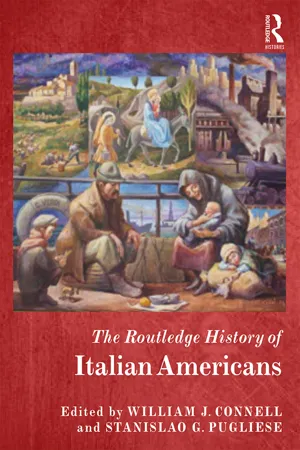
The Routledge History of Italian Americans weaves a narrative of the trials and triumphs of one of the nation's largest ethnic groups. This history, comprising original essays by leading scholars and critics, addresses themes that include the Columbian legacy, immigration, the labor movement, discrimination, anarchism, Fascism, World War II patriotism, assimilation, gender identity and popular culture. This landmark volume offers a clear and accessible overview of work in the growing academic field of Italian American Studies. Rich illustrations bring the story to life, drawing out the aspects of Italian American history and culture that make this ethnic group essential to the American experience.
eBook - ePub
The Routledge History of Italian Americans
- 660 pages
- English
- ePUB (mobile friendly)
- Available on iOS & Android
eBook - ePub
The Routledge History of Italian Americans
About this book
Information
Part I
Explorations and Foundations

Frontispiece I “The letter about the islands that the King of Spain has newly found.” An illustration depicting King Ferdinand the Catholic, Columbus with his three ships, two islands, and a group of islanders. Published in Florence, 26 October 1493, in the Italian verse translation by Giuliano Dati of Columbus’s first letter about his discovery. Photo: © The British Library Board.
1
Italians in the Early Atlantic World
Landfall
In the early hours of 12 October 1492 three Spanish ships, the Niña, the Pinta and the Santa Maria, anchored off the coast of an island in the Bahamas. It was probably the island now known as San Salvador. As morning broke the men on board saw pink beaches, trees, and streams with fresh water. Naked islanders appeared, gawking at the strange large ships that were unlike anything they had seen. Christopher Columbus, accompanied by two captains, a notary, and a representative of the Crown of Castile, went ashore. With royal banners flourishing he announced formally that “in the presence of all, he would take, as in fact he did take, possession of said island for his lords, the King and Queen.”1 Sailing further among the islands Columbus recounted in his diario or logbook how the inhabitants, who belonged to the Taíno people, swam out to the ships. They were “people of very beautiful appearance,” who painted their faces and even their whole bodies. They were “very gentle” and he thought they might easily become Christians. The natives “would be delivered and converted to our faith better by love than by force,” he wrote.2 Soon, however, he began to hear stories of another island people, the Caribs, who lived by raiding and who, he was told, consumed human flesh, a particular that Columbus initially doubted. (The word “cannibal” is derived from “Carib.”)
Simple exchanges between the Taínos and the Spaniards convinced Columbus that there were possibilities for commerce, but the islands he visited lacked the spices he had expected to find in the Far East. And since the first natives Columbus encountered possessed small quantities of gold, which they willingly exchanged for the tiny bells tied to hawks’ feet in falconry or for glass beads, this encouraged him to search for more.3 The quest for a larger gold source was grafted onto Columbus’s hopes of finding the large island of Japan, and the result was an exploration of the north coasts of Cuba and then of Hispaniola (called “Haiti” by the natives), which he reached on 5 December. Modern archeologists tell us that Taíno artifacts from Hispaniola show a sophistication superior to what Columbus must have encountered on the first islands he visited, and the political organization was more structured there. What mattered most to Columbus, however, was that Hispaniola was home to some modest deposits of gold. Cordial relations were established with a local chieftain, Guacanagarí, through whose good graces he received a number of gifts, including gold that he could present in Spain to his royal backers. After Columbus’s Santa Maria was driven aground and damaged irreparably, Columbus decided there was not enough space on the remaining two ships to make the return voyage with all of the men. With Guacanagarí’s permission, thirty-nine of the crew were left behind. They built a simple fortress, La Navidad, in which they were to await Columbus’s return. Columbus set sail for home on 4 January 1493. Sailing eastward along the coast of Hispaniola his men were for the first time violently attacked by a group of indigenous men armed with clubs and bows and arrows. They paddled canoes “almost as big as galleys,” and they spoke a different dialect. Columbus concluded these hostile folk were the Caribs.
After a stormy ocean crossing and a stop at the Azores, the poor condition of his ship forced Columbus to sail into Lisbon harbor on 4 March 1493. There he was taken into custody by the Portuguese, who were in competition in the Atlantic with the Spanish. Only after an interview with King João II was the explorer released and permitted to travel to Spain with his crew and with the seven Taíno Indians he had brought with him. In Europe the news of Columbus’s return and of his discovery of new lands across the western ocean was electrifying. A letter of Columbus’s that described his new findings was rushed to press and it circulated rapidly throughout Europe. (See, for instance, the Frontispiece to Part I). Dramatic, irreversible change ensued on both sides of the Atlantic.
Italians and the Atlantic
Italian American history began here. This is not simply because Columbus—like Amerigo Vespucci, John Cabot (Giovanni Caboto) and Giovanni da Verrazzano—were individuals who happened to be Italian. The memory of Columbus and the other Italian explorers has affected and continues to affect questions of American identity in ways that are fundamental to American and Italian American history. Equally important is the realization, thanks to recent research, that Europe’s push outward into the Atlantic was in many respects an “Italian” effort. Although these early explorers sailed under the flags of Atlantic monarchies, they were really the standard-bearers of a general movement of ideas and financial resources that stemmed from Italy. The Atlantic monarchies were in fact slow to move out into the Atlantic, and the Italian networks and financial backing that were crucial for these Italian navigators provided the additional element that made these first voyages possible.4
In these early expeditions the Italian sea captains and their investors cared about profits, not sovereignty, which was an approach the Genoese and Venetians had pioneered in the Mediterranean. The Atlantic monarchs on the other hand found it gratifying to extend their sovereignty, both for its own sake and because it would become the basis on which they shared in any profits. Of course the Italian investors did understand that the protections provided by states with sovereignty—in the form of monopolies, courts of recourse under civil and criminal law, and defense against the corsairs backed by rival European states—were advantageous in making these ventures successful. One way of looking at what happened in the years before and after 1492 is to see it as an attempted commercial conquest of the Atlantic by several groups of Italian venture capitalists. In the end the Atlantic World proved too large and risky and distant for the Italian commercial networks to be able to dominate it. In later years the monarchies that had established sovereignty came to develop their own methods of control. But there was an Italian character to much of the initial thrust into the Atlantic. Columbus and the other Italian navigators were the agents of Italian financiers even as they represented the royals under whose banners they sailed.
The first European attempt to reach Asia by way of the Atlantic occurred in 1291, when the Genoese brothers, Ugolino and Vadino Vivaldi, commanded two galleys that sailed past Cape Non in Morocco never to be heard from again. A few decades later, in his Divine Comedy (composed 1308–1320), the great Florentine poet Dante Alighieri imagined the Greek hero Ulysses sailing through the Strait of Gibraltar into the south Atlantic “in pursuit of virtue and knowledge” (Inferno XXVI.120) before his ship foundered in a tempest. Genoese captains played such an important role in the naval affairs of Europe’s western shores that in 1317 one of them, Emanuele Pessagno, was awarded the hereditary title of Admiral of the Crown of Portugal. In 1312 a Genoese, Lancelotto Malocello, landed on one of the Canary Islands, where he settled for two decades. When Malocello returned to Europe after a revolt in the 1330s by the island’s aboriginal inhabitants, known as “Guanches,” there followed a Portuguese mapmaking expedition commanded by captains from Florence and Genoa that was described in a popular treatise written by Giovanni Boccaccio.5 The Canaries would later be conquered by Spain in a long series of wars with the Guanches between 1402 and 1495.
The uninhabited islands of the Madeiras and the Azores were meanwhile settled by the Portuguese in the 1420 and 1430s. Among the first settlers of the Madeiras was Bartolomeo Perestrello, the son of an Italian nobleman from Piacenza who had moved to Portugal in 1385.6 Today Perestrello is most famous for releasing the pregnant rabbit whose feral offspring destroyed the island’s original vegetation.7 But the fact that he was awarded the island of Port Santo as a fief he could pass to his descendants created a precedent for Christopher Columbus (who would later marry this man’s daughter) in his negotiations with the Crown of Spain. The levitation in social rank involved in such a conferral would be satirized a century afterward in Don Quixote, where it is the promise of the future governorship of an “island” that induces Sancho Panza to join the knight from La Mancha in his adventures.8
Further Italian endeavors in the Atlantic included the discovery by a Venetian merchant, Alvise Cadamosto, of the uninhabited islands of Cape Verde in 1455–56, which he claimed for Portugal. In 1474, a mistaken calculation of the size of the earth led the Florentine mathematician and cosmographer Paolo Toscanelli to write a famous letter to the Portuguese court suggesting the possibility of reaching the Indies by sailing westward, and it was probably then, in Portugal, that Columbus obtained the copy that he would later use in pursuing support for his first voyage.9 Italians were active in Spanish service too. After the Portuguese established the first European trading post in sub-Saharan Africa at São Jorge da Mina (now St. George of the Mine, Ghana), the Spanish sent an armada in 1478 hoping to oust the Portuguese. The concession for the enormously profitable Guinea trade was promised to an Italian, Francesco Buonaguisi of Florence, although, unfortunately for him, the Spanish fleet was defeated by the Portuguese.10
With the creation of a reasonably well-connected area of thriving commerce in the eastern Atlantic, Italian merchant bankers, who were in some ways similar to today’s venture capitalists and always on the lookout for new sources of profit, began investing in the Atlantic trade. Genoese commercial interests in Portugal and Spain had been growing since the 1300s.11 The Bardi Bank of Florence is recorded as active in Portugal from 1338, and documents from the 1420s show the Bardi acting as correspondents for the Medici Bank in Seville, the city that would take the lead in Spain’s Atlantic trade.12 By the 1460s the Medici Bank was directly involved in the Spanish trade. Their agents in Spain included a number of Florentines from prominent families. One of them, Piero Capponi, had previously traveled all the way to Karachi.13 Especially important in encouraging Italian financial involvement was the extent to which these foreign bankers living in Spain enjoyed privileges that were denied native Spaniards. Jewish moneylenders traditionally financed man...
Table of contents
- Cover
- Half Title
- Series
- Title
- Copyright
- Dedication
- Contents
- List of Figures
- List of Color Plates
- List of Tables
- Academic Advisory Board
- Contributors
- Acknowledgments
- Abbreviations and a Note on Surnames
- Introduction: A New History for a New Millennium
- Part I Explorations and Foundations
- Part II The Great Migration and Creating Little Italies
- Part III Becoming American and Contesting America
- Part IV Postwar to Post-Ethnic?
- Glossary
- Index
Trusted by 375,005 students
Access to over 1.5 million titles for a fair monthly price.
Study more efficiently using our study tools.
Frequently asked questions
Yes, you can cancel anytime from the Subscription tab in your account settings on the Perlego website. Your subscription will stay active until the end of your current billing period. Learn how to cancel your subscription
No, books cannot be downloaded as external files, such as PDFs, for use outside of Perlego. However, you can download books within the Perlego app for offline reading on mobile or tablet. Learn how to download books offline
Perlego offers two plans: Essential and Complete
- Essential is ideal for learners and professionals who enjoy exploring a wide range of subjects. Access the Essential Library with 800,000+ trusted titles and best-sellers across business, personal growth, and the humanities. Includes unlimited reading time and Standard Read Aloud voice.
- Complete: Perfect for advanced learners and researchers needing full, unrestricted access. Unlock 1.5M+ books across hundreds of subjects, including academic and specialized titles. The Complete Plan also includes advanced features like Premium Read Aloud and Research Assistant.
We are an online textbook subscription service, where you can get access to an entire online library for less than the price of a single book per month. With over 1.5 million books across 990+ topics, we’ve got you covered! Learn about our mission
Look out for the read-aloud symbol on your next book to see if you can listen to it. The read-aloud tool reads text aloud for you, highlighting the text as it is being read. You can pause it, speed it up and slow it down. Learn more about Read Aloud
Yes! You can use the Perlego app on both iOS and Android devices to read anytime, anywhere — even offline. Perfect for commutes or when you’re on the go.
Please note we cannot support devices running on iOS 13 and Android 7 or earlier. Learn more about using the app
Please note we cannot support devices running on iOS 13 and Android 7 or earlier. Learn more about using the app
Yes, you can access The Routledge History of Italian Americans by William Connell, Stanislao Pugliese, William Connell,Stanislao Pugliese,William J. Connell,Stanislao G. Pugliese, William J. Connell, Stanislao G. Pugliese in PDF and/or ePUB format, as well as other popular books in Social Sciences & History of Art. We have over 1.5 million books available in our catalogue for you to explore.