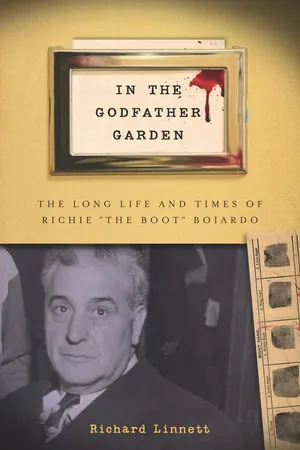
In the Godfather Garden is the true story of the life of Richie “the Boot” Boiardo, one of the most powerful and feared men in the New Jersey underworld. The Boot cut his teeth battling the Jewish gang lord Abner Longy Zwillman on the streets of Newark during Prohibition and endured to become one of the East Coast’s top mobsters, his reign lasting six decades. To the press and the police, this secretive Don insisted he was nothing more than a simple man who enjoyed puttering about in his beloved vegetable garden on his Livingston, New Jersey, estate. In reality, the Boot was a confidante and kingmaker of politicians, a friend of such celebrities as Joe DiMaggio and George Raft, an acquaintance of Joseph Valachi—who informed on the Boot in 1963—and a sworn enemy of J. Edgar Hoover. The Boot prospered for more than half a century, remaining an active boss until the day he died at the age of ninety-three. Although he operated in the shadow of bigger Mafia names across the Hudson River (think Charles "Lucky" Luciano and Louis “Lepke” Buchalter, a cofounder of the Mafia killer squad Murder Inc. with Jacob “Gurrah” Shapiro), the Boot was equally as brutal and efficient. In fact, there was a mysterious place in the gloomy woods behind his lovely garden—a furnace where many thought the Boot took certain people who were never seen again.Richard Linnett provides an intimate look inside the Boot’s once-powerful Mafia crew, based on the recollections of a grandson of the Boot himself and complemented by never-before-published family photos. Chronicled here are the Prohibition gang wars in New Jersey as well as the murder of Dutch Schultz, a Mafia conspiracy to assassinate Newark mayor Kenneth Gibson, and the mob connections to several prominent state politicians. Although the Boot never saw the 1972 release of The Godfather, he appreciated the similarities between the character of Vito Corleone and himself, so much so that he hung a sign in his beloved vegetable garden that read “The Godfather Garden.” There’s no doubt he would have relished David Chase’s admission that his muse in creating the HBO series The Sopranos was none other than “Newark’s erstwhile Boiardo crew.”
- 256 pages
- English
- ePUB (mobile friendly)
- Available on iOS & Android
eBook - ePub
In the Godfather Garden
About this book
Information
CHAPTER 1
Diamond Ritchie
None has composed a more adventurous
song of renown, one that delights!
I will sing of the new Ruggiero,
blessed with all virtues, who surpassed
all other men the world has known.
—Matteo Maria Boiardo, Orlando Innamorato, 247
Ruggiero Boiardo was born in 1890 in Naples, according to his birth certificate, and was raised in the town of Marigliano in the province of Naples. His recorded birthdate is December 8, which may not be accurate, as it is also the date of the Feast of Immaculate Conception. The Boot was placed in an orphanage as a child; Catholic orphanages often assigned the dates of important holy days to children whose actual birthdates were unknown. His biological parents also were unknown. The Boot later claimed that he was the illegitimate son of an Italian nobleman who was a descendant of the great Italian Renaissance poet Matteo Maria Boiardo, the author of Orlando Innamorato, an epic poem chronicling the heroic adventures and loves of the knight Orlando. Knighthood, horsemanship, heraldry, and chivalry became an obsession of the Boot, who considered himself, like Orlando, a warrior and “man of honor.” He kept a framed portrait of the poet prominently displayed in his home.1 A leading character in Boiardo’s epic is named Ruggiero, a valorous knight who also was orphaned at birth.
Maria Carmine Favarulo, a peasant, and her husband, Antonio Esposito, adopted young Ruggiero when he was six years old. He apparently kept his last name instead of taking the name of his new family. He emigrated with Maria Carmine from Italy to the United States when he was eleven. The transatlantic trip took nineteen days; they arrived in New York on December 18, 1901. His father had preceded them to the New World in May of the same year.
At the turn of the century there was a tremendous demand for immigrant labor in the United States, especially for workers in the railroad industries. Although contracted labor was outlawed in 1864, during the late nineteenth and early twentieth centuries, the camoristi, or Italian padrones, continued to arrange labor contracts with peasant immigrants, paying their passage and then, upon their arrival, exploiting their labor and living arrangements. Ruggiero and his parents were lured to the United States by work and the chance for a better life and were subject to the padrone system. They were sent to Chicago, where Ruggiero was put to work herding cattle on and off trains in the city stockyards.2 By age fourteen he was working with a railroad company that sent him out with construction gangs in the Dakotas, Montana, and the Northwest; he was sleeping in boxcars, “living the rough and ready life,” according to the Newark Evening News. “He was already an overgrown fellow and quite capable of taking care of himself with his fist or his tongue.”3 “I was not born with a silver spoon in my mouth,” the Boot often said later. “I was born with a wooden spoon, and I worked hard.”4
In 1906 the family broke apart, apparently over a disagreement about young Ruggerio’s upbringing. Maria Carmen took her son to Newark, where she had relatives in the First Ward. Italians were drawn to Newark at the turn of the century by railroad work; tracks connecting Newark to Jersey City were being laid across the marshes by the Pennsylvania Railroad.5 Padrones secured work gangs from the pool of newly arrived immigrants. They settled in the First Ward, opening bakeries and other businesses. By the time young Ruggiero arrived, the ward boasted the fifth highest concentration of Italians in the country and was teeming with Italian-owned macaroni factories, bakeries, shoe-repair shops, barbershops, and nearly one hundred saloons. Many of these saloons had large halls that were used for meetings and entertainment. Italian social clubs and fraternal and mutual-aid organizations were as plentiful as saloons. The mutual-aid societies were membership organizations that collected fees and provided health benefits as well as social events for members.
Factory workers and laborers made up the majority of the First Ward population; they had a ten-hour work day and earned about twelve to seventeen cents an hour. The average annual income of an Italian household was $600. Although the First Ward was part of a mid-size, industrial American city, the neighborhood was essentially provincial. Its tenements were crowded with large, extended families. Neighbors in the tenements had been neighbors in the same villages in Italy. It was an intimate world “where almost everyone was poor, where very few secrets were kept, and where every front stoop served as a village piazza.”
Ruggiero got work in a leather factory in Newark and later as a construction mason/plasterer. In 1912 he married a local girl, Giovannina Jennie Manfro, who gave birth to their first child, Agnes, a year later. Ruggiero Jr., who later would go by his middle name, Anthony, was born in 1914. That same year the Boot was convicted of marital domestic violence and sentenced to one-year probation.
In 1920, Boiardo had his next brush with the law. He was found guilty of operating a gambling house and was fined $52.05. Later that year, his wife gave birth to a daughter, Carmenella. She would die eleven months later from complications of bronchopneumonia. At the end of 1920, the Boot, at the age of twenty-nine, became an American citizen.
The Boot’s encounters with the law continued in 1921, when he was arrested for helping Tommy DiGiacomo, aka Tommy Jacobs, who owned a speakeasy, leave the scene of a crime. DiGiacomo had fought with his wife and pushed her out of the second-floor window of their apartment. The Boot spirited his friend away in a car.6 She survived, and the Boot was held as a material witness. Also that year, while driving in his car, the Boot struck Antonio Romeo, an eight-year-old boy, breaking his left leg and crushing his skull. The boy died, and Boiardo was arrested. He claimed the boy ran from the curb directly in front of his car. Several witnesses stated that “with a little more care in driving, [the Boot] might have avoided the accident.”7 The Boot was charged with manslaughter; he was convicted on January 12, 1922, and served twelve months in the Essex County Penitentiary in Caldwell. While he was in prison, Jennie gave birth to another daughter, Rosina.
Richie Boiardo’s fortunes were about to change, dramatically. The Volstead Act, the law banning the sale of alcohol, was enacted in 1919, but New Jersey remained a wet state one year after Prohibition legislation swept the country. The state’s large urban immigrant population, including a mix of European Catholics and Jews who were more liberal about alcohol use than the rural Protestants who spearheaded Prohibition, refused to accept the new dry rules, and influential German American beer barons who owned major breweries in Newark put pressure on politicians to oppose the amendment. Jersey finally ratified in 1920, saloons were shut down, and yet the state stayed wet, illegally.
Speakeasies began popping up in many American cities, especially in port cities like New York and Newark, where boats carrying contraband alcohol from Canada and Europe could dock and offload, often under cover of darkness. The 130-mile-long coast of New Jersey, with its hidden landing havens, was ideal for bootlegger speed boats running in their goods from schooners and steamers. From these hidden ports, trucks dispensed their goods to Manhattan, Chicago, Newark, Jersey City, Philadelphia, Baltimore, and Washington.
Only the most affluent speakeasies sold imported liquor, and at high prices, while most illegal saloons in poor immigrant neighborhoods sold homemade wine and beer and also moonshine (produced in pot stills, or alky-cookers) and hootch, which was prepared from nonbeverage alcohol. Immigrant families set up home breweries in basements, backyards, and garages. Some of these mom-and-pop operators graduated to the big time and began making liquor for a living. During Prohibition, the federal Prohibition administrator for New Jersey, Colonel Ira L. Reeves, declared that “Newark, New Jersey, was a manufacturing center for the booze trade.”8
Not simply an effort to stop the consumption of alcohol, Prohibition was a government attempt to legislate morality, a social program designed to curb immoral behavior and the alien customs of immigrants who were flooding into the United States. Ironically, Prohibition achieved the opposite result; it spawned a homegrown outlaw subculture of flappers, jazz speakeasies, and gangsters.
And, later, as the Great Depression kicked in midway through the so-called noble experiment, a significant number of men and women who could not find employment pursued lives outside the law in order to survive and prosper. As banks failed, unemployment rose, the stock market crashed, and a majority of Americans were living below the “minimum sustenance level.” The richest 1 percent owned 40 percent of the nation’s wealth, and the middle class consisted of 15 to 20 percent of all U.S. citizens.9 The First Ward was hit hard by the Depression, but bootlegging cash flowed heavily, and many young men took to the streets to earn a living.
In New Jersey and the greater metropolitan area, Prohibition laws and federal agents were viewed as merely a nuisance, while local and state law enforcement for the most part either looked the other way or helped facilitate the illicit liquor business. Protection money was paid out to local politicians and law enforcement. In some instances, police cars escorted bootleg deliveries. Jersey stills were reported to be generating huge amounts of alcohol “from Ocean and Monmouth counties for metropolitan consumption.”10 Gang hijackings and turf wars along with beatings and shootings for protection tributes were widespread.
Bootlegging, like any business culture, had its organizational structure, its executives, and its rules of conduct. Prior to the establishment of organized crime, which began around 1929, the bootlegging subculture operated in an ad hoc, true laissez-faire fashion, yet it still followed a basic code. The key difference between the code of conduct in legitimate business and in bootlegging was this: disagreements between competitors that could not be settled through mutual agreement were ultimately settled not in a court of law but through intimidation, violence, and bloodshed.
Boiardo began his involvement in bootlegging in the early 1920s. At the time he was working as a milk delivery man with the Alderney Dairy Company. While making milk deliveries to speakeasies in the First Ward, Boiardo learned that many of them served “hair-tonic booze,” or drinks whose ingredients included alcohol used in hair dressing and cologne cut with prune juice and caramel to mimic the color and taste of whiskey and rye. Manufactured under the wartime food-control law, nonbeverage alcohol cost $240 a barrel. Saloon keepers diluted the barrels with water and sold small glasses for thirty or forty cents, making significant profits.11
Boiardo arranged to purchase hair-tonic alcohol from John Serpico, a barber who in August 1901 had also emigrated from Marigliano. Boiardo then resold the nonbeverage alcohol to speakeasies throughout the First Ward. He soon quit his milk route and set himself up as a distributor.
By 1925 Boiardo had aligned himself with the First Ward bootlegging ring headed by Frank “Chichi” Mazzocchi, who took to calling himself the Rum King of Newark. Mazzocchi and his brothers Domenic and John owned a speakeasy in the ward called the Victory Café—which housed a boxing gym, a bowling alley, and a political association—and operated alky-cookers in rural areas throughout northern New Jersey. They hired the Boot to manage them. The Mazzocchi gang also engaged in stickups and heists. The Boot, Mazzocchi, and another gang member, Sam Angelo, were arrested late one night in 1925 outside Hausman & Sons, a shoe store on Springfield Avenue. The men were armed and allegedly preparing to rob the shop.12 They were convicted of carrying concealed weapons and served six months in the Essex County Penitentiary. While the Boot was serving his sentence, Jennie gave birth to their youngest child, Phyllis.
After getting out of the pen, the Boot, who was thirty-six years old, focused on running alky-cookers for the Mazzocchi mob in rural New Jersey while setting up his own operations by purchasing or leasing cheap farmland that was being foreclosed as the economy began to collapse, leading to the Depression. The isolation of these properties, many of them in the Mendham area and East Brunswick, helped to conceal the activity, and it was easy for the mob to keep one step ahead of the law by hopscotching from one abandoned farm to another.13
The mob also ran alky-cookers in the city. One of the most profitable, said to be owned by the Boot, was located in a garage in the back of a tenement house on Wood Street in the First Ward; it employed people from the neighborhood. At the time it was rumored to be the largest in Newark, a half-dozen gleaming 100-gallon pots that produced 100 five-gallon cans of pure alcohol per hour.14 The pot still was basically a stainless steel container in which the brew was heated while a coil of copper tubing called a condenser converted the vapor coming from the pot into a liquid. Vapors escaping from the still were highly flammable. The Boot, like many bootleggers, did not use an electric heating coil to heat his pots; he used an open flame. Often when it got cold outside workers closed the windows and shut the doors, killing ventilation and trapping the odorless and highly flammable alcohol fumes inside.
On October 25, 1927, fumes ignited and 100 five-gallon cans of alcohol exploded, blowing the roof off the garage and shaking tenement houses within a three-mile radius. Thirty-seven-year-old Sam Angelo, who had been arrested with the Boot and Frank Mazzocchi for casing the shoe store, and twenty-one-year-old Carmine DePalma staggered from the building, their clothes in flames.15 Firemen struggled to keep the inferno from spreading to tenements on the block. Angelo and DePalma died, and the Boot, not normally sentimental about people dying, was deeply saddened, according to his daughter Rosina.16
Two years later, the Boot suffered another disaster in his own alky-cooker, located in the garage next door to his house on Newark Street. The place had been raided by police and was being dismantled by Prohibition department laborers—described as “coloreds”—who created a spark with either a crowbar or a tossed cigarette, causing the explosion of a pair of 100-gallon stills, 75 five-gallon cans of alcohol, and 5 fifty-gallon drums. A flaming river of alcohol rolled out to the street scorching parked cars, and the blast hurled three “dry-force” workers, employed by the Federal Prohibition Bureau, twenty feet in the air. One was killed, and the others were critically injured. The Boot was arrested and charged with receiving stolen property. Authorities alleged that 1,250 gallons of the alcohol in the garage had been stolen in a holdup of the offices of the Frelinghuysen Avenue National Oil and Supply Company.17
Following his arrest and conviction for gun possession in 1925, the Boot began distancing himself from the Mazzocchi mob. Around 1928, he finally broke with them and formed his own gang, taking a handful of Mazzocchi hoodlums with him. The Boot built on relationships he had made while running with the Mazzocchi mob and established a firm foothold of his own in the First Ward both in the rackets and as a political power broker. He opened prosperous speakeasies in the backrooms of social clubs with names like the Ritchie Association and the Modern Political Club. He used these as a base of operations to expand into other vices like gambling and running an Italian lottery, a numbers betting game that was a favorite of Italian immigrants and laborers who could bet as little as a penny on ...
Table of contents
- Title Page
- Copyright Page
- Dedication
- Contents
- The Garden
- Acknowledgments
- Prologue: They Got Me, Joe
- 1: Diamond Ritchie
- 2: The Longy War
- 3: I’m No Crybaby
- 4: Fortunate Son
- 5: Jerry
- 6: The Club Fremont Incident
- 7: Castle Cruel
- Figures Insert
- 8: Loose Lips
- 9: That Old Gang of Mine
- 10: Cause for Indictment
- 11: The Italian Way
- 12: On the Jolly Trolley
- 13: The Mafia Exists!
- 14: This Thing of Theirs
- Epilogue: The Curse
- Timeline
- Cast of Characters
- Notes
- Selected Bibliography
- About the Author
Trusted by 375,005 students
Access to over 1.5 million titles for a fair monthly price.
Study more efficiently using our study tools.
Frequently asked questions
Yes, you can cancel anytime from the Subscription tab in your account settings on the Perlego website. Your subscription will stay active until the end of your current billing period. Learn how to cancel your subscription
No, books cannot be downloaded as external files, such as PDFs, for use outside of Perlego. However, you can download books within the Perlego app for offline reading on mobile or tablet. Learn how to download books offline
Perlego offers two plans: Essential and Complete
- Essential is ideal for learners and professionals who enjoy exploring a wide range of subjects. Access the Essential Library with 800,000+ trusted titles and best-sellers across business, personal growth, and the humanities. Includes unlimited reading time and Standard Read Aloud voice.
- Complete: Perfect for advanced learners and researchers needing full, unrestricted access. Unlock 1.5M+ books across hundreds of subjects, including academic and specialized titles. The Complete Plan also includes advanced features like Premium Read Aloud and Research Assistant.
We are an online textbook subscription service, where you can get access to an entire online library for less than the price of a single book per month. With over 1.5 million books across 990+ topics, we’ve got you covered! Learn about our mission
Look out for the read-aloud symbol on your next book to see if you can listen to it. The read-aloud tool reads text aloud for you, highlighting the text as it is being read. You can pause it, speed it up and slow it down. Learn more about Read Aloud
Yes! You can use the Perlego app on both iOS and Android devices to read anytime, anywhere — even offline. Perfect for commutes or when you’re on the go.
Please note we cannot support devices running on iOS 13 and Android 7 or earlier. Learn more about using the app
Please note we cannot support devices running on iOS 13 and Android 7 or earlier. Learn more about using the app
Yes, you can access In the Godfather Garden by Richard Linnett in PDF and/or ePUB format, as well as other popular books in Social Sciences & Social Science Biographies. We have over 1.5 million books available in our catalogue for you to explore.