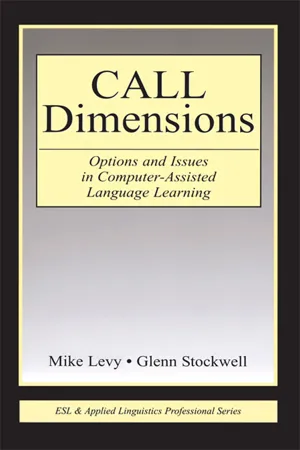
This volume gives language teachers, software designers, and researchers who wish to use technology in second or foreign language education the information they need to absorb what has been achieved so far and to make sense of it. It is designed to enable the kind of critical reading of a substantial literature that leads to a balanced and detailed knowledge of the field.Chapter by chapter, the book builds, through description, analysis, examples, and discussion, a detailed picture of modern CALL.
In this book, the label "CALL" is interpreted broadly to include technology-enhanced language learning, Web-enhanced language learning, and information and communication technologies for language learning. The work is distinguished by its attention to a range of languages rather than just English.
The authors first set the scene and introduce major areas of interest and growth in CALL, and then look in depth at seven important dimensions: design, evaluation, computer-mediated communication, theory, research, practice, and technology. Chapters on each of these topics include a description that reviews the recent literature, identifies themes, and presents representative projects that illustrate the dimension, followed by a discussion that provides in-depth analysis, and a conclusion offering suggestions for further work. Detailed references and links connect the description and discussion with original works and primary sources so the reader can follow up easily on areas of personal interest. Two concluding chapters discuss how the various dimensions might be brought together, the first from a practical point of view, the second with a view to the development of CALL as a whole.
eBook - ePub
CALL Dimensions
Options and Issues in Computer-Assisted Language Learning
- 328 pages
- English
- ePUB (mobile friendly)
- Available on iOS & Android
eBook - ePub
About this book
Information
Chapter 1
Introduction
During the last 3 decades, computer-assisted language learning (CALL) has progressed and evolved at a remarkable rate.1 Books are regularly published on the subject and at least four international journals are now dedicated to the topic. There are annual conferences devoted to it in many parts of the world, and highly active online discussion lists. This activity amply demonstrates a strong interest and commitment to the field and the range of work being undertaken. A closer examination reveals a steadily increasing level of specialization, especially in efforts to refine the underlying philosophy and principles that support CALL design, evaluation, research, and practice. CALL has grown along both the horizontal and vertical axes: It has become a rich and diverse area of work with considerable depth.
The richness and diversity of contemporary CALL, when viewed in its entirety, is a result of many factors. These include the number and range of technological tools available with the potential for use in CALL applications; an increasingly sophisticated understanding of how languages are learned (although lacking a single, overarching theory to rely on as a guide); environmental factors that lead to a variety of priorities, resources, and objectives for different learners in different settings; and particular challenges that arise as a result of the attributes or qualities of the target language. There are other factors as well, but by way of introduction it is worth discussing these four areas first of all.
In the developed world, the array of communication technologies now in use provides a good example of how technology has diversified and evolved in recent years.2 Aside from face-to-face communication, we might choose to communicate with our family, friends, or colleagues via phone (mobile or landline; voice, text, or images), or via e-mail or chat, either one to one or as part of a group (such as a tele-or videoconference). These developments in the wider world are reflected in our educational institutions, albeit with some delay. Clearly, language teachers and learners have an increasing number of possible options, whereas the use of any particular tool for teaching or learning requires a clear sense of its strengths and limitations, and an understanding of how to match the qualities of the tool with suitable language-learning tasks.
Historically, the invention of new technologies has been largely motivated by a desire to extend or to overcome our innate limitations as human beings, especially those set by our physical or mental capabilities. Thus, new technologies such as the pen and paper for writing aid our memory, the telescope or microscope enhance our vision, the telephone extends our ability to communicate at a distance, the hammer amplifies our strength, and the car or airplane extend our range. Interestingly, many of the most penetrating technologies introduced in the last 30 years have extended our ability to communicate with people at a distance, or at times when they are not immediately available. Language is intrinsically a part of these developments, because the attributes (or affordances) of each technology help shape how interactions take place and how language is used in each setting. This is just as true for nonnative speakers of a language as it is for native speakers.
The technologies used in CALL extend well beyond communication tools, however. They also include generic tools and devices such as the word processor for writing, online dictionaries for vocabulary work, or MP3 players for intensive listening practice. Typically, when compared to the more conventional alternatives, these tools are useful in providing a means for manipulating language more effectively (e.g., the word processor), supplying context-sensitive help or information more promptly (e.g., pop-up word definitions or examples), or otherwise supporting the processes required for language learning, frequently by offering greater flexibility (e.g., language practice at a time and place that suits the learner). In each case, the technological tool should be considered in relation to the task for which it is intended. Ideally, a suitable pedagogy is devised to ensure that the CALL materials are used in an appropriate, principled, and effective way.
The application of these technologies is often direct, but that is not always the case. Technological tools are also used indirectly, as a means to an end; for example, in the construction and testing of new CALL materials. This activity is one of the unique, defining features of the field. In this book, the term CALL materials is used to include the wide range of CALL artifacts or products that language teachers and designers create using technological resources (see Levy, 1997). The term CALL materials is used to encompass tasks, software, courseware, Web sites, online courses, programs, packages, and learning environments. This label is used to emphasize the connection between CALL and language-learning materials development in general—where the term materials is the accepted term (see Tomlinson, 1998). A sense of continuity between CALL and language teaching more generally is advantageous, especially in relation to language-learning materials design and development. Although in some instances materials and learning environments are distinguished and treated separately, learning environments on the computer are generally included under the materials umbrella too.3
From its earliest days, those in the field have been writing CALL materials for themselves, or working closely with others. CALL is about design, development, and evaluation, as well as research and practice conceived around a ready-made product or generic application, such as an e-mail or word processing program. In designing and developing new materials, the teacher or designer has alternatives. Prospective authors may turn to the use of a general-purpose Web editor (e.g., FrontPage), or a mainstream multimedia application like a word processor or a presentation tool (e.g., Word, PowerPoint) for development work. Alternatively, they may choose to work with a learning management system (LMS), which, in essence, is a Web-based software application that provides the teacher with an integrated system for distributing course materials, communicating with students, instigating student–student discussions, presenting quizzes, and managing a range of administrative tasks. Good examples of an LMS are BlackBoard and WebCT. Such systems are becoming increasingly common development tools at universities around the world. Another option is to use an authoring tool, such as Hot Potatoes, which provides easy-to-use templates for developing different kinds of CALL activities. Those who are especially dedicated and with the requisite expertise may turn to a markup language, which contains a wide variety of codes that can be attached to a text to indicate layout, styling, and interpretation when the document is viewed by a special application. Whichever path is chosen, the options are many, and the author’s or designer’s choice of an authoring tool needs to be suitably informed and guided.
Often, the result of such efforts is a language-learning Web site. Web sites may aim to serve a wide audience (e.g., all skills from beginner to advanced), or a more narrowly defined one (e.g., listening practice for beginners). CALL sites can differ greatly in scale and focus. They can be straightforward and simple in their aims, or multifaceted and surprisingly diverse in their range and functionality, sometimes including a large number of activities and functions supported by a range of technologies. An exceptional example of what can be achieved is the Learn Welsh Web site (BBC: Learn Welsh, http://www.bbc.co.uk/wales/learnwelsh/). The site is multidimensional and includes informal and more formal opportunities for learning language at levels from entry to advanced. It incorporates the social and cultural dimension of language learning with many examples, and includes links to many other Web sites focusing on the Welsh language or culture. It includes activities and resources ranging from the quick and simple, such as the catchphrase of the day, to the more sophisticated. For example, in the 3-D virtual town, the user can interact in language or video scenarios aimed at Welsh in the workplace and undertake accompanying exercises. Online dictionaries, spell checkers, and grammar exercises are also provided. The site makes full use of new technologies, including computer-mediated communication (CMC), such as the message board, and the text club that sends themed phases three times a week directly to the user’s mobile phone. This site illustrates what can be accomplished with imagination, a high level of resourcing, and the political will to maintain and support a minority language.
Alongside these technological developments, there have been increases in our understanding of language and how it is learned. We now have a much expanded and refined body of research to support our work. However, although we now know more about language acquisition, this new knowledge has not led to a single unified theory of language learning, but instead to a number of more narrowly defined theories that focus on specific questions and aspects of language and language learning (Jordan, 2004; Mitchell & Myles, 2004). Theoretical perspectives have also increasingly become more attuned to individual and social factors that govern the successful acquisition of a foreign or second language. For the CALL practitioner—who might be considered a consumer looking toward theory for guidance—the circumstances are not as straightforward as they once were. There are a number of compelling theories to choose from, drawn from second language acquisition research, education, psychology, and human–computer interface design. The theories have grown not only in number, but also in sophistication and complexity. Some, such as sociocultural theory, involve a considerable number of specialized concepts and levels of analysis. Thus, although using theory as a point of departure is generally to be recommended, there is no doubt that in opting to proceed in this way—in a principled fashion led by theoretical insights—the scale and complexity of the challenge has been increased. What is now needed is not so much a single solution to guide CALL, but rather a careful weighing of the options so that strengths and limitations become evident. This viewpoint grows from a belief that postgraduates, researchers, and teachers increasingly have to relate to a number of parallel perspectives in their work. This requires an appreciation and understanding not of one single viewpoint alone, but instead of a number of different perspectives concerning the nature of language and language learning.
In practical terms, our developing understanding of language teaching and learning is well represented in evolving conceptions of the language-learning task (Long & Crookes, 1991; Nunan, 2004; Skehan, 1998; Willis, 1996). Definitions of tasks have changed significantly over the last 20 years (e.g., Candlin & Murphy, 1986; Johnson, 2003; Ribé & Vidal, 1993). According to Ribé and Vidal (1993), task goals have developed from the narrower objective of activating communication and cognitive strategies to a much broader view of enriching the students’ whole experience of language and language learning. Thus, tasks may now seek to develop the learners’ motivation, their creativity, or their awareness of the many aspects that make up a language, such as the cultural or pragmatic dimensions. We might also add to this list the goals of developing learning strategies and learner autonomy. Clearly, language-learning tasks are not what they were. These new conceptions of language-learning tasks lead language teachers and designers to be responsive to a number of objectives in task design. Pedagogical goals may be partially achieved through a single task but, more likely, this combination of goals and objectives will lead to the design of a sequence, or a cycle of tasks that aims to address different goals at different times (see Levy & Kennedy, 2004; Willis, 1996). As a result, greater pedagogical expertise is now required in structuring the language-learning experience for students and in designing tasks that are appropriate in meeting learner needs and aspirations. The work is challenging for face-to-face teaching in the language classroom. It is even more so in CALL environments, where a larger number of factors are involved because of the range of technological options available and the need to effectively manage and integrate CALL work with non-CALL work.
The choice and use of technological tool/s and our understanding of how a language is learned play a large part in governing any conceptualization of CALL. Further critical factors derive from the nature of the learner and the learning context. These factors include consideration of specific learner characteristics (background, needs, goals), features of the setting (classroom, lab, home), and factors concerning the learning environment (technological, societal, cultural, institutional). The target language, the curriculum, and the teacher(s) have to be taken into account as well. These various context-specific factors help shape and determine any interpretation of CALL, and they need to be understood (see Levy, 1997). As before, we see a complex mix of variables that need to be negotiated in order to arrive at an effective CALL implementation.
To give just one example, consider for a moment a young native speaker of Japanese learning English in the latter years of high school in Japan. If we were to contemplate how CALL might be implemented in this situation, we would need to consider, at the very least, the following:
• Japan’s physical distance from English-speaking countries.
• The traditional approach to education and learning in Japan.
• Cultural goals and expectations.
• Large, homogeneous classes.
• The critical importance of success in English, especially for high school students in relation to the university entrance examinations.
• The role that university examinations play (they largely govern high school curricula, especially in later years).
• A generally sophisticated and robust technological infrastructure.
• The ubiquity of mobile technologies, especially mobile phones.
The specific factors and constraints in this profile would contribute to a particular interpretation of CALL in this setting. The point to be made here is that there are many variables to take into account in any given setting, and the decision-making process is multifaceted.
Finally, the nature of the target language itself should not be overlooked. It is surprising how often the language in question is assumed to be English. Many papers and books on CALL, knowingly or unknowingly, restrict themselves to this particular language perspective. Of course, the learning of English as a second, third, or foreign language is very important because of the significance of English as a world language. For many language learners around the world, English is the target. Also, there are many native or near-native speakers of English. This means that there are often native speakers available for collaborative projects such as those undertaken in the various kinds of CMC-based CALL. In practice, however, CALL spans many more languages than English. Often, technologies are harnessed in rather different ways, depending on the qualities and characteristics of the target language and the background and goals of the students who wish to learn them. Good examples are the scripted languages such as Japanese and the tonal languages such as Mandarin Chinese, which have specific technological requirements such as two-bit character fonts and tonal diacritics. This book is not restricted to the learning of English alone.4 We look at CALL applications and include examples in the learning of many different languages as well as English (although English still remains a very important focus).
It is clear from this short, introductory discussion that CALL consists of a rather large body of work with a sizable amount of information to absorb, and pedagogical alternatives that require matching the tool to the task and choosing from a wide range of options in relation to design, theory, and practice. The range of technological tools, and the many ways they may be applied in language learning plus the challenge of designing appropriate CALL tasks to meet the needs of learners in different settings, combine to create a considerable degree of complexity because decisions are required across a number of areas and levels.
APPROACH AND RATIONALE
This book has been designed to address the diversity and complexity of modern CALL. It seeks to describe the major topics and developments in CALL, with examples to illustrate key ideas, themes, and directions. Importantly, it seeks to embrace a degree of complexity and alternative viewpoints, rather than avoiding differences of opinion and attempting to recommend, force, or imagine a single perspective for the work of the field. We do not feel that there are grounds to support a single perspective for CALL, as we try and illustrate through the wide variety of projects described. In order to understand CALL and develop new CALL materials, we believe the best way to proceed is to consider a sample of well-conceived projects with the practical and theoretical arguments that motivate and justify them. This approach takes into account the complexities of language learning, the absence of a grand theory, and the modular approach generally taken toward theory construction and research in second language acquisition (Mitchell & Myles, 2004).5 The approach is also very relevant for CALL because it takes into account the wide variety of technological tools available, each with their strengths and limitations, and the many goals and priorities held by language teachers and learners today. Overall, we believe that dealing wit...
Table of contents
- Cover
- Halftitle
- Title
- Copyright
- Contents
- Preface
- Acknowledgments
- 1 Introduction
- 2 Design
- 3 Evaluation
- 4 Computer-Mediated Communication
- 5 Theory
- 6 Research
- 7 Practice
- 8 Technology
- 9 Integration
- 10 Emergent and Established CALL
- Appendix A: Origins of This Book
- Appendix B: Features Matrix for the Main Studies Described in Chapter 6
- References
- Author Index
- Subject Index
Trusted by 375,005 students
Access to over 1.5 million titles for a fair monthly price.
Study more efficiently using our study tools.
Frequently asked questions
Yes, you can cancel anytime from the Subscription tab in your account settings on the Perlego website. Your subscription will stay active until the end of your current billing period. Learn how to cancel your subscription
No, books cannot be downloaded as external files, such as PDFs, for use outside of Perlego. However, you can download books within the Perlego app for offline reading on mobile or tablet. Learn how to download books offline
Perlego offers two plans: Essential and Complete
- Essential is ideal for learners and professionals who enjoy exploring a wide range of subjects. Access the Essential Library with 800,000+ trusted titles and best-sellers across business, personal growth, and the humanities. Includes unlimited reading time and Standard Read Aloud voice.
- Complete: Perfect for advanced learners and researchers needing full, unrestricted access. Unlock 1.5M+ books across hundreds of subjects, including academic and specialized titles. The Complete Plan also includes advanced features like Premium Read Aloud and Research Assistant.
We are an online textbook subscription service, where you can get access to an entire online library for less than the price of a single book per month. With over 1.5 million books across 990+ topics, we’ve got you covered! Learn about our mission
Look out for the read-aloud symbol on your next book to see if you can listen to it. The read-aloud tool reads text aloud for you, highlighting the text as it is being read. You can pause it, speed it up and slow it down. Learn more about Read Aloud
Yes! You can use the Perlego app on both iOS and Android devices to read anytime, anywhere — even offline. Perfect for commutes or when you’re on the go.
Please note we cannot support devices running on iOS 13 and Android 7 or earlier. Learn more about using the app
Please note we cannot support devices running on iOS 13 and Android 7 or earlier. Learn more about using the app
Yes, you can access CALL Dimensions by Mike Levy,Glenn Stockwell in PDF and/or ePUB format, as well as other popular books in Education & Education General. We have over 1.5 million books available in our catalogue for you to explore.