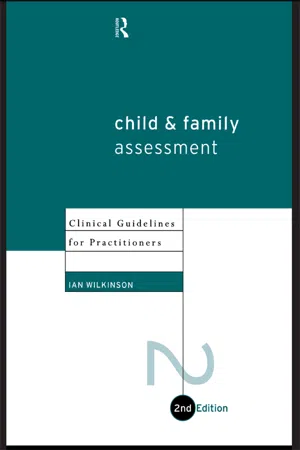
Child and Family Assessment is based on Ian Wilkinson's extensive experience of working with troubled children and families over the last twenty years. This completely revised and updated edition of Family Assessment (Gardner Press, 1993) combines a clear summary of current knowledge with practical, detailed and adaptable procedures for practitioner use.
Part one reviews the literature on child and family assessment; part two discusses the practical issues involved and provides detailed guidelines for practitioners; a final part examines the relationship between clinical practice, assessment and science with respect to children and families.
Written from an eclectic point of view in a clear and precise style, using common sense terms, this book will be an essential guide for all those in the helping professions, including therapists, psychologists, doctors, nurses, social workers and lawyers.
- 280 pages
- English
- ePUB (mobile friendly)
- Available on iOS & Android
eBook - ePub
About this book
Information
1
INTRODUCTION AND OVERVIEW
Fools rush in where angels fear to tread
Alexander Pope, An Essay on Criticism (1711)
This book stems from twenty years’ experience as an applied psychologist fulfilling a variety of roles. Mostly this has been in clinical practice, but it has also included experience of teaching and training with my own and other professions, supervision, consultation, professional representation and developing teamwork in multi-disciplinary teams. Looking back, my initial reaction to child work in the British National Health Service was one of abject dismay, if not horror, at the general disorganization and chaos—the lack of attempts to develop a systematic understanding of problems, and practices which seemed to be more defined by personal preferences of the therapist than patient need. This book is the result of what I have learned in my struggle to find a different path.
I clearly remember the anxiety when I first started working with families together, and how confused I felt; the confusion of trying to listen to five people at once and then the confusion of trying to work out who everyone was in a large case conference. After a while I began to have a sneaky feeling I was not alone in my confusion.
My initial efforts to remedy this were somewhat naïve, in that I assumed that the solutions lay in methods and the practical application of good psychometric principles. But I began by observing the practice of others and trying to define what seemed good practice, and studying what others had written. It soon seemed clear to me that there was something ethically odd about intervening in families without assessment—rather like a tradesman who is asked for an estimate and instantly starts to knock holes out of the wall. Many parents insisted: ‘We really just want to know what the problem is’. I began to be interested in process, negotiation, the patient’s view, contract, and empowerment by giving the assessment back to the patient and family in a careful and respectful manner. Only fools rush in where angels fear to tread. On the other hand, I can appreciate that to some it may seem equally foolish to try to assess something as complex as a person and their family context, so perhaps I have been the one who rushed in…
The experience during this work has taught me a lot. My views about the general disorganization of children’s services have not changed, but this is partly due to the relative infancy (in historical terms) of children’s services: plus the inherent complexity and lack of coordination of the multiplicity of agencies and professions involved in child work. They have grown haphazardly, owing to limited funding and lack of planning. This has strengthened my belief in a need for rigorous and systematic approaches to the work, and for more developmental content in training for all professions. My views of what constitutes ‘science’ have also changed considerably. A useful scientific approach must be a pluralistic scientific analysis (one that uses a variety of theoretical perspectives) and must be explicitly taught as such. The explicit use of several perspectives helps to give trainees a way of thinking about the complexity of development and family life, and helps them understand links between different problems on different levels in terms of either linear or circular causality. Multiple perspectives also help to understand individual differences and different needs. Their use also encourages a flexible approach to therapy, treatment, or problem-solving, tending to generate choices rather than single answers. Families should have choices and this is a key issue for public services.
Gale (1985) discussed the characteristics of applied research in terms of a process which is best understood using the metaphor of a journey. As you travel, the question changes and so does the destination. The literature and the process of self-evaluation force researchers to revise their views. Thus my question changed from ‘Can we develop a scientific measuring instrument?’ to ‘Is it possible to develop a system for assessment which is simple enough to use for training beginners, but which adequately reflects the complexity of psychological work with children and their families?’ In more recent times I have also used the questions ‘Do we know what we are doing? Can we find out?’ Perhaps they are the simplest but most eloquent way of describing the aims of this book.
Summary of the contents of this book
This book is intended to provide a practical but systematic guide to the assessment of the family which will be useful for trainees and practitioners of all disciplines in the helping professions, i.e. doctors, nurses, social workers, psychologists, counsellors and psychotherapists. Although much has been written about family therapy in the last couple of decades, the topic of assessment has been sadly neglected. This book will attempt to cover the topic in common-sense, non-jargon terms. It will also integrate views of the individual and the family, and aim to give practical advice to the mainstream practitioner.
This introductory chapter summarizes the contents and briefly describes important social trends and developments which underpin this work; it also relates these developments to other general trends in science, society and health care.
The rest of the book is written in three parts. Part I (Chapters 2 to 4) traces the development of important theoretical ideas which are relevant to assessment with children and families. The family structure in relation to patterns of attachment, the nature of the power hierarchy, and communication processes (particularly emotional communication) are important. The cultural context, life stages, transitions and events also need to be considered. Finally, the perceptions and beliefs of the family members must also be considered carefully, since family members construct (multiple) views of reality. In relation to therapeutic methods available for working with both individuals and families, each method makes certain assumptions about the precise nature of the problems and what the role of the therapist should be in solving them. Certain key concepts and skills can be identified, but there is no cure-all; in addition certain methods will suit certain people and not others. Users have a right to be involved in the choice about the range of options available; since family situations also present difficult ethical dilemmas for therapists in relation to confidentiality and privacy, this makes work with children and families very complex. Child and family assessment is a relatively recent activity handicapped by gaps in the knowledge base and splits among and between the various groups concerned, but principles for good practice can be identified, and Chapter 4 traces their origin and development in the literature.
Part II of the book shows what results when these principles are applied in practice. In order to present assessment as a set of practical and adaptable procedures, each chapter in this section concentrates upon a different aspect of the assessment process. The presentation is intended to emphasize practical explanation and discussion whilst also highlighting the principles which have guided the development of the approach.
Chapter 5 outlines the framework of ideas used to conceptualize family problems. The framework uses four perspectives upon the family, with a set of problem dimensions for each perspective. This helps to develop links between problems so that causal effects between individual and relationship difficulties can be perceived more easily. The developmental perspective is used to gain an overview which gives an understanding of the history and origin of problems as well as the type of broad pattern.
Chapter 6 examines the topic of preparation for family assessment. This is complex because family members often have different views, and the first part of the chapter examines ways to understand and work with patient views and motivations. Ethical dilemmas include dealing with privacy boundaries and conflicts of interest, welfare versus confidentiality, and dealing with unrealistic expectations. The wider system also has to be considered, and principles for convening family members are summarized. It is argued that an initial interview understanding patient and family views which prepares for a contractual assessment (utilizing formal assessment methods as the practitioner thinks appropriate) has a number of practical and ethical advantages. Effectively, this preliminary client-centred interview can be used to select more specific assessments if required. Finally, practical policies and procedures for preparation of families are specified.
Chapter 7 discusses the application of a family interview schedule and an accompanying rating scale which can be used to obtain a broader, comprehensive view of the child and family. This broader view is important because the level of public awareness about children’s health problems (particularly mental health) is low, leading to a high rate of unrecognized problems. The interview has three key principles: the use of normalizing statements, which facilitate disclosure, prior to the probe questions; an emphasis on seeking permission to make enquiries; and a sequential progression into more sensitive areas.
Chapter 8 considers the use of other assessment procedures. It begins by describing the use of the original Darlington Family Assessment System package in a research project and the lessons that were learned for clinical practice from its use. The advantages and disadvantages of formal assessments are summarized. The second part of the chapter considers the issue of communication with children as a special topic and gives a summary of the main principles for effective communication. Finally the use of other more specific assessment procedures is considered and useful methods for clinical practice recommended. A selective and informed use of these methods can form the basis for a skilled and professional approach to assessment with children and families.
Finally, Chapter 9 examines the central issue of how information gained from the assessment can be used to determine a therapeutic strategy for a particular practitioner interacting with a family. Six stages are proposed as a framework for choosing a therapeutic strategy, which take into account the individuality of both practitioner and family. Each stage is considered in turn, with examples and guidelines for the practitioner. Giving an assessment back to the family in a collaborative, contractual, and empowering way is also very important. The use of a written report, using plain English and avoiding jargon, to follow up verbal discussions is recommended.
Part III of the book considers the relationship between science, assessment and clinical practice. Traditional scientific approaches to family assessment are difficult to apply because of the complexity of the variables involved, and the need for a pluralistic analysis. The assessment ideas and methods in this book are intended to provide this kind of analysis and function as an aid to training. The concept of clinical guidelines can be considered as a bridge between science and practice. Clinical guidelines are intended to summarize the literature in relation to good practice and good professional ethics, to be based upon the evidence about what procedures are effective, preferably to be applicable by multiple professions, and to encourage standardized practices. The book concludes by presenting a set of brief clinical guidelines for child and family assessment which summarize the approach described.
Historical overview
One purpose of this first chapter is to place this work in a wider context. As I write these words we are rapidly approaching the dawning of a new millennium which is, according to astrology, the age of enlightenment. Hopefully this will have begun by the time some of you read this. It seems to me that one of the things we are headed for is a more explicit and wider acceptance that our reality is infinitely complex and that there is no single thread of truth or theory that can help us in all circumstances. Human theories are limited by our own mental capacity and by the context in which they develop. It is helpful to bear this in mind in relation to the history and philosophy of science, psychology and therapy. Kuhn (1962) argued that science must be understood as a social activity in which disciplines develop their own (social) rules of practice. Observations are not simply made in a neutral, non-judgemental way; in fact they are profoundly influenced by the observer’s preconceptions and underlying theoretical assumptions. Kuhn gave the name paradigms to these assumptions and the term has proved an enormously useful tool with which to compare different theories.
For a short and readable summary of the history of philosophy there are few better books than the novel Sophie’s World by Jostein Gaarder (1996). The implications for psychology of a more modern philosophical approach were summed up by Manicas and Secord (1983). They concluded that:
- theories merely represent the world
- the world is best viewed as a set of interacting, interwoven structures
- events are always the outcome of complex causal configurations at the same and at many different levels
- events are not predictable with certainty in the real world
- explaining the behaviour of a particular person requires not only psychological theory but also situational, biographical, and historical information.
In clinical psychology there has been a gradual shift over the last twenty years from purely ‘objective’ models based on learning theory towards cognitive, ecological and social models utilizing subjective and system theory concepts.
In fact what has been termed ‘postmodernism’ would take us much further. Postmodernism is a reaction to traditional conceptions of science which takes the view that objective knowledge is impossible; that every theory is relative, socially constructed and value-ridden. It has tended to result in a rejection of traditional methods to the extent that, for example, family therapists and others have had little interest in assessment because of the dominant idea that families socially construct their worlds. However, this throws the baby out with the bathwater. Traditional science certainly has limitations, and we need to be acutely aware of these limitations upon how accurate and confident we can be in our opinions and judgements about people and their families. Nevertheless to abandon the process of assessment completely is foolish, and also disrespectful to our clients or patients. Health problems do exist and are not always socially constructed. Consumer surveys also show that many people come wanting an opinion about what the problem is, rather than ‘therapy’. Although we can never be totally certain of our opinions, in practice they are often helpful to others if they are based on knowledge, experience and sound and tested clinical assessment procedures. Although our reality and theories may be socially constructed, we cannot even begin to test and evaluate them if we abandon traditional science completely. The real lesson is that traditional science and postmodernism both contain some truth and have some flaws, and they can both be useful tools for the helping professions. I have to admit that I have viewed the avoidance of assessment by family therapists with some irony, particularly when the justification has been that of new knowledge. The paradigms of social constructivism can be seen all too clearly in cognitive therapy, which is nothing new. Twenty years ago clinical psychology abandoned assessment for a decade in its rush towards the role of therapist. The tide of history is such that trends are often repeated in different ways.
There are special difficulties to overcome within health and mental health. Bopp and Weeks (1984) pointed out that psychotherapy itself emerged in an era when mechanistic and reductionist assumptions were prominent and that most activity in the helping professions is still laden with those values and assumptions. Treacher (1984) has also pointed out how, from the end of the last century, psychiatry in particular and medicine in general have focused upon individual pathology following the ‘miraculous’ discoveries of the bacteriologists Koch and Pasteur. For many years this led to a total lack of consideration of the social and economic factors that influence illnesses. Only in relatively recent years have social factors again been given real consideration, and even then this knowledge has been ignored by a government whose ideology did not accept the evidence. For many years economic and political factors discouraged social medicine, and the impact of market forces in a capitalist society ensured that medicine remains geared to pathology and not to prevention.
However, other changes occurring within Western societies have created an ideological and political need to consider how the mental health of individuals relates to the forms of social organization available to the person. Greater geographical mobility resulting in a loss of extended family support; changes in traditional gender roles; increasing divorce rates; and a developing awareness of child abuse have all contributed to a demand for knowledge of how families function and cope with their problems. Furthermore, a growing concern over the problems of large institutions has led to efforts to use the family and the community as resources in health care. The sheer economic cost of maintaining a palliative rather than preventive health system has become too much, so that a genuine effort is being made to shift to prevention rather than cure. Services are encouraged to listen to users. A big push is being made for services to incorporate knowledge and evidence into their practice rapidly, by developing and using clinical guidelines—otherwise it usually takes about twenty years for research evidence to become common practice. These trends are exemplified in current policies for mental health and learning disability. Therefore in a very clear way this work is problem-driven, since the psychology of the family has been much neglected. As health care models move to the community, the impetus to properly understand and assess families becomes stronger. This book was always intended as a set of clinical guidelines, and it is timely.
Similar trends can be seen in social policy. Recognition of children’s rights has led to a concern for the welfare of children who suffer abuse or have other special needs, and the balancing o...
Table of contents
- COVER PAGE
- TITLE PAGE
- COPYRIGHT PAGE
- TABLES AND FIGURES
- ABOUT THE AUTHOR
- ACKNOWLEDGEMENTS
- 1 INTRODUCTION AND OVERVIEW
- PART I THEORETICAL BACKGROUND
- PART II FAMILY ASSESSMENT IN PRACTICE
- PART III BRIDGING THE GAP BETWEEN SCIENCE AND PRACTICE
Trusted by 375,005 students
Access to over 1.5 million titles for a fair monthly price.
Study more efficiently using our study tools.
Frequently asked questions
Yes, you can cancel anytime from the Subscription tab in your account settings on the Perlego website. Your subscription will stay active until the end of your current billing period. Learn how to cancel your subscription
No, books cannot be downloaded as external files, such as PDFs, for use outside of Perlego. However, you can download books within the Perlego app for offline reading on mobile or tablet. Learn how to download books offline
Perlego offers two plans: Essential and Complete
- Essential is ideal for learners and professionals who enjoy exploring a wide range of subjects. Access the Essential Library with 800,000+ trusted titles and best-sellers across business, personal growth, and the humanities. Includes unlimited reading time and Standard Read Aloud voice.
- Complete: Perfect for advanced learners and researchers needing full, unrestricted access. Unlock 1.5M+ books across hundreds of subjects, including academic and specialized titles. The Complete Plan also includes advanced features like Premium Read Aloud and Research Assistant.
We are an online textbook subscription service, where you can get access to an entire online library for less than the price of a single book per month. With over 1.5 million books across 990+ topics, we’ve got you covered! Learn about our mission
Look out for the read-aloud symbol on your next book to see if you can listen to it. The read-aloud tool reads text aloud for you, highlighting the text as it is being read. You can pause it, speed it up and slow it down. Learn more about Read Aloud
Yes! You can use the Perlego app on both iOS and Android devices to read anytime, anywhere — even offline. Perfect for commutes or when you’re on the go.
Please note we cannot support devices running on iOS 13 and Android 7 or earlier. Learn more about using the app
Please note we cannot support devices running on iOS 13 and Android 7 or earlier. Learn more about using the app
Yes, you can access Child and Family Assessment by Ian Wilkinson in PDF and/or ePUB format, as well as other popular books in Psicologia & Storia e teoria della psicologia. We have over 1.5 million books available in our catalogue for you to explore.