- 256 pages
- English
- ePUB (mobile friendly)
- Available on iOS & Android
eBook - ePub
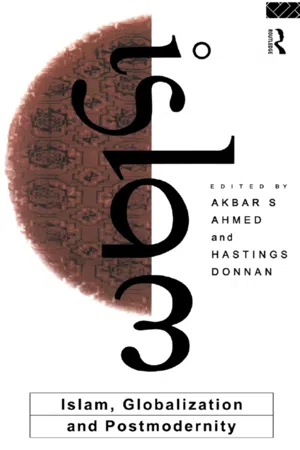
Islam, Globalization and Postmodernity
About this book
This book examines the cultural responses of Muslims to the transformations, contradictions and challenges confronting contemporary Islam as it moves towards the twenty-first century. The diffusion of populations, the globalization of culture and the forces of postmodernity have shaken the world like never before. These developments have generated a debate among Muslims which, as the contributors to this volume show, will have far-reaching consequences not just for the Muslim world, but for relations between Islam and the West more generally.
Information
Chapter 1
Islam in the age of postmodernity
Akbar S.Ahmed and Hastings Donnan
Islamic studies—or the study of Muslim groups and their religion Islam —has been changing dramatically in the last decades. Until recently, Islamic studies was largely the exotic focus of a relatively small group of academics who wrote books about it mainly for one another’s consumption. Many of these intellectuals were based in the West, and few of these were Muslims. The Muslim voice itself was seldom heard outside the Muslim world. This has been changing, partly in response to the fact that the lives of many ordinary Muslims have been changing, and partly as a reflection of the equally dramatic changes taking place in the world more generally. Many factors can explain this, and this book sets out to trace both their impact on Muslims and the latter’s responses to them.
GLOBALIZATION
Firstly, we consider the phenomenon sometimes referred to as globalization. Since it is not always clear that people mean the same thing when they talk about globalization—some talk about globalization theory, others about a global process defined with varying degrees of precision (see Robertson 1987; 1990:19–20)—it is as well to be clear at the outset about how the term is used here. By globalization we principally refer to the rapid developments in communications technology, transport and information which bring the remotest parts of the world within easy reach (cf. Giddens 1990:64). For instance, today if a development takes place in New York it can be relayed instantly across the world to Cairo or Karachi. A good example of this process of globalization is the controversy surrounding Salman Rushdie which began in the late 1980s in the United Kingdom with the publication of The Satanic Verses. Within hours, developments in the United Kingdom—in Bradford and London—provoked responses in Islamabad and Bombay. Indeed, people died as they protested against the book. Government pronouncements, media chat shows, editorials, vigils and protests reflected the heated debate. Never before in history had such developments taken place in this manner and at such speed.
One consequence of the globalization process is the necessity to look at Islamic studies not as an esoteric or marginal exercise but as something that concerns the global community. We are thus forced to look at Muslims in different parts of the world not as the preserve of specialist scholars but as an ever-present and ubiquitous reality that relates to non-Muslims in the street. And let us not forget the truly global nature of Muslim society which totals something like one billion people living in about 50 countries with significantly some ten to fifteen million living in the USA and Europe. Issues of migration arise from this reality. Here Muslims face major problems as immigrants, including racism.
Owing to the developments in and around Islam, words such as fatwa (a sermon), jihad (struggle, including armed effort), ayatollah (highly learned scholar and cleric) are now common in the West. The tabloids have popularized these words and they have entered the English language. This again is a consequence of the Western media using or misusing words and adopting and adapting them to the local usage. It also reflects the interplay and interchange of ideas between Islam and the West. An earlier example of borrowing is the word mughal, which signified the great Mughal emperors and dynasty of India and is now used for any powerful person, and particularly to refer to business tycoons (‘moguls’). Another earlier example is harem, which in Arabic designates a female sanctuary to which only close male relatives have access but which in English often suggests only the voluptuous and licentious exploitation of women. It is clear, then, that borrowing of this kind has been going on for some time. Indeed, the process of globalization itself might be said to have a long history, even if the term is of fairly recent currency.
Like much of the rest of the world, Muslims and the West have long been interconnected through international trade and economic exchange (or exploitation), locked together in what has been referred to as the ‘economic worldsystem’ (Wallerstein 1974; 1984). An embryonic form of late twentieth century globalization might thus be discerned in the collaborations between the representatives of colonial power and the indigenous élites who helped them to rule. Indeed, there are those who consider this period of human history to be one stage—and not necessarily the first stage —in the development of what we now call globalization. For example, it has been suggested that the historical path to current global complexity has passed through five phases, beginning in the early fifteenth century (Robertson 1990:26–7). Globalization is thus not necessarily the wholly novel phenomenon, unique to the latter half of this century, that some commentators appear to imply. As a process it is of considerable historical depth, and as a theory it exhibits all the notions of ‘system’ and ‘stages of growth’ which distinguish its forerunner, world-systems theory. Nevertheless, and most commentators appear to agree, late twentieth-century globalization does seem different from earlier forms in certain important respects (see Appadurai 1990:1– 5).
For one thing, the historical connections between nations have generally been previously understood largely in terms of an economic world-system. The economic content of international contact has thus been emphasized at the expense of the cultural flows which were obviously also taking place alongside the material exchanges; indeed, the place of ‘culture’ in analyses of global interconnections such as world-systems theory is a matter of some disagreement, with some alleging that it has mostly been left out (see Hannerz 1989a :204; Wallerstein 1990; Boyne 1990; Worsley 1990). But there are obviously many examples of collaborations between colonials and locals which involved much more than just political and economic co-operation; thus when the values of gentlemanly behaviour and fair play arrived in India as a cultural export from Victorian and Edwardian England, they were quickly adopted by those—such as the Parsis (see Luhrmann 1994)— who wished to please their then colonial masters. But while these cultural flows clearly existed in the past, they never seem to have been an end in themselves, and they have usually been of less interest to scholars than the material realities which underpinned them.
Today the emphasis has shifted and it is the cultural flows between nations which above all else seem to typify the contemporary globalization process (or its current phase) (cf. Robertson 1987:24). These cultural flows are not, of course, detached from economic and political realities. Because of their origins, some flows —mainly those in ‘the West’—have more force than others and so reach a wider audience. Accordingly, there has been much discussion about the possible homogenization of culture— the move towards a ‘global culture’ in which everyone will drink the same soft drinks, smoke Marlboro cigarettes, and emulate JR. Such an homogenization of culture has been questioned from a number of perspectives, and the situation is certainly more complex than is sometimes supposed. Firstly, the notion of a hegemonic global cultural centre dispensing its products to the world’s peripheries is more often assumed than described; and even if there is such a thing, it is not clear that its exports have any more significance to those they reach than its exports of a generation or two ago (Parkin 1993:85–6). Secondly, even though the same cultural ‘message’ may be received in different places, it is domesticated by being interpreted and incorporated according to local values (see Featherstone 1990:10). And finally, cultural flows do not necessarily map directly on to economic and political relationships, which means that the flow of cultural traffic can often be in many different directions simultaneously. We shall return to these points later.1
The globalization process today is also marked by the accelerated pace at which informational and cultural exchanges take place, and by the scale and complexity of these exchanges (on the latter, see Appadurai 1990:6). Facilitated by the new technologies, it is the sheer speed, extent and volume of these exchanges that have engaged popular imagination, and that seem to have led to globalization being so often represented, if perhaps a little glibly, by the VCR. Cheater (1993:3–4) lists an impressive array of such technologies from electronic mail to the satellite dish, and although these are clearly not accessible to all, they have obviously been directly or indirectly responsible for exposing many different sorts of people to new influences. Such technologies are able to uncouple culture from its territorial base so that, detached and unanchored, it pulsates through the airwaves to all those with the means to receive it.
Whatever the ultimate outcome might be—greater homogeneity or heterogeneity of culture—and this is hotly disputed, the contemporary phase of globalization has thus resulted in more people than ever before becoming involved with more than one culture (cf. Featherstone 1990:8). It is perhaps this which above all else captures the sense in which the term is used here.
DIASPORA
Of course, it is not just technologies which carry culture across national boundaries; people clearly do as well, and the twentieth century has witnessed dramatic developments in the ease with which people cross from one state to another. Moreover, unlike the population movements of the past, these postindustrial diasporas occur in a world where even the old ‘geographical and territorial certainties seem increasingly fragile’; thus today’s diasporas seem much less likely to have ‘stable points of origin, clear and final destinations and coherent group identities’ (Breckenridge and Appadurai 1989: i; see also Malkki 1992:24).
These changes have resulted in diasporas of various kinds: that of the cosmopolitan academic parodied by Lodge (1985) in a book whose very title— Small World—plays on the sense of compressed global space characteristic of globalization, that of the international business/ management/design consultant, and that of the migrant labourer and refugee. The former—who are always on the move—have given rise to the so-called ‘third cultures’, while the latter—often in search of a new home— have resulted in the linguistically, culturally and socially heterogeneous communities now typical of many parts of the globe.2 Muslims are represented in all these groups, and this volume tries to deal with each: peripatetic intellectuals as well as labour migrants. Several of the contributors thus address directly the question of how people manage the cultural uncertainties typical of such poly-ethnic situations and of how Islam is moulded to ‘foreign’ settings (Gerholm, Antoun, Werbner, this volume).3
It has often been noted that Islam explicitly encourages and even enjoins certain forms of travel, and that the movement of Muslims from one part of the world to another, whatever the purpose, resonates with the historical foundations of their religion (Eickelman and Piscatori 1990:5; Donnan and Werbner 1991:9– 10). But here too globalization seems to have greatly encouraged this willingness to move, and has added a dimension to it. Transformations of the world economy brought about by the globalization of markets and labour under late capitalism— or ‘disorganized capitalism’ as it has been called by Lash and Urry (1987)—have resulted in enormous numbers of people moving round the globe in search of work. Muslims constitute a large proportion of this population movement. It is in this manner that Muslim societies have today become part and parcel of Western countries. Muslim doctors and engineers live as American or British citizens. Their children have no intention of going back to their place of origin. The study of this Muslim diaspora raises both empirical and conceptual issues.4
Since the bulk of Muslim migrant labour has settled abroad on a permanent basis, it is important to now look at these societies as local, as indigenous not as the other, the exotic or the Oriental, pace Edward Said (1978). Thus Said’s Orientalism is dated in this new theoretical frame and we need to move beyond its position. Although pointing to something important—that is, the imbalance or asymmetry between Islam and the West and the continuing prejudice, stereotypes and caricatures created of Islam by the West—Said’s position has created serious intellectual problems, principally because of the manner in which it has been received and applied. It has led to a cul-de-sac. ‘Orientalism’ itself has become a cliché, and third world literature is now replete with accusations and labels of Orientalism being hurled at critics and at one author by another at the slightest excuse. This has had a stultifying affect on the dispassionate evaluation of scholarship. Thus, for example, in the passion generated by the debate what has been missed out is the great contribution of many Orientalist scholars. The writings of Ibn Khaldun, Ibn Battuta, or the Mughal emperor Babar come to us only through the painstaking scholarship of Orientalists who spent a life-time deciphering notes in Asian languages and sitting in remote libraries. For them it was a labour of love. To dismiss their work as simply Orientalism or as an attempt to suppress or subjugate Muslim peoples denies an important truth. Unfortunately, after Edward Said, that is how many Muslim writers do see the work of the Orientalists. If research on contemporary Muslim societies is not to be similarly dismissed as the most recent manifestation of Orientalism, it is clearly imperative to introduce conceptual innovations which both surmount the limitations of Islamic studies as identified by Said, and transcend the shortcomings of his own analysis. This would seem to be possible only by contextualizing local versions of Islam within global structures.
Sensitive and innovative research seems particularly critical for under- standing the Muslim diaspora. The diaspora has led to the oft-remarked quest for identity and authenticity, particularly for those who find themselves abroad but also, to some extent, for those who remain behind and who now find that their culture, transported to new settings, is being defined and practised in novel and sometimes disturbing ways. The empirical issues raised by diaspora thus chiefly revolve around questions of identity and the vulnerability of having to redefine the self in a world which seems constantly on the move. The hyphen of hyphenated identities like that of British-Muslim or American-Muslim, for example, both reflects and obscures the necessary conjunction of disparate cultural traces brought together in the act of ‘re-membering’ and ‘re-creating’, to borrow Fischer and Abedi’s terms (1990:253).
In the liminal zone of the culturally displaced, Muslims in the diaspora experience a range of practical, psychological and pragmatic difficulties, some of which are examined in this volume. These include the problems of establishing enduring relationships with the opposite sex, of contracting acceptable marriages, and of adapting religion to a new life (Antoun, Gerholm, Werbner). But they also include the problems of negotiating with other Muslims and agreeing with them on the meaning of Islam on foreign soil (Werbner). After all, Muslims who migrate are not only often in a minority in their place of destination, where they must encounter the cultures of the majority, but they also come from different sectarian and cultural traditions themselves. In some cases, as with Turkish Alevis in Germany for example, residence abroad may permit a greater freedom of religious expression. Thus the diaspora has released these Alevis from what they see as Sunni hegemony in Turkey, as well as enabling them to substantially reverse their hierarchically subordinate position to Sunni Turks based in Germany (Mandel 1990:163, 166).
But the diaspora raises issues of identity and direction at ‘home’ too, among those faced with the fantasy if not the reality of moving (cf. Gardner 1993), and among those who now find their ‘local cultures less pervasive, less to be taken for granted, less clearly bounded toward the outside’ than they perhaps once were (Hannerz 1990:249). Migrants return to their place of origin not only with novel versions of the world which challenge the views of those who never left (see Antoun, this volume), but also on occasion with fossilized and outmoded versions of what they left behind: ways of dressing, behaving, believing and so forth which have been developed and reshaped in their absence but which they have lovingly and carefully preserved intact while abroad. Either way, old certainties are challenged. To draw again on Fischer and Abedi writing about Iran, but to slightly modify their focus, the Muslim world and the Muslim habitations abroad ‘mirror each other at acute or oblique angles, mutually affecting each other’s representations, setting off mutating variations’ (1990:255). The very elasticity of the diasporic tie thus ensures the reciprocal redefinition of identity at both ends of the migratory chain as elements of culture rebound first this way and then that. Renewed attempts to define proper behaviour for Muslim women in Cairo and Lahore (Watson and Weiss respectively, this volume), and to establish an Islamic basis for the state in Malaysia (Nagata, this volume) might thus be interpreted as a search for identity which is at least partially stimulated by the Muslim diaspora.
The detachment of culture from territory which is entailed by diaspora, with its generation of cultures with no clear anchorage in any one space (Hannerz 1990: 237), has unleashed powerful forces which affect us all and not just those most directly involved. According to Appadurai (1990:11), for example, it is this deterritorialization which is ‘now at the core of a variety of global fundamentalisms, including Islamic and Hindu fundamentalism’. The ‘problems of cultural reproduction for Hindus abroad’ Appadurai suggests, have become ‘tied to the politics of Hindu fundamentalism at home’ (1990:11). The same could easily and realistically be said of the Muslim diaspora, with the added complication that, unlike the Hindus, Muslims abroad do not even share a common homeland. It is in this sense that the new Islamic movements in the Arab world described by Bagader (this volume) must be seen in the context of the Muslim diaspora. Indeed, the politics of all Muslim countries in this postmodern age must similarly be seen within a global frame.
GLOBAL POLITICS
New political developments have increased this awareness of the need to study Muslim societies in a global context. The recent events in Bosnia have created a sharp awareness of Muslims as a world community, both in the West and among Muslims themselves. Bosnia has become a rallying point for Muslims throughout the Muslim world, much in the manner of the Palestinians. The case of Bosnia is even used in khutbas (sermons) in a closed society like Saudi Arabia to attack the monarchy for not doing enough. The sub-text is that the élite are far too much under the sway of the West. In the West itself, Bosnia has driven home the point that Muslims tend to see the world through Islamic spectacles and interpret the suffering of the Bosnian Muslims as brought about by a West indifferent to the plight of ordinary Muslims: the feeling is that had they been Jews or Christians, the Western response would have been very different.
This in itself colours and affects how Muslim scholarship is seen or is to be seen in the curre...
Table of contents
- Cover Page
- Title Page
- Copyright Page
- List of Contributors
- Foreword
- Chapter 1: Islam in the age of postmodernity
- Chapter 2: Turkish arabesk and the city
- Chapter 3: Contested meanings and the politics of authenticity
- Chapter 4: How to be Islamic without being an Islamic state
- Chapter 5: The politics of Islamic fundamentalism
- Chapter 6: Contemporary Islamic movements in the Arab world
- Chapter 7: Challenges for Muslim women in a postmodern world
- Chapter 8: Women and the veil
- Chapter 9: Sojourners abroad
- Chapter 10: Two Muslim intellectuals in the postmodern West
- Chapter 11: Diaspora and millennium
Trusted by 375,005 students
Access to over 1.5 million titles for a fair monthly price.
Study more efficiently using our study tools.
Frequently asked questions
Yes, you can cancel anytime from the Subscription tab in your account settings on the Perlego website. Your subscription will stay active until the end of your current billing period. Learn how to cancel your subscription
No, books cannot be downloaded as external files, such as PDFs, for use outside of Perlego. However, you can download books within the Perlego app for offline reading on mobile or tablet. Learn how to download books offline
Perlego offers two plans: Essential and Complete
- Essential is ideal for learners and professionals who enjoy exploring a wide range of subjects. Access the Essential Library with 800,000+ trusted titles and best-sellers across business, personal growth, and the humanities. Includes unlimited reading time and Standard Read Aloud voice.
- Complete: Perfect for advanced learners and researchers needing full, unrestricted access. Unlock 1.5M+ books across hundreds of subjects, including academic and specialized titles. The Complete Plan also includes advanced features like Premium Read Aloud and Research Assistant.
We are an online textbook subscription service, where you can get access to an entire online library for less than the price of a single book per month. With over 1.5 million books across 990+ topics, we’ve got you covered! Learn about our mission
Look out for the read-aloud symbol on your next book to see if you can listen to it. The read-aloud tool reads text aloud for you, highlighting the text as it is being read. You can pause it, speed it up and slow it down. Learn more about Read Aloud
Yes! You can use the Perlego app on both iOS and Android devices to read anytime, anywhere — even offline. Perfect for commutes or when you’re on the go.
Please note we cannot support devices running on iOS 13 and Android 7 or earlier. Learn more about using the app
Please note we cannot support devices running on iOS 13 and Android 7 or earlier. Learn more about using the app
Yes, you can access Islam, Globalization and Postmodernity by Akbar S. Ahmed,Hastings Donnan in PDF and/or ePUB format, as well as other popular books in Theology & Religion & Islamic Theology. We have over 1.5 million books available in our catalogue for you to explore.