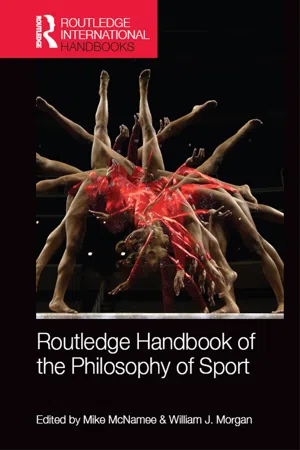
The Routledge Handbook of the Philosophy of Sport is a landmark publication in sport studies. It goes further than any book has before in tracing the contours of the discipline of the philosophy of sport and in surveying the core themes, approaches and theories that form its disciplinary fabric. The book explores the ways in which an understanding of philosophy can inform our understanding of important prevailing issues in sport. Edited by two of the most significant figures in the development of the philosophy of sport, Mike McNamee and Bill Morgan, and with contributions from many of the world's leading sport philosophers, this is an invaluable companion reference volume for any course in the social scientific study of sport, and an essential addition to the bookshelf of any serious scholar of the philosophy and/or ethics of sport.
eBook - ePub
Routledge Handbook of the Philosophy of Sport
- 460 pages
- English
- ePUB (mobile friendly)
- Available on iOS & Android
eBook - ePub
Routledge Handbook of the Philosophy of Sport
About this book
Information
SECTION II Philosophical theories and sport
5 AESTHETICS OF SPORT
Introduction
Aesthetics, as a philosophical discipline, covers two related but distinct issues: beauty and art. Thus, on the one hand, aesthetics is concerned with the nature of beauty and other aesthetic qualities, and the perception of such qualities through the faculty of taste, wherever they may be found. On the other hand, aesthetics is concerned with the nature of art and our appreciation and interpretation of art works, regardless of whether beauty is a core quality of that work. This dichotomy leads to two areas of study for the aesthetics of sport: an evaluative inquiry into the nature and relevance of aesthetic qualities (beauty, grace, drama, and so on) to the experience of playing and watching sport, and an ontological inquiry into the nature of sport and its relationship to art. At its extreme, the latter argues that sport is one of the arts, and so to be judged and assessed as such.
Aesthetics was a core concern of the philosophy of sport throughout the 1970s and 1980s. The first issue of the Journal of the Philosophy of Sport, for example, carried four papers on aesthetics (Kuntz 1974, Geakin and Maasterson 1974, Thomas 1974, Ziff 1974). Edited collections of philosophical papers on sport typically carried a section on aesthetics (see, for example, Gerber and Morgan 1979; Morgan and Meier 1988), as did monographs (Hyland 1990); edited collections devoted to the aesthetics of sport were published (see Whiting and Masterson 1974) and Lowe (1977) published a monograph, the culmination of work that began with his doctoral studies. While the aesthetics of sport was somewhat eclipsed by ethics in the following two decades, a number of recent publications – including special issues of both the Journal of the Philosophy of Sport (Lacerda 2012) and Sports Ethics and Philosophy (Mumford 2011; Edgar 2013) – signal a revival.
This chapter rehearses the core debates that have developed within the philosophy of sport over, firstly, the aesthetic evaluation of sport and, secondly, the possible identity of sport and art, before commenting on recent developments within the aesthetics of sport.
Sport and aesthetic quality
Evaluative and ontological questions have been debated side by side throughout the history of the aesthetics of sport and it is therefore little more than a matter of convenience to begin this exposition with the evaluative issues of aesthetic qualities such as beauty. C. L. R. James’s 1963 essay, ‘What is Art?’ (a chapter from his paean to cricket, Beyond a Boundary, 1983: 195–211) is a case in point. James wants to establish an identity between sport and art and does so on the ground that both have qualities that yield what he calls ‘aesthetic pleasure’. In the philosophical literature, aesthetic pleasure is typically understood as the response to the experience of beauty. An object is beautiful precisely in that one experiences aesthetic pleasure upon beholding it. For James, sport and art are alike created and performed to yield the experience of aesthetic pleasure and thus to be beautiful.
James illustrates this through cricket. The rules of cricket, like the rules of any sport, shape the possibility of the players’ physical movements, albeit, for James, cricket realises this with unique subtlety. The movements of the bowler, constrained by the prohibition on straightening their arm during delivery, and of the batter, who while free to choose a range of shots is yet typically disciplined by the paradigmatic side-on stance of the coaching manual, are conventional. That is to say that, in comparison with the freedom of our mundane movements, they are constrained and shaped by conventions adopted simply for the purpose of playing cricket. So, just as a work of art, a sculpture say, refines the appearance of the mundane human body, posing it and shaping it so that it is beautiful, so too the rules of cricket, and sport in general, pose and shape the athlete’s body. By highlighting only certain bodily gestures and behaviours, as well as through its repetitive structure of balls and overs, and in the core confrontation between batter and bowler, cricket, James argues, encourages a life-enhancing and pleasurable aesthetic contemplation closely akin to our experience of great art.
Despite its early date, James’s argument is a subtle and sophisticated contribution to the aesthetics of sport. As such, it may be taken to highlight a number of the more fundamental issues within the discipline. Firstly, the essay implicitly raises a question as to exactly what the relevant aesthetic qualities of a sport might be. ‘Beauty’ may seem a self-evident aesthetic quality, yet James in fact only passingly refers to ‘beauty’, preferring the more sophisticated and rather technical terms, ‘significant form’, ‘tactile values’ and ‘movement’ borrowed from the art critic, Bernard Berenson. James’s argument indeed works, in part, because Berenson understands art works as stirring the imagination of the viewer, so that one may feel the bulk of the objects represented in the art work, ‘heft their weight, realize their potential resistance’. The art work encourages ‘us, always imaginatively, to come into close touch with, to grasp, to embrace, or to walk around’ the objects represented (Berenson 1950: 60). There is an embodiment to Berenson’s engagement with art that readily lends itself, in James’s hands, to articulating the spectator’s involvement with the physical struggle and discipline of the athlete.
Others offer a more straightforward list for the appropriate aesthetic qualities of sport, such as Elliott’s (1974: 112) ‘swiftness, grace, fluency, rhythm and perceived vitality’ or Aspin’s (1974, 126) grace and elegance. It may be suggested here that the focus lies very much on the movement of the athletes and the formal patterns that they epitomise. While Hohler (1974: 55) similarly focuses on movement, his appeal to the integration of conflicting components broadens the scope of the aesthetic quality of the sport to the game as a whole. Kupfer (1995: 392–6) suggests a hierarchy from simple ‘linear’ games, such as the 100 metres or javelin, in which quantitative distances or times alone matter, through ‘qualitative’ sports, such as gymnastics, that are judged in terms of discipline and elegance of bodily movements, through to sports that entail direct competition between individuals or teams, such as tennis or soccer. These are ‘dramatic’ sports (Kupfer 1995: 396). The aesthetic possibilities become more subtle and complex as one moves up the hierarchy, and indeed the aesthetic qualities themselves, on this account, vary from sport to sport. The aesthetics of sport is then not merely a matter of the gracefulness of individual movements but of the dramatic development of the competition as a whole.
Kupfer (1979: 359) characterises the well-played and thus aesthetically pleasing game as a ‘see-saw scoring, the delicate balance between offences and defences, the entire rhythm of the game … fulfilled in the ending which is, in addition to a terminus, a climax’. In effect, Kupfer’s drama and James’s significantly formed cricketer are alike picking up on a core theme that runs through much of the literature in philosophical aesthetics. This is the argument that beauty lies in the bringing together of disparate elements into a harmonious whole. It may be noted that such an approach presupposes that the aesthetic judgement of sport is, in fact, exclusively to do with the harmonious. There is, for Kupfer, something aesthetically troubling about a game that is won by the team that played less well and so deserved to lose, or perhaps even a win ground out against a more talented opponent.
Edgar (2013: 100–20) has argued that the exclusive focus on the harmonious and beautiful leads to a very narrow and rather conservative approach to the aesthetics of sport. It neglects the fact that much sport is ugly and not merely in the distorted physical gestures of athletes but, more importantly, in the ever-present threat of defeat and failure. Not everyone can be a winner, and there is a danger that an aesthetics akin to Kupfer’s will see sport only from the perspective of the (deserved) winner. Edgar therefore argues for the aesthetics of sport to embrace something akin to modernism in the arts and thus to recognise that the aesthetic worth of much sport, like much modern art, lies in its defiance of simple harmony. A sporting aesthetic would then focus upon disruptive or, to use Nietzsche’s term Dionysian, elements – such as the bitterness of defeat, the undeserved victory and an awareness of the everyday pain and suffering that underpins sporting achievement – that spoil the Apolline surface of coherence and harmony. More radically, this might suggest that sport requires an aesthetic language that is distinct to that of the arts (and especially the more traditional arts). Lacerda (2011) has begun to explore this by arguing for ‘strength’ as an aesthetic category.
The second issue that James’s essay raises lies in his appeal to ‘aesthetic’ pleasure. If sport is pleasurable in this sense then it is something more than a mere entertainment or recreation. Philosophical aesthetics has linked the experience of beauty to the feeling of pleasure since at least the work of Shaftsbury (2000) and Hutcheson (2008) in the seventeenth and eighteenth centuries. As Ghose (1974: 68) notes, in everyday language and in the language of sports reporting, ‘beauty’ is frequently used as little more than an exclamation of ‘private ecstasy’. As such, it would suggest little more than excitement or surprise – and a subjective one at that, which no one else need share. Yet for James, aesthetic pleasure is ‘life enhancing’ and, as such, has a weight and significance well beyond mere excitement or entertainment. The distinction is articulated by Kant. He differentiates the pleasure (Lust) that one experiences before an object of beauty from the mere agreeableness (Annehmlichkeit) that is derived from an object that satisfies sensual desires (see Kant 1952, section 3). A flower judged for its beauty yields pleasure, while an apple that is enjoyed for its flavour and for satisfying hunger is merely agreeable. Kant’s point serves to emphasise the depth of the claim that an aesthetics of sport is making. In appreciating beauty, one is not indulging animal appetites – or, put more mildly, seeking mere entertainment – but rather engaging the rational and most dignified aspect of one’s nature. This suggests that a genuine aesthetic appreciation of sport, as proposed by James, takes us well beyond sport as a merely entertaining diversion to touch upon the very dignity of what it is to be human – in James’s terms, to experience sport is to have one’s life enhanced.
The third strand that emerges from James’s argument concerns the nature of aesthetic judgement and thus the role played by taste. A typology such as that derived from Kupfer, presented above, implies that aesthetic qualities are properties of the sport itself and, thus, that beauty or drama are akin to red or fast – qualities that can be perceived by any one with more or less well developed perceptual faculties. A more subtle position (and one that Kupfer may hold: see Kupfer 1995: 398) entails either that aesthetic qualities are ascribed to the object in the act of tasteful judgement or that there is some interaction between the objective qualities of the object and the act of judgement and this interaction yields a perception of aesthetic qualities. Aesthetic qualities would not then be objective in any simple sense and the recognition of aesthetic qualities in sport would require of the spectator and even competitor some appropriate capacity to make judgements of taste.
While anyone with normally functioning sensory faculties can judge the sensible properties, such as its colour or motion, it is typically argued that the recognition of aesthetic qualities requires something more. This may be expressed as saying that aesthetic qualities are supervenient upon sensible properties (Sibley 2001: 52). Such supervenient qualities are recognised only through a judgment of taste. It may then be argued that, in judging something to be beautiful or pleasing and thus in exercising taste, one must take a distinctive stance towards that thing. One appreciates beauty only if one is within an aesthetic attitude. In Kantian aesthetics, this is an attitude of disinterestedness (Kant 1952: 50).1 To exercise taste presupposes that one has no interest in the object judged. One does not desire that it should fulfil some pre-existing purpose or, indeed, that it has any extrinsic purpose. One brackets out all interest in its practical applications. Thus, an apple that is judged to be beautiful is so judged merely as a harmo...
Table of contents
- Cover Page
- Half-Title Page
- Title Page
- Copyright Page
- Dedication
- Table of Contents
- Contributors
- A historical introduction to the philosophy of sport
- Section I Philosophical approaches to the conceptualization of sport
- Section II Philosophical theories and sport
- Section III Key issues and themes in the philosophy of sport
- Index
Trusted by 375,005 students
Access to over 1.5 million titles for a fair monthly price.
Study more efficiently using our study tools.
Frequently asked questions
Yes, you can cancel anytime from the Subscription tab in your account settings on the Perlego website. Your subscription will stay active until the end of your current billing period. Learn how to cancel your subscription
No, books cannot be downloaded as external files, such as PDFs, for use outside of Perlego. However, you can download books within the Perlego app for offline reading on mobile or tablet. Learn how to download books offline
Perlego offers two plans: Essential and Complete
- Essential is ideal for learners and professionals who enjoy exploring a wide range of subjects. Access the Essential Library with 800,000+ trusted titles and best-sellers across business, personal growth, and the humanities. Includes unlimited reading time and Standard Read Aloud voice.
- Complete: Perfect for advanced learners and researchers needing full, unrestricted access. Unlock 1.5M+ books across hundreds of subjects, including academic and specialized titles. The Complete Plan also includes advanced features like Premium Read Aloud and Research Assistant.
We are an online textbook subscription service, where you can get access to an entire online library for less than the price of a single book per month. With over 1.5 million books across 990+ topics, we’ve got you covered! Learn about our mission
Look out for the read-aloud symbol on your next book to see if you can listen to it. The read-aloud tool reads text aloud for you, highlighting the text as it is being read. You can pause it, speed it up and slow it down. Learn more about Read Aloud
Yes! You can use the Perlego app on both iOS and Android devices to read anytime, anywhere — even offline. Perfect for commutes or when you’re on the go.
Please note we cannot support devices running on iOS 13 and Android 7 or earlier. Learn more about using the app
Please note we cannot support devices running on iOS 13 and Android 7 or earlier. Learn more about using the app
Yes, you can access Routledge Handbook of the Philosophy of Sport by Mike McNamee, William Morgan, Mike McNamee,William J. Morgan,William Morgan, Mike McNamee, William J. Morgan in PDF and/or ePUB format, as well as other popular books in Social Sciences & Ethics & Moral Philosophy. We have over 1.5 million books available in our catalogue for you to explore.