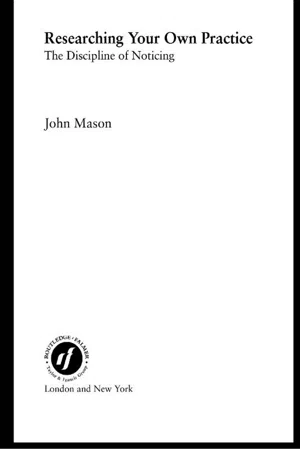
Central to caring professions such as teaching is the need to notice and be sensitive to the experiences of pupils and teachers. Starting from this position, Researching Your Own Practice demonstrates that in order to develop your professional practice you must first develop your own sensitivities and awareness. One must be attuned to fresh possibilities when they are needed and be alert to such a need through awareness of what is happening at any given time.
By giving a full explanation of this theory and a guide to its implementation, this book provides a practical approach to becoming more methodical and systematic in professional development. It also gives the reader a basis for turning professional development into practitioner research, as well as giving advice on how noticing can be used to improve any research, or be used as a research paradigm in its own right.
The discipline of noticing is a groundbreaking approach to professional development and research, based upon noticing a possibility for the future, noticing a possibility in the present moment and reflecting back on what has been noticed before in order to prepare for the future. John Mason, one of the discipline's most authoritative exponents, provides us here with a clear, persuasive and practical guide to its understanding and implementation.
- 288 pages
- English
- ePUB (mobile friendly)
- Available on iOS & Android
eBook - ePub
About this book
Information
Part I
Enquiry
This book is about transitions:
from being a sensitive practitioner awake to possibilities, perhaps dissatisfied with aspects of the status quo;
through reflective practices,
to engaging in productive and effective personal professional development;
through drawing on published research and colleagues’ experience,
to contributing to the professional development of others;
through being systematic and disciplined in recording,
to undertaking research and participating in a research community.
Its aims are, therefore, pragmatic and, although the soundness of the approach will be validated (or not) in your own experience, practice alone is merely practice; doing is merely doing. The whole thrust of this book is that the natural and intuitive actions of any teacher can be developed, made more systematic and more disciplined, to good effect. This process involves both the adoption of appropriate alternative or modified practices, and the development of criteria for deciding what constitutes appropriateness. The two go hand in hand. As Maturana (1988) observed, ‘Reason drives us only through the emotions which arise in us.’
The single chapter in this part is about practice, about the various acts which are essential for any teacher who is doing more than going through the motions. Certain elements will then be extracted in Part II to constitute noticing.
1 Forces for development
Every practitioner, in what ever domain they work, wants to be awake to possibilities, to be sensitive to the situation and to respond appropriately. What is considered appropriate depends on what is valued, which in turn affects what is noticed. Thus every act of caring and supporting depends on noticing: noticing what students are doing and what they are likely to need in the near future in order to achieve their goals (Langer 1989). Every act of teaching depends on noticing: noticing what children are doing, how they respond, evaluating what is being said or done against expectations and criteria, and considering what might be said or done next. It is almost too obvious even to say that what you do not notice, you cannot act upon; you cannot choose to act if you do not notice an opportunity. Of course we all would like to do so much more than we do, even though there is not the time in which to do it. It is not always possible to devote enough time to listening and observing, to planning and preparing. The Discipline of Noticing provides a way to select and work at one or two aspects at a time. It focuses attention on enhancing awareness by sharpening and enriching those moments when you get a taste of freedom as you participate in a creative moment. It focuses attention on changing what can be changed, if it is deemed appropriate to change, not fussing about what cannot be changed for social, cultural, or institutional reasons.
We have to develop implicit theories of action in order to make professional life tolerable. There are too many variables to take into account all at once, so we develop routines and decision habits to keep mental effort at a reasonable level. To change the routine or question the theory is to reverse the process, to draw attention once more to myriads of additional variables, and to raise the possibility of paralysis from information overload and failing to cope (Eraut 1994: 34). Not to change, modify, experiment is to be stuck in the rut of habit, ending up where those habits lead. As the sage put it, ‘If you don’t change your direction, you may end up where you are headed.’
Each act of teaching, of caring, of supporting, is also an act of learning: learning about the students, learning about the situation, and learning about oneself. Or at least that is the myth which is promulgated. If it were true, then there would be a lot more variation in practice from day to day than there actually is, a lot more experimentation, and a lot more pleasure from teaching. A good deal of pleasure in any of the caring professions, comes from seeing those being supported change and develop. But there is more. An important source of pleasure comes from participating in a moment of choice, by making an informed decision to act non-habitually, to respond professionally rather than just react. But the practical facts of the matter are that there is too much to attend to in any interaction, too much to be aware of, too much to notice. So we get through as best we can. Although it is a common and often quoted sentiment that ‘Experience is the best of schoolmasters’, or ‘you learn from experience’, it is also often questioned. For example, Benjamin Franklin (1758) suggested that ‘Experience keeps a dear school, but fools will learn in no other, and scarce in that’. Far from learning from experience moment by moment, we react, just managing or coping.
One thing we do not seem to learn from experience,
is that we do not often learn from experience alone.
is that we do not often learn from experience alone.
A great deal can be learned from getting in and doing things, but after a while the learning is supplanted by ingrained habits ‘learned’ from experience. Supporting and caring for others, whether as teacher or in some other way, is such a complex activity that it is essential to develop stratagems and tactics for dealing with common situations, which then become habitual. We cannot afford to think out a response to each emerging incident. Habits must be developed in order to free our attention to keep in mind our over-all goal. The trouble with habits is that ‘habit forming can be habit forming’ (Shigematsu 1981 no. 341).
Instead of responding sensitively to situations, we frequently react according to established patterns. We may even find ourselves quickly classifying people and situations in which we are involved and then reacting to those stereotypes before we realise what has happened. So we continue to believe we act freshly all the time, when in fact much of the time we react rather than respond.
By contrast, in those few brief moments when we feel we have participated in an informed choice, when we have acted freshly and appropriately, there is a sense of freedom, of meaning, of worth-whileness and self-esteem. It is these moments of personal freedom which keep us going.
The details of caring in general and of teaching in particular necessarily involve noticing. We notice that the people being cared for are restless or their attention is elsewhere, so we switch our own attention to match theirs. We notice that a class is losing concentration, so we switch the mode of interaction from whole class to groups or individuals, or introduce a fresh task; we notice that some students are working quickly while others are not, so we try to give more attention where it seems needed, challenging each in ways we feel most appropriate for the individual. If we notice that some technique which we hoped they had mastered is suddenly problematic again, we may choose to switch tasks and rehearse the technique again before proceeding.
Noticing requires sensitivity. I cannot notice that some students are bored if my attention is focused on my own nervousness or insecurity. I need to become aware of the ebb and flow of energy in the classroom (and each class is different in this respect).
To notice an opportunity requires two things. I have to be awake to the situation at the moment, and I have to have alternative actions prepared which will also come to mind in the moment. For example, I cannot invoke a technique like ‘circle-time’ if I have never heard of it or never imagined myself using it. And even though I may decide in advance of a lesson that I want to generate some discussion, I may get so caught up in the flow of events that I forget all about it during the lesson.
So on the one hand we notice all the time, make choices, and get through the day. On the other hand, there is so much more that we could notice, so many more options we could choose between.
Personal forces
Students often just do not seem to learn despite having been shown, taught, and having apparently learned: the cry from the heart that ‘I did fractions with them all last half-term, and today they still couldn’t do it’ must be familiar to every teacher. The topic could be anything: some element of grammar, some aspect of writing, some scientific principle. You explain patiently, build up from examples, use apparatus and diagrams, carefully work through techniques, and yet still they don’t remember. You reduce it all to a few simple rules and try to get them to memorise them; still no significant success. You look around for some other approach, some other materials. If you find a possibility, you work at that for a bit, and for a while you feel better. Then even that begins to pale and you look around again.
Development is a cyclical process; sometimes exhilarating and positive, often frustrating and negative. No description is likely to be complete, but there are usually cycles of

| Grumbling | about how things are, leading to |
| Griping | about specific frustrations, leading to |
| Groping | for some alternative, leading to |
| Grasping | at some passing possibility, which with luck leads to |
| Grappling | with some issue and proposed actions, developing into |
| Gripping | hard to ‘something that works’, then finding further |
| Grumbling and Griping as the substance seems to leak out. | |
A new cycle begins. This book is about breaking out of a cycle of frustration with the Grs.
What triggers a new phase of personal development? Most frequently there is some form of disturbance which starts things off. It may be a surprise remark in a lesson, a particularly poor showing on a test, something said by a colleague, something asserted in a journal or book, or a moment of insight. Whatever it is, something startles me out of my current habits.
Disturbance can have positive and negative aspects: a small disturbance can usually be encompassed, while a large disturbance may be disruptive. An idea for doing things differently can be seen as an opportunity, or as a pressure. If the disturbance is experienced as negative, then I need some mechanism for dissipating the energy which comes with noticing, and this is achieved in characteristic ways such as blaming others or myself, or justifying my actions by showing how I could not actually have done otherwise. Often these justifications take the form of inner monologues, and sometimes they creep out into conversation. The disturbance itself is eliminated or ignored.
Whatever their form, blame and justification, explanation and judgement only dissipate the energy which could otherwise be turned to good use, setting up the possibility of acting differently in the future. This is what the discipline part of noticing is all about.
If the disturbance remains, if something positive attracts my attention, something different to try which I hope or believe will make a difference may come to mind. So I pursue it in detail. I try ‘it’ out for myself.
Account 1: Trying it out
I read that in a survey many children answered 0.3 × 0.3 with 0.9 Would my pupils do that? I try it out to see. Does it make a difference if I offer them a choice between 0.9 and 0.09 or just ask them for the answer, or ask whether 0.9 is correct? If I tell them that some other children incorrectly answered 0.9, will mine be stimulated to say what they think the others might have been thinking?
I read that in a survey many children answered 0.3 × 0.3 with 0.9 Would my pupils do that? I try it out to see. Does it make a difference if I offer them a choice between 0.9 and 0.09 or just ask them for the answer, or ask whether 0.9 is correct? If I tell them that some other children incorrectly answered 0.9, will mine be stimulated to say what they think the others might have been thinking?
Probing someone else’s thinking is difficult at the best of times when there is one researcher and one ‘subject’. The way you pose the question, your tone of voice, your body posture, and the context in which the probe arises, all influence the response.
What might lie behind the answer of 0.9, if it does turn out to be prevalent? One day I hear a child saying ‘oh point five times oh point five is oh point twenty-five’ and suddenly I hear in my head
‘oh point four times oh point four is oh point sixteen, oh point three times oh point three is oh point nine’.
What wonderful mathematical thinking! A pattern has been seized upon and extended. What a pity it is applied to inappropriate data! By inappropriately pronouncing decimal numbers, children may be led into an inappropriate generalisation. Now I have been sensitised by my following up of the 0.3 × 0.3 = 0.9 answer and come across a reason. Now I can make a distinction: I can praise the thinking while criticising the answer. Next time I can offer a pupil a disturbance and some praise at the same time.
Account 2: Repeating back
I suddenly caught myself repeating back to the class what one student had just said. I recognise that I do this a lot.
I suddenly caught myself repeating back to the class what one student had just said. I recognise that I do this a lot.
There is nothing wrong with repeating back. No judgement is being made what-soever. But if I recognise that I do it all the time, that it has become a habit, I might decide I want to gain the freedom not to repeat back sometimes. One useful thing to do is to make a list of positive and negative features of repeating back:
| Positive | Negative |
| • I am sure everyone hears | Especially if it becomes a habit: |
| • I gain time to think about a response or to locate another child to respond | • Students may become used to listening only t... |
Table of contents
- Cover Page
- Title Page
- Copyright Page
- Preface
- Acknowledgements
- Introduction
- Part I: Enquiry
- Part II: Noticing
- Part III: The Discipline of Noticing
- Part IV: Using Aspects of the Discipline of Noticing
- Part V: From Enquiry to Research
- Part VI: What About . . .?: Questions and Concerns
- Epilogue
- Appendices
- Bibliography
Trusted by 375,005 students
Access to over 1.5 million titles for a fair monthly price.
Study more efficiently using our study tools.
Frequently asked questions
Yes, you can cancel anytime from the Subscription tab in your account settings on the Perlego website. Your subscription will stay active until the end of your current billing period. Learn how to cancel your subscription
No, books cannot be downloaded as external files, such as PDFs, for use outside of Perlego. However, you can download books within the Perlego app for offline reading on mobile or tablet. Learn how to download books offline
Perlego offers two plans: Essential and Complete
- Essential is ideal for learners and professionals who enjoy exploring a wide range of subjects. Access the Essential Library with 800,000+ trusted titles and best-sellers across business, personal growth, and the humanities. Includes unlimited reading time and Standard Read Aloud voice.
- Complete: Perfect for advanced learners and researchers needing full, unrestricted access. Unlock 1.5M+ books across hundreds of subjects, including academic and specialized titles. The Complete Plan also includes advanced features like Premium Read Aloud and Research Assistant.
We are an online textbook subscription service, where you can get access to an entire online library for less than the price of a single book per month. With over 1.5 million books across 990+ topics, we’ve got you covered! Learn about our mission
Look out for the read-aloud symbol on your next book to see if you can listen to it. The read-aloud tool reads text aloud for you, highlighting the text as it is being read. You can pause it, speed it up and slow it down. Learn more about Read Aloud
Yes! You can use the Perlego app on both iOS and Android devices to read anytime, anywhere — even offline. Perfect for commutes or when you’re on the go.
Please note we cannot support devices running on iOS 13 and Android 7 or earlier. Learn more about using the app
Please note we cannot support devices running on iOS 13 and Android 7 or earlier. Learn more about using the app
Yes, you can access Researching Your Own Practice by John Mason in PDF and/or ePUB format, as well as other popular books in Education & Education General. We have over 1.5 million books available in our catalogue for you to explore.