eBook - ePub
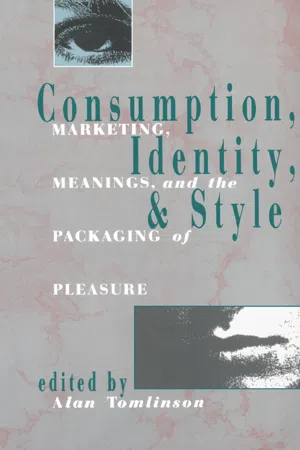
Consumption, Identity and Style
Marketing, meanings, and the packaging of pleasure
- 272 pages
- English
- ePUB (mobile friendly)
- Available on iOS & Android
eBook - ePub
About this book
First Published in 1990. This is a book about the meaning of our lives as consumers. It is about leisure, lifestyle, and markets in today's consumer culture. In 1986 one measure of people's use of time in Britain identified television watching as the major activity for both men and women outside paid employment and sleeping.
1
Introduction
Consumer culture and the aura of the commodity
ALAN TOMLINSON
Some of the best people of our time speak now only in this dark language. Their grave voices have to compete with the jingles of happy consumption, the only widespread form of contemporary optimism.
Raymond Williams, ‘Walking backwards into the future’,
New Socialist, May 1985, p. 21.
whether the acute new awareness of self—its demands, its privileges, its rights—that had invaded the western psyche since the First World War was a good thing or a largely evil consequence of capitalist free enterprise…whether people had been media-gulled into self-awareness to increase the puppet-master’s profits or whether it was an essentially liberalizing new force in human society.
John Fowles, Daniel Martin (Jonathan Cape, 1977, BCA edition, p. 555).
The basis on which good repute in any highly organised industrial community ultimately rests is pecuniary strength; and the means of showing pecuniary strength, and so of gaining or retaining a good name, are leisure and a conspicuous consumption of goods.
Thorstein Veblen, The Theory of the Leisure Class (1899), (Mentor, 1953, p. 70).
This is a book about the meaning of our lives as consumers. It is about leisure, lifestyle, and markets in today’s consumer culture. In 1986 one measure of people’s use of time in Britain identified television watching as the major activity for both men and women outside paid employment and sleeping. On average, women watched slightly over three hours a day of television; men a little more.1
But if we look at the range of consumer activities and leisure spending in people’s daily lives it is clear that much more goes on in the home, around and beyond the television set. Nearly one in three people in this survey (this is not an introduction to a television game show!) have an alcoholic drink at home; one in five or so regularly eat at fast-food restaurants (maybe to get back home for the favourite programme!) and one in thirteen bring the fast food home. Home entertaining is quite regularly engaged in by 6 per cent of the sample. Although this may not sound many, it represents several million people in Britain. That is a far from insignificant ‘group’ of consumers.
Out of the home, church or religious meetings vie with keep fit, individual sports, billiards, darts or visits to the pub as the most time-consuming regular activities. Running these close is ‘taking a long walk for pleasure’, though the tables do not show whether these are the same people as the 6 or 7 million who appear to go ‘motoring for pleasure’. Going out to events in public—circuses, cinema, concerts, fairs, museums—is clearly in decline, only 1 in 50 or so people doing so with any regularity. Theme parks are constituting a new public leisure space, now more popular than most of these other more traditional ‘going out’ activities.
Alton Towers, the fun park set in the splendour of the Staffordshire countryside, attracted 2,250,000 paying visitors in 1986, the biggest paying attraction in the United Kingdom outside London.
The point about all this is that if even 1 in 50 can be encouraged to engage in an activity at all regularly, that constitutes a pretty big market. The market value of total leisure spending in 1986 was £56,242 million. The same figure, projected through to 1992, is put at £94,663 million.2 That’s a lot of growth, a lot of businesses, a lot of jobs. The British working population may have been seen, once, as the cast of labourers toiling away in the workshop of the world. More and more, British workers and earners are seen as prolific and discriminating potential consumers. It is the nature of this shift which is the binding concern uniting the different contributors in this book.
Over a quarter of a century ago J.K.Galbraith observed, in his classic critique of modern consumer society, the need for a ‘theory of social balance’, for a combined concern with publicly provided services and privately produced goods. His vision of the imbalance at the heart of the postwar affluent society became one of the most widely quoted cultural comments of our time:
The family which takes its mauve and cerise, air-conditioned power-steered and power-braked car out for a tour passes through cities that are badly paved, made hideous by litter, blighted buildings, billboards, and posts for wires that should long since have been put underground. They pass on into a countryside that has been rendered largely invisible by commercial art… They picnic on exquisitely packaged food from a portable icebox by a polluted stream…3
It’s all there in this passage: family-based conspicuous consumption; indulgence alongside neglect, boom running side by side with blight; the intrusion of the copywriter into the natural environment. Galbraith was warning the advanced industrial world, the capitalist world, that if pursued as a major social objective, production would lead to modes of consumption taking place against a backcloth of neglect of public needs. He also implied that the desires and the needs of the affluent consumer were ‘no longer evident’ to the consumer himself. From different angles, other commentators in North America (Vance Packard in particular, in his sustained critique of the communications/image-building industries)4were offering critiques of consumerism, critical interventions, exercises in demystification.
Debates on the exploitative dimensions of contemporary capitalism have focused upon the experience of work, the nature of paid labour. The political dimensions of patterns of consumption have received little comparable sustained attention. Yet it is particular modes of consumption upon which many major productive processes now depend. Galbraith urged, quite rightly, the need to develop a balance between the public and the private, between state services and private enterprises. Without such a balance his scenario of the picnic excursion, of privileged plenty backgrounded by highly visible public deprivation, has come true many times over—most emphatically perhaps in atrophying regions of the North in Britain, where cultural heritage from Bradford to Merseyside is being effectively reworked as a set of tourist attractions. As Margaret Thatcher herself put it a few years ago: ‘There’s a great industry in other people’s pleasure.’ The top ‘paying’ and ‘non-paying’ United Kingdom tourist attractions are listed in Tables 1.1 and 1.2.
There is not a lot of fun in the freebies here. Blackpool nudges out the worthy self-improving activities dominating the rest of the list, winning for the carnivalesque over the cultural tone of our museums, galleries and monuments. But the list of paying attractions is interesting. Theme and fun parks pack the paying punters in. In York you experience the city’s Viking history now, rather than just looking in on it via dead relics of the past. London still has four in the top ten—the grotesque Tussauds, the gory Tower, the dazzling plant life of Kew and the trapped wild life in the Zoo—but the major growth areas are the heritage experiences, the fun parks and all-in leisure environments. Margaret Thatcher sees a great industry. In packaging people’s pleasure, and constantly searching for the most lucrative novelty, this leisure and tourist industry prospers in a Britain in which the imbalance pointed to by Galbraith is as prominent as ever. Patterns of production have shifted, with typical forms of mass production giving way to flexible production catering for the market demands of a more fragmented social order. And the landscapes of worldwide capitalism have changed with steel-mills dominating Third World skylines and (with DAF using a United Kingdom advertising agency to launch its new truck) image-building and marketing the First World’s forte, rather than manufacture. Fortunes are made in the new consumer and leisure industries. Sir Terence Conran, Richard Branson; these are the quintessential entrepreneurial giants of late capitalism, peddling interior design and cultural software for a new generation of lifestyle specialists. The captains of industry of the nineteenth century have little in common with these contemporary cultural brokers. If the Conrans and the Bransons are captains of anything, they are, in Stuart Ewen’s telling phrase, captains of consciousness.5 We are a consumer generation, in Galbraith’s words again, ‘synthesized, elaborated and nurtured by advertising and salesmanship’.6
The examination of patterns of consumption and leisure is a key contemporary task. For it raises hugely significant questions about what we believe and think, how we arrive at our beliefs, what we do, and how our actions express particular beliefs or values. Propagandists of the new right know this, which is why the apparent paradox of the new plastic usurer-culture is so perfectly in line with their views. Although the rhetoric of Mrs Thatcher conjures up the jam-jar cash economy of the kitchen, her economic growth is dependent upon spending before saving and her ideological hold is premised upon a notion of freedom in the marketplace.
Table 1.1 Top 10 United Kingdom paying attractions for 1986 (number of visitors)
Table 1.2 Top 6 United Kingdom non-paying attractions for 1986 (estimated number of visitors)
As we near the end of the second millennium, we will no doubt see ‘2000’ used as a dramatic landmark in the development of human civilization. But if ‘1984’ symbolized debates about political freedom and citizenship, ‘2000’ will come to symbolize issues concerning economic freedoms and consumerism. In Britain media institutions already offer an example of how things might move. Rupert Murdoch’s takeover of The Times, for instance, led to the appointment of an editor whose editorial direction was, in Hugo Young’s words, a drift from the notion of citizen as victim to a notion of citizen as consumer (New Statesman, 2 November 1984). We may have survived in 2000. Many of us may be free. But free for what? By then, worldwide, the sign of satisfactory survival might well be the colour television set and video, the personal transport system, the personal organizer, the personalized deodorant.
It is in the sphere of consumption—conspicuous leisure on the basis of adequate disposable income—that many will seek to express their sense of freedom, their personal power, their status aspirations. The effect of such a trend upon collective consciousness and cultural relations in particular societies cannot be understated. Popular culture and everyday life have always been of great concern to our political and economic masters. If popular culture can be reduced to a set of apparent choices based upon personal taste then we will see the triumph of the fragmented self, a constant lust for the new and the authentic among a population of consumer clones. That is why the issue of leisure, lifestyle, and consumption is a political one. If religion was, in Tawney’s celebrated phrase, vital to the rise of capitalism, it is consumption which has become vital to its continuation and expansion.7

Figure 1 Sears, Roebuck’s five buildings, 1900

Figure 2 Front and back cover of Sears, Roebuck catalogue, Fall 1900
Markets have developed, throughout this century, which have radically altered the act of consumption. Take, for instance, mail order. Montgomery Ward and Co. began the mail order business in the United States in 1872, an opportunistic business initiative intended to constitute frontier pioneers as a consumer market. The more famous Sears, Roebuck and Co. issued its first catalogue in 1893, diversifying beyond Sears’s and Roebuck’s initial interest in jewellery and watches. From 200 pages of listings in 1893, it had expanded to over 1100 pages by 1900. The emphasis was very much on the honest sale, the good deal, the reliable source. The inside back cover (Figure 1) of the 1900 catalogue simply depicts the size and scale of the buildings from which the stock was dispatched. The front and back cover pictures were both the same (Figure 2), placing strong emphasis on value for money in the sticks as well as the city.8
Consumer goods were mimetically represented in the catalogue. Illustrations were simply faithful reproductions of what you would get for your money. If you wanted some gentlemen’s suspenders, Sears Roebuck showed you what you’d get and also threw in a bit of advice: ‘While we quote cheap suspenders, we do not warrant or recommend them. The better qualities are the cheapest in the end.’9 From suspenders to leggings, rubber boots to toys, open lavatories to corsets, the emphasis was upon the integrity of the product, rather than its aura or its effect upon the consumer. Contemporary mail order catalogues might still stress value for money and consumer choice, but there is a fundamental difference in emphasis: the commodity has acquired, in late consumer capitalism, an aura beyond just its function. The commodity now acts on the consumer, endows him/her with perceived qualities which can be displayed in widening public contexts; consumption becomes a riskier business. It is the difference between buying an object mainly for its function, and acquiring an item for its style. Motor cars or jeans, for instance, are produced and consumed as more than functional means of mobility or clothing.
The role of the car in contemporary culture has altered in precisely this way. As early as 1949 Ford advertised its new model as ‘a living room on wheels’, with soft seats, modern fabrics and ‘picture-window’ visibility.10 For the super rich and uninhibitedly status conscious, the car is only the raw material for the ‘King of the Kustomisers’, George Barris, to display his talents on. Barris painted Elvis Presley’s Cadillac limousine with a gold murano pearl. Hub-caps and grille were gold plated. Even the telephone in the centre seat’s pull-down section was gold. The interior of Liberace’s Cadillac Eldorado included a piano keyboard motif on the seats and a musical score of his theme-song ‘I’ll be seeing you’, with a miniature candelabra on its hood. Poor chicanos restyle second-hand models with brightly coloured carpets and chandeliers. The commodity itself is altered into an object of individual fantasy for the purpose of display.11
Shifts in production principles and advances in industrial technology brought the car into the mas...
Table of contents
- Cover Page
- Title Page
- Copyright Page
- List of illustrations
- Notes on the contributors
- Preface
- 1 Introduction
- Part one Trends in consumption and leisure
- Part two The visual media and consumption
- Part three Consumer culture(s) and the market—some case studies
Trusted by 375,005 students
Access to over 1.5 million titles for a fair monthly price.
Study more efficiently using our study tools.
Frequently asked questions
Yes, you can cancel anytime from the Subscription tab in your account settings on the Perlego website. Your subscription will stay active until the end of your current billing period. Learn how to cancel your subscription
No, books cannot be downloaded as external files, such as PDFs, for use outside of Perlego. However, you can download books within the Perlego app for offline reading on mobile or tablet. Learn how to download books offline
Perlego offers two plans: Essential and Complete
- Essential is ideal for learners and professionals who enjoy exploring a wide range of subjects. Access the Essential Library with 800,000+ trusted titles and best-sellers across business, personal growth, and the humanities. Includes unlimited reading time and Standard Read Aloud voice.
- Complete: Perfect for advanced learners and researchers needing full, unrestricted access. Unlock 1.5M+ books across hundreds of subjects, including academic and specialized titles. The Complete Plan also includes advanced features like Premium Read Aloud and Research Assistant.
We are an online textbook subscription service, where you can get access to an entire online library for less than the price of a single book per month. With over 1.5 million books across 990+ topics, we’ve got you covered! Learn about our mission
Look out for the read-aloud symbol on your next book to see if you can listen to it. The read-aloud tool reads text aloud for you, highlighting the text as it is being read. You can pause it, speed it up and slow it down. Learn more about Read Aloud
Yes! You can use the Perlego app on both iOS and Android devices to read anytime, anywhere — even offline. Perfect for commutes or when you’re on the go.
Please note we cannot support devices running on iOS 13 and Android 7 or earlier. Learn more about using the app
Please note we cannot support devices running on iOS 13 and Android 7 or earlier. Learn more about using the app
Yes, you can access Consumption, Identity and Style by Alan Tomlinson in PDF and/or ePUB format, as well as other popular books in Social Sciences & Marketing. We have over 1.5 million books available in our catalogue for you to explore.