- 264 pages
- English
- ePUB (mobile friendly)
- Available on iOS & Android
eBook - ePub
About this book
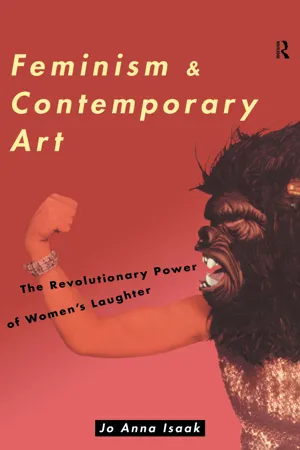
Looks at the work of a diverse range of artists and explores the effect of feminist theory on art practice. The book provides a provocative and valuable account of the diversity and revolutionary potential of women's art practice.
Information
1
THE REVOLUTIONARY POWER OF WOMEN'S LAUGHTER
In the beginning was the gest he f jousstly says, for the end is with woman, flesh-without-word, while the man to be is in a worse case after than before since sheon the supine satisfies the verb to him! Toughtough, Tootoological. Thou the first person shingeller. Art, an imperfect subjunctive.
James Joyce, Finnegans Wake
The history of Western art begins with images of laughter—the laughter of women. In Lives of the Artists, the founding text for the discipline of art history, Giorgio Vasari tells us that the young Leonardo da Vinci began his artistic career by portraying laughing women. These heads of laughing women, “teste di femmine, che ridono,” first fashioned in clay and then cast in plaster, were “as beautiful as if they had been modelled by the hand of a master” (quoted in Freud 1910:111). The laughing heads have been lost from the canon of Leonardo's art, but when Freud turns art historian in his analysis of the childhood of Leonardo, he returns to Vasari's account of these images of laughing women: “The passage, since it is not intended to prove anything, is quite beyond suspicion,” Freud assures us, thereby arousing our suspicions (ibid.).
Something is at stake here: Freud suspects some obsessional behavior in the way Leonardo returns to images of laughing women in subsequent portraits. He examines the account of the lost fragments for a clue to the most famous enigma in the history of art—the unsolved riddle of the expression on the Mona Lisa's face. Haunted by the smile himself, Freud discovers that it has become an obsessional topic amongst art historians. He presents the early commentary on this painting as one might set out pieces of evidence in an unsolved mystery. Freud finds, as he sifts through various biographers of Leonardo, that they too have become obsessed with the enigmatic smile: “Walter Pater, who sees in the picture of Mona Lisa a ‘presence…expressive of what in the ways of a thousand years men have come to desire’…writes very sensitively of ‘the unfathomable smile, always with a touch of something sinister in it, which plays over all Leonardo's work’” (ibid.: 110). The idea that two contrary elements are combined in the Mona Lisa's expression recurs in several commentaries: For Angelo Conti the smile is more than a smile; it is a laugh, and what that laugh expresses is something quintessentially female, both seductive and threatening: “The lady smiled in regal calm: her instincts of conquest, of ferocity, all the heredity of the species, the will to seduce and ensnare, the charm of deceit, the kindness that conceals a cruel purpose,—all this appeared and disappeared by turns behind the laughing veil and buried itself in the poem of her smile…Good and wicked, cruel and compassionate, graceful and feline, she laughed” (quoted in ibid. 1910:109).
After citing many passages of this sort, none providing a satisfactory answer to the enigma, Freud announces that he is giving up on his investigations: “Let us leave unsolved the riddle of the expression on Mona Lisa's face, and note the indisputable fact that her smile exercised no less powerful a fascination on the artist than on all who have looked at it for the last four hundred years” (ibid.: 109). But this is a ruse, for it is exactly at this moment that Freud links the smile of the Mona Lisa to the laughing terracotta juvenilia and then to Leonardo's mother: “It may very well have been that Leonardo was fascinated by Mona Lisa's smile for the reason that it awoke something in him which had for long lain dormant in his mind— probably an old memory” (ibid.: 110). Freud goes on to assert that “the smiling women are nothing other than repetitions of his mother Caterina, and we begin to suspect the possibility that it was his mother who possessed the mysterious smile—the smile that he had lost and that fascinated him so much when he found it again in the Florentine lady” (ibid.: 111).
As with the lost laughing heads, there is very little information about Caterina, whom Freud describes as “probably a peasant girl” who had her illegitimate child “torn” from her when she was very young. Her name does not appear in Leonardo's journals except in connection with a meticulous accounting of her funeral expenses. The one thing Freud feels certain he knows about her is that she is remembered by her son as laughing. “This memory was of sufficient importance for him never to get free of it when it had once been aroused; he was continually forced to give it new expression” (ibid.: 110). Freud is one of many scholars who think Leonardo strove to portray this expression in all of his works. Something about these laughing women and their enigmatic expressions has long been disquieting the discourse of art history.
Acknowledging that biographers are frequently drawn to their subjects because they feel they have characteristics in common with their “hero,” Freud undertakes his own obsessional investigation of what lies behind the “laughing veil.” In his essay “On Narcissism,” written four years after the essay on Leonardo, Freud makes an odd series of connections. He links women and humorists in a rather bizarre sequence that includes great criminals, children, cats and large beasts of prey, as those who seem to have maintained an original, primary narcissism that the adult male has renounced. Women who love only themselves are, in Freud's account, “the type of female most frequently met with, which is the purest and truest one” (1914:88), and he declares these characteristics in women are the greatest source of fascination for men. “It is as if we envied them for maintaining a blissful state of mind—an unassailable libidinal position which we ourselves have since abandoned” (ibid.: 89). Such women, he feels, while very charming, are the most likely to provoke complaints about their enigmatic nature. We remember that in the history of Freud's writings, the woman who provoked the most complaints of this sort was the Mona Lisa. It may be that we can read back into Freud's account of Leonardo's attachment to his mother the early outlines of the theory of primary narcissism.1 What is important about Freud's discovery to historians of art is that it points to a breach in the assumed patriarchal contract of artistic production, which has always been a contract between father and son—the constant production of signs, by men, in furtherance of predominantly masculine perspectives, anxieties, and desires. Freud's discovery suggests that the impetus for Leonardo's artistic production derives from an attempt to recover a maternal identification, more specifically, an identification with a woman who maintained a primary narcissism.
While narcissism may seem a rather doubtful characteristic for women to claim as an asset, a number of feminist theoreticians have seen narcissism, along with hysteria, as a potential site of resistance, especially to specular appropriation. “For once,” says Mary Jacobus, “Freud defines woman not in terms of lack but in terms of something she has; primary narcissism replaces the missing phallus” (1986:105).2 In his essay on narcissism Freud does not indicate what advantage women might derive from maintaining primary narcissism; in fact, he offers motherhood as a way for the narcissistic woman to overcome this condition and learn to love on the masculine model. It is not until the essay On Humour, written in 1927, that we begin to see the potential of narcissism for women. Now narcissism, rather than merely being a vehicle to elicit the admiration or envy of men, has become a laudable quality in its own right. What Freud calls the “triumph of narcissism” occurs as a result of “the grandeur” of humor. “Humour has something liberating about it; but it also has something of grandeur and elevation…The grandeur in it clearly lies in the triumph of narcissism, the victorious assertion of the ego's invulnerability. The ego refuses to be distressed by the provocations of reality, to let itself be compelled to suffer. It insists that it cannot be affected by the traumas of the external world; it shows, in fact, that such traumas are no more than the occasions for it to gain pleasure” (1927b:162).
We recall that the human beings who are able to maintain this primary narcissism into adulthood include women, criminals, and humorists. The importance of this grouping becomes clearer when, to illustrate the dynamics of the humorous gesture, Freud gives the example of a criminal, about to be hanged on a Monday, who remarks, on the way to the gallows, “Well, this week is beginning nicely.” A certain rationale for narcissism now becomes apparent. The criminal, like the narcissistic woman, is outside the law; both are attempting to evade its effects, if only for a moment, by asserting pleasure. Freud assures us in the essay on narcissism that the theory was not developed out of “any tendentious desire on my part to depreciate women” (1914:89). Freud is not, in fact, discussing biological imperatives, but rather social structures, the constraints they impose upon the individual, and the psychic mechanisms the individual develops to evade these constraints.
At the end of Marleen Gorris's film A Question of Silence (1983) we are given an instance of how humor may be used by women to evade the law. Three female criminals on trial for murder begin to laugh at the questions put to them by the prosecutor. This is the type of laughter Freud describes as capable of displaying a “magnificent superiority over the real situation” (1927b:162). Their laughter “breaks up” the courtroom and, by extension, the law. It is infectious, spreading to other women in the courtroom and then out into the film audience. The women file out of the courtroom laughing and, in turn, the women in the movie theater leave laughing. This is an example of the revolutionary power of women's laughter.
In his short essay on humor Freud comes very close to delineating a political strategy for those without access to power: “Humour is not resigned; it is rebellious. It signifies not only the triumph of the ego but also of the pleasure principle, which is able here to assert itself against the unkindness of the real circumstance” (1927b:163). We are reminded here of Leonardo's mother whose real circumstances were made even more unkind when her infant son was “torn” from her and given to her “better born rival.” Are we then able to read in the expression portrayed in so many of Leonardo's paintings the faint outline of a case study of primary narcissism, a characteristic that enabled the young mother to refuse to suffer and transcend her real circumstance? Was Caterina possessed of this “rare and precious gift”—rebellious laughter? Was it because Leonardo was so successful in portraying the potential of this expression that later men looking upon this work have recognized in it something they both desired and experienced as a threat?
In suggesting that women have a special purchase on laughter as a strategy of liberation, Freud anticipates a number of contemporary theories linking the calculated optimism explicit in the feminist project with pleasure—particularly a sensual or erotic pleasure associated with the body. If, as Walter Benjamin suggests, “there is no better start for thinking than laughter. And, in particular, convulsion of the diaphragm usually provides better opportunities for thought than convulsion of the soul” (1978:235), this laughter or jouissance may be a catalyst that could enable a break or subversion in the established representational and social structure.
A number of contemporary women artists are conducting an epistemological investigation of the reality that, as Roland Barthes rather bluntly put it, “has already been written for us.” In the only way available to them, in the guise of an amusement, they are instancing the continual discovery of ways to interrogate the generative nature and generative bounds of representation, making it dis-play through its own playful lapsus its structural elements, its inviolable conventional limits, its immanent possibilities. In this strategy the conventions and power of language are disrupted by a witticism or a pun, operating like a meta-language athwart the text—annihilating, for an instant, its domination by the challenge of non-sense.
These strategies are related to a much older and more overtly political theory of laughter: Rabelais's theory of laughter as misrule, a laughter with the potential to disrupt the authority of church and state. Such ideas may have influenced Barthes's and Julia Kristeva's notions of laughter as libidinal license, the jouissance of the polymorphic, orgasmic body. While investigating the revolutionary potential of the workings of the avant-garde text Barthes was pleased to discover what he called an “admirable expression”—the “body of the text.” The expression stresses the corporeality of language, rather than its instrumentality or its meaning. “Does the text have a human form?” Barthes asks. “Is it a figure, an anagram of the body? Yes, but of our erotic body” (1975:17). For Kristeva and other French feminists this erotic body is the territory of the mother, what Kristeva terms the “semiotic,” verbal play, not controlled by symbolic conventions. It is the language that experimental writing liberates, absorbs, and employs, a “pre-sentence making disposition to rhythm, intonation, nonsense [that] makes nonsense abound with sense: makes one laugh” (1977:25).
Subsequently, in Desire in Language Kristeva suggests it might be necessary to be a woman to explore the potential insurgency of this heterogeneous body, to take up what she calls “that exorbitant wager of carrying the rational project to the outer borders of the signifying venture of men” (1980:x). Whenever an attempt is made to establish a visual practice that escapes patriarchal specularization or a specifically feminine mode of writing that is not female mimicry of male discourse, the vexed question of essentialism arises. The fear is that such theories, as Terry Eagleton puts it, “may be no more than a high-falutin version of the sexist view that women babble.” Eagleton's defense of Kristeva is important to our understanding of the work of artists engaged in disruptive play: “It is important to see that the semiotic is not an alternative to the symbolic order, a language one could speak instead of ‘normal’ discourse: it is rather a process within our conventional sign-systems, which questions and transgresses their limits…On this view, the feminine—which is a mode of being and discourse not necessarily identical with women—signifies a force within society that opposes it” (1983:190). Michèle Montrelay goes even further and suggests that it is one thing to desire, but to realize this desire, to engage in a maternal rather than a paternal identification, to enjoy Jocasta, results in the “ruin of representation.” In this enjoyment “repression is no longer anything but a gigantic pantomime, powerless to assure the throwing back into play of the stake of desire. We know that, for want of a stake, representation is not worth anything” (1990:259). Perhaps the women artists discussed in the following chapters are able to take that risk and enjoy it more readily because, as Montrelay suggests, femininity does not know repression, even though, as she reminds us, “it is femininity, not women, that can take on such a status” (ibid.: 260). Or perhaps, as women, they have nothing to lose when the “fictive” props of the social structure are removed.
THE HERSTORY OF LAUGHTER
The first history of laughter and the carnivalesque became available to Western scholars with the translation in 1968 of Mikhail Bakhtin's monumental study Rabelais and His World. The study dealt with carnival not simply as a ritual feature of European culture long since past; rather, it marked out the carnivalesque as a site of special interest for the contemporary analysis of art, literature, cultural politics, and social revolt. We learn from Bakhtin that the laughter of the Middle Ages functioned as the unofficial opposition to medieval ideology—asceticism, sin, atonement, suffering, fear, religious awe, oppression and intimidation. Because it existed unofficially, outside the Church, it was marked by exceptional radicalism, freedom, and ruthlessness. “As opposed to the official feast, one might say that carnival celebrates temporary liberation from the prevailing truth of the established order; it marks the suspension of all hierarchical rank, privileges, norms, and prohibitions” (Bakhtin 1968:10). It is ambivalent in nature, related to the underworld, to change, to revolution and renewal. During carnival, established authority and dogmas of morality or re...
Table of contents
- Front Cover
- FEMINISM AND CONTEMPORARY ART
- RE VISIONS: CRITICAL STUDIES IN THE HISTORY AND THEORY OF ART
- Title Page
- Copyright
- Dedication
- Contents
- List of illustrations
- Acknowledgements
- INTRODUCTION
- 1 THE REVOLUTIONARY POWER OF WOMEN’S LAUGHTER
- 2 ART HISTORY AND ITS (DIS)CONTENTS
- 3 REFLECTIONS OF RESISTANCE: WOMEN ARTISTS ON THE OTHER SIDE OF THE MIR
- 4 MOTHERS OF INVENTION
- 5 MAPPING THE IMAGINARY
- 6 ENCORE
- Notes
- Bibliography
- Index
Trusted by 375,005 students
Access to over 1.5 million titles for a fair monthly price.
Study more efficiently using our study tools.
Frequently asked questions
Yes, you can cancel anytime from the Subscription tab in your account settings on the Perlego website. Your subscription will stay active until the end of your current billing period. Learn how to cancel your subscription
No, books cannot be downloaded as external files, such as PDFs, for use outside of Perlego. However, you can download books within the Perlego app for offline reading on mobile or tablet. Learn how to download books offline
Perlego offers two plans: Essential and Complete
- Essential is ideal for learners and professionals who enjoy exploring a wide range of subjects. Access the Essential Library with 800,000+ trusted titles and best-sellers across business, personal growth, and the humanities. Includes unlimited reading time and Standard Read Aloud voice.
- Complete: Perfect for advanced learners and researchers needing full, unrestricted access. Unlock 1.5M+ books across hundreds of subjects, including academic and specialized titles. The Complete Plan also includes advanced features like Premium Read Aloud and Research Assistant.
We are an online textbook subscription service, where you can get access to an entire online library for less than the price of a single book per month. With over 1.5 million books across 990+ topics, we’ve got you covered! Learn about our mission
Look out for the read-aloud symbol on your next book to see if you can listen to it. The read-aloud tool reads text aloud for you, highlighting the text as it is being read. You can pause it, speed it up and slow it down. Learn more about Read Aloud
Yes! You can use the Perlego app on both iOS and Android devices to read anytime, anywhere — even offline. Perfect for commutes or when you’re on the go.
Please note we cannot support devices running on iOS 13 and Android 7 or earlier. Learn more about using the app
Please note we cannot support devices running on iOS 13 and Android 7 or earlier. Learn more about using the app
Yes, you can access Feminism and Contemporary Art by Jo Anna Isaak in PDF and/or ePUB format, as well as other popular books in Art & Art General. We have over 1.5 million books available in our catalogue for you to explore.